
AI creates more than $100B of value in 2025 against $86.5B of 2024 incremental capex at the five hyperscalers: spending is running behind demand, not ahead.
"Monthly token volume is up 50 times in a year." That number came out of Google I/O 2025, and it is the single most striking data point on AI demand right now.
Key takeaways
- Generative AI revenue is tracking to $62.5B in 2025: OpenAI at $12.7B, 3.4 times last year's $3.7B, and Anthropic's annualized revenue up from $1B at the end of 2024 to $3B at the end of May 2025.
- Cost reduction is the underrated half. Operating margin at the four big cloud companies, Alphabet, Amazon, Microsoft and Meta, hit 27.51% in the latest quarter against a long-run average of 20.5%, worth about $23.3B of extra profit for the year versus a year ago.
- Add it up and AI delivers more than $100B of value in 2025, against $86.5B of incremental capital spending (capex) in 2024 from the five largest US hyperscalers. On a three-year payback test, the 2024 spending is already covered.
- Compute is still short. Google pushed its capacity bottleneck out from mid-2025 to year-end, and we expect capex growth to stay above 20% through next year.
Our November 2024 post, The Complete Guide to the Electronics Inventory Cycle, Part 2, argued that the one big difference in this cycle is that exponential AI growth has changed the industrial structure of the inventory cycle itself. At the time we showed that NVIDIA and TSMC together already contributed more than half the earnings of the Philadelphia Semiconductor Index (SOX), which is how far AI and non-AI had pulled apart.
Now that the market has started to question whether AI compute investment has gone too far, and whether this capex wave is about to slow, the latest data tells a more striking story: AI may be creating value faster than the money is going in.
OpenAI's revenue is estimated at $12.7B this year, 3.4 times last year's. Anthropic's annualized revenue has run from $1B at the end of last year to $3B at the end of May. Even the AI lines at traditional software as a service (SaaS) vendors have started to take off. That is not what a bubble looks like; it is an industrial revolution that is speeding up.
With the electronics inventory cycle throwing a sell signal, the AI names, the trend side of the market, stand out even more. So has the overinvestment the market worries about actually happened?
On the data we have compiled, the value AI creates in 2025 will be more than $100B, while the incremental capex of the five largest US hyperscalers in 2024 was $86.5B. Put another way, this so-called investment mania is not excessive, and if anything it may be struggling to keep up with how fast demand is breaking out.
That is exactly the conclusion of Part 3 of that guide, our December 2024 post: a trend runs through the cycle rather than turning with it, and keeps compounding through the downswing. This post pulls the relevant data together and lets it talk.
Generative AI revenue breaks out: $62.5B estimated for 2025, and the slope of token demand is clearly steepening
After the DeepSeek episode at the start of 2025, when a cheap open-weight Chinese model landed close to frontier performance and briefly knocked AI stocks down, three things changed.
- Applications grew fast. The open-source community threw everything at AI agent development, and usage rose sharply.
- Thinking time got longer. Every vendor added chain of thought (CoT), which substantially lengthens how long a model reasons before it answers.
- Capability improved. AI can now handle more tasks reliably, which is pushing enterprises into large-scale adoption.
The numbers presented at Google I/O 2025 confirm the trend: the world is adapting to AI, and monthly token volume is up 50 times in a year.
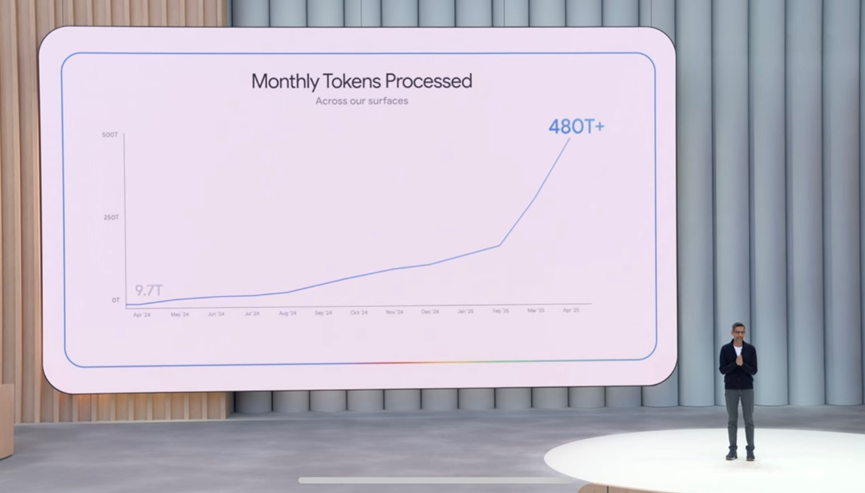
With applications opening up this far, revenue estimates at the vendors involved have been revised higher all year.
- OpenAI: 2025 revenue of $12.7B, 3.4 times last year's $3.7B.
- Anthropic: annualized revenue from $1B at the end of 2024 to $3B at the end of May 2025.
- SaaS applications are starting to pull their weight: ServiceNow's Now Assist is at $250M of annual contract value (ACV), which the company expects to reach $1B by the end of 2026.
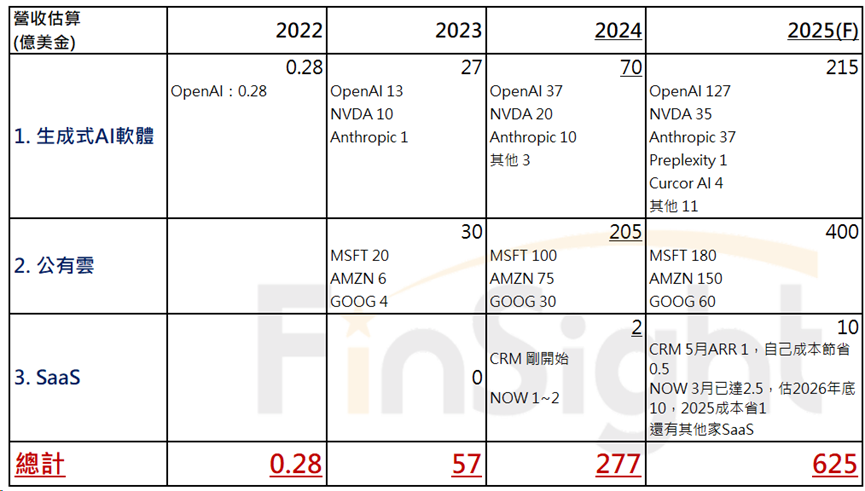
This is the conservative version. It counts only what vendors currently guide to, so a genuine application boom could push it higher, and it does not yet include what AI contributes to existing businesses or through cost reduction. The full calculation is built bottom-up from vendor guidance across model companies, public cloud and SaaS, and it put revenue above $62.5B by the end of 2025.
The generative AI lag: each layer grows on the same curve, about a year behind the last
The generative AI timeline above shows revenue arriving on a three-stage growth path.
- OpenAI first: $28M at launch in 2022, $1.3B in 2023, $3.7B in 2024, an estimated $12.7B in 2025 (as reported in March 2025).
- Anthropic right behind: $100M at launch in 2023, $1B in 2024, $3B of annualized recurring revenue (ARR) at the end of May 2025 (the optimistic $3.7B year-end figure estimated back in February probably needs revising higher).
- Business to business (B2B) SaaS AI revenue: $100M to $200M at launch in 2024, $1B in 2025.
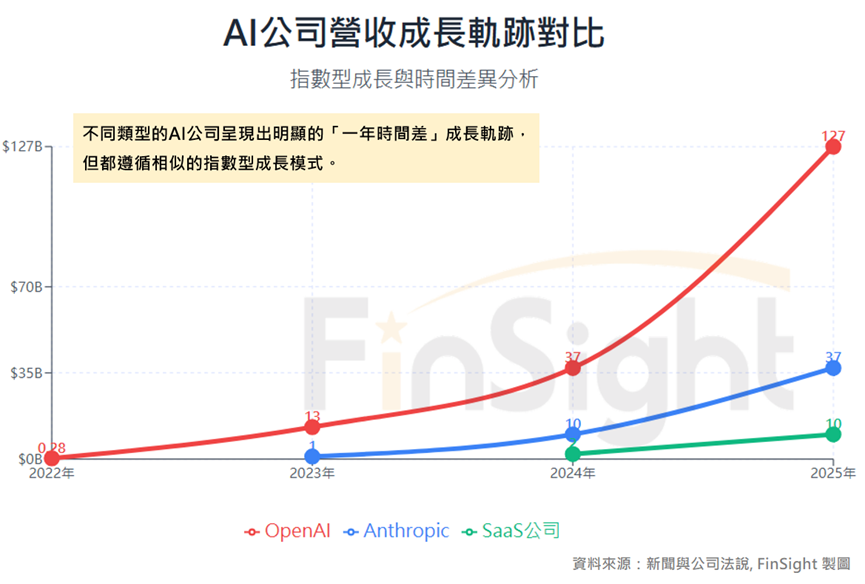
All three grow at the same speed as the one in front of them. They are simply a year apart.
Over this stretch the range of AI use has widened from single modality to multimodal. Creative work in video and images keeps improving, and the newest models already produce video detail close to real. Problem solving that needs logic has become steadily more efficient, with CoT lifting reasoning ability noticeably, and with MCP (Model Context Protocol) standardizing the plumbing so more workflows can pull AI in and raise productivity. That opens up more B2B AI applications.
The AI wave has not arrived as one explosion at a single moment. It arrives in layers, and keeps evolving at its own pace.
The step-function lag tells us three things.
- The diffusion follows a regular pattern. AI moves from frontier research to product to enterprise application on a predictable lag, and it is not only large companies moving: the rise of open source has the community moving too.
- The exponential growth is common to all of them. The three groups started at different times, and all three still show a similar exponential curve.
- The market opportunity comes in layers. Late starters begin later and still grow fast at their own point in the sequence, because once the application stage arrives, what matters is how users in each industry imagine using AI in their own situations.
A Morgan Stanley report found that roughly 25% to 45% of users on the major AI platforms shop, compare prices or research products there. AI use has moved from gathering information into actual buying decisions.
On these numbers we are in the strongest stretch of AI industrialization, and this change has only started. Every stage has its own window, which is why AI companies of very different types can each find their own growth track.
Cost reduction: the other half of AI's value, and the half nobody counts
Cost reduction is the other half of what AI contributes, and it is badly underrated. The latest earnings say it plainly: profitability at the hyperscalers has recovered noticeably.
Cloud earnings for 1Q25 showed profitability recovering ahead of expectations.
- Microsoft: after two quarters of calls in which depreciation weighed on results, profitability was guided up.
- Amazon: AWS operating margin hit a record 39.5%, entirely on better operating efficiency.
- Alphabet: depreciation pressure has started to bite, and profitability still held up strongly.
In the same quarter, B2B SaaS vendors talked about the cost reduction they get from running AI on themselves.
- Salesforce calls itself "Customer Zero" for its own AI products. Running Agentforce internally saves $50M a year, about half its current AI product ARR.
- ServiceNow has already realized $350M of internal business value and expects $100M of cost savings in 2025, about 40% of its current AI product ARR.
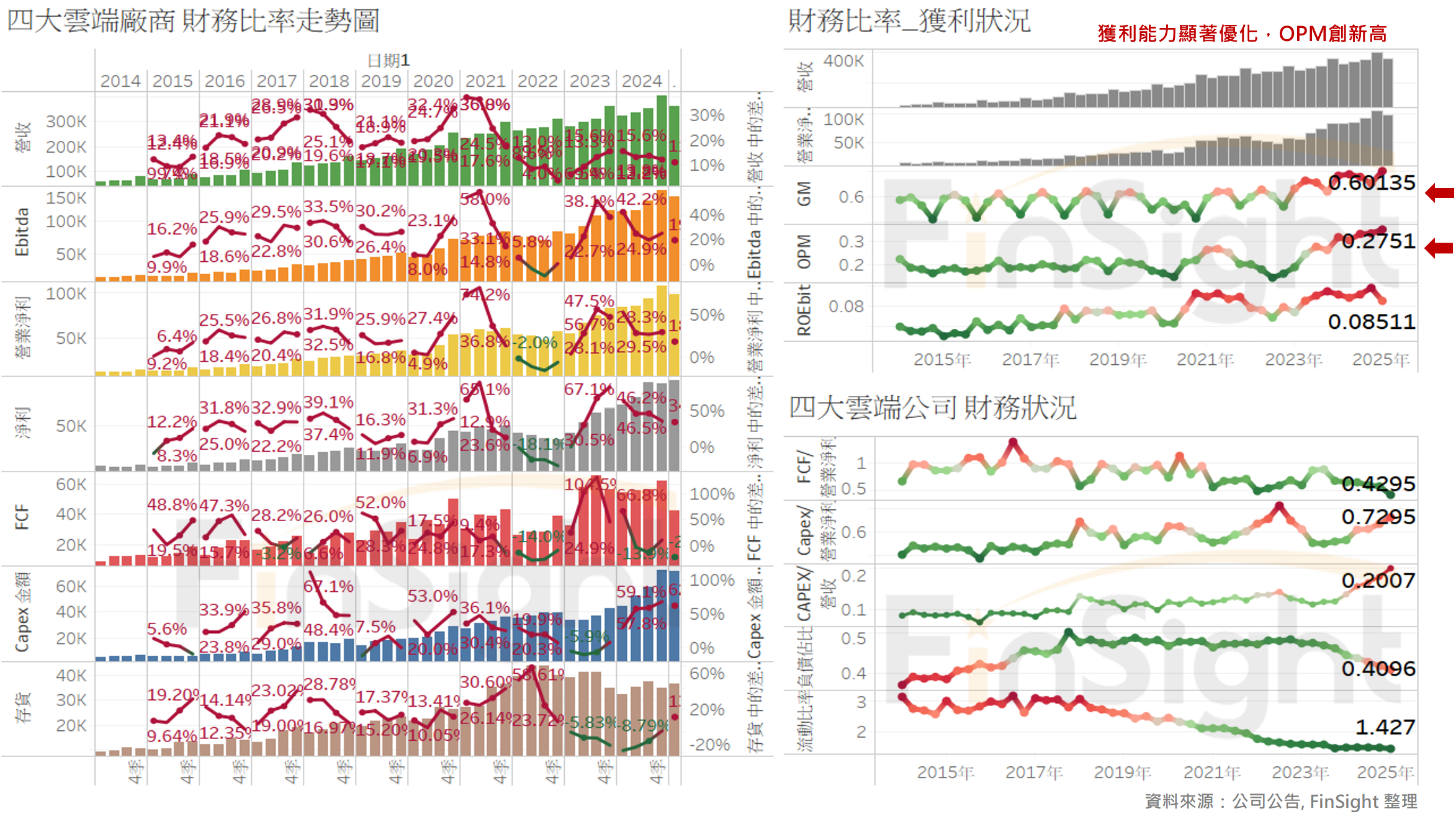
Pull the financial ratios of the four hyperscalers (Alphabet, Amazon, Microsoft, Meta) together and their operating margin reached 27.51% in the latest quarter, above 25.88% a year earlier and 23.13% in 4Q23, and far above the long-run average of 20.5%.
Every one of them said internal efficiency gains from AI were the main reason profitability beat, and the aggressive layoff headlines are part of the same story.
Take this quarter's revenue at the hyperscalers and apply the operating margin they ran before generative AI shipped. Profitability is about 4.38 percentage points better than at the end of 2023, which converts to $15.6B of extra profit in the quarter, or $62.7B carried across the year. Measure only the margin gain against the year-ago quarter and the extra profit is $5.8B for the quarter and $23.3B for the year.
The $23.3B version, the one measured against a year ago, is about half the $40B of incremental AI revenue we estimate the public clouds will add this year, and it is in line with the internal cost reduction Salesforce and ServiceNow describe from using AI on themselves.
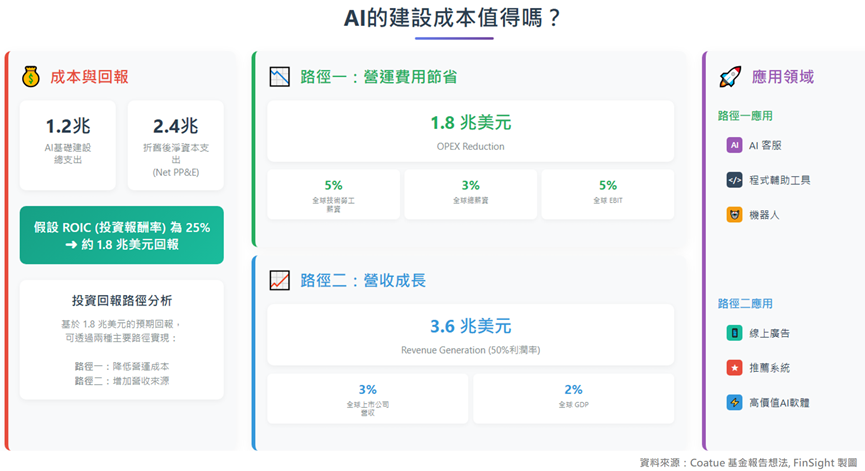
Coatue estimates that $1.2T of total global AI infrastructure spend can produce $1.8T of return through two paths, one counted as cost saved and one as revenue earned.
- Operating expense savings, $1.8T of cost taken out: using AI to cut labor and operating costs. That is roughly 5% of global technical-worker wages, 3% of total global wages and 5% of global earnings before interest and tax. The main areas are AI customer service (automating support to reduce headcount), coding assistants (faster development, lower software development cost) and robotics (replacing labor in manufacturing and services).
- Revenue growth, $3.6T of gross new revenue, which is $1.8T net at a 50% margin: using AI to create new commercial value and new revenue lines. That is roughly 3% of global listed-company revenue and 2% of global gross domestic product. The main areas are online advertising (better targeting and personalization lifting conversion), recommendation systems (better user experience and platform stickiness) and high-value AI software (AI features lifting average revenue per user, or ARPU).
Adding up what AI contributes to the business in 2025:
- Incremental revenue: $62.5B.
- Cost reduction: $23.5B, conservatively, being $23.3B at the four hyperscalers plus the $200M that SaaS vendors quantified on their calls.
- Efficiency gains in existing businesses: more than $14.2B, and we hold this one loosely. Companies describe the gains but almost none of them quantify the amount, so it is not fully counted anywhere.
- Total: more than $100B.
Include the efficiency gains and AI's measurable contribution in 2025 is comfortably above $100B. Even counting only incremental revenue and cost reduction, it is $62.5B plus $23.5B, or $86.0B.
AI contributes $100B in 2025: is the investment too much, or not enough?
Back to the question that matters most. Is the current level of capex reasonable? Is AI investment still a bubble?
Start with the incremental capex of the five largest US hyperscalers. The base is what each company was already spending on its own existing business, so we read the increment as the change in investment behavior driven by generative AI.
- 2023 capex increment over the prior year: none. 2023 capex was lower than 2022.
- 2024 capex increment over the prior year: $86.5B.
- 2025 capex increment over the prior year: $97.8B.
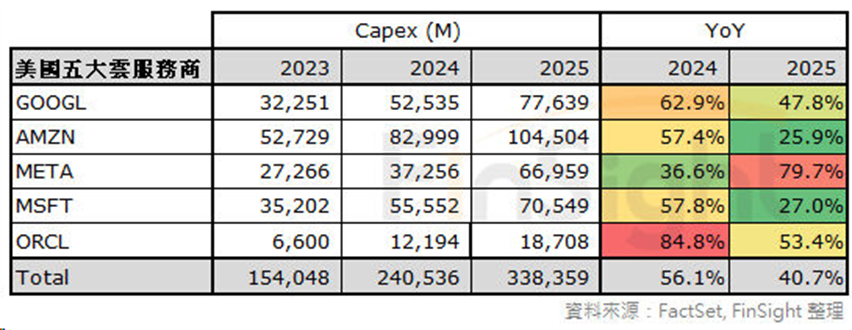
Depreciation on this investment runs five to six years. We use a tougher three-year test: the spending has to pay back in matching incremental revenue and cost reduction well inside its accounting life. Set the $86.5B of incremental capex in 2024 against the $100B of value AI creates in 2025 and it clears in year one. On the $63.3B the hyperscalers capture themselves ($40B of incremental revenue plus $23.3B of cost reduction) it clears comfortably inside the three-year test. On that basis the sharp increases of the past two years are reasonable.
Pulling the current picture together, willingness to keep spending is high.
- Incremental revenue covers it. Generative AI incremental revenue alone reaches $65B in 2025, and adding the cost reduction effect, an estimated $23.3B, supports the current scale of investment.
- Compute stays short. Google has pushed the compute bottleneck out from mid-year to year-end, and several vendors say the reason is demand running ahead of expectations, rather than the tight supply they cited before.
- Competitive pressure is rising. A crowd of competitors has emerged, which forces the large players to invest faster to hold their lead.
The risks worth flagging.
- The capex here is estimated from the capital investment of the five largest US hyperscalers. Judging by NVIDIA's data center revenue, these companies account for roughly 65% of it. For the hyperscalers themselves we work with our 2025 estimate of $40B of incremental revenue plus $23.3B of cost reduction, so $63.3B.
- Over the past two years these companies have also shifted a much larger share of capex toward AI: Amazon from 60% to more than 90%, Alphabet from 70% to more than 90%. So the actual AI investment is larger than the increment on its own. We ran a version of this calculation earlier, when we checked whether NVIDIA's output could be absorbed.
- Cash flow at the hyperscalers fell noticeably last quarter, so the cash position needs watching from here.
- Meta is the only large hyperscaler without a public cloud, so its operating results show what AI contributes to an existing business. It is worth watching as the bellwether.
- Power demand is the pain point that keeps expanding, and the power build-out behind it has to keep going.
A technology revolution nobody can afford to lose: in our view the fastest-growing market in history
What makes this AI revolution unusual is that it is a war nobody can afford to lose.
History says so.
- The internet era: Google rose on its search engine.
- Mobile internet: Apple and Google dominated the smartphone ecosystem.
- Cloud: Amazon, Microsoft and Google became the market leaders.
Every one of those paradigm shifts reshuffled the whole technology ecosystem. Missing the AI wave can mean losing your seat at the table in the next technology cycle.
But this post is not here to make the strategy argument. We have already shown, from the actual numbers, that the market AI has created is level with the $100B of one year's incremental investment. As Microsoft said in its latest results, even while it scales AI investment it still expects operating margin to be up slightly on the year. That tells you the current investment is creating higher value rather than dragging profit down.
Putting the analysis together, our view is that AI investment is not excessive and may still be running behind the pace at which demand is breaking out. That is also what most of the large vendors keep telling the market.
- Revenue growth is beating expectations. The generative AI market is growing exponentially. The steepening slope of token demand, the speed of enterprise adoption and the change in consumer behavior all say this technology revolution is accelerating.
- The cost reduction effect is large. AI creates incremental revenue and it also lifts operating efficiency substantially.
- Supply and demand are still out of balance. Compute may stay short through year-end, which says demand is still strong.
- Competition is intensifying. The intensity of the technology race forces vendors to keep raising investment.
AI is penetrating far faster than expected. As the ServiceNow CEO put it on an earnings call, enterprise AI is the only $20 trillion market opportunity coming in the next five years. That is a vendor sizing its own market, so read it as a claim rather than a measurement. With software applications still growing quickly, we expect capex growth to stay above 20% through next year. We will of course keep tracking the application data as it comes in.
AI is not a forecast anymore. It is in the numbers, and the numbers say paradigm shift rather than bubble.