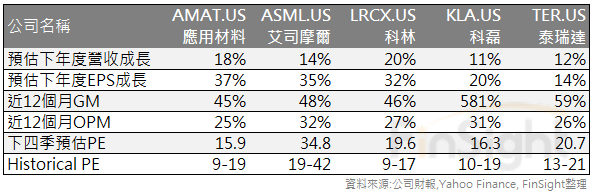
The five major equipment makers point to a semiconductor upturn: TSMC guides 2020 capex to $15 to $16 billion, and memory spending bottoms this year.
The five major equipment makers we track (Table 1) have all now reported. Our quarterly chip equipment earnings roundup covered the same group after their third quarter 2019 calls (November 2019), and we have now worked through what they said this quarter. Equipment vendor results roll straight up into the capital spending roadmap of the chipmakers above them, which makes this group the leading indicator for the whole semiconductor cycle. Line the vendors' comments up against the chipmakers' capital spending plans and you get a consolidated read on the cycle.
Key takeaways
- The vendors confirm the semiconductor cycle is in an upturn. Their outlooks leave out two risks: wider Huawei sanctions, and the coronavirus outbreak reaching end demand.
- Logic and foundry stay optimistic for 2020, and the two largest customers keep capital spending (capex) at record highs. TSMC guided 2020 capex to $15 to $16 billion.
- Memory is where the language firmed up most: more definite wording than last quarter and an explicit timing on the recovery. Prices are already reflecting it, NAND ahead of DRAM, and 2020 memory capex should bottom and turn up, though the spread between makers is wide.
- China keeps spending, and SMIC (Semiconductor Manufacturing International Corporation), China's largest foundry, is expanding capex sharply. Display is at the trough of its spending cycle with 2020 turning positive, and TSMC's nodes at 16nm and below should be over 60% of revenue in 2020, which pulls more extreme ultraviolet lithography (EUV), more masks and more process steps through the rest of the equipment makers.
What the large vendors say confirms that semiconductors are in the recovery phase of the cycle. That outlook does not account for the following risks:
- Huawei sanctions widening further.
- The coronavirus outbreak reaching the demand side.
Either one could force the vendors to revise their views, so we will adjust our own as those two develop.
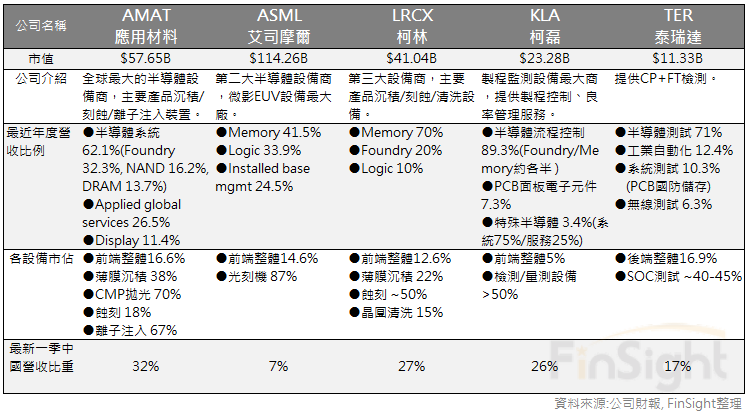
We sorted what each company said on its call into five buckets: logic and foundry, memory, display, the China market, and the effect of EUV.
Logic and foundry
The vendors carried over the view they gave last quarter. As chipmakers lean harder on leading edge nodes and keep chasing technology, every vendor stayed optimistic on 2020 demand for logic and foundry equipment.
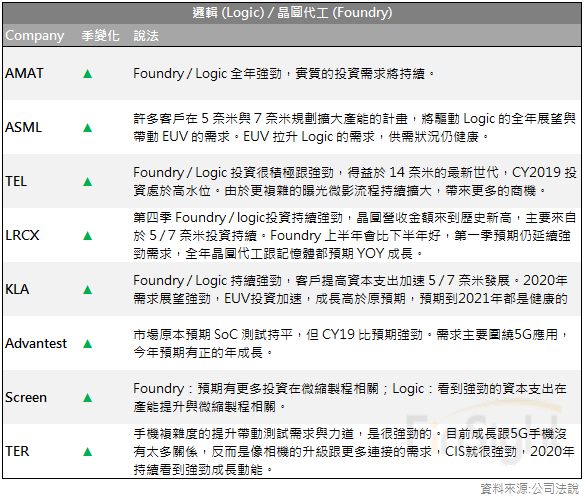
The two largest customers are both holding 2020 capital spending at record levels. On the guidance TSMC gave on its call, 2020 spending goes up again to $15 to $16 billion, and we wrote in our earlier post on TSMC's January call (February 2020) that this number may even need to be revised higher.
In 2019, mobile was 49% of TSMC revenue and high performance computing (HPC) was 30%. The company expects revenue from both to grow more than 20% in 2020, with Internet of Things (IoT), the third largest segment, growing 15%. With 5G and AI doing the pulling, the view on logic and foundry stays optimistic.

Memory
The vendors are more positive than they were last quarter. The wording is more definite, and this time they put a timing on the recovery, so they are surer of the turn in memory.
Memory shows signs of recovering in 2020, and memory prices have already started to reflect that outlook, with NAND leading DRAM. The second half is generally seen as good, with both pricing and the supply and demand balance more stable.
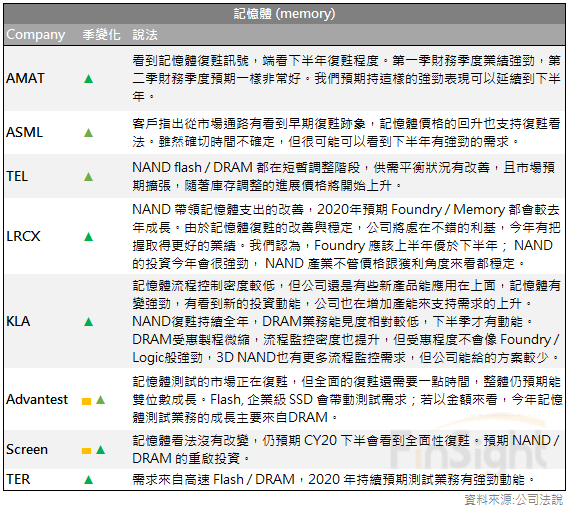
On the memory makers' own capital spending, 2020 investment should bottom and turn back up, but the spread between the individual companies is wide.
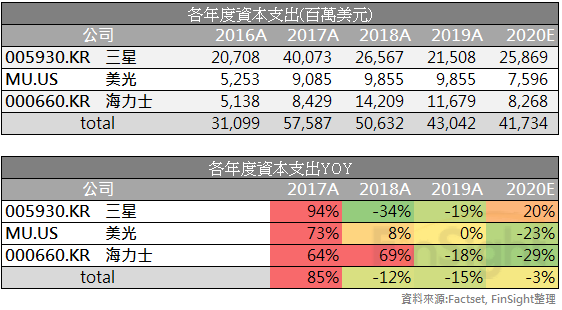
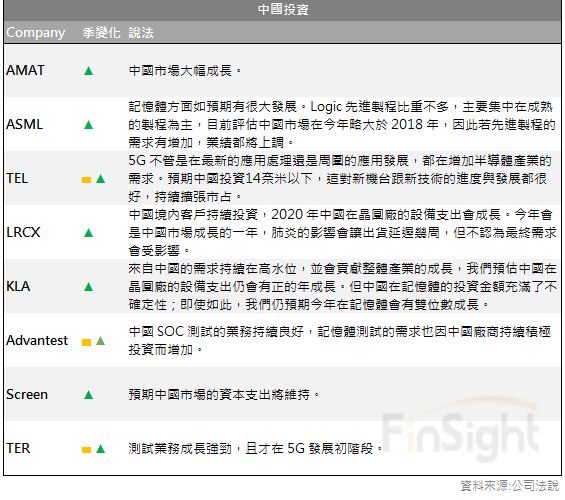
China semiconductor capital spending
Equipment spending by Chinese wafer fabs is still running strong, and it is moving toward more advanced nodes. Memory in China is the less certain piece, though growth there could still reach double digits.
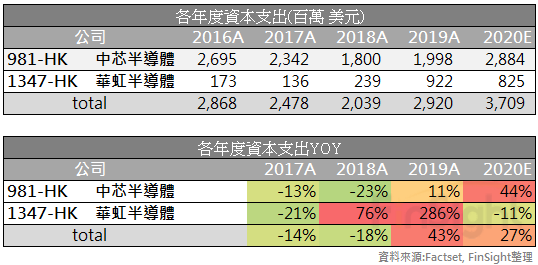
SMIC keeps expanding capital spending, and the growth rate is large. The push to design US content out of the supply chain, plus an urgent need to upgrade technology, has taken capital spending at the Chinese makers to its highest level in several years.
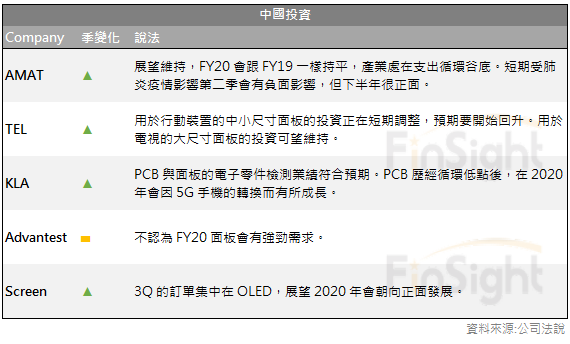
Display
Display is sitting at the trough of its spending cycle, and the view on 2020 has turned positive.
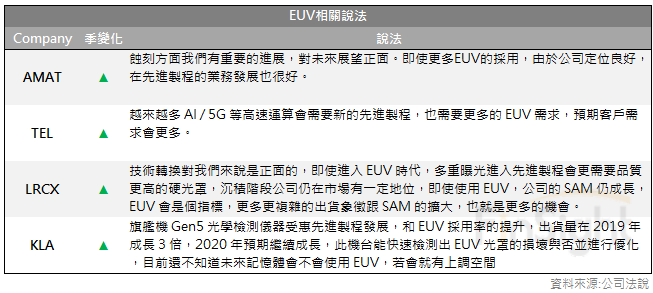
What more EUV means
Leading edge nodes keep taking a larger share of TSMC's business: in 2020, nodes at 16nm and below should be over 60% of revenue, and EUV usage climbs along with those nodes.
The vendors all take a positive view of that rising leading edge mix, because more EUV adds complexity, which means more masks and more process steps. That flows through to the revenue of the other equipment makers too.
The 2020 outlook is optimistic, and the outbreak is the wild card
Logic and foundry: with 5G and AI pulling demand, there is still a lot to expect here. Once the outbreak is in the picture, we prefer the business to business (B2B) side, which splits into data center and 5G base station buildout.
- Data center: on top of the jump in data volumes, enterprise demand to move to cloud is still enormous, and the remote collaboration that comes with the outbreak helps the cloud business as well.
- 5G base stations: because of the outbreak, the market expects the Chinese government to speed up 5G base station construction starting in the second quarter of 2020.
Memory: the destocking phase is very likely ending, and NAND should again do better than DRAM.
China market: China is not slowing down its capital spending. Semiconductors have long been an industry the country actively wants to build up, and the push to design US content out of the supply chain and to substitute domestic product is still moving fast.
The effect of EUV: as leading edge nodes matter more, more EUV has to come in, which raises the complexity of the process flow. More masks and more steps mean more capital is required, and that gives the large, profitable players a bigger advantage.
Most of these calls took place before the outbreak had spread worldwide. Set the outbreak aside and the overall outlook is fairly optimistic, and on the evidence of our January 2020 post on Taiwan's inventory cycle, inventory is still low.
The real fear is that the outbreak develops far enough to hit consumer demand, which would land hard on business to consumer (B2C) products. That is the variable we keep watching from here.