All five chip equipment makers beat in the third quarter of 2020. SEMI's standing 2021 forecast is 24% growth, and China WFE holds at $9.5B to $10B.
Our earlier posts have argued that capital spending (capex) at the big chip makers is the bellwether for tech. What the upstream equipment makers say matters just as much, because their order books lead the fab spending that follows. Applied Materials, Lam Research, KLA, ASML and Teradyne have all reported, so here is our read of the third quarter of 2020 calls and what we take from them.
Key takeaways
- Every one of the five calls came in better than expected: foundry stayed busy all year, the memory story went from mixed messages to a single consistent one confirming the bottom is in, and Chinese semiconductor investment is still running hot.
- SEMI, the industry association, has 2021 equipment spending growing 24%, with demand the pandemic pushed out of 2020 deferred into 2021 rather than lost.
- WFE (wafer fab equipment) estimates held after last quarter's upward revisions: Applied Materials sees 2021 at least matching 2020, ASML kept its number unchanged, KLA is again stressing it will beat the market average, and Teradyne raised its memory test market estimate to $900M.
- China WFE stays at the $9.5B to $10B the vendors revised it to last quarter, and the hit to equipment company financials that the market feared from US China trade restrictions has not shown up.
- Looking into 2021, all five expect foundry and logic strength to carry through, with memory following end demand higher.
Top down: total equipment spending keeps growing
SEMI revised its 2020 and 2021 equipment spending forecasts after the pandemic hit, on the view that this year's demand is deferred, not lost. Its 2021 number is 24% growth, and we covered it in our August 2020 quarterly chip equipment earnings roundup. Biden won the November 2020 election, and the market now expects US China relations to move from tense to easier. Put that together with what TSMC and the equipment makers have said on their calls over the past two quarters, and Chinese semiconductor investment looks set to step up rather than stall. We think the bull trend in semiconductors is still running.

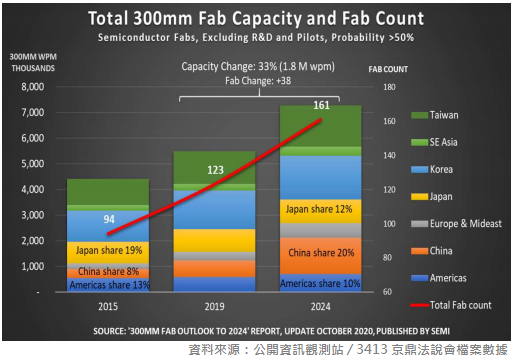
The latest SEMI data shows the scale of 300mm (12 inch) wafer fab investment stepping up year after year and running strong through 2023. Of the capacity added over the next five years, most of it sits in Taiwan and China, which says even more about how busy equipment spending is.

On the total WFE market, after last quarter's upward revisions the tone this quarter stayed optimistic and the numbers were mostly flat. Applied Materials expects next year to hold at least at this year's level. ASML's estimate is unchanged from last quarter. KLA is again stressing that the company will do better than the market average. Teradyne kept its start-of-year estimate for system on chip (SoC) test, part of the back end, meaning the test and packaging steps that follow wafer manufacturing, and raised its memory test market estimate again, to $900M. Note the gap between the biggest vendor and the trade body: Applied is guiding to roughly flat while SEMI is at up 24%. Neither side addressed the other on these calls, so the two numbers sit side by side for now.

Bottom up: memory is the clearest recovery
Foundry and logic: not much has changed from last quarter. Demand from 5G, artificial intelligence (AI) and the internet of things (IoT), and demand for advanced nodes are still strong, and the toolmakers think that healthy state carries into next year. Automotive and industrial end markets are recovering, and that recovery is expected to continue into 2021.

Memory: the language is more definite and more positive than last quarter. Customers are still working inventory down, and DRAM investment this year has run well below normal, so 2021 should bring a stronger recovery in DRAM than in NAND. On the back end, Teradyne raised its memory test market estimate again. It expects the move to DDR5, the next generation DRAM standard, to keep accelerating through 2021, and as memory develops, higher performance and compute requirements mean test intensity goes up from here. Over the medium term it sees memory test demand staying healthy.

China: following on from the high China revenue share we flagged in our August 2020 quarterly chip equipment earnings roundup, China stayed a high share of revenue at each of the vendors this quarter and kept growing. They left their estimate of the China WFE market where they revised it to last quarter, at $9.5B to $10B. The negative financial hit the market worried about from US China friction and export restrictions has not happened. The companies still say they ship in compliance with every trade rule, that nothing has been affected so far, and that they do not see these issues ending the long term build out.

Display: Applied Materials is as positive as ever and kept last quarter's view. The worst is behind it, the bottom is in, and the long run picture is good. Next year gets its lift from large size TV and wider adoption of OLED.

Below are the basics on the main equipment makers.

Across the five calls our read is the same one: foundry and logic strength carries into 2021, memory has confirmed its bottom and follows end demand higher, and China spending holds, so the equipment cycle still has room to run.