The equipment makers guided 2020 wafer fab equipment back to $57 to $59 billion, the pre-pandemic level, with China WFE at $9.5 to $10 billion.
Capital spending at the large chipmakers is the bellwether for tech. What the equipment makers upstream say matters just as much, because their order books lead the industry. The five large equipment makers we track (Table 1) have now all reported the June 2020 quarter, and this is our quarterly chip equipment earnings roundup of what they said.
Key takeaways
- Results beat expectations and lined up with our earlier view that the pandemic deferred spending rather than cutting it. Most vendors revised the outlook back to the pre-pandemic level, and capacity and supply chains are back to where they were before the shutdowns.
- Wafer fab equipment (WFE) guidance for 2020 moved back up to $57 to $59 billion, the level the industry was talking about in January 2020, before the pandemic.
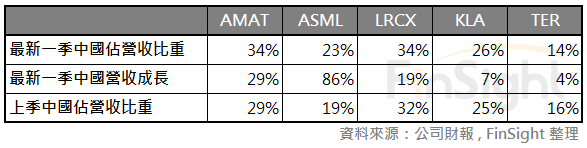
- China is still the hottest end market: every vendor grew its China business this quarter, and the 2020 China WFE estimate was revised higher to $9.5 to $10 billion. The US and China trade restrictions have not hit anyone's numbers so far.
- The industry trade association (SEMI) cut 2020 equipment spending to a 4% decline but raised 2021 to 24% growth. The demand is deferred, not gone, so we think the semiconductor bull trend runs on.
The short version: this earnings season came in close to what we had argued and ahead of what the market expected. Foundry investment stayed strong, memory is healthy, and China semiconductor investment is still running hot. The trade restrictions the market worried about did not show up in anyone's financials. Every vendor is positive on the second half of 2020 and on 2021.
Demand is back to pre-pandemic levels, and the deferred spending lands in 2021
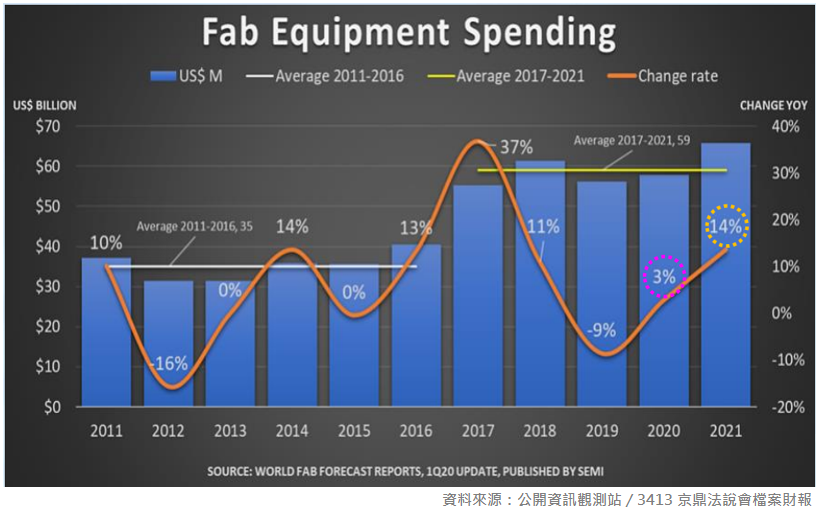
What the vendors said this quarter matches the industry association's own forecasts for equipment spending in 2020 and 2021. The two charts below show the association's estimates as of the first quarter of 2020 and then as of the second quarter of 2020. In the first quarter of 2020 it looked for 3% growth in 2020 and 14% growth in 2021.
The pandemic then pushed the association to cut full year 2020 equipment spending to a 4% decline. It kept the view that the demand is only pushed out, and raised 2021 equipment spending to 24% growth. Put that together with what the equipment makers are saying about each end market and with what TSMC said on its own call, and we think the semiconductor bull trend is still intact.

The calls also showed China semiconductor investment staying hot.
Every vendor grew its China business this quarter, which tells you the momentum behind China's semiconductor buildout has not faded. China's "new infrastructure" program, Beijing's 2020 push into 5G, data centers and chips, sits behind it, along with broader government support for the technology sector. Several quarters on, that support has only gotten stronger, so we continue to like the import substitution story for Chinese equipment makers. The technology gap versus the US leaders is wide, but under a localization mandate the tools get bought even when they are not the best tools, because buying them builds the domestic base.
What the vendors say about the global wafer fab equipment market
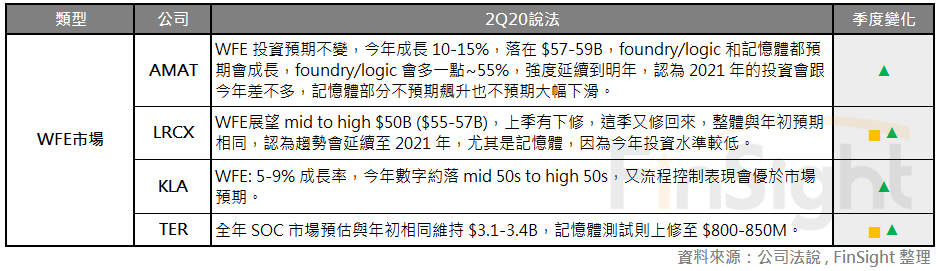
On wafer fab equipment (WFE), the front end tools that build the chip on the wafer, most vendors revised their 2020 view back to where it stood in January 2020 before the pandemic, at $57 to $59 billion. On the back end, Teradyne kept its full year system on chip (SoC) test market estimate at $3.1 to $3.4 billion and raised its memory test market estimate to $800 to $850 million.
Among the large buyers of that equipment, several raised full year capital spending:
- TSMC: on its July 2020 call it raised capex by $1 billion, and we think there is a good chance TSMC raises again next quarter, taking guidance of $16 billion to $17 billion up toward $19 billion to $20 billion. The sell side has started saying the same thing: Macquarie sees full year capex possibly reaching $20 billion.
- SMIC (Semiconductor Manufacturing International Corporation): the May 2020 call took full year capex from $1.1 billion to $4.3 billion. The August 6, 2020 call raised it again, and the company put that move at from $2.4 billion to $6.7 billion, an increase of 56%.
- Intel: 2020 capex is down slightly on the 7nm delay, but $15 billion is still a big number.
- Samsung: the company plans to add capacity ahead of rising demand, and analyst capex estimates for 2020 and 2021 are up 5% and 3% from the prior quarter.
Now to what each vendor said, end market by end market.
Logic and foundry
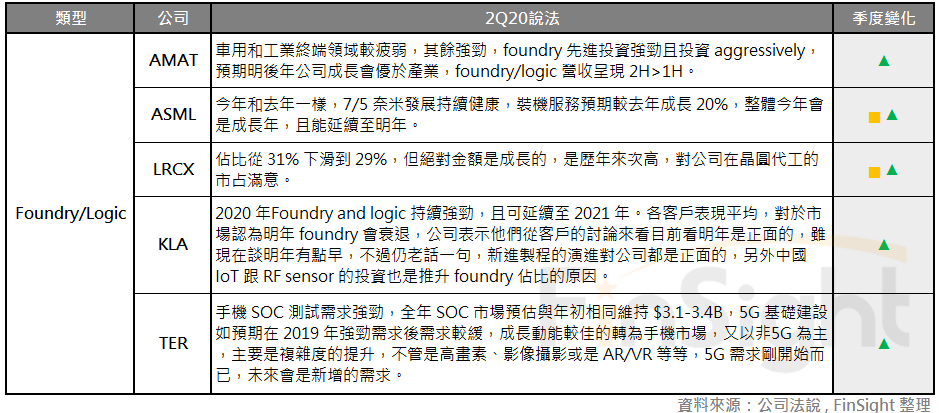
Foundry and logic did not change much from the prior quarter. Automotive and industrial end markets are weak, but everything else carried the same strong demand as before, with no sign of the slowdown the market had worried about. With 5G, AI and the internet of things (IoT) all building out, demand for leading edge nodes stays strong.
Memory
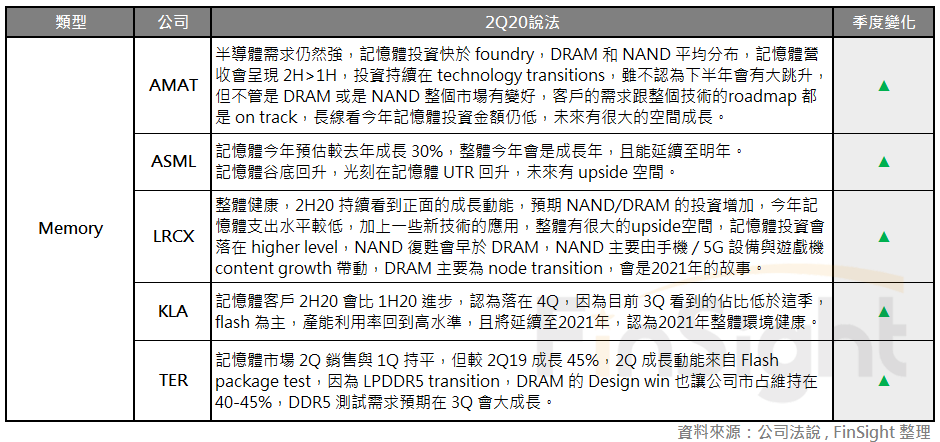
On memory, every vendor was more upbeat than last quarter. The recovery off the bottom is continuing, the market is healthy today, the second half of 2020 should be better than the first half, and that carries into 2021.
Applied Materials, ASML and Lam Research all noted that memory investment in 2020 is still low by historical standards, which leaves room for estimates to be revised higher. Lam Research kept its earlier view that NAND recovers before DRAM, and that DRAM is a 2021 story. On the back end, Teradyne said test demand for DDR5, the next generation of main memory, should grow meaningfully in the third quarter of 2020.
China semiconductor capital spending
As noted above, every vendor grew its China business, and the 2020 estimate for the China WFE market was revised higher to $9.5 to $10 billion. The negative financial hit from US and China friction and export restrictions that the market feared did not materialize. Every company said it is shipping in full compliance with trade rules and has seen no impact so far, and none of them think these issues stop the long term buildout.

Display
On display, Applied Materials was its usual bullish self: 2019 was the trough, and the recovery continues. It sees 2021 looking much like 2020, was positive on the high end of the market this quarter, and stays optimistic on the long term opportunity and the total addressable market (TAM).

Bottom line: chip equipment earnings beat
Having worked through this quarter's equipment calls, here is how we are positioned:
- The semiconductor bull trend continues, and we like the equipment makers and the foundry leader TSMC. What the vendors said matches the industry association's spending forecasts: the 2020 decline caused by the pandemic gets deferred into 2021, and 2021 equipment spending rebounds sharply. Both the chipmakers and the equipment vendors see broadening applications and technology change as a multiyear growth driver, so we think the bull trend driven by that innovation runs on. This will not be a rally where everything goes up. Money will crowd into the names with the most certain earnings growth within the sector.
- China semiconductor investment stays hot. With domestic tool demand this strong, the first tier Chinese domestic toolmakers we would watch, mostly listed only in China, are Naura, which has the broadest product line, and ACM Research, the leader in cleaning tools (US listed, with a China listing planned by the end of 2020), followed by SMEE in lithography, AMEC in etch, and Changchuan Technology in entry level test and metrology. ACM Research is the only one of these that US investors can buy on a US exchange.