
Taiwan's electronics inventory cycle gave a buy signal in November 2023. The last three ran four to six quarters, with the electronics index up 30% to 50%.
We are back after a year away, and we are picking the site back up. The first thing we want to write about is the Taiwan electronics inventory cycle, a trading rule we have tracked and tested for years: the last sell signal came in May 2022, and a buy signal fired in November 2023.
Key takeaways
- A buy signal fired in November 2023: inventory days at Taiwan component makers fell below their year-earlier level in the third quarter of 2023, and we bought at the November 15 close.
- The past three buy signals ran four to six quarters, with the TWSE electronics sector index (the electronics index) up 30% to 50% and volatility falling as the trend took hold.
- The May 2022 sell signal did its job: from that call, Taiwan's main market index, the TAIEX, fell 23.5%, the electronics index fell 24.5%, and TSMC fell 30.5%.
- Sell signals have historically come six to eight quarters after a buy signal, so this bull leg should run at least into mid-2024. The exit to watch for is new orders minus inventories on the purchasing managers index (PMI) turning negative again.
Taiwan's electronics supply chain holds a central place in the global tech chain, and electronics stocks are the core of the Taiwan market: the electronics index makes up the bulk of its market cap. Our earlier work showed that inventory swings in that supply chain drive much of the cycle in electronics stocks. The last sell signal came in May 2022; the buy signal that followed fired in November 2023, and past cycles say the rally after a buy signal is a clean one to own. So this post goes back through the previous signals and checks whether the rule still works.
What happened after the last sell signal in May 2022
The inventory cycle is the swing in inventory levels between the suppliers in the middle of the electronics chain and the demand side downstream. When end demand is strong and inventory clears quickly, the industry cycle is usually turning up and electronics stocks go with it. When demand weakens and destocking slows or inventory builds, the cycle is probably turning down and electronics stocks come under pressure.
Our earlier work found that the three to four year cycle in the Taiwan electronics index is closely tied to inventory levels. On that basis we defined buy and sell signals and backtested them.
- Buy signal: inventory days at Taiwan electronic component makers fall below their year-earlier level in the reported financials. Destocking is accelerating, and a new leg up in the inventory cycle may be starting.
- Sell signal: Taiwan manufacturing PMI new orders minus inventories (the preliminary sell signal) or new orders minus customers' inventories (the final sell signal) turns negative. Demand is weakening, destocking is slowing, and the inventory cycle may be rolling over from up to down.
Taiwan's manufacturing PMI is published monthly by CIER (the Chung-Hua Institution for Economic Research); like the ISM index in the United States, its sub-indices are diffusion readings around 50, where a reading above 50 means more companies report growth than decline, so new orders minus customers' inventories is a spread, not a level. Entry and exit prices are the close of the next trading day after a signal appears. Third quarter financials have to be filed by November 14, so a buy signal there is executed at the November 15 close. If the PMI release on May 3 produces a sell signal, the exit is the May 4 close.
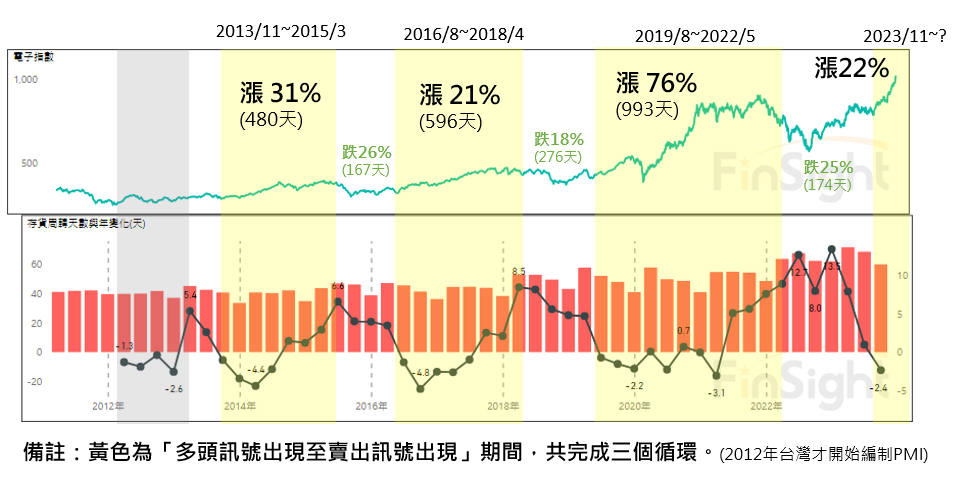
History says that after a sell signal, the bear phase runs close to six months and the electronics index falls roughly 20%.
Measured from our May 2022 post calling an inventory correction in Taiwan's electronics supply chain, the TAIEX fell 23.5% and the electronics index fell 24.5%, worse than the broad market. TSMC, the bellwether of the group, was not spared either, down 30.5% in total. Once again, following the inventory sell signal kept investors out of a 20% to 30% drawdown.
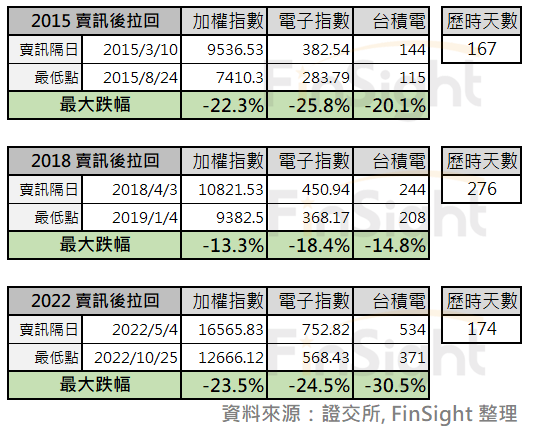
The buy side works too. Across the past three bullish inventory cycles, once the buy signal fires, prices move into a steadier uptrend with lower volatility, usually running four to six quarters, with the electronics index up 30% to 50%.
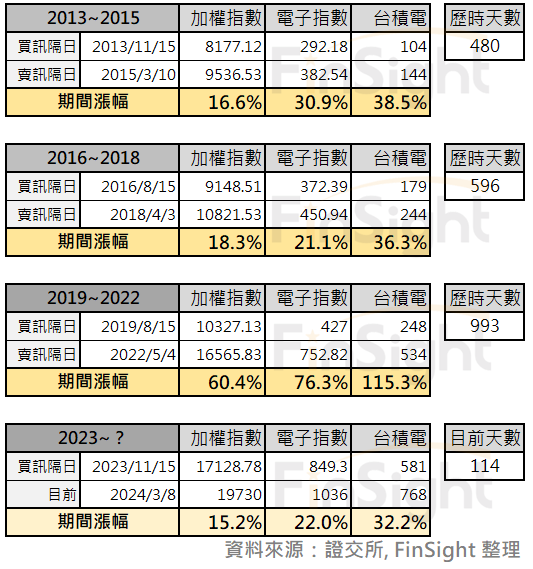
Three inventory cycles in ten years, and where we stand now
2013 to 2015: bought November 15, 2013, sold March 10, 2015
- In the third quarter of 2013, inventory days at electronic component makers fell below their year-earlier level, and PMI new orders minus inventories had already turned positive in July. Once the third quarter 2013 filings were complete and the buy signal was confirmed, we went long on November 15, 2013.
- After the February 2015 PMI, new orders minus inventories turned negative, confirming the inventory cycle had turned from bull to correction. The sell point was the first trading day after the PMI release on March 9, 2015, so March 10, 2015.
- In April 2015, electronic component and information and communication technology (ICT) exports also turned negative year over year, further confirming the downturn in the inventory cycle. Even selling on that later export signal would have kept investors out of the 2015 bear market.

2016 to 2018: bought August 16, 2016, sold April 3, 2018
- In the second quarter of 2016, inventory days gave another bullish signal, and PMI new orders minus inventories had turned positive first, in May. Once the second quarter 2016 filings were complete and inventory days were confirmed below their year-earlier level, we bought on August 16, 2016.
- After the March 2018 PMI, new orders minus inventories turned negative, confirming the inventory cycle had turned from bull to correction again. The sell point was the first trading day after the PMI release on April 2, 2018, so April 3, 2018.
- Electronics stocks then chopped sideways before selling off hard from the end of 2018. In June 2018, electronic component and ICT exports turned negative year over year, confirming the downturn once more. Selling on the export signal would also have kept investors out of the 2018 decline.

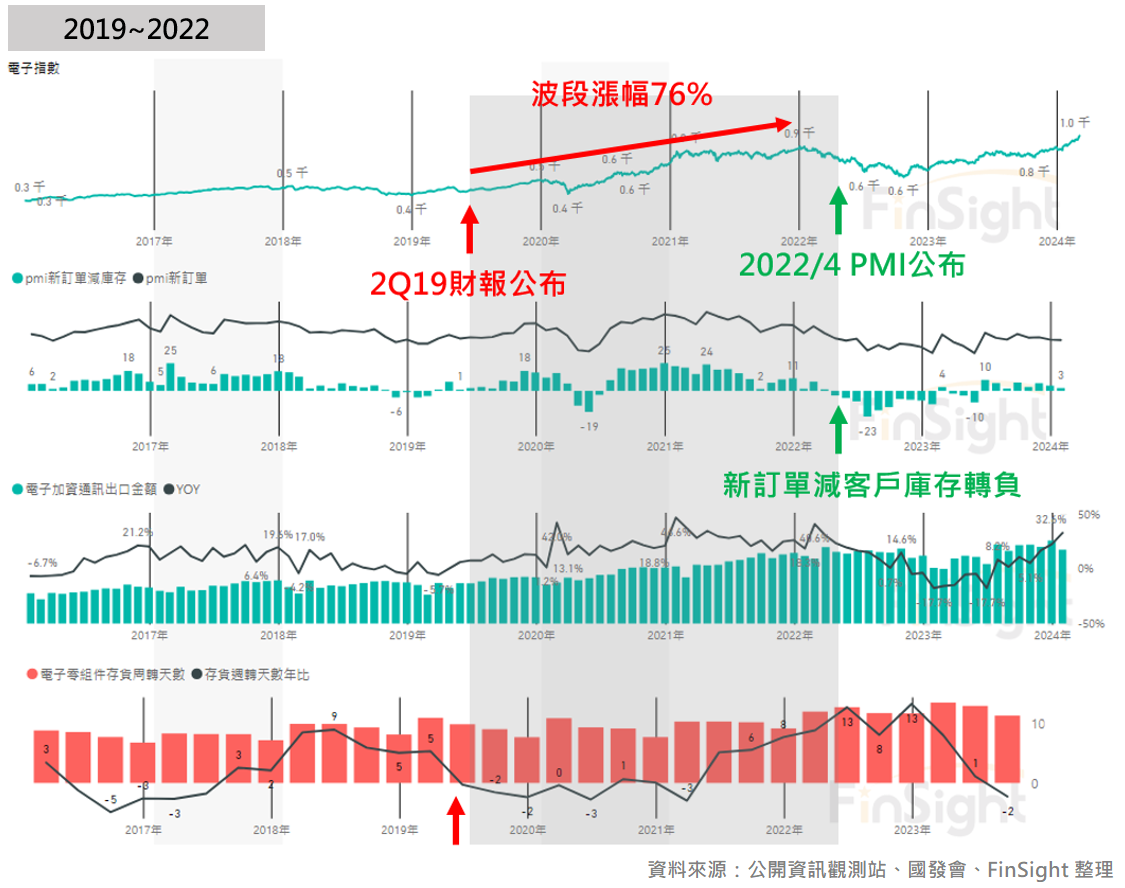
2019 to 2022: bought August 16, 2019, sold May 4, 2022
- In the second quarter of 2019, inventory days gave another bullish signal, and PMI new orders minus inventories had turned positive early, in June. After the second quarter 2019 filings were complete, we bought on August 16, 2019.
- In early 2020 the pandemic hit both prices and new orders hard, then both rebounded quickly. Through that unusual stretch, inventory levels stayed low. What came next, a surge in consumer demand, a strained supply chain, and enormous liquidity from the major central banks, made this bull leg of the inventory cycle longer and larger than normal.
- It ran until the April 2022 PMI, when new orders minus customers' inventories turned negative, confirming the inventory cycle had entered a correction again. The sell point was the first trading day after the PMI release on May 3, 2022, so May 4, 2022.
- Prices then chopped and began falling faster at the end of the year. One difference this time: electronic component and ICT exports did not turn negative year over year until September 2022. Selling on the export data would not have kept investors out of a decline of more than 30% this time.
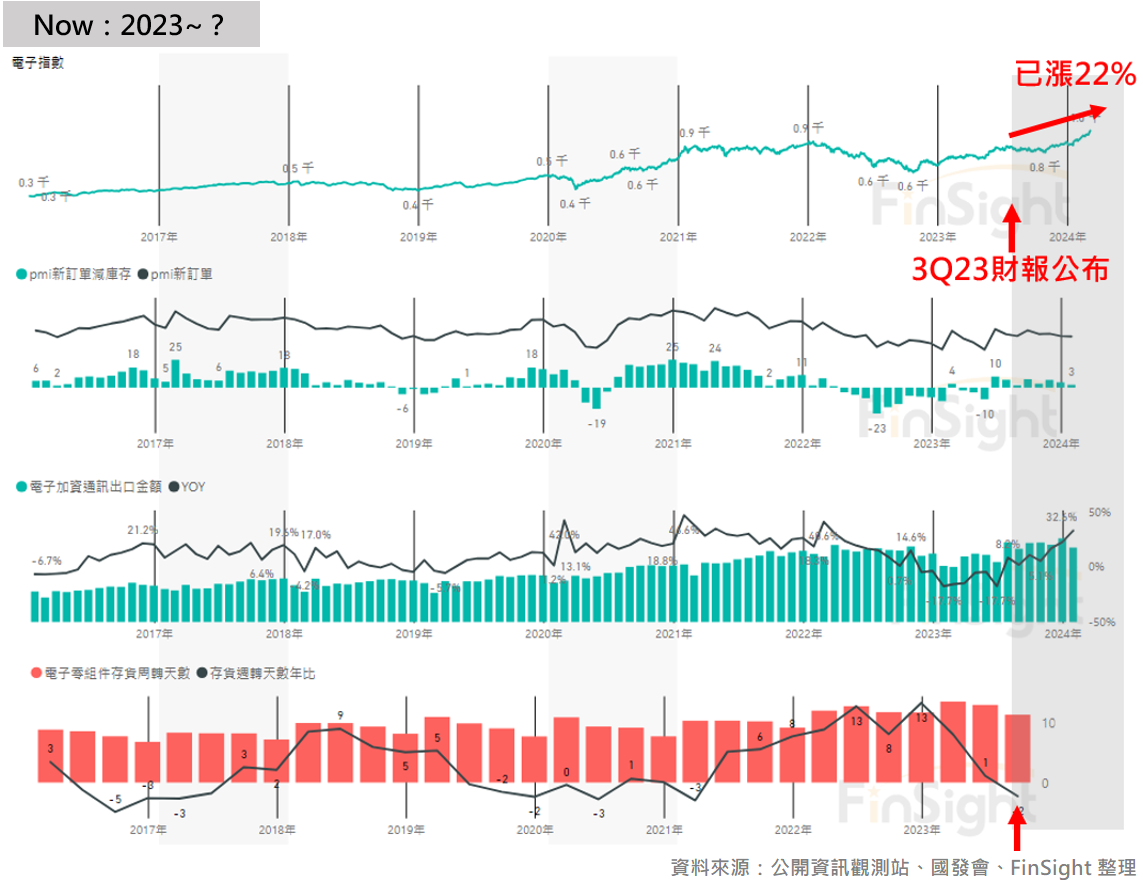
Now: 2023 to ?
- In the third quarter of 2023, inventory days gave another bullish signal. That means a new bull leg of the electronics inventory cycle started in November 2023, and on the historical pattern it should run four quarters or more. After the third quarter 2023 filings were complete, we bought on November 15, 2023.
- Past cycles say the sell signal usually shows up six to eight quarters after the buy signal. The first half of that window is where the trend normally runs; the second half turns choppy. On timing alone, this bull leg of the inventory cycle should last at least into mid-2024. From there we watch closely for PMI new orders minus inventories to turn negative again, to catch the exit.
Bottom line: the rule still works, and a new bull cycle is under way
The buy and sell signal rule on the Taiwan electronics inventory cycle is still doing its job. When the buy signal fires, electronics stocks usually put together a strong advance. When the sell signal fires, it keeps investors out of the obvious pullback that follows.
By the time the buy signal appears, electronics stocks are usually well off the bottom. Even so, once the bullish signal is confirmed, they can still run a clear uptrend, and that phase often lasts three to four quarters. Early in the restock the trend is steady; later on it turns into choppy consolidation. On current form, this leg in electronics stocks should last at least into mid-2024. After that we need to watch the pace of restocking and the timing of the sell signal.
The sell signal has its own catch: by the time it appears, electronics stocks have usually already topped. Confirming the sell signal means the bull run is over, and what typically follows is a large decline over a short window.
A last reminder: the electronics inventory cycle is not a standalone system. It is best used to guide overall position sizing through the turns between bull and bear, not to call absolute highs and lows. For real long-term value investors, trading these short-term signals frequently burns a lot in transaction costs, and in an uptrend you will often buy back the quality names you sold at a higher price.
We worked through that in our December 2022 post on how a trend follower trades the inventory buy and sell signals. We have learned more about that fit since then, and we will write it up.