
Intel's 7nm slipped six months and outsourcing is on the table for 2023. TSMC guided Q3 2020 gross margin to 50% to 52%, above its 50% target.
TSMC and Intel shares both moved sharply around their second quarter 2020 earnings calls, and between them the two reports mark the start of a new era in semiconductors.
Key takeaways
- Intel confirmed a six month delay in 7nm and said it may look for outside capacity from 2023. The first 7nm CPU now lands at the end of 2022 or early 2023, and the data center part not until the first half of 2023.
- TSMC guided third quarter 2020 gross margin to 50% to 52%, above its 50% long-term target, even as 5nm starts to ramp and takes 2 to 3 points out of margin.
- Analyst estimates for TSMC 2020 net income went from up 24% year over year to up 37.5%. Earnings per share (EPS) estimates for 2020 and 2021 went from NT$16 and NT$18 to NT$18.15 and NT$19.50.
- High performance computing (HPC) is now 33% of TSMC revenue, and data center is more than 35% of revenue at both Intel and NVIDIA, contributing more than half of profit. Leading-edge process decides who wins that market, and TSMC is the hinge.
For us, most of what was in the two reports was not a surprise.
- TSMC raised its full year revenue outlook and its capital spending. We had flagged a possible capex increase in our June 8, 2020 post on the inventory model and again in our July 15, 2020 post on the investment logic behind this run in tech.
- Intel's 7nm slipped six months, and to keep new products on schedule the company expects to look for outside capacity in 2023. The timing matches the call in our December 2019 post on TSMC's process leadership, that Intel would face a painful decision after 2022. What we did not expect was that Intel would confirm the 7nm trouble in this quarter's report.
What was new to us in these reports is profitability.
Both companies are ramping a leading-edge node right now (5nm at TSMC, 10nm at Intel), and their gross margins are going in opposite directions. As leading-edge nodes get harder and the capital bill gets bigger, the leader's advantage widens and the laggard has a much harder time closing the gap.

TSMC's virtuous circle: margins beat, and estimates were revised higher across the board
The highlight of TSMC's call this quarter was gross margin coming in well above expectations. Even with the third quarter of 2020 being the quarter 5nm starts volume production, the company guided gross margin to 50% to 52%, above its 50% long-term target.
The main driver of TSMC's gross margin is utilization, followed by the 2 to 3 point dilution that comes with launching a new leading-edge node. With utilization still full in the third quarter, the guide was clearly better than expected, and analysts revised earnings estimates up sharply.

TSMC reports in New Taiwan dollars (NT$), which traded at roughly 29 to 30 per US dollar in 2020. Source: analyst consensus, our compilation.
The 2020 revenue estimate went up 5% from the prior number, in line with what the company guided. The 2020 net income estimate went from up 24% year over year to up 37.5%, with 2021 net income still up 6% on top of that. EPS estimates for 2020 and 2021 went from NT$16 and NT$18 to NT$18.15 and NT$19.50.
What those upward revisions mean for us is that the bull cycle runs longer. Our earlier read of the Taiwan electronics inventory cycle, the swing in inventory through Taiwan's electronics supply chain that we use to time the group, had the bull leg that began in the third quarter of 2019 ending in the fourth quarter of 2020. Because TSMC is such a large share of total earnings in the group, its full year upgrade gives that end point a chance to slide into the first quarter of 2021.
One caveat. TSMC's full year guide of above 20% revenue growth implies fourth quarter revenue below the third quarter. That is worth watching, but we think the full year comes in better than the company's guide, so we lean toward fourth quarter net income staying positive year over year.
Intel's vicious circle: 7nm delayed, and profitability falling fast
The bombshell in Intel's quarter was the six month delay in 7nm, and the company's willingness to look for outside capacity after 2023 to keep products on schedule. On the current plan the first 7nm CPU arrives at the end of 2022 or early 2023, and the data center CPU not until the first half of 2023.
Intel's real problem is that competitors are threatening it and share keeps leaking away.
- AMD has picked up 4 to 5 points of consumer share over the past year. In data center it has grown for several quarters running and hit its 10% share target by the middle of 2020.
- Apple is moving the Mac to its own ARM chips built on TSMC 5nm.
- Chinese domestic CPUs keep developing, and the sell side expects their share of the CPU market to go from 0.5% to 1%.
- This goes beyond the CPU market. In HPC used for AI, GPUs are growing faster than CPUs. NVIDIA puts its data center total addressable market at $20 billion by 2023 counting GPUs alone, against $3.49 billion of data center revenue in the past four quarters, which implies revenue can still multiply several times over.
Every one of those competitors builds its product advantage on TSMC's leading-edge process. Unless Intel can get its own leading edge out on schedule, the choice in front of it is brutal. On this call, given the choice between losing share to rivals with better performing products and using an outside foundry to keep its own products competitive, Intel chose the foundry.

We think the reason is that the 10nm ramp and the 7nm trouble are pulling Intel's profitability down hard.
With 10nm products ramping this quarter, operating margin in the PC segment fell from 43.2% in the prior quarter to 29.9%. For Bob Swan, a CEO who came up through finance, that number is probably intolerable, which is why the company was willing to say out loud this quarter that outsourcing is on the table.

Management kept saying on the call that demand for 10nm products and the ramp itself are going better than people think, and that there is no real problem before 2022. Looking at the product competition ahead, though, we think this is a good window for TSMC and its customers to take share faster. If AMD can pull its 5nm products forward (currently planned for 2022), the pressure on Intel goes up again.
The paradigm shift in semiconductors: an HPC era with TSMC at the center
Growth in semiconductors over the next few years comes from AI and 5G, and the key component of the AI era is the high performance computing chip.
Pulling together the latest quarter of revenue at several important chip companies: HPC is 33% of TSMC revenue, and data center is more than 35% of revenue at both Intel and NVIDIA. Because data center products are high spec and high margin, their contribution to profit at those two companies runs above 50%.
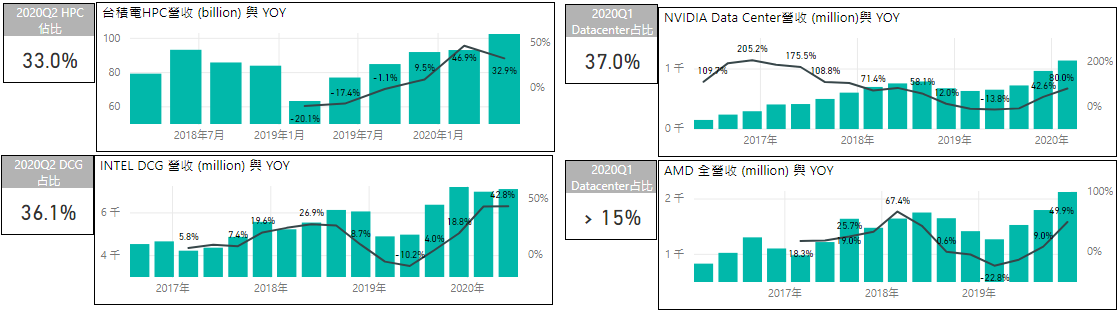
With data center rising as a share of the business and demand for high end compute still climbing, most chip companies credit one supplier as a main reason they can take share: TSMC, Taiwan's largest listed company.
On an earlier visit to Xilinx in the US, the company told us the reason it can stay ahead of Altera in field programmable gate arrays (FPGAs), chips the customer can reprogram after they ship, is its close work with TSMC, which is what lets it get leading-edge products out. After Intel bought Altera, the 14nm product line never ran smoothly, and that gave Xilinx room to take the leading-edge business.
On AMD's recent call, the company said much the same: TSMC's process lead is what lets AMD show an advantage, which is how it has products that stand up to Intel and keeps taking share. It also said that if TSMC and Intel ever get close on process, AMD's share gains will slow. (AMD and GlobalFoundries parted ways on leading-edge nodes, and GlobalFoundries announced in August 2018 that it was stopping work on 7nm.)
NVIDIA is about the only one that does not put leading-edge process at the top of the list. It argues that software and platform are what make its products competitive, so compared with other chip companies NVIDIA is usually not in the first group onto TSMC's newest node.
We do agree NVIDIA's GPUs are formidable in AI training, and the ecosystem CUDA has built is a moat competitors have trouble crossing. Even so, the Ampere A100 launched this year uses TSMC 7nm plus CoWoS (chip on wafer on substrate) packaging. NVIDIA may not say it out loud, but it leans on TSMC as much as anyone. (We also like A100 demand a lot, and wrote that up in our May 2020 post on NVIDIA's data center quarter.)
When leading-edge investment gets harder, the number of players keeps shrinking, and the leader's profit advantage keeps widening, the strong get stronger and the winner takes more.
Bottom line: Intel's admission confirms TSMC's winner take all role
Going back to the last section of our July 15, 2020 post on the investment logic behind this run in tech: we said this is not a market where everything rallies together. The job is to pick the most certain growth trends and the strongest companies of the era out of an uncertain environment.
- In the data driven AI era, the high performance computing chip is the brain that processes the data.
- Inside chip company revenue, data center has become the main act, close to half of profit.
- High performance computing chips need leading-edge process combined with heterogeneous 3D packaging, and TSMC plays the key role.
- The technology leaders that own the trend can see their valuations move up significantly.
So our view is this: with Intel confirming that it will look to another foundry for help in 2023, TSMC's winner take all role is confirmed, and the multiple the market pays the leader should move up meaningfully.
At the same time, the TSMC alliance, meaning TSMC and the fabless customers that build on its leading-edge process, AMD and NVIDIA among them, will keep taking share in the HPC market.