
TSMC is down 11% year to date through June 8, 2022 and 20% off its high, yet high performance computing is now its largest line, up 59% year over year.
Most of what we have written in 2022 has been top down: valuations have to reset as central banks drain liquidity, inventory is building through the electronics chain, and Taiwan's inventory cycle sell signal has fired. The one exception was the note we published ahead of TSMC's January 2022 earnings call, where we were bullish on both TSMC's earnings and its stock for the year. We were wrong on the stock, so this is an update on where we stand.
Key takeaways
- The call went against us. Through June 8, 2022, TSMC is down 11% year to date against 8.5% for the TAIEX (Taiwan's main market index), and down 20% from its high against 10% for the index.
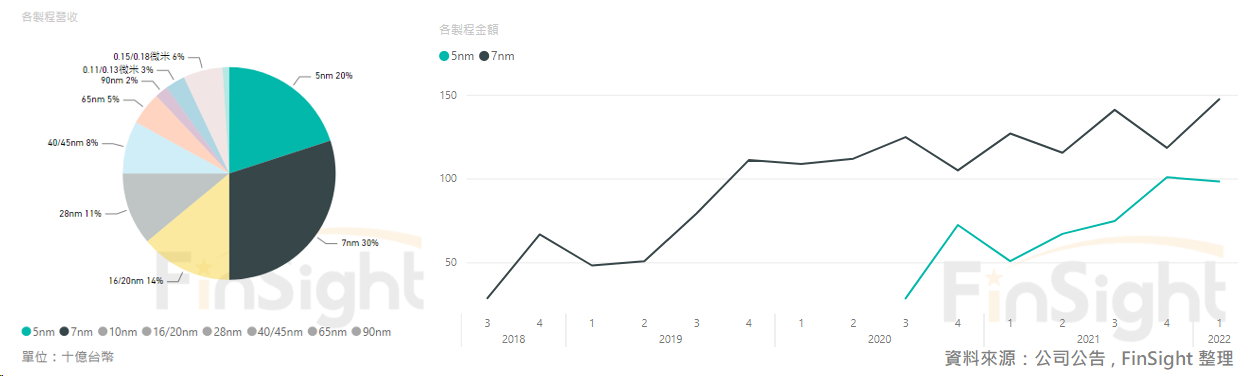
- The business went the other way. High performance computing (HPC) is now TSMC's largest product line and grew 59% year over year, ahead of every other line, and nodes at 7nm and below are more than half of revenue.
- Valuation is the first problem. With the US 10-year Treasury yield at 3% against only 1% at the end of 2020, we cut TSMC's multiple roughly in half, from a peak of 30x at the end of 2020 to about 15x, with more downside if yields keep pushing above 3%.
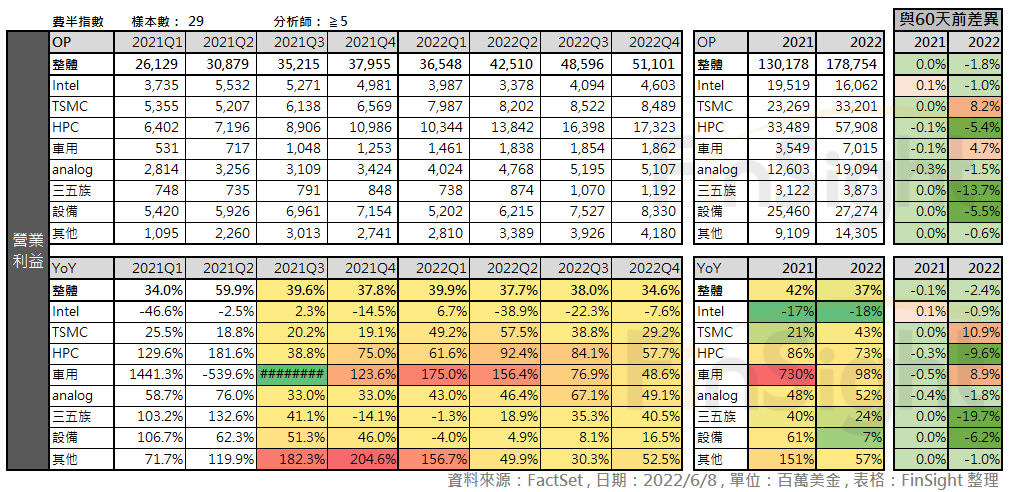
- Estimate cuts have started. Consensus for HPC operating profit at Philadelphia Semiconductor Index members is 5.4% below where it stood 60 days ago, leaving TSMC and auto chips as the only parts of US semis still being revised higher.
The conclusion first. After the two earnings calls TSMC has held in 2022, we are more confident about its central position in the new era, and we expect its revenue and earnings to keep outperforming the semiconductor industry. We do not know how wide the near-term inventory correction will run. Over the long run, TSMC is still the cleanest way to own the data driven era.
The charts come from the TSMC model we rebuild within a day of every earnings call.
Strong results, and an absolute lead in the new data era
The financials and the guidance TSMC put out on both of its 2022 calls made us more confident in its role in the data driven megatrend: TSMC sells picks and shovels no matter which end customer wins.
The highlight of the latest call was the raise to both revenue and profitability, gross margin and operating margin. The company sees weaker handset and consumer demand, but HPC and automotive have filled the gap, so TSMC's own order book is still very tight.
Against exponential growth in data volumes, compute is the horsepower of the new era, which is why we have always cared most about growth in the HPC line. In the latest quarter HPC was not only the largest product line, its 59% growth year over year was well ahead of everything else.
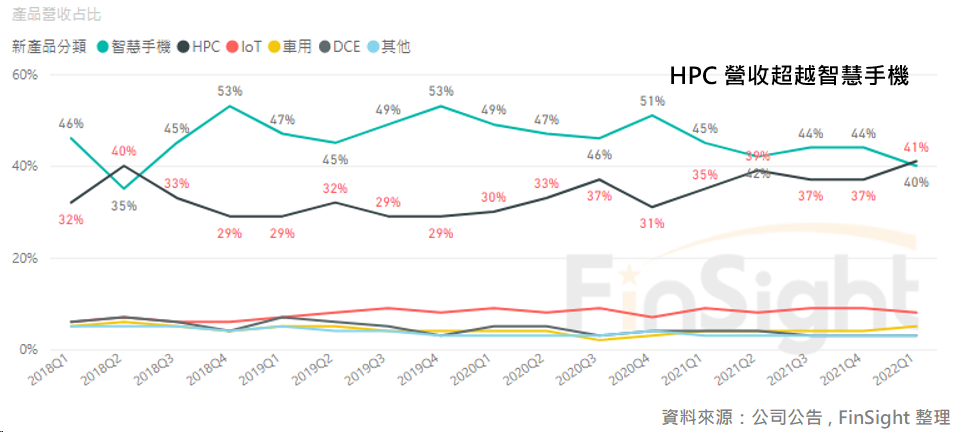
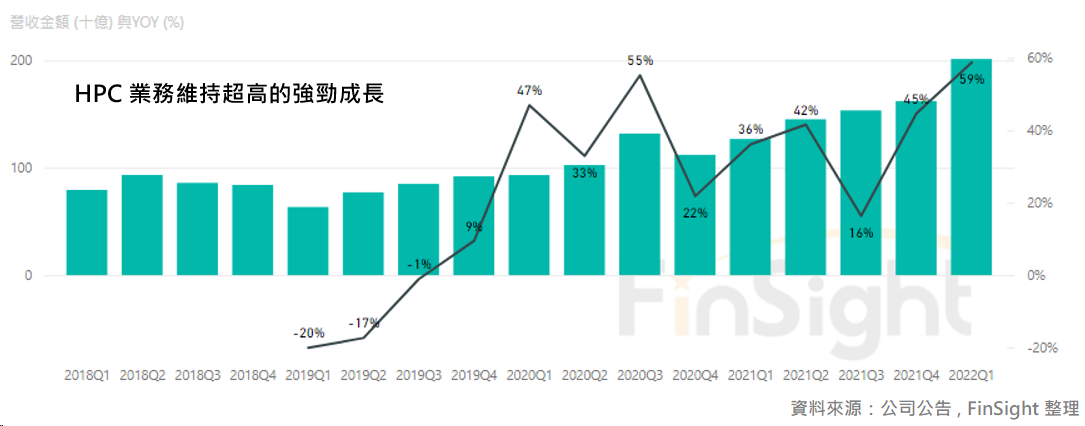
The advanced node mix keeps climbing at the same time: 7nm and below is now more than half of revenue. Among the foundries, TSMC is the one that captures the full benefit of advanced nodes, so its mix tilts further toward HPC as consumer demand fades. That is not true of its peers, which is why the consumer slowdown bites less here.
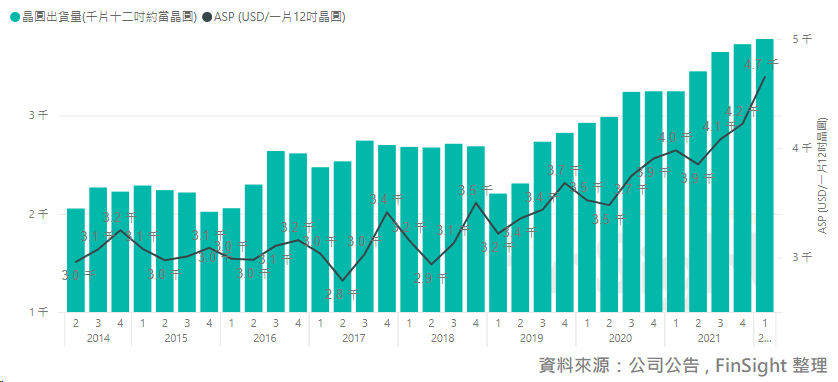
The operating numbers have improved visibly too, mostly because of TSMC's own standing. Wafer ASP (average selling price) jumped, the long-term gross margin target was raised, and utilization is still running full.
The company's language, its results and its outlook confirm the same thing step by step: TSMC is the biggest beneficiary of the trends that will define the next decade: cloud, AI and the data center. Even with end markets going through a near-term wobble, the long run still runs through HPC and advanced nodes lifting wafer ASP, which is the rising silicon content story.
Looking back at the TSMC thesis: data center HPC demand, advanced nodes and 3D packaging
Why does growth in HPC and advanced nodes keep raising TSMC's standing in our view? The path runs through five earlier posts of ours.
- Part one of our two-part series on TSMC's 3D packaging, from October 2020, on how it gives TSMC an absolute lead in the post-Moore era: once the world moves into ubiquitous computing, better performance and lower power draw are the baseline the market demands from every step forward in semiconductors. TSMC 3DFabric, a one stop service for delivering system integration more efficiently, becomes the key to widening TSMC's moat.
- Part two of that October 2020 series: rather than focusing on demand for advanced nodes and 3D packaging the way the market did, we looked at the shift in end markets and found that data center and enterprise investment would produce an endless stream of demand for more performance at lower power, driving HPC demand from cloud to edge for years.
- Our April 2021 piece on what Intel's IDM 2.0 turn tells us: with a new CEO in place and the strategy reset, we saw further confirmation that data centric computing is shifting value through the HPC supply chain. We favored fabless designers, the chip companies that design but do not manufacture, working on open XPU acceleration platforms, XPU being the catch-all for accelerators beyond the CPU, and we favored foundries able to do advanced nodes and heterogeneous integration.
- Our November 2021 piece on the data center war getting hotter: a year on, looking at who was winning and who was losing, the winners were already taking a larger share of the profit pool, and the big were getting bigger. Our favorite was the TSMC alliance, meaning TSMC together with the fabless designers that build on its advanced nodes.
- Our December 2021 piece on enterprise spending accelerating digital transformation: the core driver of growing data volumes is that digital transformation is no longer a choice but a question of corporate survival. Over the next decade of the data revolution, business to business (B2B) processes get re-engineered. The companies that embrace it first become the winners, and the ones that do not get pushed out faster.
In the data driven era the buyer moves from consumer to enterprise, and when enterprises do more business in the cloud, buying a more expensive chip actually makes their operations more efficient. TSMC's results these past few quarters, with HPC and advanced nodes both taking a larger share, are the evidence that the data driven era is paying off.
For a trend this right, as long as you believe the data driven tech revolution continues, the market keeps expanding and the fundamentals keep grinding higher. For investors with deep pockets and a long horizon, we would buy the pullbacks.
The negatives: tightening, and an inventory correction of uncertain breadth
Good results do not exempt TSMC from the environment around it. Two negatives still worry the market: tightening compressing the multiple, and an industry inventory correction whose breadth is not yet clear.
- Tightening compresses the multiple. Valuation and the government bond yield move inversely, so rising rates have to hit valuation. The US 10-year Treasury is at 3% now against only 1% at the end of 2020, which is why we cut valuation levels roughly in half. For TSMC, the peak P/E at the end of 2020 was 30x, and halving that takes you back to 15x. If the US 10-year keeps strengthening above 3%, there is further downside to the multiple from there.

- The industry inventory correction. It has already shown up in certain sectors, but how far does it reach? That needs close watching as the adjustment plays out. NVIDIA's history says the best trend is not necessarily spared, and that the change of view only arrives at the tail end of the correction.
This quarter's numbers carry a warning of their own. Through 2021 we said semis still had three sources of upward revisions: TSMC, HPC and automotive. This quarter, consensus for HPC operating profit came in 5.4% below the estimate of 60 days ago. The only parts of US semis still being revised higher are TSMC and auto chips, and the cuts everywhere else are getting deeper. Note what is being cut here: TSMC's own HPC revenue is still compounding, while the profit forecast for its HPC customers is coming down.
Why we keep holding the data driven trend through the drawdown
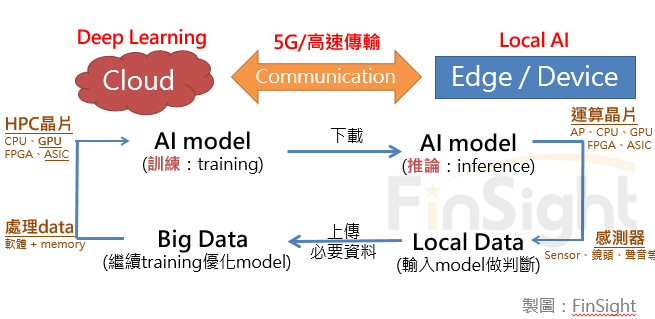
Our top-down work is about timing, but we run a second strategy alongside it: buy and hold on long-term trends. We have covered AI since 2016, when Jensen Huang was calling the shift earlier than anyone, and the data driven tech revolution has been our favorite long-term trend ever since.
If you accept that trend, the biggest beneficiaries get to stay strong. That makes the three names that sell into it regardless of who wins, NVIDIA, TSMC and Microsoft, the most important on our board.
The right posture toward a tech megatrend is to hold for the long run. Putting idle cash to work now on a fixed schedule should produce a very good long-term return. Given TSMC's standing and its valuation, we think the stock can double once the tightening cycle ends and the broad environment turns bullish.
A warning to close. This piece takes the long view, but looking at the rest of 2022, we think the market stays a high volatility environment at least through the end of the third quarter, because the Federal Reserve is staying tight. On top of that, with US Treasury yields still strengthening, multiples have further room to fall, and the cuts to fundamentals are only starting. Guard against the double hit of multiple compression and earnings cuts arriving together. As the environment keeps getting harsher, credit risk and liquidity are the things to watch closely from here.