
TSMC held a 53.4% gross margin with 5nm at 8% of Q3 2020 revenue, and its board approved a record $15.1 billion of capital appropriations.
The bull run in Taiwan electronics stocks has further to go: electronics inventory says it extends into the first half of 2021, and a shift in consumer spending is creating real product demand on top of that. More Taiwanese manufacturers are now saying it on the record: this wave is structural, driven by AI and 5G, not the ordinary cycle that gave us 2017 to 2018.
Third quarter 2020 earnings back that up. Revenue estimates were revised higher, profits beat, and inventory did not build in any meaningful way. On the demand side, auto chip makers said demand had bottomed and was turning back up, and Qualcomm said 5G handset shipments would reach 500 million units in 2021.
For the fourth quarter, company after company told us they worry only about not having enough supply, and none of them worry about demand. We think semiconductor demand stays strong for some time yet.
So our view on the semiconductor industry this quarter is still positive.
This post checks our October 2020 two-part series on TSMC's 3D packaging against what the third quarter numbers actually showed.
Key takeaways
- TSMC's third quarter 2020 gross margin came in well above expectations at 53.4%, with 5nm in volume production and already 8% of revenue, and the fourth quarter guidance midpoint is 52.5% with 5nm heading to 20% of revenue.
- Full utilization absorbed the 2 to 3 percentage points of gross margin drag a new node normally carries, so underlying profitability is improving, not just holding.
- Intel is going the other way: data center operating margin fell 10 percentage points to 32.2%, a two year low, and average selling prices are falling faster, down 15% year over year in data center and down 7% year over year in notebooks even in a market short of supply.
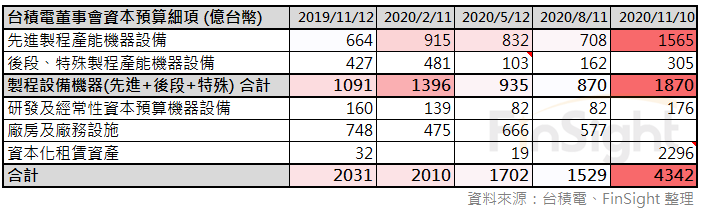
- TSMC's board approved a record $15.1 billion of capital appropriations on November 10, 2020, with about $6.5 billion, or 43%, going into equipment for advanced nodes, back end and specialty processes. That is the company's largest single quarter commitment to advanced node tools on record, and it keeps our odds high that 2021 capital spending (capex) grows again.
Q3 2020 earnings: the TSMC alliance takes share faster, and Intel's pricing pressure builds
The most striking thing after this round of earnings is how much wider the profitability gap between these companies has become. When we say the TSMC alliance, we mean TSMC plus the fabless designers that build their products on its leading edge nodes, against Intel's integrated model on the other side.
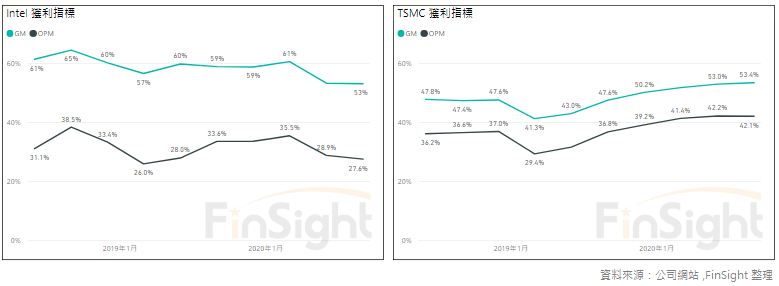
TSMC's gross margin this quarter came in well above expectations. Even with 5nm entering volume production in the third quarter at 8% of revenue, and with the fourth quarter expected to reach 20%, gross margin still printed 53.4% in the third quarter and a 52.5% midpoint for the fourth.
Full utilization is the main reason, but historically three things have moved TSMC's gross margin a lot: the exchange rate, product mix and utilization. This time full utilization offset the 2 to 3 percentage points of gross margin drag that a newly ramped node normally brings, which tells you the earnings power of the whole company is improving.
At that level of profitability, analysts have revised EPS estimates higher across the board. For 2021 numbers, the single biggest question is how long full utilization lasts. Our October 2020 work on Taiwan's electronics inventory cycle, which tracks how far mid-chain inventory runs ahead of or behind end demand, says there is nothing to worry about on inventory correction through the first half of 2021.
Intel's quarter went the other way.
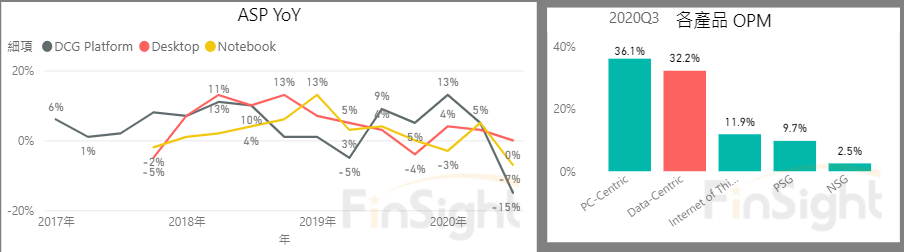
Intel's earnings power deteriorated sharply, mostly dragged down by the 10nm ramp. Data center, which used to be the cash machine, saw operating margin fall 10 percentage points to 32.2%, the lowest in two years. More important, average selling prices across Intel's product lines fell faster this quarter. Data center ASPs were down 15% year over year, which you can pin on inventory correction at customers, but notebook ASPs were down 7% year over year in a market that has been desperately short of parts. That last one most likely reflects price competition.
Over the same stretch, every research firm survey we have seen shows AMD still gaining share, in consumer PCs and notebooks and in the data center.
AMD's own results show none of the inventory correction pressure Intel described. The company raised its 2020 revenue growth guidance from 32% to 41%, with strong growth in both data center and consumer CPUs, and kept its view that the second half would be better than the first. Customer count and demand for the new Zen 3 Milan generation keep rising, and AMD is seeing more enterprise customers adopt it. That is the opposite of what Intel described.
The reason for the gap is mostly that AMD still holds only about 10% of the data center market (the company's estimate, based on CPU unit volumes, while most research firms estimate share on revenue), and that Intel keeps delaying new products. Data center buyers care about upgrade cycles more than anyone else, because only a product with more compute per watt lowers the cost of running the data center.
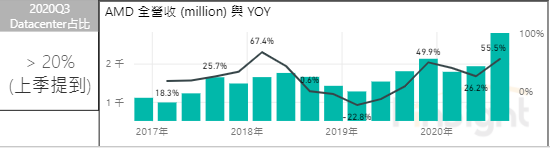
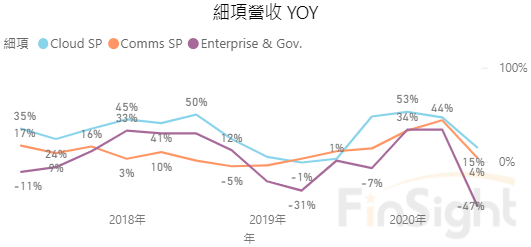
None of this has reversed. As long as AMD keeps launching competitive products on schedule, we expect it to keep taking share from Intel, and the share shift should be even more visible in the fourth quarter.
TSMC's capital appropriations jump, and the money goes into advanced node equipment
When TSMC's customers keep gaining share, TSMC's own order visibility gets better.
We had put high odds on TSMC raising its capex guidance. In the end TSMC guided 2020 capex to about $17 billion, the top end of its range. Then on November 10, 2020 the board approved a record $15.1 billion of capital appropriations. That is the authorization Taiwan-listed companies disclose before the money is spent, drawn down over several quarters rather than all at once, and it keeps our odds high that capex grows again in 2021.
Look inside that appropriation and 43%, about $6.5 billion, goes into equipment for advanced processes, back end and specialty processes, with another 52% in property and capitalized leased assets. TSMC did not break out the rest. The growth is concentrated in front end advanced node tools, and this will be the largest single quarter investment in advanced nodes in the company's history.
Our view: with AMD continuing to take share and TSMC spending heavily to expand advanced node capacity, the TSMC alliance's advantage keeps widening.