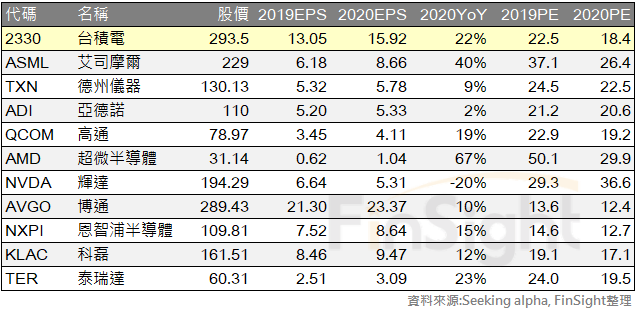
TSMC raised annual capex to $14 to $15 billion from $10 billion. 7nm is 25% of revenue, and at 18.4x 2020 EPS the stock is not expensive.
TSMC's third quarter 2019 earnings call kept the same investment direction as the prior quarter: 5G handsets and high performance computing (HPC). The news was capital spending (capex). The company raised its annual capex plan to $14 to $15 billion from $10 billion, and it can do that because of the position it holds in leading edge process technology. That raises our confidence in the leading edge story.
The detail has to wait for the January 2020 call, and for now all we know is that the first half of 2020 will be better than a normal seasonal trough. The valuation still works: in our reading, the members of the Philadelphia Semiconductor Index (SOX) with a real technical moat trade at 20x earnings or better, so TSMC at 18.4x is not expensive.
Key takeaways
- Capex raised to $14 to $15 billion a year from $10 billion, aimed at leading edge capacity for 5G handsets and HPC. The 2019 additions are $1.5 billion for 7nm and $2.5 billion for 5nm, mostly EUV (extreme ultraviolet lithography) tools.
- The financial outlook did not move with it: 5% to 10% revenue growth and a 50% gross margin. The January 2020 call is where that gets tested, starting with whether growth runs above 10%.
- 7nm is already 25% of revenue and the early 5nm ramp should go better than 7nm's did, but 5nm revenue comes from a few large customers rather than the roughly 100 on 7nm, so utilization and margins get lumpier from here.
- TSMC now puts 2020 5G handset penetration at about 15%, up from single digits six months ago, or roughly 225 million units on a 1.5 billion unit handset market. Mature nodes stay oversupplied, with 28nm not full for two years.
What was different this time: little on the financials, and a capex raise that leaves a lot to the imagination
Compared with past TSMC calls, this one said very little about growth. Management held the long-term model at 5% to 10% revenue growth and a 50% gross margin, and the only mix detail was 5G handset penetration. What they did give was a striking capex number: $14 to $15 billion a year, up from $10 billion. The money goes to leading edge capacity for 5G applications, meaning both handsets and HPC. The 2019 additions are $1.5 billion for 7nm and $2.5 billion for 5nm, and the bulk of it is EUV tools.
Capex went up and the revenue and gross margin outlook did not. That gets settled on the January 2020 call. The things to watch there are whether revenue growth runs above 10%, how much depreciation and the 5nm ramp take out of gross margin, and the state of the industry. The company did not give more granular numbers, so on whether this capacity build carries risk we are relying on management's word: they say they work closely enough with customers to know their strategies and their inventories.
Go back to the capex expansion in 2010. TSMC also moved first into 28nm, the big volume node of that generation, and that drove revenue and profit into an up cycle. Today 5nm and 7nm are still in that early spending phase, and the pull comes from AI plus 5G. Cisco's 2016 study put the compound annual growth rate (CAGR) for global data at 27% from 2016 to 2021, with less than 10% of that data actually put to use. By one industry estimate, training a voice model takes roughly 100 times the GPUs of training an image model. Demand for leading edge capacity has support behind it, and it is not the thing to worry about.
TSMC: the long-term position is secure, and customer concentration at the leading edge adds volatility
ASML's results show EUV orders running hot, and ASML has capacity limits of its own; it also says service revenue grows once these tools are in production. TSMC's added capex is concentrated in EUV tools for leading edge nodes, and EUV is hard to bring in. Management stressed on this call how difficult EUV processing is. TSMC says it can secure EUV tool deliveries in both 2019 and 2020, while the general market view is that Intel does not get its EUV tools until after 2021. TSMC is ahead on equipment and on production readiness, and history says you cannot simply install the tools and be done. That makes the 5nm and 7nm franchise more secure.
To judge TSMC's growth and market position you only need to watch the leading edge. 7nm is already 25% of revenue and should keep climbing in 2020. The early 5nm ramp should also go better than 7nm's did, which makes us more confident that 5nm contributes more than 10% of revenue within two years. On the customer side, Qualcomm's 5nm orders are coming back to TSMC, and AMD keeps taking CPU share from Intel.
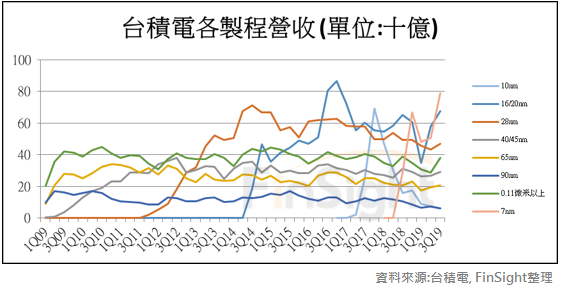
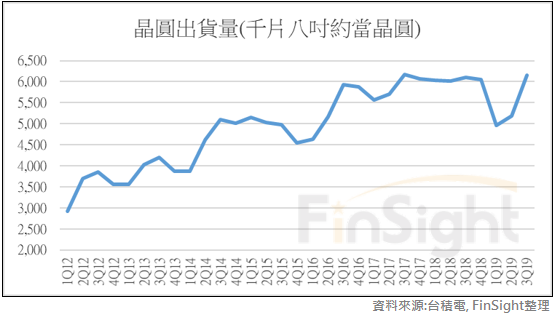
The other side of a bigger leading edge is more volatile results. The 50% gross margin target assumes utilization above 90%. On 7nm management talked about roughly 100 customers; 5nm revenue will come mainly from a few large ones. The first half of 2019 is the example: adjustments to customers' inventories cut TSMC's utilization and hit gross margin.
China revenue is worth flagging: it hit a record, up 40% year over year in the third quarter of 2019 and 20% of the total. TSMC is in good shape, and the US-China trade war is pulling 5G handset demand forward. But with that concentration, future capacity adjustments at customers will bite harder into TSMC's profitability.
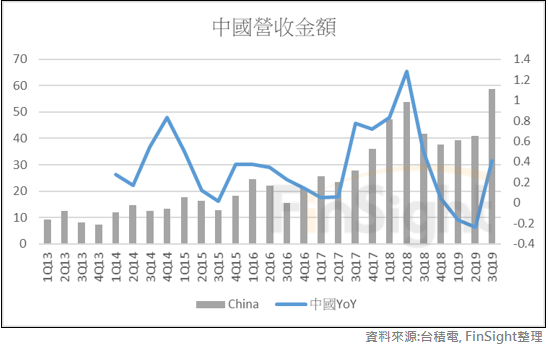
Figure 3 is reported in New Taiwan dollars (NT$), which traded at roughly 30 to 31 per US dollar in 2019, so the record level in NT$ terms is a record in dollar terms too.
The industry picture has not changed: 5G handsets and HPC, with no real improvement in mature nodes
We began raising our 5G handset numbers on the second quarter 2019 call, and the direction of this quarter's capex says the handset business is still good, so what matters now is the gap between the volumes and what the market already expects. TSMC now puts 2020 5G handset penetration at about 15%, up from single digits six months ago. On a 1.5 billion unit handset market for the year, that is roughly 225 million 5G phones in 2020. TSMC's handset volumes match current expectations, but Huawei cutting its overseas volumes is a live risk.
Looking further out, 5G means handsets and HPC together, and HPC picked up in the fourth quarter of 2019. On the second quarter 2019 call the company put handsets at 45% of revenue and HPC at 30%, so HPC is far from a side business in the 5G build. In the second quarter of 2019 most HPC vendors guided to inventory adjustments ending in the second half of 2019 and business turning back up. That now looks more certain and worth waiting for. The names to watch are AMD and NVIDIA, plus King Yuan Electronics (2449), a Taiwan listed test house that also benefits from HPC.
Mature nodes are the other story: more competition and oversupply. TSMC expects 28nm to stay short of full utilization for two years. Vanguard International Semiconductor (5347), a Taiwan foundry whose business sits mostly in mature nodes, sounds cautious as well. Full year semiconductor estimates have not gone up, US names such as Texas Instruments sounded better in the second quarter of 2019 but not because end demand had improved, and Micron's inventory is also concentrated in older nodes. Leading edge and mature nodes have split, and the optimism sits entirely in leading edge and 5G. TSMC raised capex, but the equipment spending is concentrated at ASML, and more EUV means less demand for other etch and deposition tools. The industry is still growing, so Applied Materials and Lam Research simply benefit less. 5G related equipment demand should continue as it did in the second quarter of 2019.
Editorial note: we revised this read three weeks later, in our quarterly chip equipment earnings roundup for Q3 2019, where the equipment makers argued that the added process complexity keeps demand for the existing tools intact.
Related Taiwan names: confirming reads on the same trend
None of these are easy to own from the US, and all of them are Taiwan listed, but they confirm or contradict the TSMC read before it shows up in US names.
- Silicon wafers: inventory at the Taiwan wafer suppliers is holding at normal levels.
- IC (integrated circuit) design: among the TSMC linked names, M31 Technology (6643) licenses design IP tuned for 16nm, Global Unichip (GUC, 3443), TSMC's design services affiliate, benefits mainly from 7nm (5nm looks two years out), and Alchip (3661) is driven by 16nm demand in China. The trend toward more ASICs (application specific integrated circuits) on leading edge nodes helps all three, but not in the near term.
- Packaging: ASE Technology Holding (3711) should get both higher millimeter wave (mmWave) 5G handset penetration and advanced packaging orders that spill over, since TSMC will not keep all of its own packaging in house. King Yuan Electronics (2449) is the clearer beneficiary of the HPC recovery.
Valuation: 18.4x against the SOX at 16.5x, with room to move higher over time
The near term looks good. The first half of 2020 will not be as soft as a normal seasonal trough, and an easy first quarter comparison makes growth easier to come by. The consensus we compile has 2020 EPS growing 22%, which puts the stock at 18.4x, a premium to the SOX at 16.5x but below the other large SOX members near 20x. With TSMC's position in the industry improving, the price here looks fairly safe.