
TSMC beat in the first quarter of 2020 and guided full year growth to 14% to 19%, but a 5nm heavy second half points to falling utilization.
TSMC held its earnings call on April 16, 2020, and the first quarter numbers surprised the market. Putting up a quarter like that with the pandemic running through the supply chain tells you how hard TSMC is to displace.
Key takeaways
- First quarter 2020 net income was NT$117.987 billion and earnings per share were NT$4.51 (New Taiwan dollars, running around 30 to the US dollar at the time). Utilization, the share of capacity actually running, was high, and gross margin and operating margin both came in above the guidance range.
- TSMC guided full year revenue growth to mid to high teens, or 14% to 19%, better than the Street, while cutting its view of the semiconductor market from 8% growth to flat or slightly down and the foundry market from 17% to a range of 8% to 12%. Management said it has not seen a single customer cut orders.
- The arithmetic behind that guidance puts second half revenue flat to down against the first half. For 5nm to be 10% of full year revenue it has to run at 20% of the second half, which pushes mature node revenue down, takes utilization with it, and lands on gross margin alongside the 2 to 3 points of dilution 5nm was already expected to bring.
- China was 22% of first quarter revenue and has grown about 80% year over year for three straight quarters. The US export rules aimed at Huawei (the Entity List restrictions of 2019 and the tighter rules then under discussion) make that the single largest variable in the story, and TSMC's capital spending (capex) plan leaves only about $2.5 to $3.5 billion for the second half.
In our earlier post on TSMC's long and short term picture (February 2020), written after the January call, we said China's outbreak had put a question mark over smartphones while data center was rebounding on solid footing, and that the size of the board's capital appropriations suggested capex would have to be revised higher.
After this call our view is that the guidance is better than consensus, but the product mix points to second half utilization falling, and the US export rules aimed at Huawei leave the China market unsettled. The company's long term position is not in question. The second half of 2020 depends on where the pandemic goes.
Foundry leadership is secure, and both the quarter and the outlook beat consensus
TSMC's first quarter 2020 profit came in above consensus, with net income of NT$117.987 billion and earnings per share of NT$4.51. With utilization running high, gross margin and operating margin both landed above the guidance range.
Advanced nodes are still the engine. 7nm held at 35% of revenue, the same share as the prior quarter. The company expects 7nm to be more than 30% of revenue for the full year, and 5nm, which is about to enter volume production, to reach 10%. Together, advanced nodes should be 40% of total revenue in 2020.
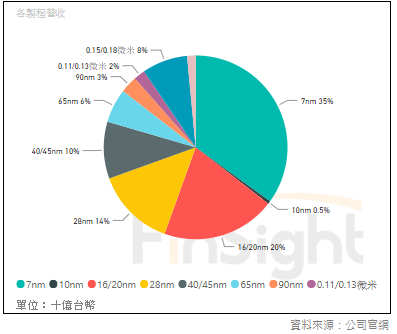
The company cut its full year view of semiconductor industry growth from 8% to flat or a slight decline, and the foundry market from 17% growth to a range of 8% to 12%. Its own full year growth estimate is mid to high teens, or 14% to 19%, which is better than the Street had. Management was explicit that it has not seen customers cut orders: the lower industry numbers come from worry about end markets, not from the order book.
Look at the two largest applications in the quarter. Smartphone revenue grew 47% year over year and high performance computing (HPC) grew 42%, with total revenue up 42%. Both benefited from full order books and an easy comparison against 2019. For the second quarter the company expects phones to be softer than planned, with HPC filling in the dollars that phones give up.
5G and HPC were already the multi year trend. The pandemic added to both: working from home expanded cloud usage and pulled HPC development forward. The full year 5G penetration estimate for handsets is unchanged at 15%, while total handset units are expected to fall by a high single digit percentage.
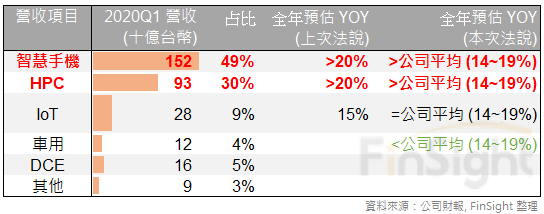
The call confirms what we already believed about the process lead. TSMC's order book was barely touched in a quarter when the virus was tearing through everything around it, because customers are reluctant to pull advanced node orders first.
Even if the pandemic eases in June, the second half is flat to down
Results and guidance both beat, but management's own numbers say a strong first quarter plus a cut full year outlook equals second half revenue flat to down against the first half. Work the arithmetic. 5nm only ships in volume from the third quarter, so for it to be 10% of full year revenue it has to run at 20% of second half revenue. At 20%, revenue from the mature nodes falls sharply against the first half and utilization falls with it. Add the 2 to 3 points of gross margin dilution that 5nm was already expected to bring, and second half gross margin is under pressure.
The comparison base in the second half of 2019 was high. Put that together with a lower gross margin and second half profit and growth will be clearly worse than the first half.
All of this rests on the company's assumption that the pandemic eases in June, and that is the part carrying the most uncertainty. In our April 2020 post on life after lockdown and the disruption and innovation that follows, we argued that the virus can come back before a vaccine arrives and that the process could take 18 months. We will be living alongside this virus for a while.
So TSMC's assumption is, in our view, the better case. If the pandemic follows a worse script, the reference point is the first quarter of 2019, when wafer shipments fell 19% and TSMC's gross margin fell 7 points. Second half profit would then have to come down as utilization slips.
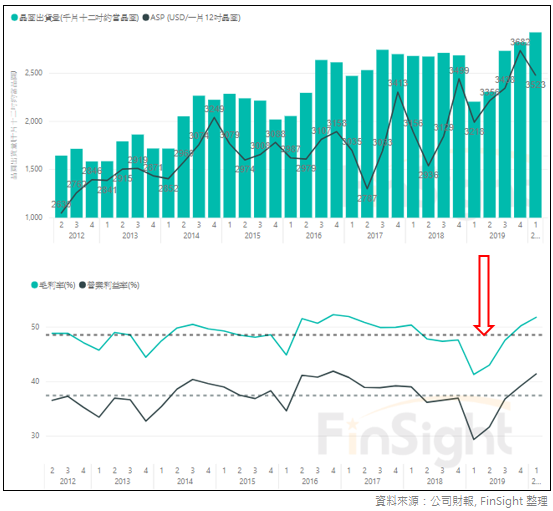
On last quarter's call we noted that the board had already approved $13.3 billion of capital appropriations for the first half of 2020, and that at that pace capex would probably have to go up. First quarter capex was $6.39 billion, and the company kept its full year capex plan at $15 to $16 billion. That leaves roughly $2.5 to $3.5 billion for the second half, a sharp step down from the first quarter run rate, and TSMC's equipment suppliers could see revenue fall quarter by quarter because of it.
China is 22% of revenue, and the US rules on Huawei are the wild card
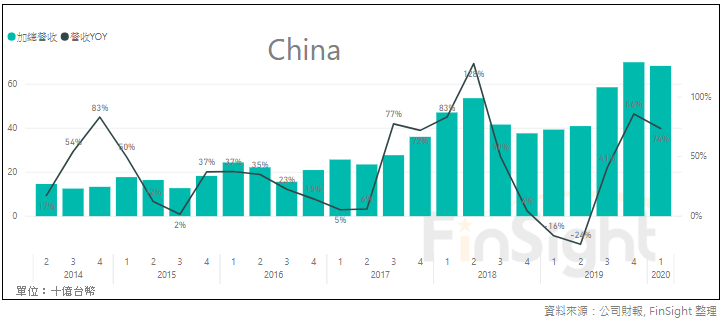
China was 22% of TSMC's revenue in the first quarter. Revenue from China has grown around 80% year over year in each of the last three quarters, which makes it one of the more important sources of recent growth. Management said it has not lost any share to SMIC (Semiconductor Manufacturing International Corporation, China's largest foundry), which speaks to both TSMC's position in the industry and its technology lead.
The question a lot of people asked on this call was about the US China trade war and whether TSMC intends to build in the United States. The company's answer: a US fab would raise costs and create a staffing problem for engineers, but if it does build there it would be at an advanced node. Management framed it as long term supply chain strategy rather than plain risk management.
The Semiconductor Industry Association (SIA) has written to the White House more than once arguing that sanctioning TSMC would do serious damage to the industry. In our view the fact that those letters keep being written is itself a sign that the question is live on both the government and the industry side. Politics keeps TSMC's positioning between the US and China markets unsettled.
The position is still hard to shake, and the second half comes down to the pandemic
Hybrid cloud, data center and AI were already riding the trend, and the pandemic accelerated all three. That has produced strong demand for TSMC's advanced nodes, and the tech companies on the receiving end have held up relatively well: the Nasdaq 100 has already recovered its decline for 2020.
The second half economy is still a question mark. If the pandemic runs past June without easing, or if consumption comes back slowly, the semiconductor market and TSMC's shipments both go lower, and utilization and gross margin come under pressure. An internal Google memo, as reported at the time, said the company would slow hiring and adjust the pace of its data center investment because of the hit to its business. That does not necessarily mean corporate capex gets cut right away, but the longer and deeper the pandemic runs, the harder the damage to the broader economy is to dismiss.
We are worried that the uncertainty around the pandemic produces an inventory correction in the second half. Over the long run, we still like TSMC's position.