Morgan Stanley's twelve post-pandemic tech trends, the themes whose ETFs are already up more than 30% in 2020, and a screen of US-listed e-commerce names.
In an era of excess liquidity and deep uncertainty, the market goes hunting for whatever growth looks most certain right now. That was the argument in our July 15, 2020 post on the investment logic behind this run in tech. We think that growth is new technology. This post sets out what new technology actually covers, from three angles: what the sell side is saying, where money is flowing, and what estimated profit and cash flow look like.
Key takeaways
- Morgan Stanley's report on technology eating the world lists twelve trends the pandemic pulled forward, and capital markets have been chasing them all through this stretch. The biggest pools on its numbers: enterprise information technology (IT) at about $1.5 trillion, and healthcare, an economy Morgan Stanley sizes at $4 trillion in the US and $8 trillion globally.
- In a pandemic year, plenty of US-listed theme funds, the exchange traded funds (ETFs) that hold a basket of stocks around one idea, are still up more than 30% in 2020, and the winners cluster in a handful of themes: internet (Chinese and US consumer platforms plus business software as a service), e-commerce, esports and gaming, healthcare, and clean energy including electric vehicles.
- Screening on average estimated net income and cash flow for 2020 and 2021 together, rather than year over year growth, keeps a collapsed 2020 from flattering the 2021 comparison and finds the industries that still grow profit through the pandemic: software, semiconductors, healthcare, consumer discretionary retail (e-commerce), medical devices, internet media and hardware.
- E-commerce is the cleanest expression of the shift, with a US market Morgan Stanley sizes at about $750 billion, and the group has broadened into advertising and fintech payments. We stay long software and semiconductors even at these multiples, but the better risk reward now sits in healthcare and semis, which have not run as far.
Tech is eating the world: the forces shaping the post-pandemic era
Morgan Stanley recently published a report titled Technology Is Eating the World. It pulls together twelve big trends now under way in the wake of the pandemic, and capital markets have already been paying up for most of them.
The points that matter most, in our summary:
- Faster public cloud adoption. The pandemic pushed companies onto the cloud so people could work remotely. A survey of chief information officers in mid March, cited in the report, showed 89% expected to accelerate public cloud adoption. We already know that even under lockdown most companies kept running remotely, and more firms in the US and Japan now say remote work is here to stay, which keeps pulling on cloud and compute demand. The enterprise IT market is roughly $1.5 trillion.
- Collaboration software and data management. As workflows digitize faster, companies generate and analyze more data, and working from home lifts demand for cloud collaboration platforms. For the vendors, the pie itself is getting bigger.
- E-commerce. Morgan Stanley calls 2020 the inflection point for e-commerce: as the pandemic drags on, spending on travel and eating out falls, government stimulus adds subsidy, and shopping from home gets more of the wallet. It sizes the US market at about $750 billion.
- Contactless payments. Strong growth in electronic payments offsets the drop in offline consumption. Contactless is a clear multiyear growth trend coming out of the pandemic.
- Digital entertainment and connectivity. Demand for streaming video, music and online gaming is rising, which lifts demand for connectivity and makes 5G that much more important.
- Offline advertising keeps moving online. Internet advertising should recover faster than other ad formats, and it pushes small and midsize businesses toward social media and e-commerce exposure. Total advertising still suffers as marketers cut budgets, but online is what comes back first. The US market is about $123 billion.
- Big tech moving into healthcare. The pandemic has pulled technology companies into health care, and the market has not priced this yet. We expect regulation to ease and more new entrants to arrive. This is the newest of these trends and the one least discussed so far. Morgan Stanley sizes the healthcare economy it is moving into at $4 trillion in the US and $8 trillion globally.
- The rest: food delivery, paperless workflows and automation, global trade conflict, and augmented and virtual reality applications.
Most of these will not be new to readers.
With the pandemic still spreading, the new normal keeps changing how we live. Judging by last quarter's US earnings calls, most companies believe the migration of data to the cloud will not slow down even once the virus recedes.
Our own research has mostly focused on high performance computing chips and software demand. Setting those trends alongside where the market is actually putting money, we see several more areas worth watching.
Where the money is going, and what estimated profit and cash flow say
We used the ETFdb.com screener on US-listed theme funds, excluded products that magnify or invert the index and anything under $300 million in assets, and sorted by year to date return to see which themes the market likes most this year.
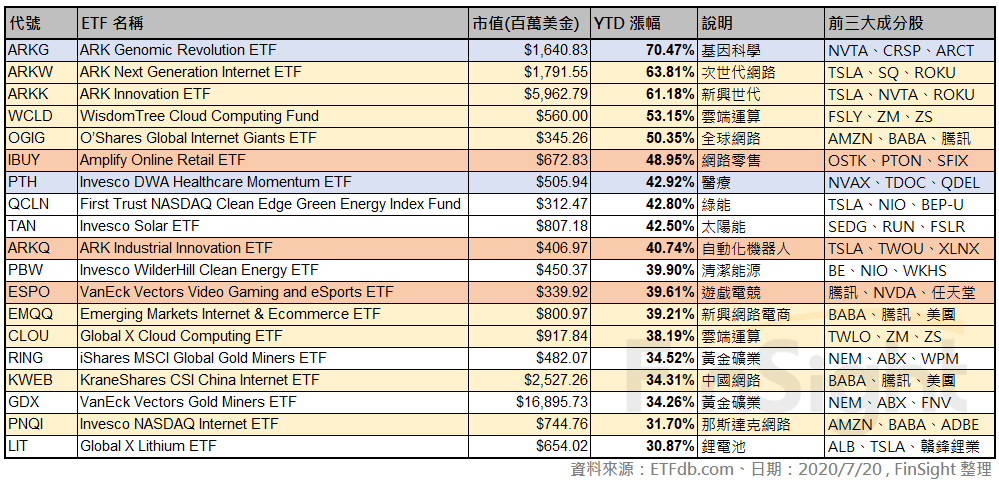
Even in a pandemic year, a good number of theme funds are up more than 30% in 2020, and those gains sit in a few specific themes: internet (Chinese and US consumer internet leaders plus business to business (B2B) software as a service), e-commerce, esports and gaming, healthcare, and clean energy including electric vehicles.
With the Federal Reserve flooding the system and cash everywhere, money is chasing structurally advantaged trends without much regard for price.
So what about estimated profit and cash flow?
We usually look at industry profit growth year over year. Here we wanted to find the industries whose absolute profit still grows through a pandemic. So we took estimated net income and cash flow for 2020 and 2021 together and worked with the two year average level and growth, which keeps a collapsed 2020 from flattering the 2021 comparison. Then we looked for industries whose profit can still reach a new peak after the pandemic.
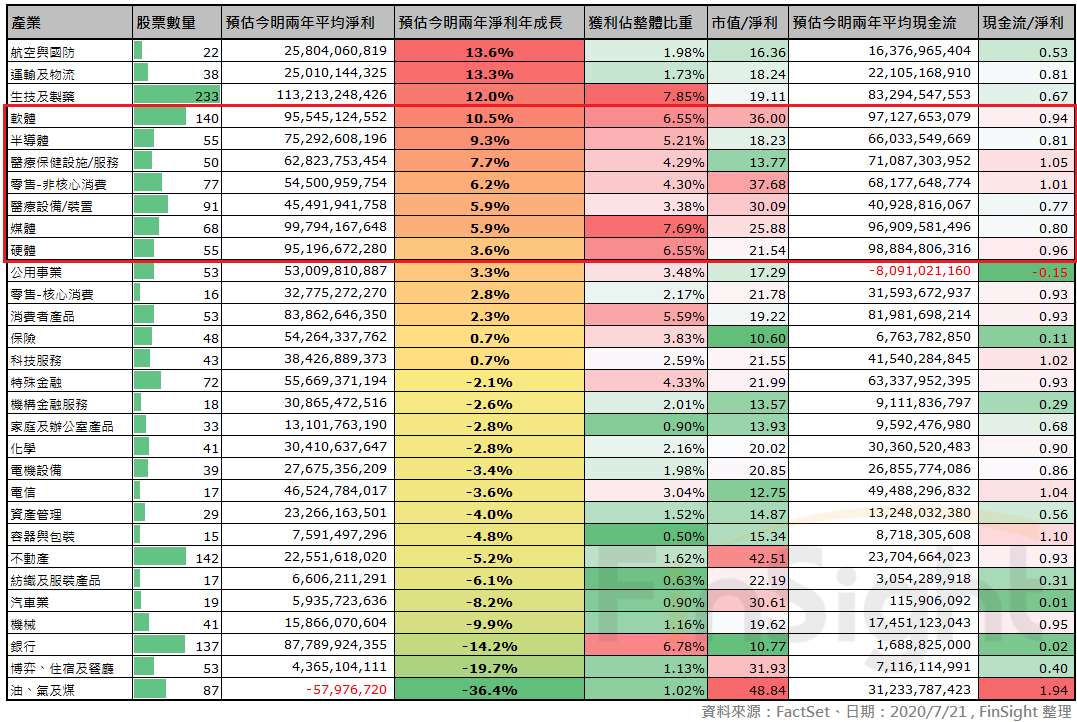
Estimates are analyst consensus, our own compilation, aggregated by industry and ranked on average net income growth across 2020 and 2021.
Ranked that way, and adjusting for which companies also show better cash flow, the industries we like are software, semiconductors, healthcare, consumer discretionary retail (e-commerce), medical devices, internet media and hardware.
With the pandemic hitting every industry, cash flow in software, e-commerce and medical devices stands out. Structurally advantaged industries really do put up better financials even through a shock like this one.
The pandemic is speeding up e-commerce penetration, and here is the US-listed group
It is US earnings season, and plenty of analysts have already raised target prices on tech names before the numbers even print. Take Amazon: the recent target hikes rest on the view that the pandemic pulls forward e-commerce penetration. On that logic, a second wave would only strengthen Amazon's long term business and market position further.
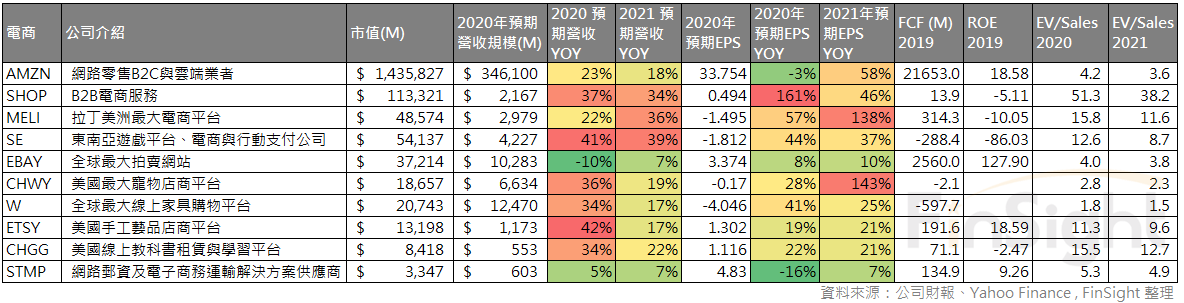
Below we put the US-listed e-commerce names into a table. Most are constituents of the Amplify Online Retail fund, plus a few e-commerce companies operating outside the US.
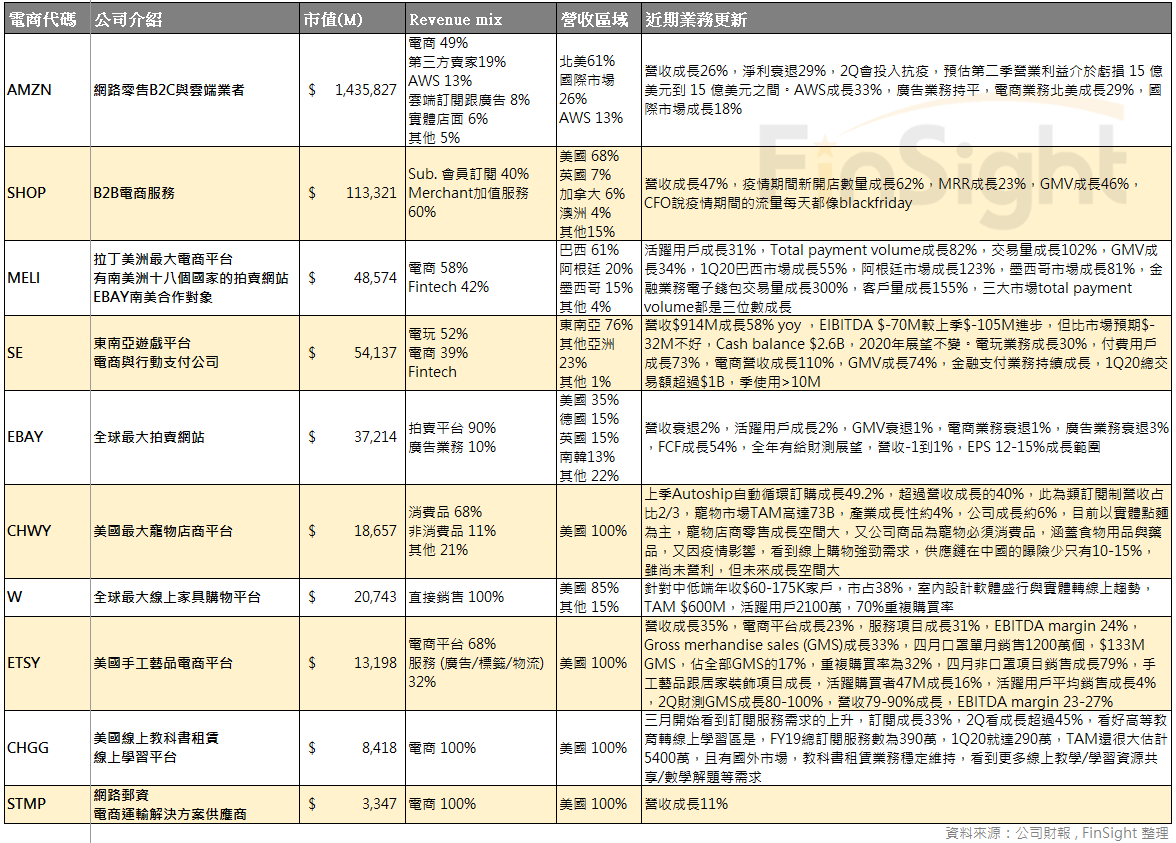
As the pandemic drives e-commerce demand higher, the market itself has split into niches, each with its own defensible corner. Platforms that help sellers optimize and platforms that sell one category well have both won plenty of investor attention in this stretch.
For example:
- Helping sellers build a brand: Shopify and Wix.
- Category specialists: eBay in secondhand goods, Etsy in crafts and cloth face masks, Wayfair in online furniture, Chewy in pet supplies, and Chegg in online education and learning.
- E-commerce outside the US: MercadoLibre, the largest platform in Latin America, and Sea, the largest in Southeast Asia.
We also see e-commerce companies pushing hard into adjacent lines. Amazon's cloud business needs no introduction. The most common adjacency is advertising: use the platform's traffic to attract advertisers, as Amazon, eBay and Etsy all do.
The other line these companies are pushing into is fintech and payments. Every e-commerce platform runs into the problem of moving money, and solving it inside the platform both raises willingness to use it, on the buyer and the seller side, and earns more commission along the way. That is why MercadoLibre and Sea are both building fintech aggressively.
Bottom line: the themes we will keep tracking
As daily life changes structurally, anything connected to the internet is thriving with it. Pulling today's threads together, healthcare, electric vehicles, e-commerce, contactless payments, esports and gaming, software platforms and semiconductors are all themes we intend to keep tracking.
For now we stay long software and semiconductors even at these multiples, and we think the run has further to go. Software has already run a long way, though, while healthcare and semiconductors have not, and they have a shot at beating pessimistic earnings expectations. Those may be the better places to look.