S&P 500 2020 earnings estimates fell to minus 19.7% by May 8, 2020. Software estimates were revised up 2.7%, and the cloud index is up 21% this year.
Stocks fell fast and then rebounded at a speed we rarely see. As of May 8, 2020, the Nasdaq is back to where it started the year, and software has gone one better: the group is making new highs.
Key takeaways
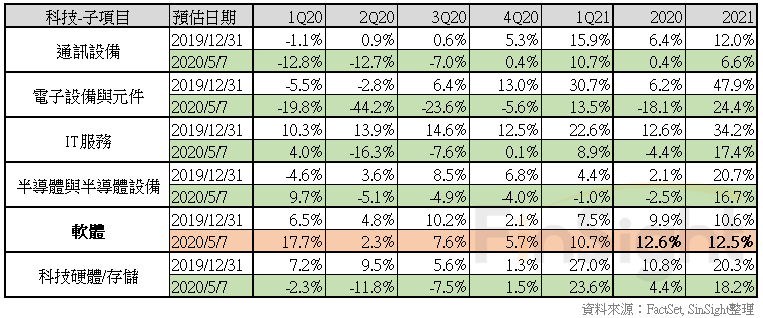
- Corporate earnings estimates are being cut hard, and software's are going the other way. The consensus for S&P 500 2020 earnings moved from a 4.5% decline on April 3, 2020 to a 19.7% decline on May 8, 2020, while software's 2020 estimate was revised up 2.7% to 12.6% growth and 2021 up 1.9% to 12.5%.
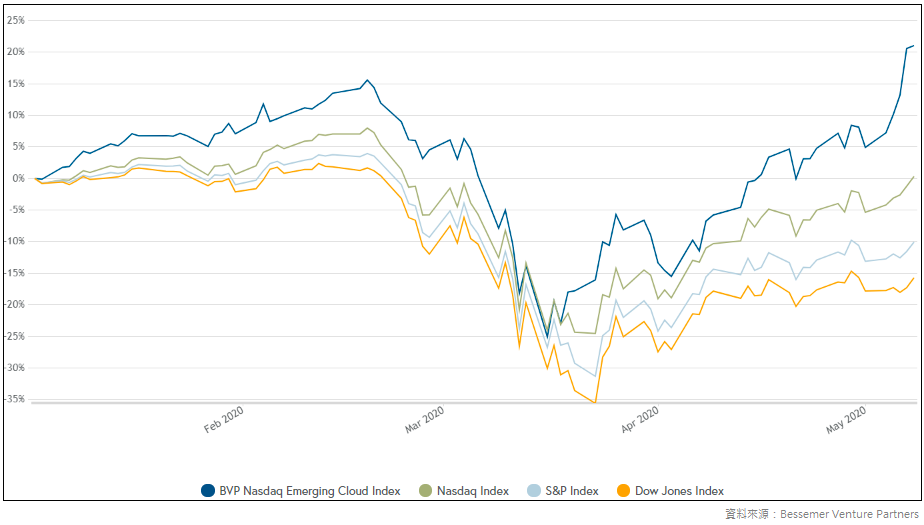
- The market is paying for that. The BVP Nasdaq Emerging Cloud Index (EMCLOUD), compiled by Bessemer Venture Partners, is at an all time high, up 21% year to date through May 8, 2020, against 0.7% for the Nasdaq, minus 10% for the S&P 500 and minus 15% for the Dow.
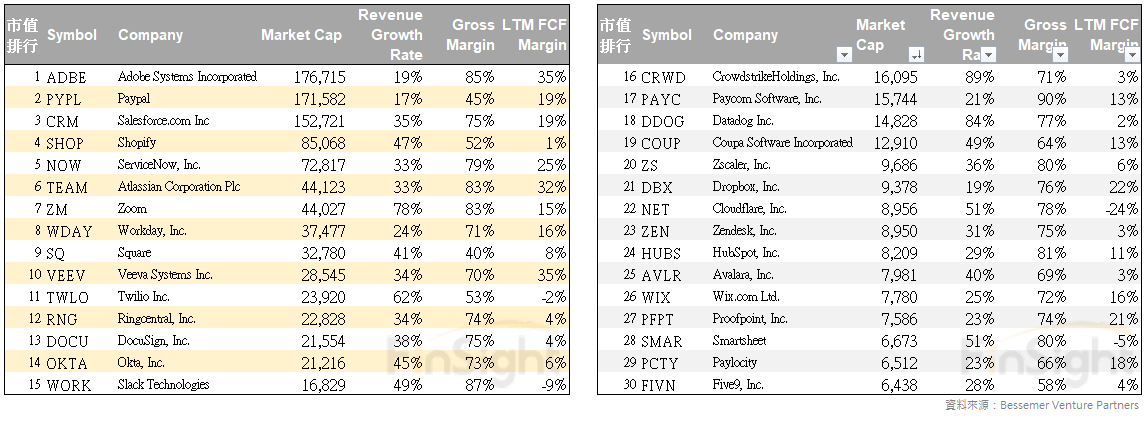
- Close to 19 software names with market caps above $1 billion are at new highs. Ten of the fifteen largest constituents of the BVP cloud index are among them: PayPal, Shopify, ServiceNow, Atlassian, Zoom, Veeva, Twilio, RingCentral, DocuSign and Okta.
- US bond futures now price the possibility of negative policy rates within months. A long stretch of low rates is one of the few certain things in this market, and it argues for higher multiples on companies with strong balance sheets, steady cash flow and a trend behind them.
S&P 500 earnings estimates are getting cut hard, and software's are going up
The first quarter 2020 US reporting season is almost done. As of May 8, 2020, 86% of the S&P 500 had reported.
Over the past month the market cut its 2020 earnings estimate for the S&P 500 sharply, from a 4.5% decline on April 3, 2020 to a 19.7% decline on May 8, 2020. The second half looks worse than it did before as well. The latest estimates have the third quarter down 23% and the fourth quarter down 11.4%, with no clear rebound until 2021.
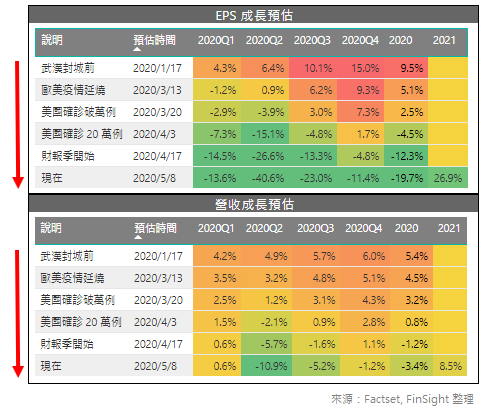
Most companies have pulled their guidance, and the outlook for consumer spending in the second half is unclear. Expectations have moved from a V shaped recovery to a U, or an L, meaning a slow climb back at best. The damage to fundamentals is worse than the market assumed going into this reporting season.
The gap between industries, though, is very wide.
A new way of living kills some industries and builds others. The estimate revisions by sector say the same thing.
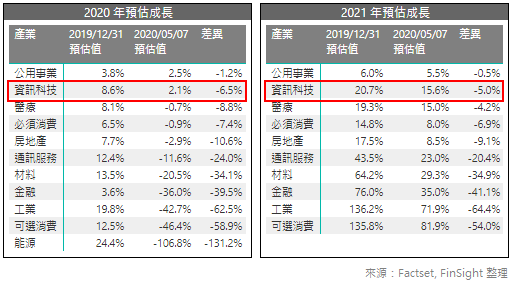
Technology and utilities took the smallest cuts, and both still carry positive earnings growth for this year and next. Healthcare and consumer staples also held up well, with estimates flat for 2020 and back to growth in 2021. Everything else, industrials, financials, consumer discretionary, real estate and energy, saw growth cut hard and took the worst of it.
Break technology down further and software stands out: its earnings estimates are now higher than they were at the end of 2019. The 2020 estimate was revised up 2.7% to 12.6% growth, and the 2021 estimate up 1.9% to 12.5%. Software is one of the very few subsectors whose numbers are going up this year.
The pandemic changed how people live and sped up the pace of technology adoption. With S&P 500 earnings expected to fall close to 20% this year, software's growth is direct evidence that the trend behind it got a push.
Microsoft and Adobe carry heavy weights inside that software group. Our April 2020 post on Microsoft Teams usage in locked down Italy growing 775% in a single week showed how the pandemic pulled forward enterprise cloud migration and widened Microsoft's lead. The same thing is happening at other business to business (B2B) software as a service (SaaS) companies.
Software stocks are strong, and the emerging cloud index is at a record
The market is buying those fundamentals. The Nasdaq is back to flat for the year while the S&P 500 and the Dow are still down double digits, and close to 19 software stocks with market caps above $1 billion are at new highs. The BVP Nasdaq Emerging Cloud Index (EMCLOUD), compiled by Bessemer Venture Partners, is at an all time high and up 21% year to date.
Most of the index constituents are B2B SaaS companies. Sorting the weights by market cap shows that the largest names also have the better cash flow profiles. Of the top fifteen, the ones at record highs are PayPal, Shopify, ServiceNow, Atlassian, Zoom, Veeva, Twilio, RingCentral, DocuSign and Okta.
It is not only US software. The same trade is working in China and Hong Kong, where two Hong Kong listed names sit near record highs: Kingdee International (268.HK), one of the local enterprise software leaders, and the China cloud computing exchange traded fund (ETF), 2826.HK.
A long stretch of low rates should lift multiples on the best balance sheets
With fundamentals holding up, is there room for software multiples to go higher?
US bond futures last week were pricing the possibility that the United States goes to negative policy rates within a few months. With fundamentals in recession and the path of consumer spending unclear, a long stretch of low rates has become the one near certainty in an uncertain market. Rates and valuations move in opposite directions, so lower for longer leaves room for money to crowd into the assets investors want, and for their multiples to rise.
At the same time, plenty of companies in other industries are heading into real operating trouble. So our view is that this market will pay up for strong balance sheets, steady cash flow and exposure to a long term trend.
In The Subscription Series, Part 2, our December 2019 post on the SaaS competition map, we walked through how the cloud changed the way software is sold, and how many SaaS companies moved from perpetual licenses to subscriptions. That shift gave them more cash flow and better visibility, and it put them closer to the customer, which in turn made their products better.
So whether you look at the industry trend, at the growth in the numbers, or at the visibility of the cash flow, we think the leading SaaS names have room for their multiples to go higher.