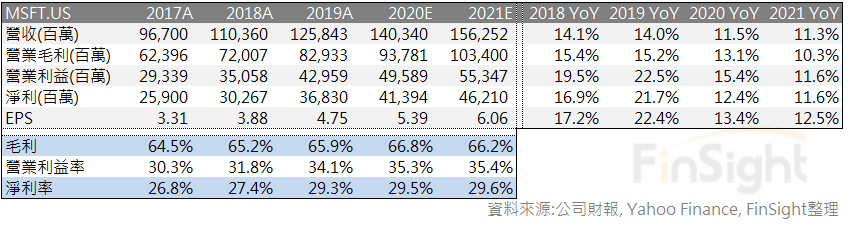
Azure grew 59% in the third quarter of 2019 against 35% at AWS, and commercial cloud drove 80% of Microsoft's revenue growth over four quarters.
Earlier posts in The Subscription Series covered the investment logic behind software as a service (SaaS) (November 2019) and how SaaS companies compete (December 2019). Today we turn to the fastest growing large company in SaaS: Microsoft.
Key takeaways
- On October 25, 2019, Microsoft beat Amazon for the $10 billion JEDI contract from the US Department of Defense, a direct win over the market leader in cloud.
- Azure revenue grew 59% year over year in the third quarter of 2019 against 35% at AWS, and Azure's growth is still building while AWS has already slowed.
- Commercial cloud added $1.2 billion of revenue over the past four quarters while total revenue added $1.5 billion, so cloud is 80% of Microsoft's growth, and commercial cloud operating margin keeps improving while AWS margin has slipped.
- Round two of the cloud fight is hybrid, and Microsoft is set up to win it: 95% of the Fortune 500 run Azure, SAP named Azure its preferred cloud partner in October 2019, and Teams has more than 20 million daily active users against 12 million at Slack.
On October 25, 2019, the US Department of Defense announced that Microsoft had beaten Amazon for the $10 billion Joint Enterprise Defense Infrastructure (JEDI) contract, supplying commercial infrastructure as a service (IaaS) and platform as a service (PaaS) for the department to build out its business systems and run its missions.
The award says something bigger too. Microsoft's cloud buildout now threatens Amazon's lead in cloud services. In the third quarter of 2019, Azure revenue grew 59% year over year and AWS grew 35%. On top of that, Azure's growth momentum is still building, while AWS has already slowed.
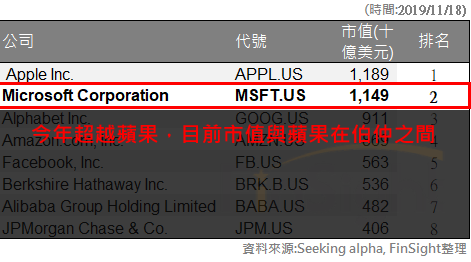
Microsoft is up close to 50% so far in 2019. Its market cap passed Apple and Amazon to become the largest in the world, until Apple took the top spot back in the third quarter of 2019. The two are neck and neck now.
The turnaround: the hardest CEO job in the world, and how Nadella reset Microsoft's future
Satya Nadella took over Microsoft in 2014. Profit and revenue were still at record levels, but the move to mobile was going badly. Windows, the main product, stayed tied to the PC. Microsoft had tried to push a mobile operating system and its own phones, and consumers did not buy them, so the stock lagged. Before he took the job, Silicon Valley was broadly negative on Microsoft's prospects, and the business press even ran a piece asking why anyone would want to be Microsoft's CEO.
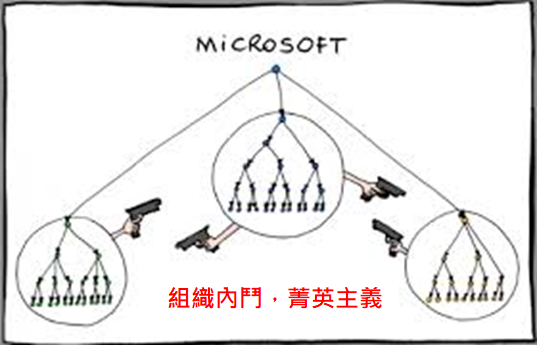
Nadella went back to the company's founding purpose, empowering people, and put Microsoft to work helping customers get their own work done. That lines up with the mindset shift we described earlier in this series, the one the subscription model forces on a vendor: your job is to make the customer successful. In practice it meant stronger cooperation across groups, more open systems and more open ways of working, and a willingness to work with competitors.
In his first year Microsoft shipped the first version of Office that ran on Apple's iPad. It joined the Linux Foundation in 2016. In 2018 it bought GitHub and its huge open source community, reversing the company's old hostility to open source. Since then it has shared data with Adobe and SAP, worked with Sony, its old enemy in gaming, on AI and cloud gaming, and even supported Amazon, its cloud rival, on voice assistants.
Cloud sits at the center of all of it. Nadella ran the cloud computing group before he got the top job, so he knew the demand and the trend cold. Cloud work needs many applications running together and data flowing in from different departments and even different companies, so an open ecosystem and real partnerships matter. His line was that Microsoft should be a company that learns it all, rather than the company that used to insist it knew it all.

In a public letter in 2015, Nadella said the core of Microsoft's strategy was to build the best productivity services platform for a mobile first, cloud first world. That process killed off the old PC giant and rebuilt it as a cloud culture based on openness and integrated data. In 2018 Microsoft reorganized and split into three groups:
- Cloud + AI, the intelligent cloud and Microsoft's future: Azure, servers, databases, customer relationship management (CRM) and enterprise resource planning (ERP).
- Experiences and Devices, the intelligent edge: Windows, Office 365, Skype and Surface.
- AI + Research, which develops new technology: VR, AR, Bing and Cortana.
Windows, the product that made Microsoft powerful, has disappeared from the group names. Cloud and AI are now the priority. Split by revenue, the personal computer matters less every year, and the data shows it growing slower than the other lines. In the cloud era, data is what matters most: software delivered through the cloud helps customers get their work done, and data and software are what drive strong profit growth.
Microsoft's revenue lines are:
- More personal computing: Windows OEM, Windows cloud services, search advertising and Surface.
- Productivity and business processes: Office products, Dynamics products and LinkedIn.
- Intelligent cloud: Azure, server products and enterprise services.


Commercial cloud: the revenue split that shows where the growth comes from
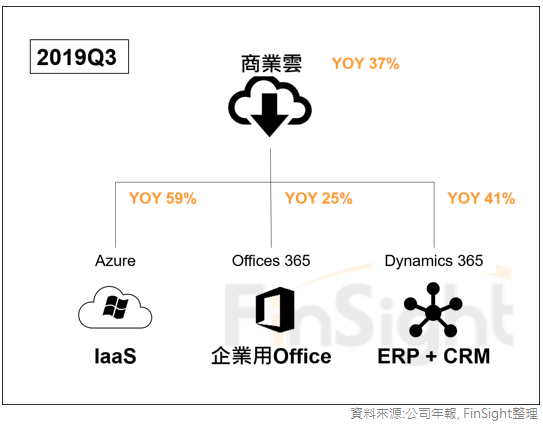
Commercial cloud covers the enterprise business Microsoft does in the cloud:
- IaaS: Azure, growing faster than AWS and second in market share.
- Office 365: the shift from a one time license sale to a cloud subscription.
- Dynamics 365: ERP plus CRM, outgrowing the standalone CRM vendors.
Cloud revenue is Microsoft's main growth engine today. In its filings Microsoft groups its cloud related revenue into a commercial cloud line. Over the past four quarters, commercial cloud revenue grew by $1.2 billion while total revenue grew by only $1.5 billion, so commercial cloud accounts for 80% of the growth. Its share of revenue keeps climbing, which means Microsoft's growth rate now comes down to how fast commercial cloud adds revenue.

IaaS needs heavy and continuous capital spending, so depreciation runs high. Whoever builds early gets to depreciate early and monetize early, and profitability improves with it. The SaaS services layered on top can push profitability further if cross-selling makes the products work as complements and if stronger premium features support upselling. All of that tests how well a software company improves its products, and how tightly those products support each other and share data.

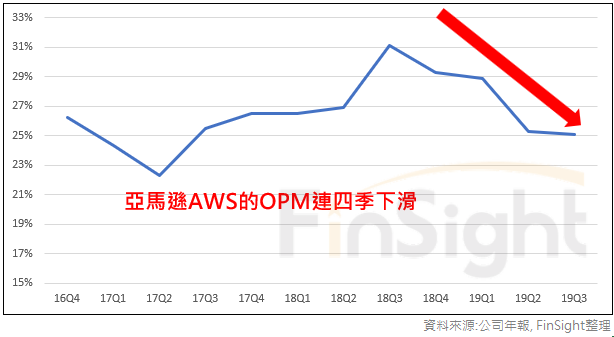
Commercial cloud is not only a rising share of revenue. Its operating margin has improved steadily over the past two years. Compare that with Amazon, the current share leader: AWS keeps cutting prices, its profitability has stopped improving, and it has slipped. That gap has a lot to do with cloud entering a new competitive phase.

Round two of the cloud fight is hybrid
In round one, Amazon invested ahead of everyone else in AI and data center buildout and took the lead in public cloud. Microsoft caught up on the strength of its existing software franchise and an open, partnership driven approach that kept widening its cloud ecosystem and its customer count.
The public cloud story was written by startups and consumer internet companies. Uber and Lyft rented space on AWS at the start because public cloud was the cheap way to build. As they scaled, they became a strong base of demand under AWS.
As public cloud competition got fiercer, round two began, and it centers on enterprises moving to the cloud. Enterprises used to collect data from what users did online. 5G pushes that collection out to the endpoint, and enterprises want their critical data to stay inside the company and stay secure. They also need the business to run smoothly in the cloud, with no disconnection or latency that breaks operations. That is what makes hybrid cloud the main architecture for enterprises moving to the cloud.
Multicloud products have to be open enough that each cloud connects to and supports the others. That depends on how broad a vendor's product line is, and on how closely it watches and meets customer needs. Microsoft's current hybrid cloud offering covers shared identity, security management, the data platform and a consistent cloud platform.
Through acquisitions and continuous investment, Microsoft has gone hard at the security worries that hold enterprises back, including AI that watches for threats and responds on its own. It works: 95% of the Fortune 500 run Azure today.
A more open Microsoft has become the default partner for enterprises
In October 2019, Microsoft and SAP announced that Azure would be SAP's preferred cloud partner under a three year agreement. Under the deal, Microsoft will distribute SAP Cloud Platform components on Azure so that SAP ERP and SAP S/4HANA customers can move from on premises deployments to the public cloud more easily, which should cut the complexity and the cost of an SAP move to cloud. It is another win for Microsoft in the enterprise cloud transition.
So why does Microsoft keep picking up more strategic partners in this shift?
Our view: with Azure as the core business, Microsoft is willing to strengthen every kind of software function around it in order to round out its cloud services, and it will work with competitors as long as their software is good enough or has enough users. That is also why Microsoft embraced the open source community: open source builds the open environment it needs.
Acquisitions and partnerships keep widening the Azure ecosystem. At the Microsoft Ignite developer conference in 2019, Microsoft, SAP and Adobe announced they would open their data to each other on the Azure architecture. Sharing data and running AI on it raises how well all three understand customers and their business, and produces better forecasts.
Microsoft also launched the Microsoft Power Platform this year, a PaaS layer for cross department integration and workflow automation inside enterprises. It brings together three existing SaaS services: Microsoft Power BI, Microsoft Flow and Microsoft PowerApps.
Power BI handles the dashboards, Flow the automation and PowerApps the app building, all without a developer: a manager's email pushed out automatically, specific data saved to the cloud or to a spreadsheet, a business application built by the person who needs it.
On the Power Platform, a company can build what it needs for itself, chain automated tasks together, monitor operations continuously and add functions quickly and flexibly, with Microsoft Teams as the collaboration tool for communication and teamwork.
Over the past two years more than 500,000 organizations worldwide have adopted Microsoft Teams for internal communication. Microsoft recently announced that Teams has more than 20 million daily active users, ahead of the 12 million at its rival Slack, and Slack fell as much as 10% intraday on the announcement. Power Platform plus Teams is the combination for productivity and team collaboration.
Most enterprises are looking for a cloud transition right now, and IT demand keeps growing while IT staffing is hard to fill. Microsoft Power Platform cuts that IT burden, speeds up how fast new IT functions get stood up, and still handles a customer's specific requirements. Microsoft has a powerful set of cloud solutions, so it is no surprise SAP chose Azure as its preferred cloud partner.
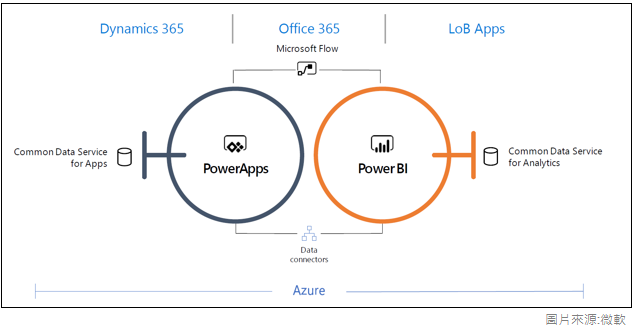
Chief executive Satya Nadella described the Power Platform business on Microsoft's earnings call in October 2019.
Nadella said Microsoft is building Power Platform as the extensibility framework for both Microsoft 365, including Teams, and Dynamics 365, bringing together low code and no code app development, robotic process automation and self-service analytics so that anyone in an organization can build an intelligent app or a workflow where none exists. He said Power Platform already had more than 2.5 million monthly active developers, that Power Apps lets domain experts, the people closest to the business problem, design, build and publish custom apps quickly, and that 84% of the Fortune 500 had already created Power applications.
Where we come out: Microsoft has the lead and a moat as enterprises move to the cloud
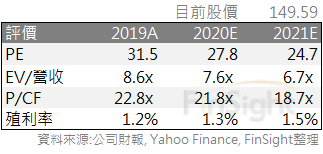
Microsoft missed the mobile wave, but it made the transition and caught the cloud trend. With 5G and hybrid cloud applications coming, its open ecosystem and strong software franchise give it a deeper moat than its competitors, and the market is already paying a premium multiple for that. We like Microsoft's competitive position, and we will keep tracking the company and the industry closely.