
Cloud infrastructure spending hit $37.1 billion in the fourth quarter of 2020, up 35% year over year, and the top five providers hold 80% of the market.
Public cloud is a large market moving in the right direction, and it has been one of our standing research themes. With the December 2020 earnings season now finished, we have pulled the numbers and the management commentary from the major cloud companies into our cloud tracker. The picture across the group is consistent: every operator is more positive on public cloud than it was a quarter ago, and cloud keeps getting more important to their customers.
Key takeaways
- Cloud infrastructure spending was about $37.1 billion in the fourth quarter of 2020, up $4 billion sequentially and 35% year over year, a record. Full year 2020 spending was about $129 billion, and the market doubled in nine quarters.
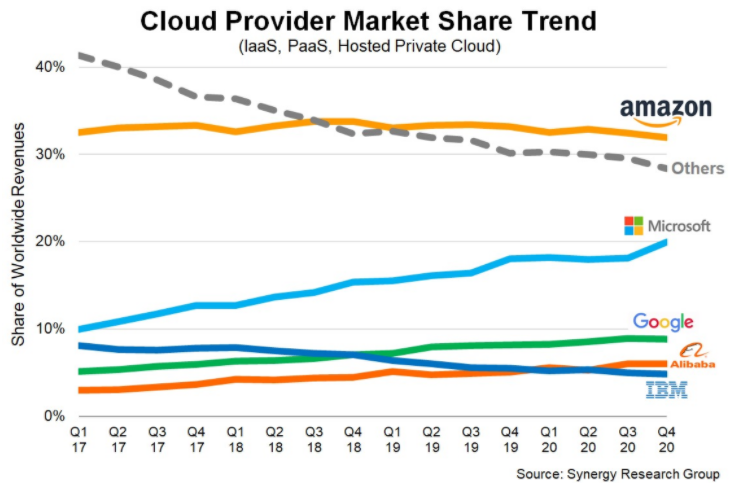
- This is an oligopoly and it is getting tighter. The top five providers hold 80% of the market. Amazon has held 32% to 34% for four years, Microsoft has gone from 10% to 20% over 16 quarters, and smaller providers have given up about 13 points of share over the same stretch.
- Capital spending guidance for 2021 moved higher. Microsoft expects sequential increases in dollar terms, Google says 2021 capital spending (capex) will rise significantly, Facebook is holding its guide of $21 billion to $23 billion (up 31.3% to 43.8%), and Amazon keeps data center investment healthy while its logistics spending stays uncertain.
- Barriers to entry are high and rising. Google Cloud still lost $1.2 billion in 2020 after years of investment, and all three of the large clouds have now extended server depreciation lives, which gives them more room to keep competing on price.
Cloud is a huge, fast growing market: Amazon leads, Microsoft is taking share fast
Start with how the industry researchers see the market. What follows is our summary of work from Synergy Research Group.
- Cloud infrastructure is a big market and still growing fast. Enterprise spending on cloud infrastructure services (infrastructure as a service (IaaS), platform as a service (PaaS) and hosted private cloud) was about $37.1 billion in the fourth quarter of 2020, $4 billion more than the prior quarter and 35% higher than a year earlier, a record. Full year 2020 spending was about $129 billion, with strong growth in every region of the world. Growth at that speed reflects data migrating to the cloud on both the consumer and the enterprise side, and from the second half of 2020 we heard a number of companies say on their earnings calls that enterprise cloud migration was visibly accelerating.
- Public cloud is the engine of that growth, and scale wins. Within cloud infrastructure services, public cloud IaaS and PaaS make up the bulk of the market. Public cloud carries heavy upfront costs and clear scale advantages, and the top five public cloud providers together hold 80% of it.
- Microsoft keeps taking share and is the biggest winner from enterprise cloud migration. In the fourth quarter of 2020 Amazon and Microsoft together held more than half of the global market. Microsoft went from 18% in the third quarter of 2020 to 20%, and over the past 16 quarters its share has climbed from 10% to 20%. Microsoft's cloud position runs from IaaS through PaaS to software as a service (SaaS), which makes it a single stop for enterprises and individuals alike. Our March 2021 post on Microsoft's December 2020 quarter argued that this is the model best placed to win as enterprises move to the cloud.
- Amazon holds a steady lead at about a third of the market. Its share has sat between 32% and 34% for the past four years and was 32% this quarter.
- The largest providers keep gaining. Microsoft, Google and Alibaba have all added share steadily, and most of the losses have come from smaller cloud providers, which have given up about 13 points of share over the past 16 quarters. Even so, a market growing more than 30% a year still leaves room for small providers to grow.
- Enterprise spending keeps rising to meet healthy cloud demand. Fourth quarter 2020 enterprise spending grew 35% year over year, the second straight quarter in which growth accelerated. A market this large doubled in size in only nine quarters.
Healthy cloud demand pushed 2021 capital spending guidance higher
Guidance from the large cloud companies (the hyperscalers) was mostly positive. Here is where each of them stands on capital spending.
- Microsoft (revised slightly higher): Azure growth came back up to 50%, and gross margin stayed high, helped by the accounting change that began the prior quarter. The company will keep investing to meet growing global demand for cloud services and expects capital spending to increase sequentially in dollar terms.
- Google (revised higher): Google Cloud grew 46% year over year, which is healthy. Capex fell in 2020 because the pace of office facility investment slowed, but servers were still the largest driver of investment in the fourth quarter, followed by data centers. Ground construction and office fit-outs should return to normal this year, so 2021 capex will increase significantly, with servers still the largest driver of technical infrastructure spending. From 2021 Google is changing the estimated useful lives of servers (from three years to four) and certain network equipment (from three years to five), which Google says adds about $2.1 billion to profit in 2021.
- Facebook (raised last quarter, unchanged this quarter): fourth quarter 2020 capex was $4.8 billion, mostly data centers, servers, office facilities and network infrastructure. For 2021, guidance stays where the company put it last quarter, at $21 billion to $23 billion, up 31.3% to 43.8% year over year, covering data centers, servers, network infrastructure and office facilities, including construction work delayed by the pandemic.
- Amazon (neutral): 2020 spending grew about 50%, most of it in the fulfillment network. The company is still building its 2021 plan, and because the pandemic driven conditions of 2020 will not repeat this year, the 2021 number carries risk and uncertainty. Cloud infrastructure remains the healthier growth piece of that investment: Amazon keeps investing to support AWS, which posted revenue of $12.7 billion in the latest quarter, up 28% year over year.
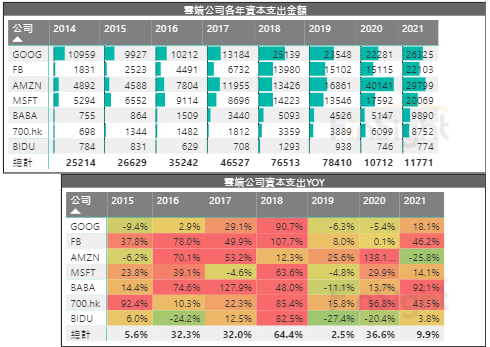
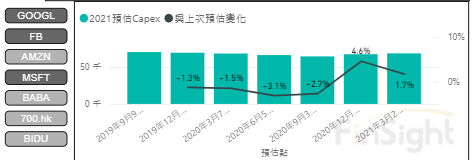
Net of all that, strong cloud demand is pulling capital spending guidance higher.
Microsoft and Google are raising spending, Facebook is holding at an already high level, and Amazon has uncertainty on the logistics side while its data center investment stays healthy.
Public cloud demand is strong: growth is reaccelerating and backlog is up sharply
Our March 2021 post on Microsoft's December 2020 quarter found the standout was the acceleration in cloud: Azure growth turned back up off a high base and margins kept climbing, which says the company's competitive position in cloud is very strong. Here we fill in what the other two heavyweight public cloud companies said about their cloud businesses.
Amazon AWS: steady growth, but operating margin slipped
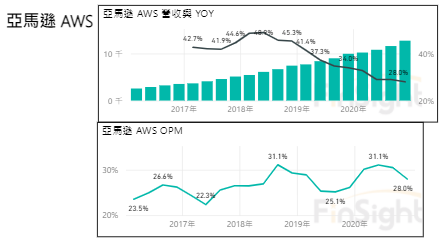
AWS is the largest public cloud provider and still grew revenue 28% year over year, which says the product is genuinely competitive. Three things stood out this quarter.
- Backlog jumped. The balance was about $50 billion at year end, up 68% year over year. The company says AWS is winning acceptance in the market, with strong utilization and revenue growth, and annual revenue reached $51 billion. To keep up with that growth it is improving its infrastructure planning to meet capacity needs.
- Operating margin fell from the prior quarter. In January 2020 Amazon extended the depreciable life of its data center assets from three years to four, which lifted operating margin from around 25% to 30%. This quarter operating margin was down sequentially. Management says the result reflects the balance between investing, lowering prices, driving cost efficiency and protecting margin, and that the effect of the accounting change will be smaller this year. Our take: price cuts in public cloud are a moving target. After the accounting change, AWS clearly has more room to cut price and defend its share. But Azure made the same depreciation change in August 2020 and Google made it in January 2021, so now that the others have caught up, price competition keeps running. The result is that late entrants find it even harder to get in, and even the incumbents will struggle to hold margin steady.
- Cloud capital spending keeps rising. A great deal of last year's capital went into the fulfillment network, so the total capex number carries uncertainty. But AWS utilization and revenue are both growing quickly, and infrastructure will remain the healthier part of Amazon's capital spending.
Google Cloud: healthy growth, and it keeps investing while profitability improves
Google was very positive on cloud this quarter, and an accounting change lifted reported profitability sharply.
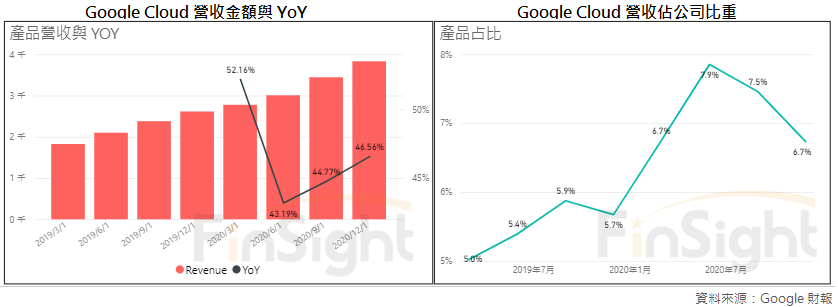
- Healthy growth and a much larger backlog: Google Cloud grew 47% year over year, and backlog rose from $19 billion in the third quarter to nearly $30 billion. Over the past two years cloud revenue has more than doubled, from $5.8 billion in 2018 to $13.1 billion in 2020, and undelivered orders nearly tripled from 2019 to 2020.
- Continued investment in the cloud business: looking forward, Google will keep investing in cloud to scale the business and improve profitability. It is not only capital spending: Google has tripled its Cloud Direct sales force and expanded its partner sales channels.
- Depreciation lives extended: on this earnings call Google said that starting in 2021 it will change the estimated useful lives of servers and certain network equipment. Even after all these years of investment, Google Cloud still lost $1.2 billion for the year, which tells you how high the barriers to entry in public cloud are. With the depreciation change, that loss should narrow, giving Google more room to compete with its rivals.
Bottom line: cloud is a large, fast growing market with real barriers to entry
Whether you look at the industry research or at what the operators themselves say, enterprise cloud migration keeps speeding up. Providers are accelerating investment to capture the order flow, and we expect data center investment by the hyperscalers to pick up clearly in 2021.
A market this healthy pulls its supply chain along with it. Supply shortages may hold back growth in the first half of 2021, but on a full year view the pickup in second half demand should be very clear. In that setting, beyond compute, networking and memory chips, watch the ODMs (original design manufacturers) that actually build this gear. Add the move of software defined architecture out of the data center and into telecom equipment and electric vehicles, and there is more business coming for Taiwan's ICT (information and communication technology) industry. More on that separately.