
NVIDIA data center revenue grew 80% to a record in the first quarter of 2020 and reached 37% of sales, and the A100 is only starting to ship.
At the end of March 2020 we ran two posts: one on what NVIDIA said as its GTC event got under way, where work from home was lifting data center demand, and one on Microsoft Teams usage in locked down Italy growing 775% in a single week as the pandemic pushed enterprises to the cloud. Both pointed at the same thing, two companies whose businesses stand to gain from Covid-19 rather than suffer from it.
NVIDIA runs on its own fiscal calendar: the quarter reported here is its fiscal first quarter of 2021, which ended April 26, 2020. We call it the first quarter of 2020 throughout.
Key takeaways
- Data center revenue hit an all time high in the first quarter of 2020, up 80% year over year, and its share of company revenue jumped to 37%, close behind gaming at 43%.
- The A100 shipped inside the quarter and already contributed meaningfully, even though NVIDIA only launched it on May 14, 2020. Management says second quarter visibility in data center is very high, with record purchases from both public cloud and enterprise customers.
- The customer mix has changed: vertical industries now account for 50% of data center revenue, and the T4 inference chip holds a steady double-digit share and is growing fast. Public cloud is no longer the only engine.
- We like the long term trend here, with one caution: analysts have revised earnings per share (EPS) estimates higher, but their estimates already put the stock at 45 times forward earnings.
After both companies reported, their outlooks stayed strong, and analysts revised EPS estimates higher for each.
We still worry about semiconductor inventory in the second half of 2020. Even so, our view on NVIDIA is more positive than it was, for two reasons: the 7nm data center product NVIDIA showed at its GTC keynote on May 14, 2020, which the pandemic had moved online, performs very well, and the first quarter 2020 results it reported on May 21, 2020 beat expectations.
This post works through both events, and the segment numbers below come straight from the quarter NVIDIA reported.
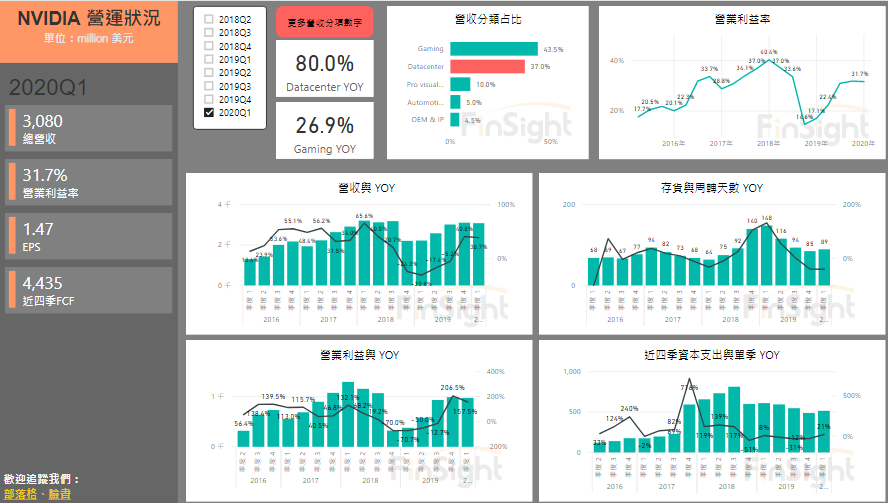
First quarter 2020 results: data center grew 80% to an all time high
NVIDIA total revenue grew 38% in the first quarter of 2020, helped mostly by an easy comparison against a weak first half of 2019.
Gaming, still the largest share of revenue, hit its seasonal soft patch: revenue came in below the prior quarter and grew only 27% year over year. The first half of 2020 gets a lift from the pandemic. GeForce gaming laptops started shipping in the first quarter and unit shipments should peak in the second quarter, so the usual seasonal lull will not feel like one. There is no clear guidance for the second half yet.
At GTC the company said plainly that the new Ampere architecture will be used across its consumer product line, so the market expects Ampere based consumer GPUs in the second half, most likely announced in the third quarter of 2020. With the 7nm A100 showing a large step up in performance, expectations for that refresh are high.
The standout in this quarter, though, was data center.
Data center revenue hit an all time high, and 80% year over year growth is very strong. Its share of company revenue jumped to 37%, not far behind gaming, the largest segment, at 43%.
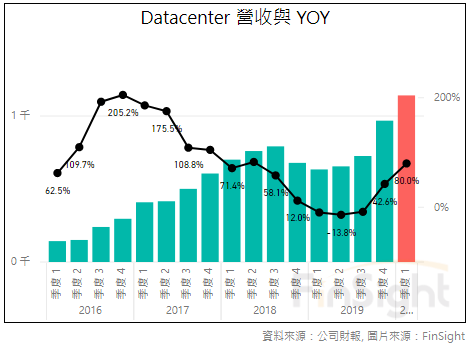
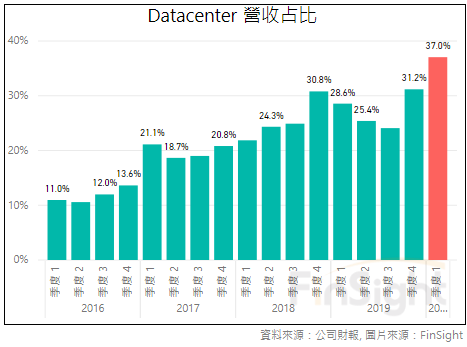
Management is still bullish on data center. The A100 was only launched on May 14, 2020, but it shipped during the first quarter and already made a meaningful contribution. The company said second quarter visibility in data center is very high, that public cloud and enterprise customers both bought at record levels, and that AI training and inference revenue grew together.
The company gave no second half outlook, but on the earnings call management said it is happy with the A100 order book for the second half.
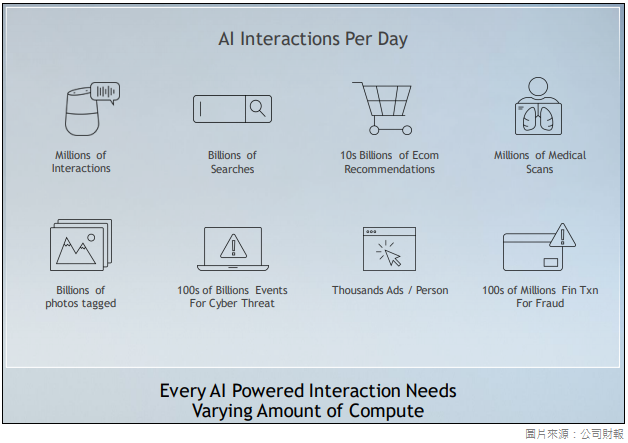
The data center market is not the market it was, and AI going into production is driving GPU demand
On recent earnings calls NVIDIA has kept repeating that the AI market has changed in kind. We covered that in our March 2020 post on what NVIDIA said at GTC. Looking at NVIDIA's data center today, several things are different from the past:
- Better algorithms have made natural language and recommendation systems the fast movers in AI: the very large models used in conversational AI carry 10 to 20 times the parameters of image models, and up to 100 times in special cases. Models like that push GPU demand up sharply.
- AI is going into production, and inference is growing fast: the T4 inference chip holds a steady double-digit share of the data center business and is growing quickly.
- The customer base is broadening fast: public cloud and vertical industries are both expanding, public cloud is no longer the only source of momentum, and vertical industries now make up 50% of NVIDIA data center revenue.
- Edge data centers will start to look like the cloud: from large scale cloud out to the edge clouds that telecom operators and enterprises deploy, NVIDIA expects software defined data centers to become the standard for 5G.
The company argues the setting is very different from 2017, when the V100 launched. Back then AI acceleration was a new line of business. Today AI is built into all kinds of internet applications.
The pandemic is also forcing a structural rearrangement of industries and markets.
On the earnings call NVIDIA CEO Jensen Huang said enterprises now have to decide where to double down on investment, that the pace of enterprise migration to the cloud is accelerating, and that they need to own a hybrid cloud computing infrastructure.
He put the addressable market for information technology (IT) transformation at about $1 trillion against a cloud market of only about $100 billion today, growing 40% a year, and said that migration will create a large opportunity for NVIDIA's data center business and for the new A100.
The first big data center refresh in three years: the Ampere based A100
Look back at how NVIDIA built its AI franchise. It starts in 2016, with the Pascal based P100 aimed at the data center and with the company breaking out data center revenue for the first time. The market worked out that running AI training on GPUs is very efficient.
At CES in 2017, Jensen Huang's opening keynote pushed AI to the top of the agenda. On May 10 that year, at GTC, NVIDIA launched the Volta based V100 for the data center. Its performance and its high speed compute aimed squarely at AI training made it the part everyone in AI wanted, and the stock gapped up 17% that day.
As the public clouds put more money into cloud buildout and demand for AI compute rose, their data center capital spending (capex) climbed quarter after quarter, peaking at 62% year over year growth in 2018 before an inventory correction the following year.
A review of the architectures NVIDIA has launched in recent years and the data center products that came with them:
- Pascal: an architecture used across the full product line, with both data center and consumer graphics parts. The P100 launched in April 2016 for high end data center compute, built on TSMC's 16nm process with CoWoS packaging, 15.3 billion transistors.
- Volta: a data center line focused on supercomputing and high end AI. The V100 launched in May 2017 for very high end data center compute, built on TSMC's 12nm process with CoWoS packaging, 21.1 billion transistors. It was called a monster part, and the market expected it to sweep the AI training opportunity and open a gap over the competition. The V100 is still the most important product line in NVIDIA's data center business today.
- Turing: focused on mainstream graphics and AI inference, a separate line from Volta with no overlap. The T4, aimed at AI inference, launched in September 2018. By the second half of 2019 inference revenue had grown sharply, T4 unit shipments passed the V100 for the first time, and inference reached a double-digit share of data center revenue.
- Ampere: at GTC the company confirmed this architecture will be used across the entire GPU product line, consumer parts included. The A100 launched in May 2020 for high end data center compute and is the first big refresh since the V100. It is built on TSMC's 7nm process with CoWoS packaging, 54.2 billion transistors, and uses SmartNICs, network cards that do part of the processing themselves, from Mellanox, the company NVIDIA acquired. A single DGX, NVIDIA's own rack ready AI server, holds 8 A100s and 9 Mellanox SmartNICs to speed up data movement, plus 2 AMD CPUs.
NVIDIA's own comparison of the A100 against the V100 shows a large step up in performance.
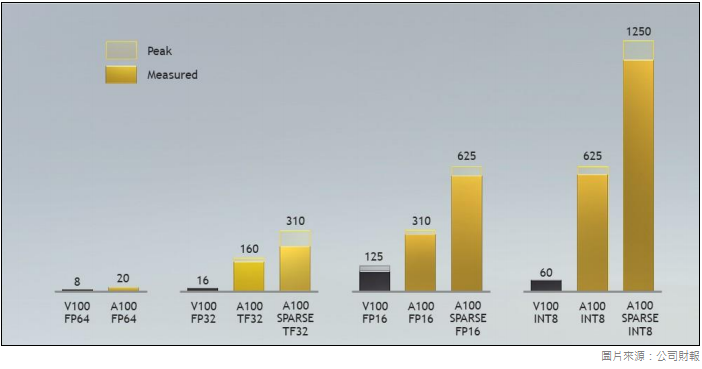
- Performance: large gains at every precision. At INT8, the 8 bit integer format used for inference, performance is up at least 10 times. Turn on sparsity acceleration, which lets the chip skip the zeros in a model's weights, and INT8 training and inference performance is up 20 times.
- MIG, or multi instance GPU: one large A100 can be partitioned and used in pieces, which lifts utilization.
- Training and inference in one part: on BERT, the natural language model, training runs 6 times faster and inference 7 times faster than on the V100.
A first new part in three years delivering a big performance gain is no surprise on its own. What matters is that the A100 pulls training and inference into a single acceleration platform, and that it is backward compatible and scales out. No wonder Jensen Huang kept repeating at the launch that the more you buy, the more you save.
The A100 will be genuinely attractive to cloud vendors deploying AI servers.
Bottom line: NVIDIA's data center growth has a good chance of continuing
A few reasons we think NVIDIA's growth can keep running:
- The setting is different from before. Deploying AI is now the consensus across industries, and it is showing up in reported results.
- The A100 is the first refresh of the top end data center part since the V100 in 2017, three years ago, and it has a chance to repeat the growth pattern that followed.
- Beyond the performance gain, the A100 can run AI training and inference at once and can be split among different users, which sharply improves operating efficiency for cloud vendors.
- With Mellanox consolidated from next quarter, NVIDIA's data center business should pass half of total revenue, turning this into a company whose revenue is mostly AI. NVIDIA says Mellanox products sit in 60% of the world's supercomputers and 100% of AI computers.
We do worry about the cuts to data center capex and the inventory correction starting in the second half of 2020, especially the fourth quarter. But the large cloud companies have also said the capex cuts are mostly in building construction. Pandemic driven internet usage is up, so investment in servers should hold at a decent level.
Weighing it all up, with GPUs continuing to benefit from demand for AI compute, we like NVIDIA's long term uptrend at this stage. One caution: analysts have revised EPS higher, but their estimates now put the stock at 45 times forward earnings, which is on the high side. Size the position accordingly.