
Microsoft's December 2020 quarter: revenue up 17% to $43.1 billion, the fastest in eight quarters, with Azure growth back up from 47% to 50%.
The fourth quarter 2020 earnings season in the US was a striking one. Results came in well above expectations, guidance was positive, and analysts raised earnings estimates broadly. For the S&P 500, our compilation of analyst consensus at the end of 2020 had fourth quarter earnings falling 9.4%. Earnings grew 3.9% instead, and even off that higher 2020 base, 2021 earnings are forecast to grow another 23.9%. US companies have shown real resilience.
Key takeaways
- Microsoft's December 2020 quarter: revenue of $43.1 billion, up 17% year over year and the fastest growth in eight quarters; net income of $15.5 billion, up 33%; EPS of $2.03, up 34%; and gross margin at a record 74%.
- Commercial cloud was 39% of company revenue, growth reaccelerated to 33.6% off an already high base, and gross margin held at 71%. Azure went from 47% growth back up to 50%, the fastest of the major public clouds (AWS 28%, Google Cloud 47%, Alibaba Cloud 50%).
- Part of the profit improvement is accounting: starting the prior quarter, Microsoft extended the depreciable life of Azure servers from three years to four. Google made a similar change this quarter, and AWS, which moved first in early 2020, posted its first operating margin decline since its own change.
- Using Gartner's public cloud revenue published in mid-2020, and assuming AWS grows near 30% while Azure grows 50%, Azure can pass AWS as the largest public cloud as early as 2025.
By sector, energy, consumer discretionary, financials, communication services and information technology produced the five biggest earnings surprises. Technology, the group we follow most closely, still beat estimates by 16% even against elevated expectations.
Among the large technology companies, the quarters that impressed us most were Apple, Microsoft and Google. Today we cover Microsoft and will write up the others later.
A big beat against high expectations, and Microsoft keeps digging its B2B SaaS moat
Microsoft has long been the name we rate highest in business to business (B2B) software as a service (SaaS), meaning business software sold to enterprises on subscription. Our December 2019 post on Microsoft's turn to the cloud and its claim to be the strongest name in SaaS argued that the second inning of the cloud would be decided by enterprise migration: Microsoft had the most complete strategy, and it built an unusual moat by staying open and working with more partners.
In April 2020, with the pandemic hitting, we saw Microsoft using that lead to take enterprise migration business quickly. Our April 2020 post on the pandemic accelerating the move to the cloud went through the Microsoft Power Platform strategy: not just building out public cloud, but giving a customer the whole cloud stack in one place.
Given how well Microsoft grew in 2020 and how high expectations had become, we did not expect much from its growth this year. Then Microsoft beat on every line that mattered.

Revenue was $43.1 billion, up 17% year over year, the fastest growth in eight quarters. Net income was $15.5 billion, up 33%. EPS was $2.03, up 34%. Gross margin set another record at 74%.
After the release, analysts revised earnings and price targets higher across the board, to EPS of $7.58 this year and $8.61 next year, growth of 13.0% and 13.5%. That puts the shares at about 27 times forward earnings, meaning price divided by the next four quarters of estimated earnings.
The headline of the quarter: cloud growth accelerated
Microsoft's growth comes down to commercial cloud, the business built from Azure, Office 365, Dynamics 365 and the rest. Commercial cloud was 39% of company revenue this quarter, growth reaccelerated to 33.6% off a high base, and gross margin stayed high at 71%.


Much of the profit improvement came from an accounting change: starting the prior quarter, Microsoft moved the depreciable life of Azure server assets from three years to four. Even so, the result shows the first mover advantage that heavy capital investment in public cloud eventually buys.
Microsoft is not the only one making that change. Google adjusted depreciable lives this quarter too, extending servers from three years to four and some networking equipment from three years to five, which is a large part of why its quarter came in well ahead of expectations. AWS, which adjusted its public cloud depreciable lives first in early 2020, posted its first quarterly decline in operating margin since that change; the company said the result reflects the balance among investment, price cuts, cost efficiency and margin. Price competition in public cloud is dynamic, and holding profitability on a steady upward path the way Microsoft has is genuinely hard.

By line, Azure growth went from 47% back up to 50%, ahead of expectations. Azure is now the fastest growing of the major public clouds (AWS 28%, Google Cloud 47%, Alibaba Cloud 50%), and it is growing faster than AWS did at the same revenue scale.
That pace rests on Microsoft's strategy and how its ecosystem works. Azure brings together Power Platform, the GitHub developer layer, Teams, Power Apps and Azure database services, so you have to judge Microsoft Cloud on the whole bundle rather than on Azure alone. Power Platform in particular, the subject of our April 2020 post on the pandemic accelerating the move to the cloud, passed 11 million monthly active users this quarter, up 95% year over year, and every service it connects makes Azure harder to leave.
Microsoft's partnerships point the same way. Alongside the earlier GitHub acquisition and the SAP partnership, its January 2021 announcement of a $2 billion investment in the self-driving company Cruise also specified that Cruise will use the Azure cloud computing platform to improve fleet profitability. Cloud is one of the main reasons Microsoft strikes these deals in the first place.
Taking the whole setup together, we are comfortable saying Azure becomes the largest public cloud, on the assumption that AWS keeps growing near 30% while Azure holds near 50%. Using the public cloud revenue Gartner published in mid-2020, on those growth rates the two cross as early as 2025.
Pandemic or no pandemic, the enterprise migration to the cloud does not go backward
Microsoft reports in three segments, and the cloud one, Intelligent Cloud, grew revenue 20% year over year, far ahead of the other two. That segment holds Azure, Windows Server, GitHub and other server products and enterprise services, all of it aimed at corporate IT upgrades.
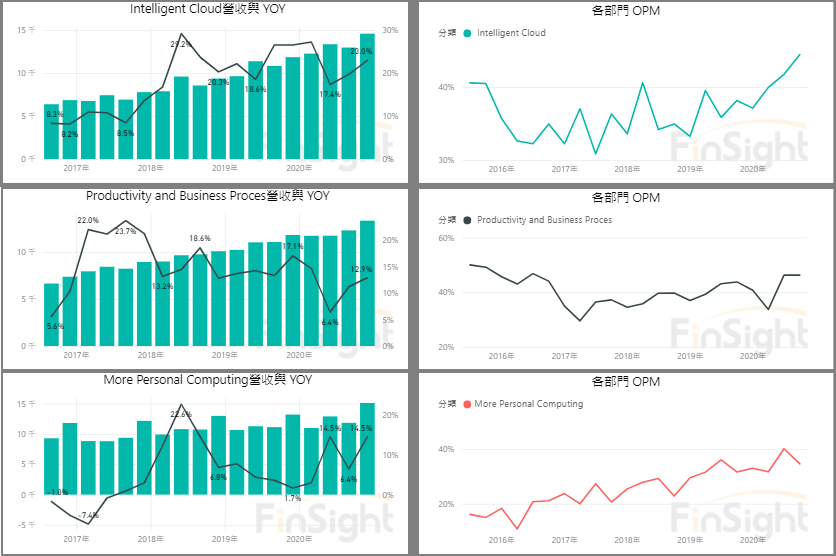
On the earnings call, management said the pandemic imposed constraints on customers, which raised the value they place on flexibility and pushed digital transformation up the priority list. They called that a structural change, and said Microsoft, as a full platform technology company spanning business applications, industry solutions and infrastructure, will benefit from a trend that size.
Gartner's latest forecast has global end-user spending on public cloud growing 18.4% in 2021 to $304.9 billion, above the $257.5 billion spent in 2020 and a sharp pickup from 6.1% growth in 2020 on the same measure. Gartner also expects cloud services to make up 14.2% of the total IT spending market by 2024, up from 9.1% in 2020.
What looks settled is that the pace of enterprise migration to the cloud does not turn just because the pandemic gets under control. As cloud usage rises, adopting cloud becomes the new normal.
We think Microsoft keeps widening its lead across the whole cloud stack, and within a few years it has a real chance to be the largest public cloud platform. With the enterprise migration to the cloud a settled trend, Microsoft's earnings power stands out, and it keeps benefiting as the cloud computing era plays out.