
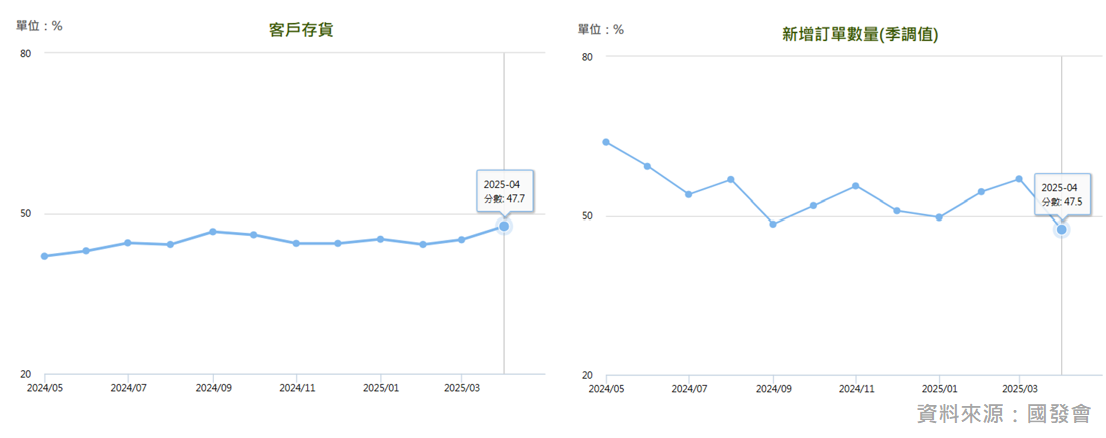
Taiwan's April PMI put new orders at 47.5 against customers' inventories at 47.7, the final sell signal of this electronics inventory cycle.
After our electronics inventory sell-signal framework fired its preliminary signal in early October 2024, we wrote a series of posts looking back at how far the index fell after past sell signals and at what makes this cycle structurally different because of AI. In early May 2025 the final sell signal in the same framework arrived, pushed along by the Trump tariffs. This post looks at what the index did after past final sell signals, and at what is different this time.
Key takeaways
- Taiwan's April 2025 purchasing managers' index (PMI), released May 2, put new orders at 47.5 and customers' inventories at 47.7, both under the 50 line that separates a shrinking reading from a growing one. New orders minus customers' inventories went negative for the first time in this cycle: the final sell signal.
- It came seven months after the preliminary signal of October 4, 2024, inside the 2 to 8 month gap history says to expect.
- History says the swing low lands 1 to 5 months after the final signal, so roughly between June and October 2025.
- Three things are different this cycle: inventory days have not yet turned up year over year, the TAIEX (Taiwan's main market index) was already about 7.8% below where the preliminary signal fired, and AI versus non-AI has split hard. The setup looks like 2018, not 2015 or 2022.
For background, the three earlier parts of this series:
- The Complete Guide to the Electronics Inventory Cycle, Part 1: Taiwan's Preliminary Inventory Sell Signal Has Fired (November 2024)
- The Complete Guide to the Electronics Inventory Cycle, Part 2: Exponential AI Growth Has Rewritten the Industry Structure Behind the Cycle (November 2024)
- The Complete Guide to the Electronics Inventory Cycle, Part 3: Trends Outlive Cycles, and Ten Years of TSMC Proves It (December 2024)
The final sell signal has appeared, and history says the low is still ahead
Start with what we wrote in our earlier post on this cycle's preliminary sell signal, published in November 2024.
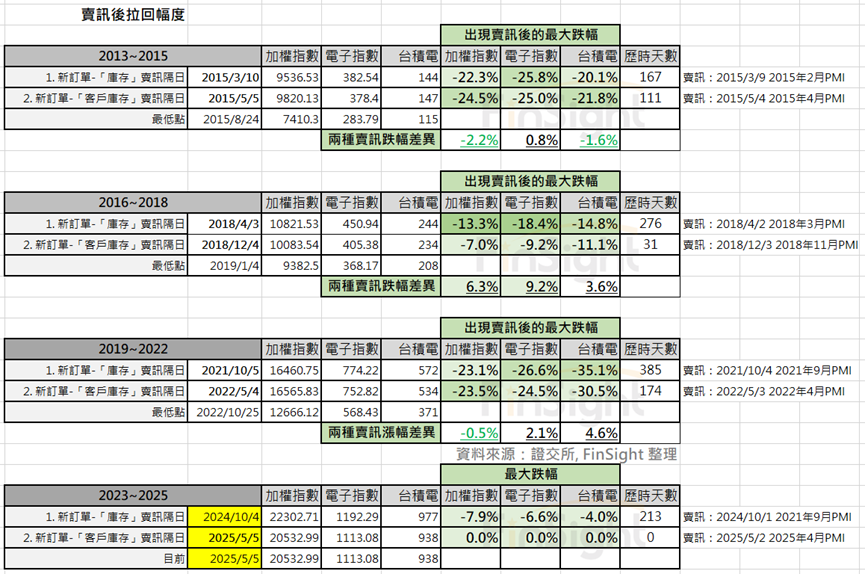
- The September PMI released in October 2024 put new orders minus inventories below zero: the preliminary sell signal of this cycle.
- The bull run into that signal was the second largest swing on record, behind only the 2019 to 2022 leg, which topped in 2021.
- Going by past cycles, from the preliminary signal to the eventual low the TAIEX fell 13% to 24% and the TWSE electronics sector index (the electronics index), which makes up the bulk of Taiwan's market cap, fell 18% to 26%, over 167 to 276 days, which put the low somewhere between late March and the end of July 2025.
That post went through both signals in detail: the preliminary signal, PMI new orders minus the surveyed manufacturers' own inventories, and the final signal, PMI new orders minus the inventories their customers are holding. What we found:
- The preliminary sell signal (new orders minus inventories) fires early. The low comes 5 to 12 months later, but it sidesteps the bigger drawdown: on the electronics index, 18% to 27%.
- The final sell signal (new orders minus customers' inventories) fires 2 to 8 months after the preliminary one. About half the time you sell at roughly the same level as the preliminary signal, and the other half you sell lower. By the time it fires the index is already in, or about to enter, a fast decline, and the low comes 1 to 5 months later. It sidesteps 9% to 25% on the electronics index.
- Both signals still lead the low. If we have to label them: inventories is the left-side signal, the early signal, which fires before the turn is confirmed and lets you scale out gradually while you check on the industry; customers' inventories is the right-side signal, the confirming signal, which fires only after the turn is confirmed. It is the final signal, the one that says the index is entering its last leg down.
Seven months after the preliminary signal, the final signal finally arrived.
Taiwan's April 2025 PMI, released on May 2, 2025, showed new orders falling to 47.5 and customers' inventories rising to 47.7. Both are diffusion readings around 50, so the PMI spread we defined in Part 1, new orders minus customers' inventories, measures a difference and not a level. That spread turned negative for the first time in this cycle: the first customers' inventories signal since the preliminary signal fired on October 4, 2024.
The steep drop in April new orders came from the Trump tariff fight, but customers' inventories also ticked up, and the year-over-year decline in overall inventory days has already narrowed. Put together, the odds that we are in the tail end of the cycle rise sharply. The seven-month gap between the two signals sits inside the 2 to 8 months history says to expect.
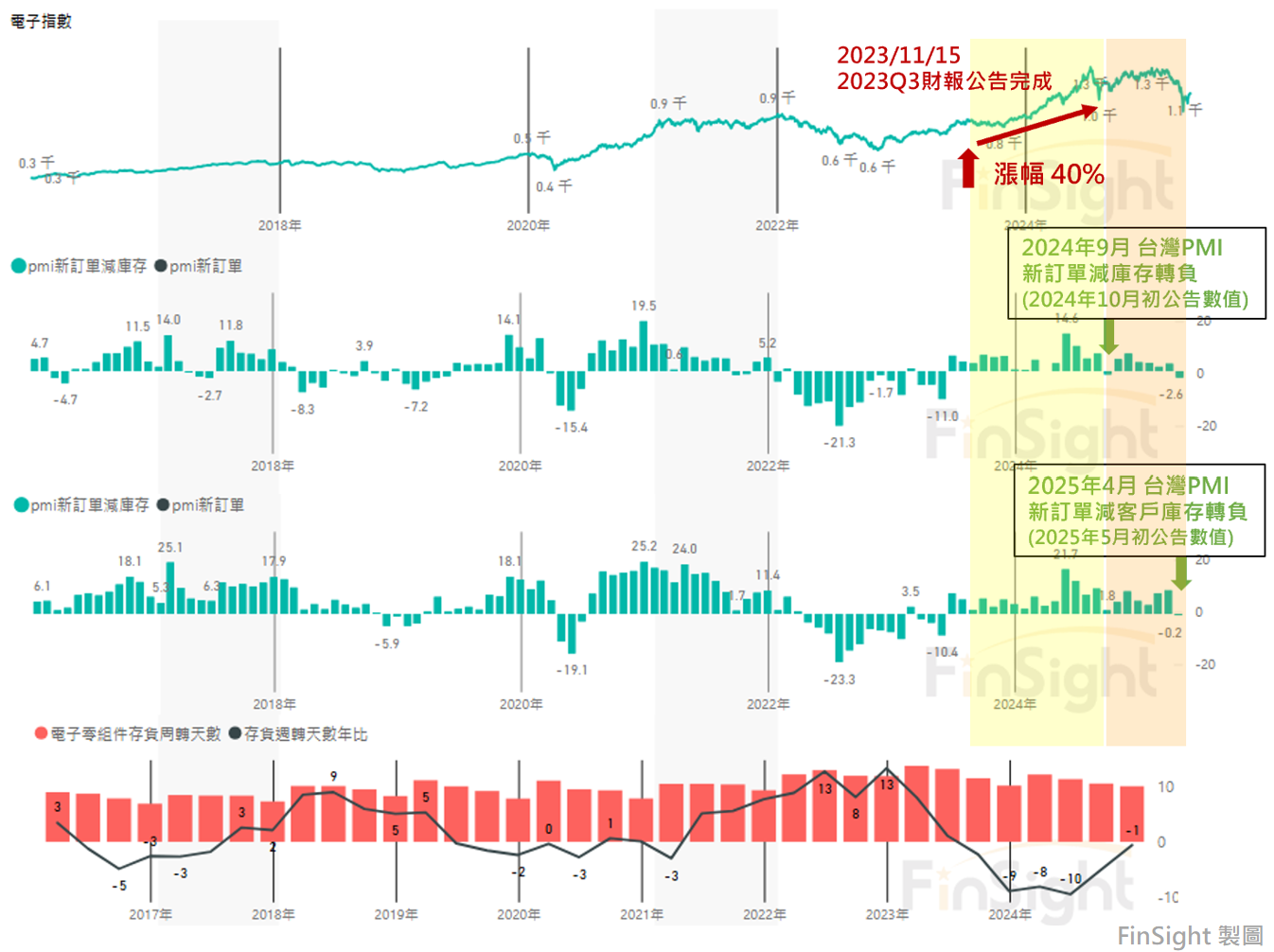
Measured from this cycle's buy signal, which fired in November 2023: sell on the preliminary signal and the Taiwan electronics index was up 40.4% over the swing, sell on the final signal and it was up 31.1%. Either way, running the sell discipline off the signals keeps most of the swing profit. The difference is that the preliminary signal sells the left side and the final signal sells the right side. Our own view has not changed: once the preliminary signal fires, the odds of another large move up drop and the index most likely goes into a choppy range. If you were levered at that point, cut it hard and take some profit.
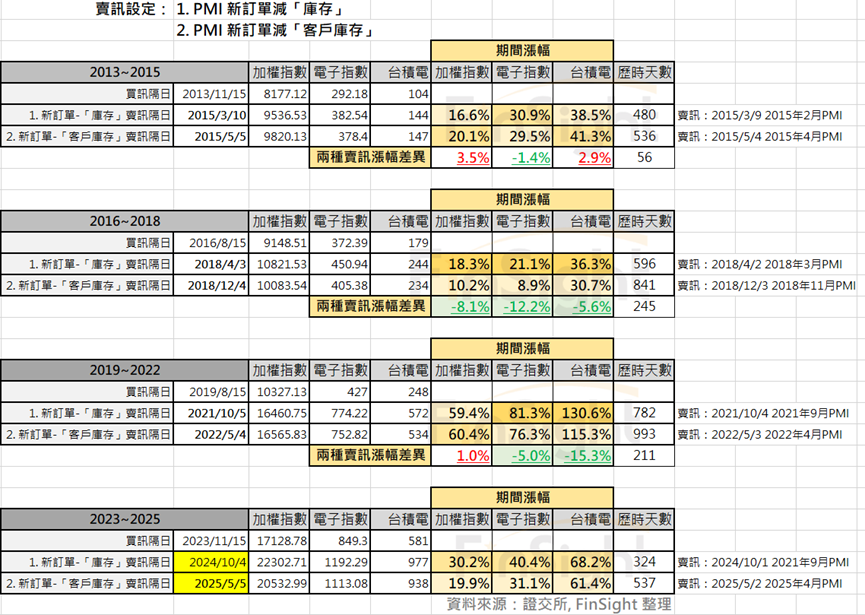
As for what comes after the signal, this swing is not finished, so we cannot yet confirm that the low will land after the final signal. The electronics index bottomed in April, 22.1% below where the preliminary signal fired, which is in line with the drawdown past bear cycles have delivered.
But going by history, once the final signal fires the index is either about to fall or already falling, and the signal still gets you out ahead of the swing low.
What makes this cycle different
Three things stand out.
One: inventory days have not yet turned up year over year
In past electronics inventory cycles, by the time the final sell signal (PMI new orders minus customers' inventories) fired, inventory days had usually already turned up year over year, meaning companies were visibly building inventory.
This cycle looks different. When the final signal fired in May 2025, the most recent financials we can see, 4Q24, still showed inventory days below their year-earlier level, just by much less than before.
That tells us the industry structure has changed, particularly with AI and non-AI pulling apart: the aggregate inventory numbers are being offset by continued strong demand in the AI segment. It lines up with what we argued in our November 2024 post on how AI's exponential growth changed the industry structure behind the inventory cycle. The AI winners now contribute more than half the profit of the entire electronics industry, so the traditional inventory cycle indicators are being distorted by a structural change.
Taiwan-listed companies should have their latest financials filed by the middle of May 2025, and we will come back with an analysis once those are in.
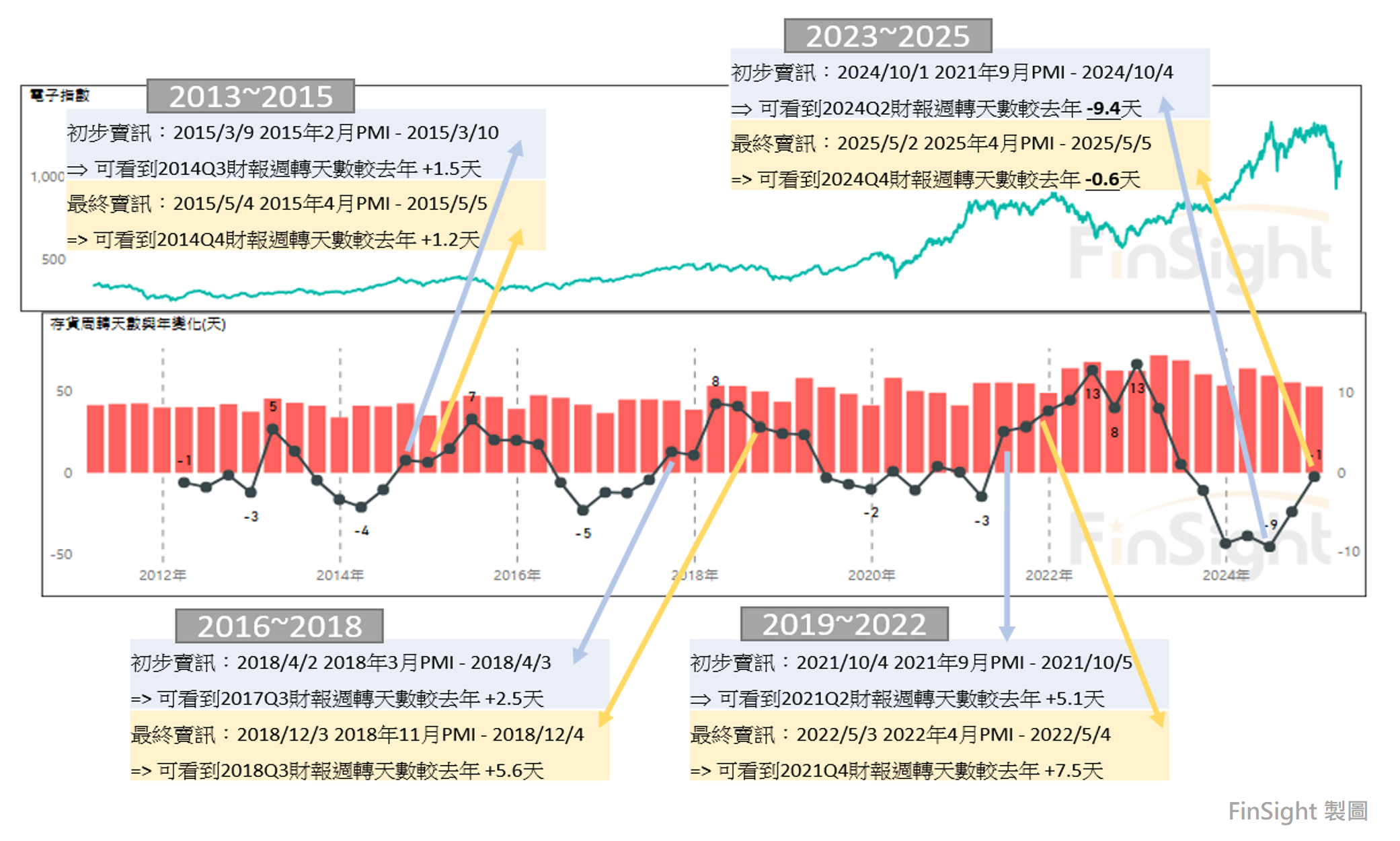
Two: the index had already corrected before the final signal fired, the way it did in 2018
In this cycle, by the time the final signal fired the electronics index had already pulled back from where the preliminary signal fired. That pattern looks more like 2018 than like 2015 or 2022.
In the 2018 cycle the preliminary signal fired in April, the market then went through a high-volatility range, and by the time the final signal fired in December the index had already come off its high. This cycle rhymes: the preliminary signal fired in October 2024, the index then rallied, started correcting visibly from February 2025, bottomed in April, and then recovered enough that when the final signal fired in May 2025 the broader TAIEX sat about 7.8% below where the preliminary signal fired.
If 2018 is the guide, the drawdown after the final signal is much smaller than in other phases of the cycle, and the bottom shows up faster (this time it looks like it could be the second low of a double bottom). After the second signal in 2018 the electronics index fell 9.2% and made its low a month later.
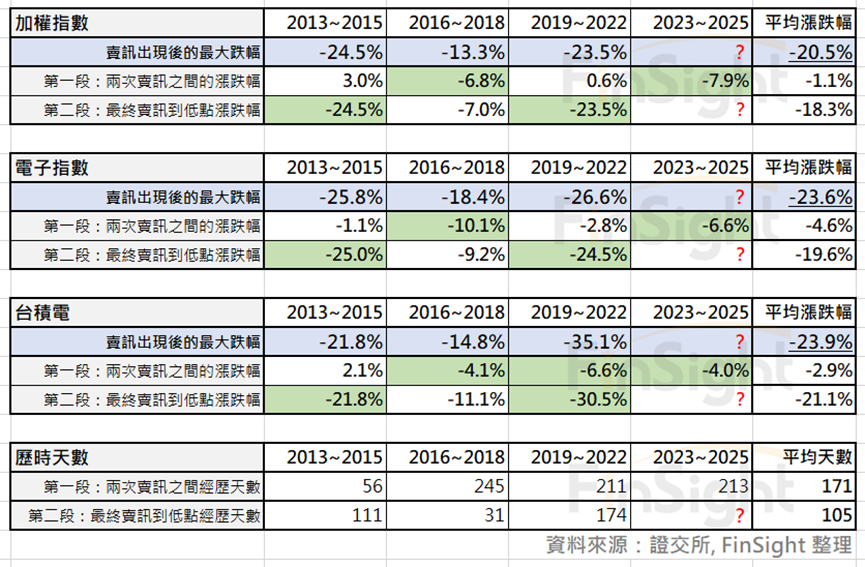
Three: AI and non-AI are still miles apart
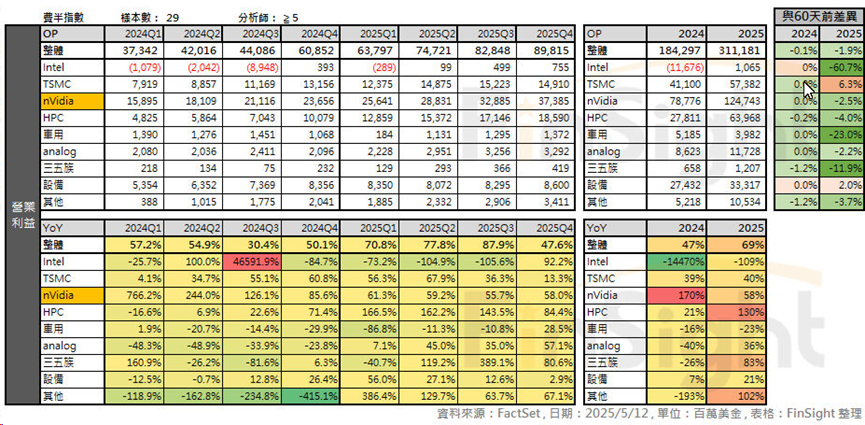
The most striking feature of this inventory cycle is how far apart AI and non-AI have moved. Take the latest earnings estimates for the components of the Philadelphia Semiconductor Index (SOX). Over the 60 days since earnings, TSMC's operating profit estimates were still revised higher, while every other name saw clear cuts to its earnings power. (NVIDIA has not reported yet.)
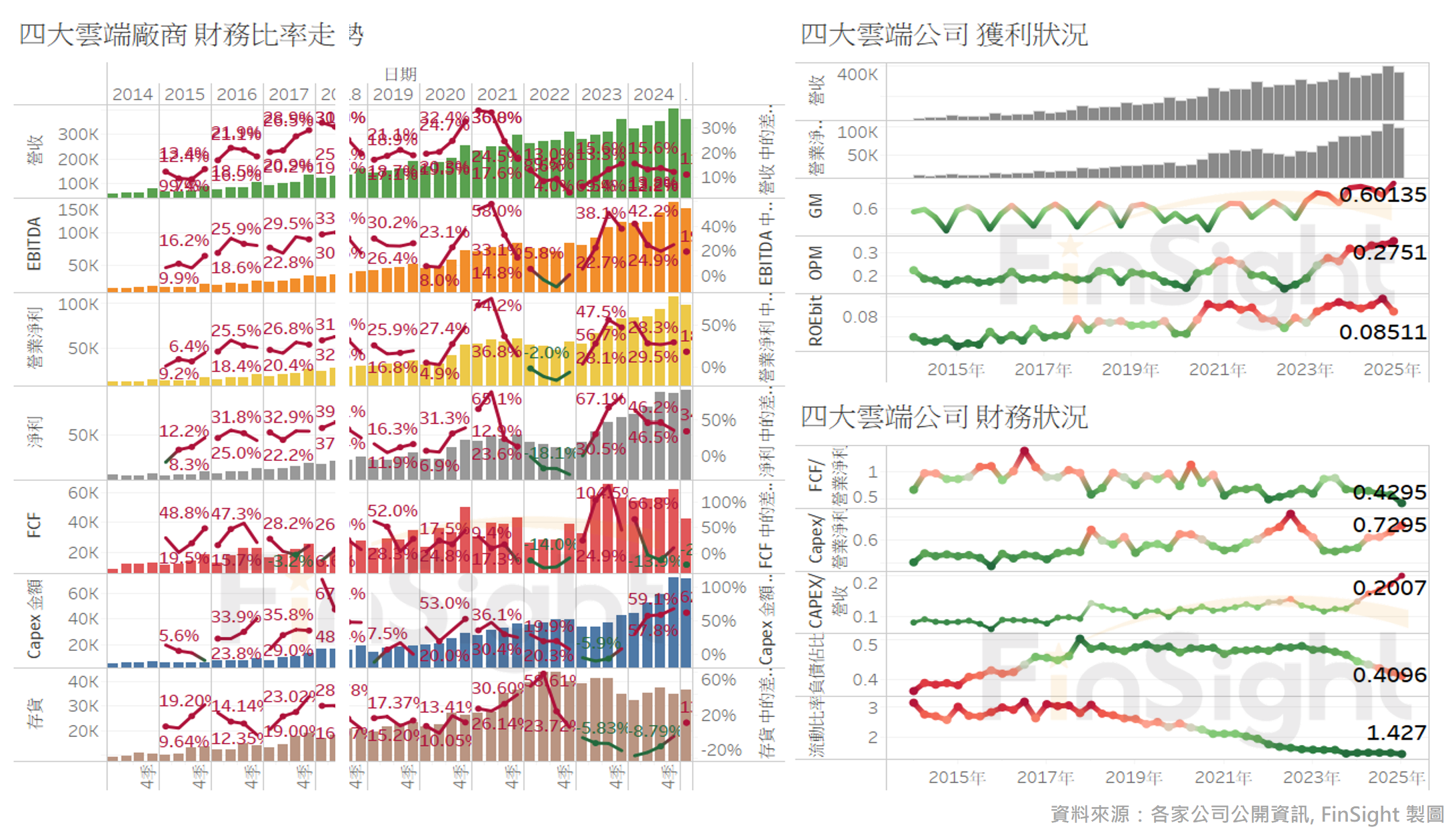
On top of that, our post on 1Q25 earnings at the four large cloud companies, Microsoft, Alphabet, Amazon and Meta, showed not only that compute is capacity-constrained but that earnings power has clearly recovered, with AI driving growth in both their core businesses and cloud. Faced with AI applications growing this fast, the hyperscalers will find it very hard to stop spending. That fits our earlier work showing that once a cloud capital spending (capex) cycle starts it tends to run for three years, in this case out to 2026.
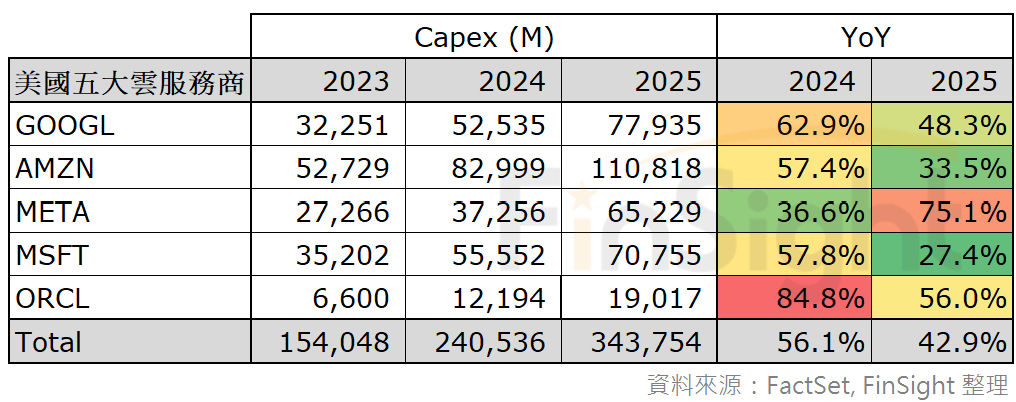
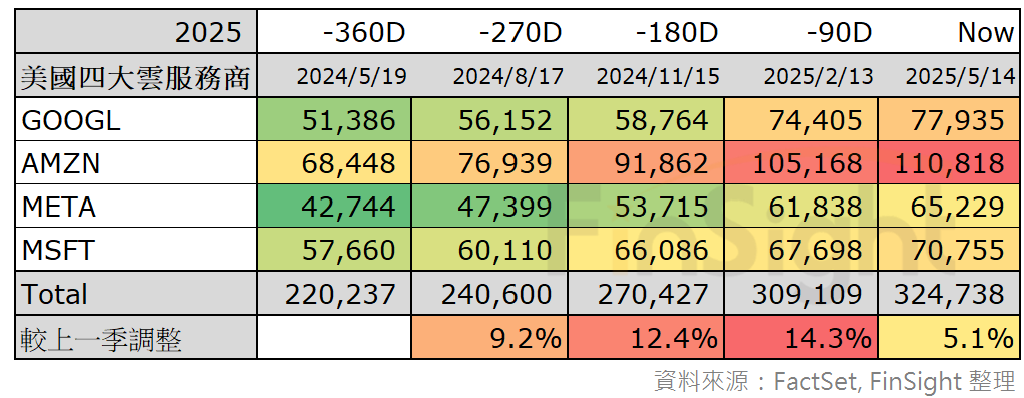
This split makes the traditional electronics inventory cycle indicators harder to read, and no single indicator now captures the state of the industry. For investors it probably calls for a two-track approach: hold the core AI supply chain with a trend mindset for the long run, and trade the non-AI side around the inventory cycle signals.
Bottom line: how to think about positioning after the final sell signal
The final sell signal marks the point where this electronics inventory cycle enters its tail end. Going by history, a swing low should land 1 to 5 months after the final signal, roughly between June and October 2025.
But several things are clearly different this time. Inventory days have not yet turned up year over year, the AI and non-AI industry structures have pulled far apart, and the index was already down about 6% to 8% when the final signal fired. We expect the drawdown after the final signal to look more like 2018: milder, and more about putting in the second low of a double bottom than making a fresh low.
Our view is still that this cycle is playing out against a structurally changed industry, and that the force of the trend may outweigh the pull of the cycle. So for long-term investors holding the AI chain rather than trading the cycle, the final sell signal has historically been a decent place to add. Once the final signal has fired, the next thing to wait for is the buy signal of the next cycle.
That said, because this inventory cycle does not behave like past ones, we will run another detailed pass once Taiwan and US earnings are out, to confirm where in the cycle we actually stand.