
Intel's incoming CEO says most 2023 products stay in-house while outsourcing widens. AMD leads 50.8% of desktop PassMark submissions, a 15 year first.
For the past year the market has been fixated on one question: will Intel outsource production to TSMC? The stock has moved a lot on it. This post walks back through what Intel itself has said over the past year and a bit, what that says about the competition and cooperation between the two companies, and where we come out.
Key takeaways
- Incoming CEO Pat Gelsinger, named on January 13, 2021 and effective February 15, 2021, said on the January 21, 2021 earnings call that the majority of Intel's 2023 products will be built internally, while use of external foundries widens for certain technologies and products.
- Intel already outsources 15% to 20% of its production: GPUs, Altera FPGAs, Mobileye automotive chips and Habana AI chips all run on TSMC 7nm. The incremental outsourcing is likely to sit outside server and consumer CPUs, and once those products move out they rarely come back.
- Two of the three forces taking share from Intel do not depend on the outsourcing decision at all: the shift of compute from CPU to XPU (accelerators such as the GPU, the FPGA, or field programmable gate array, and the ASIC, or application specific integrated circuit) and the rise of ARM at the endpoint. Only the TSMC and AMD triangle is affected.
- AMD reached 50.8% of global desktop CPU submissions in the latest PassMark data, which measures share of benchmark submissions rather than unit share, passing Intel for the first time in 15 years, and its roadmap is steady: Zen 4 on 5nm, with TSMC's SoIC (system on integrated chips), a wafer level 3D stacking technology, expected to reach products in 2022.
- Our conclusion: Intel has to ship 7nm products in 2023 with volume behind them. There is no fallback. We stay positive on TSMC's ability to push its process roadmap forward and help its customers take share.
Intel's strategy shift over the past year
The turn starts in December 2019, when CEO Bob Swan told a Credit Suisse technology conference that Intel would stop defending 90% share of a small market and instead chase a much larger addressable market in which it holds roughly 30%. That was the strategic reset.
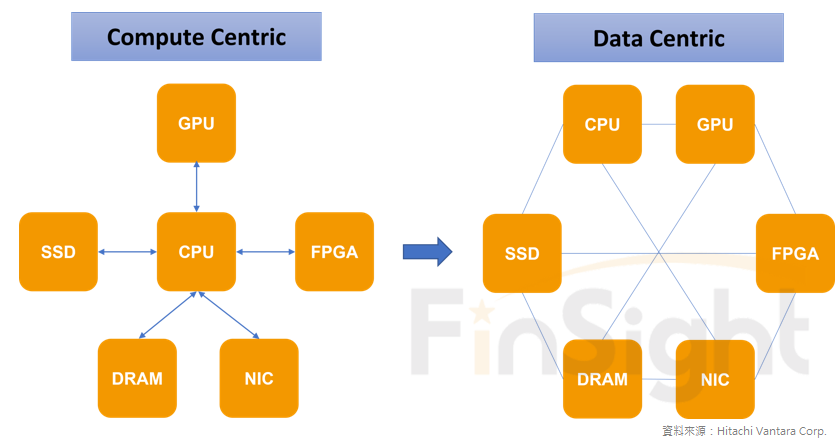
We wrote about it at the time, in our December 2019 note on what Intel's CEO said and what it implied for TSMC's lead in semiconductors. Our view: Intel's 10nm delay had created a CPU shortage, which forced it to put more capital spending (capex) into 14nm capacity it should have been retiring. That is a misallocation of resources. On top of that, end demand was moving from a CPU-centric model to a data-centric one, which widens the market for XPUs, and that makes heterogeneous integration and 3D packaging far more important inside high performance compute chips. With competitors moving one after another onto TSMC's advanced nodes and 3D packaging, 2022 was going to be the point where Intel had to decide whether to outsource.
Then in July 2020, on the second quarter 2020 earnings call, Intel said 7nm had run into process problems and would slip to late 2022 or early 2023. In our July 2020 post on what TSMC's and Intel's results said about the new era in semiconductors, we argued that the two companies were entering opposite loops on profitability: one virtuous, one vicious. Advanced node capex is enormous, so whether a new process launches on time moves the profit line hard. The leader's advantage compounds and the laggard's pressure becomes severe.
Over the following six months Intel repeated in public that it had found the specific step in the 7nm flow that was defective, that the fix worked, and that it had simplified the 7nm architecture to make sure new products land in 2023.
In December 2020, again at a Credit Suisse forum, Bob Swan not only pointed to the 7nm progress but said that pursuing leading-edge technology is part of what Intel is, and that it would keep investing in 7nm, 5nm and 3nm. He laid out three priorities:
- Give customers a predictable product roadmap. Everything through 2022 is fine; the open question is how to use third party foundries from 2023 onward (whether to use them, how much, and for how long).
- Keep developing the integrated device manufacturer (IDM) model, meaning a company that designs and makes its own chips. Intel sees IDM as core to the company, and a new form of IDM would give it maximum flexibility between internal manufacturing and outsourcing, while pushing packaging technology and design capability further.
- Keep investing in leading-edge process development, covering 7nm, 5nm and 3nm.
So as of the end of 2020, the company was still committed to IDM and to funding leading-edge process development itself.
The new CEO: most 2023 products built internally, but more outsourcing
Ahead of TSMC's earnings call, on January 13, 2021, Intel announced it would change CEOs on February 15, 2021. Pat Gelsinger, an engineer by background who spent 30 years at Intel and was most recently CEO of VMware, takes over, and the press release repeated once more that 7nm is on track.
Gelsinger joined Intel's January 21, 2021 earnings call and said that after reviewing the data from the past six months of 7nm work, his read on the process matches that of the existing management team.
The outsourcing plan will not be settled until he takes over on February 15, 2021, and full year 2021 guidance comes no later than the April earnings call. Still, his position is clear:
"I am pleased with the progress made on the health and recovery of the 7-nanometer program," Gelsinger said. "I am confident that the majority of our 2023 products will be manufactured internally. At the same time, given the breadth of our portfolio, it's likely that we will expand our use of external foundries for certain technologies and products." (Pat Gelsinger, incoming CEO, Intel fourth quarter 2020 earnings call)
On the same call, Intel stressed again that it is adding 7nm capacity and will not stop funding leading-edge development. Three points stood out as the ones management considers key:
- A new form of IDM. Three things drive the outsourcing decision: the roadmap, the economics, and keeping control of the supply chain. Intel plans to keep using its IDM advantage while investing to lead in technology development. Its argument is that having both internal manufacturing and outsourcing is something competitors do not have, and Intel can balance the two to deliver leadership products that keep customers over the long run.
- Advanced packaging matters more and more. Chiplets improve yield, and moving from a CPU structure to an XPU structure means GPU, AI, memory, security and software all have to be considered together.
- Continued investment in leading-edge process. The progress on 7nm over the past six months matters, and Intel will keep investing in the node after 7nm. It is also raising 7nm spending to prepare for the next generation of tools. Confidence in 7nm is high, so most production stays internal, but the outsourced share goes up.
Some context on the current mix. Intel's outsourced share today is 15% to 20%, and it already includes GPUs, Altera FPGAs, Mobileye automotive chips and Habana AI chips, all on TSMC 7nm, with a good number of those products having moved up from 28nm. Outside CPUs, in other words, Intel's product lines already lean heavily on TSMC's advanced nodes. So the expanded use being discussed here is probably in products other than server and consumer CPUs. Once those move out it becomes very hard to pull them back in-house, and the company concentrates on optimizing the CPU process.
Intel also repeated the market change it has been describing for a year: CPU to XPU. The CPU still matters, but customers need a family of XPUs to optimize for specific workloads. In the fourth quarter of 2020 Intel launched a new discrete GPU and oneAPI, a cross-industry unified programming model built on open standards. It is positive on the data center inference market and is adding AI features to everything it sells, from cloud to endpoint.
As more compute moves from the cloud out to the endpoint, the whole network has to get smarter, and that pulls both general purpose and custom architectures (FPGA and ASIC) further into telecom. Intel will work with VMware on 5G strategy, because 5G moves computing out of the data center and into the network equipment itself.
That cloud-to-edge network upgrade is also the opening for communications equipment vendors building on open 5G architectures. As we argued in our November 2020 post on AMD buying Xilinx, the semiconductor M&A of the past year has been driven by the network and compute upgrade running from cloud to edge. Intel and VMware is one example. AMD buying Xilinx is another, taking AMD into the telecom market it never served before.
Intel's plan needs time to prove out, and this time there is no fallback
Put all of Intel's public statements together and the direction is consistent enough.
But demand is shifting toward a data-centric model, and competitors are shipping strong new products. Share is moving away from Intel on three fronts:
- XPU as the center of data-centric compute. Cloud and AI workloads expand the XPU market, which covers GPU, FPGA and ASIC. With those chips growing faster than CPUs, the CPU share of the pie falls.
- ARM chips in high performance endpoint devices. Apple's in-house M1, strong Chromebook sales (MediaTek, which supplies chips into those machines, estimates ARM-based Chromebooks can grow 60% in 2021) and Microsoft's software platform support for ARM should all lift ARM endpoint volumes. On top of that, China-designed ARM chips keep gaining share in parts of the data center, which cuts into x86.
- AMD, the x86 competitor, keeps shipping new products with TSMC. What customers care about most is a roadmap that lands on time, and working with TSMC has kept AMD on an annual cadence. On its earnings call AMD said its data center business is improving quarter by quarter, that it sees no inventory correction, and that its server customer base is now expanding into enterprise accounts it previously found hard to reach. And in the latest PassMark data, AMD holds 50.8% of global desktop CPU submissions, a share of benchmark submissions rather than unit share, passing Intel for the first time in 15 years.
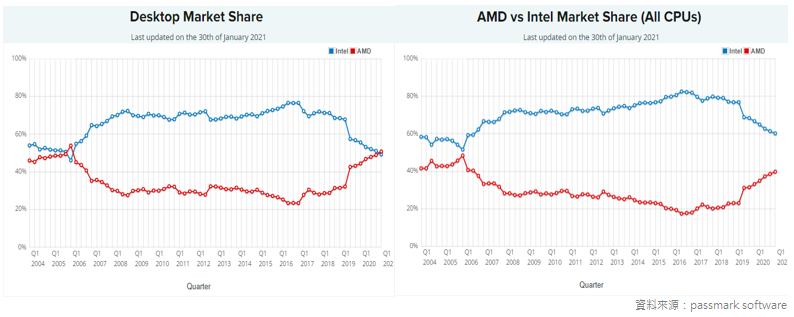
Of those three pressures, two do not change whatever Intel decides on outsourcing: XPU share and ARM share both keep rising. The only one Intel's manufacturing strategy can affect is the triangle with TSMC and AMD, and AMD's process cadence remains steady, with Zen 4 expected on 5nm and, later, on SoIC stacking (TSMC has said SoIC will be in products in 2022).
Bottom line: Intel is a national asset, but customers care about the roadmap
On this call the incoming CEO called Intel a national asset. Against that backdrop, we do not think the company gives up the IDM model, because handing over leading-edge foundry technology would leave Intel dependent on a supplier it does not control. China's attempt to build a semiconductor industry is the cautionary case: the most advanced foundry technology is the piece it cannot catch up on.
But with demand shifting on this scale, every customer is talking about the roadmap. When everyone downstream has to time product launches to chip schedules, Intel has to guarantee new products plus enough volume so that nobody else's plans break. Delivering new products on schedule is still the thing that matters most.
Our view: Intel has to launch 7nm products in 2023 and guarantee sufficient volume, because strong competitors are shipping new products on time and taking share, and outsourced or not, the pressure from ARM and XPU on CPU share does not go away. If the process does come together, Intel is back competing with AMD in CPUs and that would be the point to raise the valuation, but proving it takes until 2023. Until then we stay positive on TSMC, which helps its customers take more share as it executes its process roadmap.