Our bottom-up estimate puts 2024 GenAI revenue at $27.7B and 2025 at $52B, as agents arrive and enterprises run three or more models each.
Over the past year the generative AI market changed shape completely. In 2023 OpenAI stood alone. In 2024 the challengers caught up, and the market looks nothing like it did.
Key takeaways
- We size 2024 generative AI revenue at $27.7B across model companies, public cloud and software as a service (SaaS), and $52B for 2025 on deliberately conservative growth assumptions.
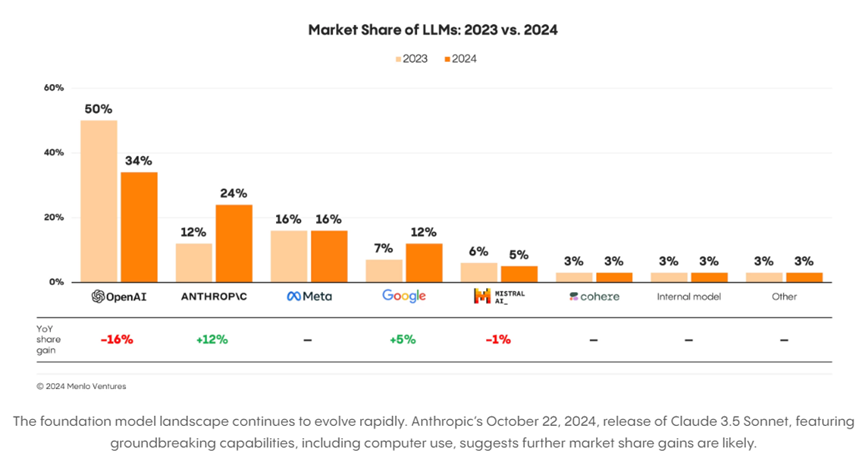
- OpenAI's share of enterprise model usage fell from 50% to 34% while Anthropic doubled from 12% to 24%. The average enterprise now runs three or more models, so this is not a winner-take-all market.
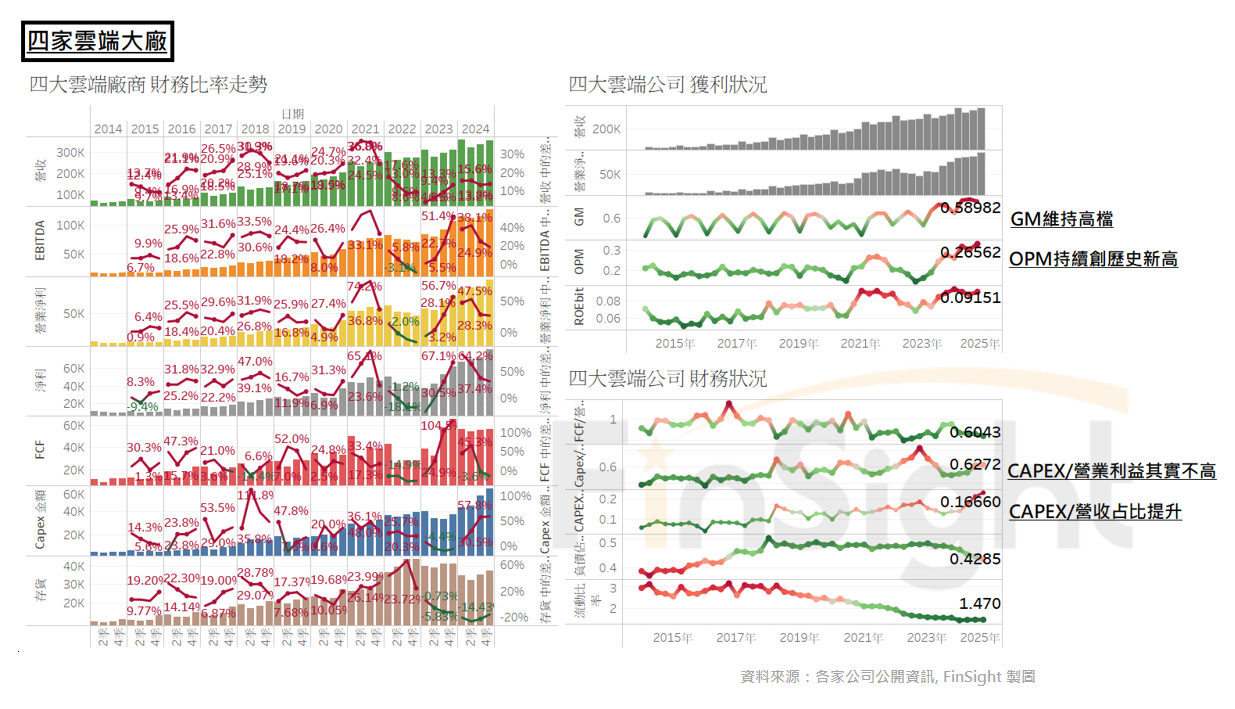
- The July worry is over. US software earnings growth turned back up year over year, and the four US hyperscalers set new highs on operating margin even with capital spending at a record 16% of revenue.
- Agents are the next leg. Salesforce has closed more than 200 Agentforce deals since its October 24, 2024 launch at $2 per conversation, and ServiceNow's AI products already add 1 to 2 points of growth on an $11B revenue base.
Our earlier post on enterprise AI model share looked at the two big shifts of 2024, OpenAI losing share and retrieval-augmented generation (RAG) taking off, and made three points:
- The market is growing fast: enterprise AI spending in 2024 grew sixfold from the prior year to $13.8B.
- Model share moved hard and fast: OpenAI fell (from 50% to 34%), other models rose (Anthropic, Google), and a multi-model strategy became the norm, with the average enterprise adopting three or more models.
- The core techniques shifted: adoption of RAG and agent applications climbed sharply, while prompt engineering, fine-tuning and reinforcement learning from human feedback (RLHF) all declined.
This post looks at that fast-moving market from three angles:
- Sizing the explosive growth in the market itself.
- Earnings that show software growth turning back up, with profitability improving markedly.
- A competitive field that has gone from OpenAI alone to several strong players, and a technology stack that has gone from one model to multi-model orchestration.
Put these together and you get a chain running from foundation models to public cloud to agents: a more open, more varied AI market, with the application layer opening up fastest.
The market is growing fast: we estimate generative AI revenue tops $50B next year
We took the main companies that benefit from generative AI software, pulled together what they have said in recent news and on earnings calls, and split them into three buckets to size the market.
First, generative AI software: annualized revenue above $7B by the end of 2024.
- OpenAI: $4B annualized at year-end, 2.5 times the $1.6B at the end of 2023.
- NVIDIA software: $2B annualized at year-end, double the $1B at the end of 2023.
- Anthropic: $1B of revenue this year, ten times the $100M at the end of 2023.
- Perplexity: $50M this year, five times the $10M at the end of 2023.
Second, public cloud: three strong players, with roughly $20.5B of AI-related annualized revenue by the end of 2024.
- Azure: about $10B on a quarterly annualized basis at year-end. Microsoft expects its AI business to cross the $10B annual run-rate milestone next quarter, the fastest any business has done so in company history. AI contributed 12 points of Azure's growth in 3Q24. If $10B of AI revenue accounts for 12 points of Azure's growth, Azure is running at roughly $80B a year (the AI contribution was 1% in 2Q23 and 6% in 4Q23). Azure OpenAI usage has more than doubled versus six months ago. Azure is capacity-constrained right now, and management expects growth to accelerate in 1Q25 as more AI infrastructure comes online.
- AWS: working from what the company has said, we estimate roughly $7.5B annualized at year-end, crossing $10B from 2025. Amazon describes an AI business at a multibillion-dollar revenue run rate (the third quarter in a row it has used that phrase), growing more than 100% year over year and three times faster than AWS did in its own early days. On the company's own framing, year-end will be the fourth straight quarter above $1B of revenue, and with growth still doubling we expect the business to clear $10B next year, so we conservatively put the year-end run rate at $7.5B. Over the past 18 months AWS has shipped twice as many machine learning and general AI features as other major cloud providers.
- Google Cloud: scaling off AWS, we estimate roughly $3B annualized at year-end. Cloud revenue was $11.4B in the quarter, accelerating clearly to 34% year over year. Annualize that quarter and Google Cloud is about 40% of AWS revenue at $110B a year, so scale AWS's AI revenue by that and you get about $3B. That ignores the fact that Google Cloud is growing more than twice as fast; adjust for that and the year-end AI run rate could be close to $4.5B. We carry the $3B into the total to stay conservative. Gemini is now built into every Google product with more than 2 billion users, and Gemini API calls are up 14 times in six months.
Third, SaaS: AI agents arrive, and 2025 is when the wave breaks.
Salesforce: early demand for the agent product is strong, but it is too new to show up in reported revenue.
- The stock rose 10% after earnings. Revenue grew 8% year over year and operating margin improved to 33%.
- Agentforce has closed more than 200 deals since its October 24, 2024 launch. The top 25 deals used an average of more than five cloud products. Management points to thousands more potential deals in the pipeline across an installed base of 135,000 customers. Selling has only just started, so Q4 Agentforce orders are not expected to contribute meaningfully to current remaining performance obligation (CRPO).
- Pricing is consumption-based at $2 per conversation, with a return on investment (ROI) calculator for customers.
- The case at UCSF (the University of California, San Francisco) is how Salesforce explains the labor savings: a traditional human-handled interaction costs about $100, an Agentforce interaction about $1.50. That cuts operating cost sharply, speeds up service, and takes load off clinical staff.
- Indirect benefit: Salesforce expects to take 25% to 50% out of its own annual service volume.
- It is hiring 1,400 salespeople worldwide to support Agentforce's growth.
- When Salesforce launched Agentforce in September, its CEO framed it as the arrival of the third wave of AI: after predictive models and generative AI, agents become the next major stage. Looking further out, he predicted two more stages: a fourth wave of robots, arriving soon, and a fifth wave in which artificial general intelligence (AGI) most likely arrives too. Those last two are his forecast, not ours.
ServiceNow: AI already contributes $100M to $200M of revenue and is still growing fast.
- Revenue passed the $11B milestone, with growth holding above 20%.
- The AI products have been out for only three quarters and already have 2 customers paying more than $10M, 6 paying more than $5M, and 44 paying more than $1M.
- AI is adding 1 to 2 points of revenue growth, which on $11B of revenue is roughly $100M to $200M.
- The Pro SKU with AI features is priced more than 30% higher, and it is the fastest-growing new product in the company's history.
- One example of the productivity gain: optimizing clinical trials in pharma, which can take 10% to 20% out of a 6.6-year cycle.
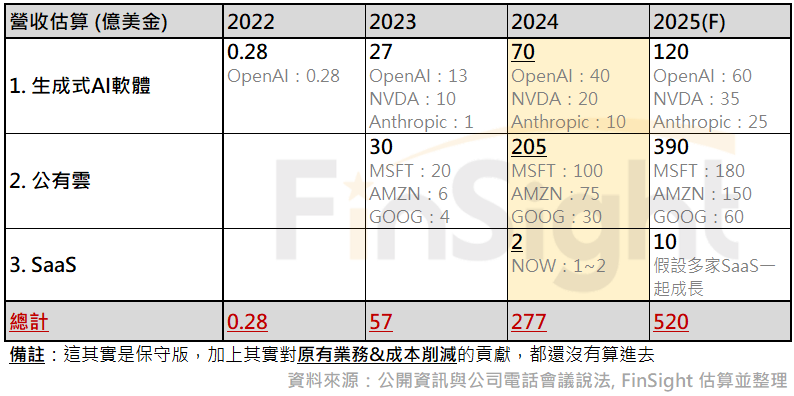
Adding all of it up, the table below estimates the revenue contribution from generative AI based on what the vendors themselves have said.
These companies together produced roughly $27.7B of AI revenue this year. Discounting current growth rates for 2025 to keep the number conservative, and without assuming the capacity that several vendors say frees up next year, we get $52B of revenue in 2025. The growth momentum is visibly moving along the chain from generative AI software to public cloud to SaaS. The applications keep widening out, and the market is growing fast.
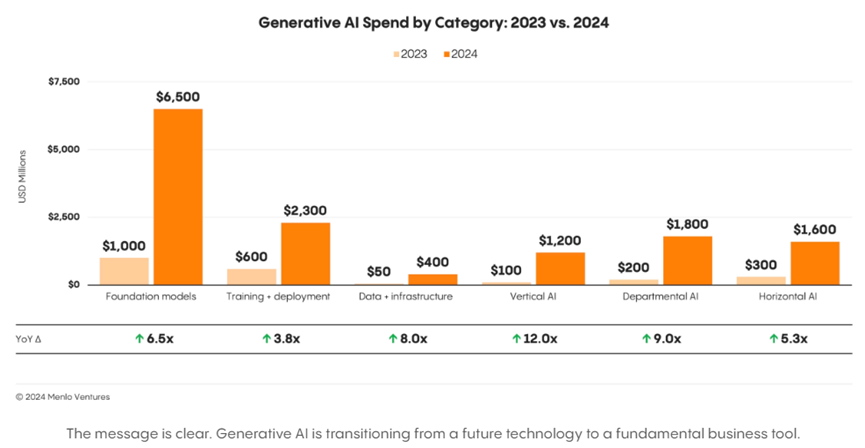
Our earlier post on Menlo Ventures' enterprise AI survey pulled that research together, and several of its figures point the same way:
- Generative AI investment grew sixfold this year: in 2024 generative AI became a core strategic priority for enterprises, with AI spending reaching $13.8B against $2.3B in 2023, an increase of more than six times. 72% of decision makers expect to expand their use of AI tools, though about a third of enterprises are still working out how to implement.
- Agents went from 0% last year to 12%, aimed at a $400B software market and, beyond it, $10 trillion of services spend. That requires new infrastructure: agent authentication, tool integration platforms and the like.
The July earnings-season worry is over: software growth and profitability both turned back up
At the mid-year earnings season (2Q24), going on what companies said at the time, revenue growth was capped by short-term capacity constraints and unclear applications, profits were starting to take a hit from depreciation, and US software earnings growth turned down year over year. In the past that has been a signal that things cool off for a while, so we were somewhat worried.
This quarter's results say otherwise. US software earnings growth has turned back up year over year, and profitability (operating margin) is holding at historic highs. The four US hyperscalers (Microsoft, Alphabet, Amazon and Meta) pushed operating margin to yet another new high. Even at this level of capital spending, these companies can still hold good margins.
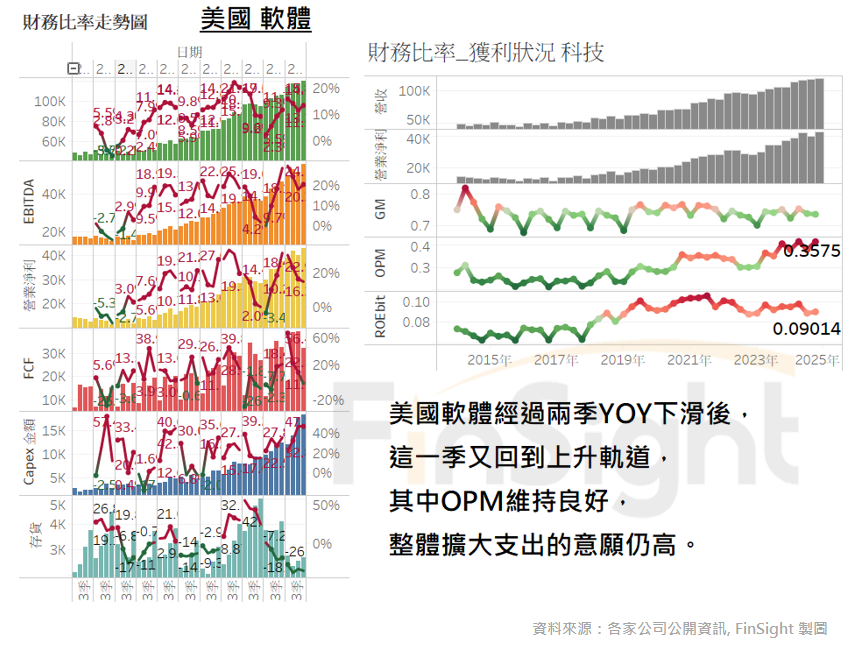
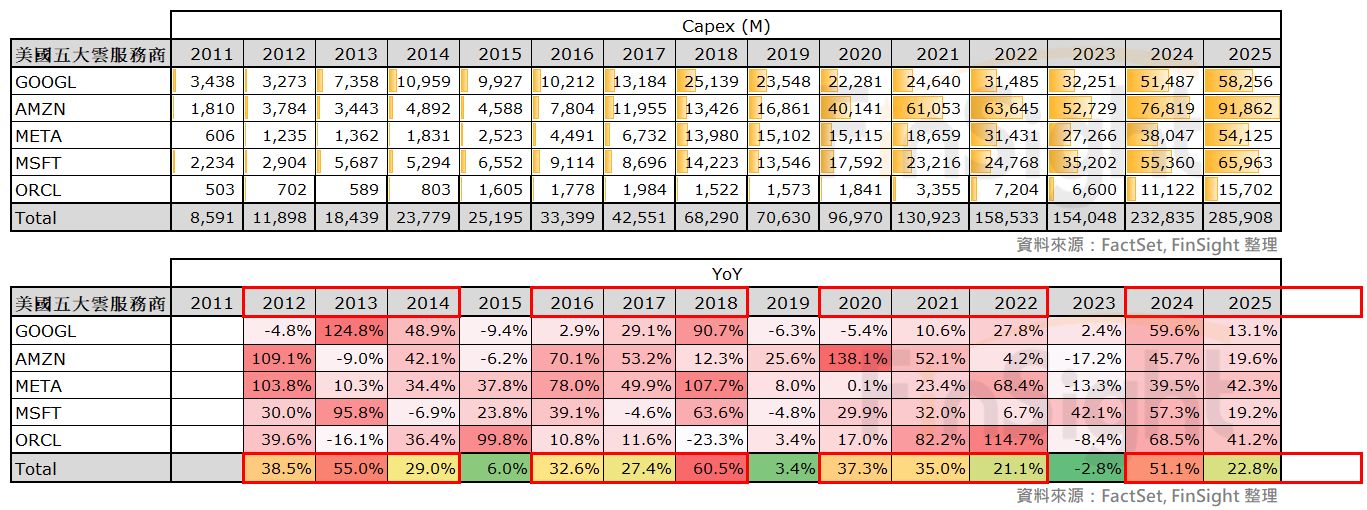
Precisely because profitability improved so much, capital spending as a share of revenue has hit a record high of about 16%, but capital spending as a share of operating income is still inside its historical range and not unusually elevated.
The US software ETF IGV has kept setting all-time highs, which may simply be the market pricing in the fact that software growth is reaccelerating on AI.
The most important shift in the 2024 GenAI market: from one dominant player to real competition
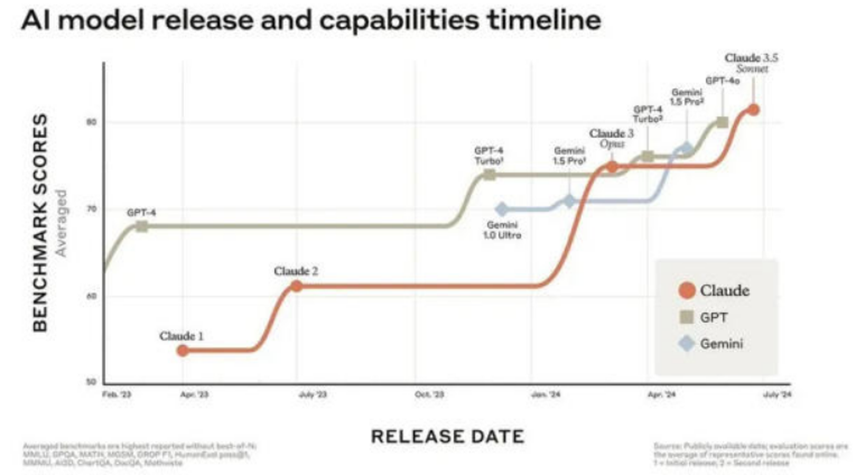
Looking back at this year in generative AI, the clearest change is that the market went from OpenAI standing alone last year to several vendors competing on the same field. One milestone was Anthropic's Claude 3 family in March of this year, the first time a model genuinely caught up with and in places passed OpenAI on benchmark scores. That set off a season of every major vendor pushing hard and racing to ship new models.
Vendors in this competitive wave are refining their own large language models and, just as hard, widening the set of use cases they can serve. Claude's Artifacts feature, for instance, opened up a genuinely new mode of use. In a market where every big tech company still has a shot at winning, this also explains why capital spending has been revised higher quarter after quarter this year.
The model share numbers from that earlier enterprise AI post:
- OpenAI fell sharply, from 50% to 34%, and lost its outright lead.
- Anthropic rose fast, from 12% to 24%, and is now the second most used model in applications.
- Meta held flat at 16% and kept third place.
- Google also grew meaningfully, from 7% to 12%, and held fourth.
- On top of that, a multi-model strategy became the norm in 2024, with the average enterprise adopting three or more models.
Multi-model orchestration: three or more models per enterprise, and a pie that keeps getting bigger
One of the important trends of 2024 is that the average enterprise now adopts three or more AI models. AI applications have moved from one dominant model to a pattern where several models work together. As Amazon founder Jeff Bezos has put it, AI models are heading toward specialization, the same way you call a different friend depending on the question. Each model has its own edge: some are strong in a particular domain, some respond with lower latency, some are more flexible to call through an API.
This market structure does not just mean the whole thing gets bigger. It breaks the winner-take-all outcome people had been forecasting. Even inside a single use case, a company may run several AI models at once: a small, low-parameter model handles day-to-day tasks and keeps running costs down, while a larger model takes on the harder work and can even act as a teacher model to improve the others. That heterogeneity lets every model vendor find its own position in a growing market, and together they push the technology forward and deepen adoption.
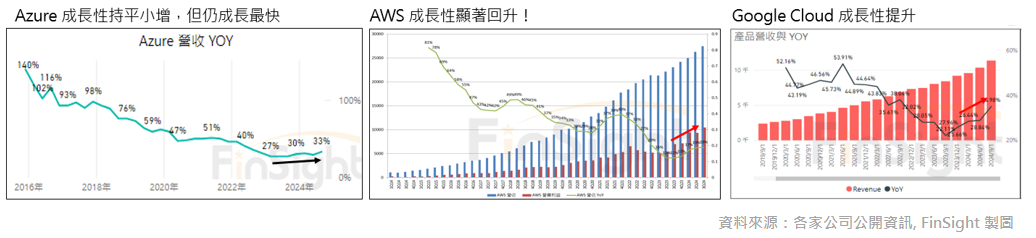
The public cloud operating numbers reflect this year's share shift too. Azure's growth was flat overall because it is capacity-constrained, though the company thinks it can accelerate once the bottleneck opens up in 2025. AWS and Google Cloud, both of which benefited this year from other models gaining share, saw growth accelerate clearly.
At two recent investor conferences, Microsoft also talked about agents working together across vendors, and about rising model complexity still demanding a great deal of compute:
- Competing with the other AI agent vendors (Salesforce, Google) is not an either-or fight, it is a multi-party collaboration.
- Internal results from Copilot: the sales team created 10% more opportunities, closed deals more than 20% faster, and revenue per head rose more than 9%.
- Investment splits into two main directions: long-term infrastructure (about 50%), meaning data centers, power supply and fiber networks; and meeting short-term demand (about 50%), meaning servers and other equipment that can be reallocated flexibly.
- Model complexity keeps rising: longer context handling, heavier demands on the attention mechanism, and steadily improving reasoning.
- In the cloud era Microsoft was the follower, building cloud infrastructure behind AWS. In the AI era it has become the leader, and it will use its existing customer relationships and technical advantages to drive innovation.
Conclusion: the AI software market is accelerating along the chain from foundation models to public cloud to agents
Go back through the things we were worried about. This quarter's results reversed all of them.
- In July we worried about growth slowing: software earnings growth was turning down year over year, and Microsoft said public cloud capacity would stay constrained until 1Q25. Now: software growth has turned back up, public cloud is growing strongly, and agents are creating a new source of growth.
- In July we worried about profitability taking a hit: Microsoft's public cloud margin was revised down slightly. Now: margins at both the large cloud providers and the software companies are still improving.
- Last year the view was that the model race would be a brutal fight, winner takes all, with everyone else spending for nothing. Now: the pie is getting bigger, several models are used together, and both the number of beneficiaries and the revenue at stake may be larger than people imagined. What has not changed is that racing toward a smarter model is still what matters, because only a smarter model can carry the applications nobody can picture yet.
- We also worried about when compute would run into a period of overbuild. Now: NVIDIA first said inference was 40% of the business, and it is still 40%, which means training and inference are growing together. On top of that, plenty of vendors cannot open up their models' performance because they are short of inference compute. Once that compute arrives, model performance could take a large step forward.
On the demand side, there is no question that end-user software applications are opening up in a big way. The chain from foundation models to public cloud to agents matches what industry people predicted earlier: applications could scale up dramatically in 2026 and 2027, and vendors will make sure they are ready to meet the enormous opportunity a technology revolution brings. So we keep our earlier call that this round of upward capital spending revisions can run three years, through 2026.