
Q3 2021 semi earnings split hard. Intel's 2022 operating income was cut 20% and gross margin is heading to 51% to 53%, while AMD and NVIDIA take share.
Around March 2021, the pace of progress we were seeing across the technology supply chain got us excited enough to start this series, The Data Driven Tech Revolution. This is the third piece.
Key takeaways
- The third quarter 2021 earnings season split the Philadelphia Semiconductor Index (SOX). Revenue estimates for 2021 and 2022 went up 0.6% and 1.9%, but aggregate operating income estimates did not move, so the implied operating margin fell. Analysts also raised 2022 capital spending (capex) estimates 10%, which pressures returns further out.
- Intel's 2022 operating income estimate was cut 20% after its results, while TSMC and the US high performance computing vendors had 2021 and 2022 estimates revised higher.
- Intel guides to no revenue growth in 2022 and to gross margin falling from 57% today into a 51% to 53% range over the next two to three years. Its data center operating margin is 31.6%, and revenue from cloud customers fell 20% year over year in the latest quarter.
- Taiwan's Institute for Information Industry, a government backed research body, forecasts AMD taking a much bigger slice of ODM direct shipments, meaning servers the cloud companies buy straight from contract manufacturers rather than from Dell or HPE. AMD's share of cloud data center ODM direct shipments rises from 10% in 2020 to nearly 25% in 2023, with ARM based chips at 9%, which would cost Intel more than 10 points of share in 2023.
Part 1 came out of Applied Materials' analyst day. The case the semiconductor industry is making there is simple: data is growing much faster than compute is growing, and that gap pushes semiconductor demand into a self reinforcing cycle. Every high performance computing (HPC) vendor is buying assets and raising investment to get ready for that market.
Part 2 looked at IDM 2.0, the turn Intel is trying to make as an integrated device manufacturer (IDM): keep its own fabs, buy capacity outside, and sell foundry services to other chip companies. In a data centric chip world the center of computation moves from the CPU to the XPU, the whole set of accelerators around it, and the key to better performance moves from process node alone to advanced 3D packaging. That is a paradigm shift in how the semiconductor industry has worked.
In that world, we think a semiconductor supply chain company that wants to lock in customers has two choices:
- Be a fabless designer of heterogeneous chips, buying its way to better XPU performance. NVIDIA is the example.
- Be a foundry that can do both, advanced process nodes plus heterogeneous 3D packaging. TSMC is the example.
Intel's chief executive, Pat Gelsinger, sees the data driven future, but he inherited a hard fact: time is not on Intel's side. Competitors caught up a while ago. If Intel cannot ship a product in 2023 that stands up to them, it will be losing share and raising capital spending at the same time, and that would cut its earnings power sharply.
The past six months have made the picture clearer. This post uses the September quarter results to show why we think the environment is brutal for Intel.
US semiconductor earnings are splitting into winners and losers
The SOX has been making new highs, but the third quarter 2021 results underneath it are sharply divided. At the index level, earnings revisions are not much to look at. At the company level the gap between good and bad is very wide, and money is crowding into the names with the most visible growth.
We took the 30 companies in the SOX, kept those with at least five analysts publishing on them, and calculated where the market's earnings estimates sit now and how they differ from 50 days ago, at the end of September 2021, before the third quarter 2021 earnings season began.
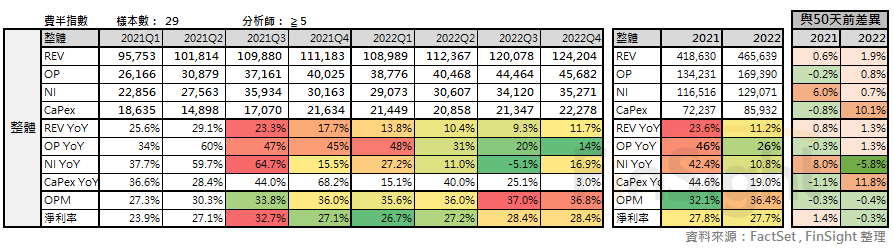
Through this earnings season analysts raised revenue estimates broadly, by 0.6% for 2021 and 1.9% for 2022, putting revenue growth at 23.6% and 11.2%. Aggregate operating income estimates barely moved, holding growth at 46% for 2021 and 26% for 2022. The result is that the operating margin the market now expects for the SOX is lower than what it expected before. Analysts also raised 2022 capex estimates by 10% versus 50 days ago.
Split the index into Intel, TSMC, the HPC vendors, auto semiconductors and the rest, and the earnings estimates look very different bucket by bucket.
- Revenue estimates went up everywhere, with HPC and auto semiconductor vendors getting the biggest increases over the past 50 days.
- Operating income is where the split shows. Intel's 2022 operating income estimate is 20% lower than it was before the results. TSMC and the HPC vendors had 2021 and 2022 operating income raised, and the US HPC names in particular are now expected to grow earnings strongly in 2022 as shortages ease. Auto chips are still short in 2021, but the squeeze is being worked through, and 2022 estimates for auto vendors went up 10%, the largest increase of any bucket versus 50 days ago. Some semiconductor companies tied to smartphones and long lead-time parts had their 2021 growth cut.
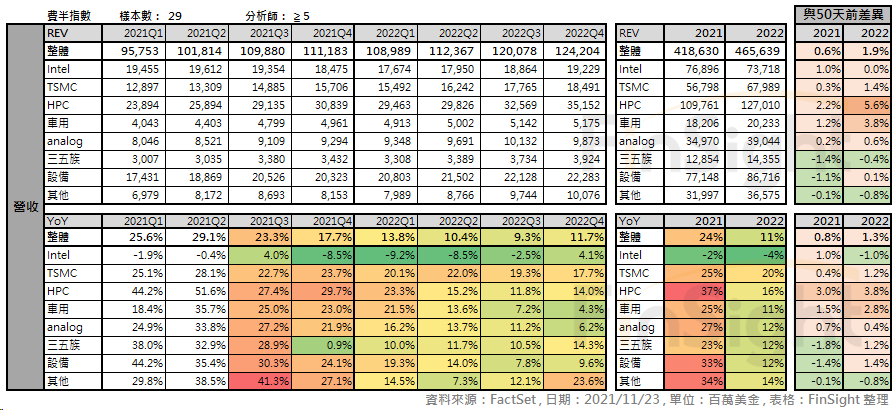
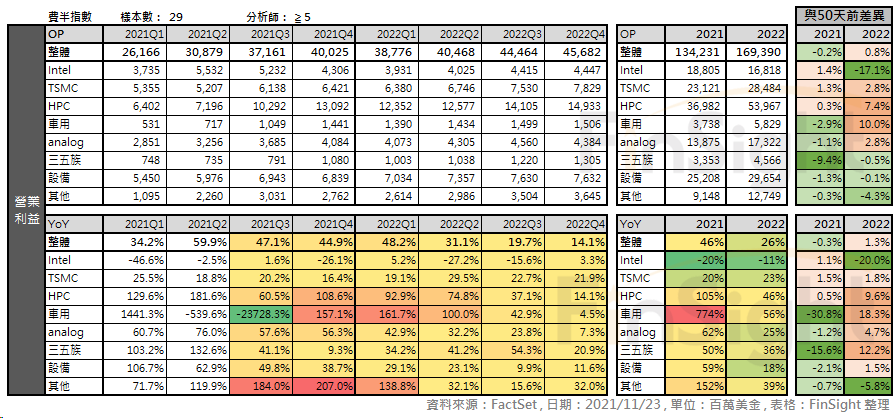
US high performance computing chips and auto semiconductors both had shipments held back by shortages over the past year. With supply loosening and end demand still strong, this quarter brought clear upward revisions. The groups leading the tape lately are the same ones showing up in these revisions.
Data center competition is heating up, and Intel keeps losing share
Come back to Intel against the rest of the HPC group. We read this quarter as evidence of enormous operating pressure on Intel, because for an HPC vendor the data center is the most profitable business, the fastest growing business, and the one with the most future in it. Taking data center share has to come first strategically.
The core customers for high performance computing chips are the end customers who run their businesses on clouds, platforms and ecosystems, because that is where the huge data volumes sit. Data centers burn a lot of power, so cloud customers never stop chasing energy efficiency. That is what is moving demand for leading edge process nodes out of consumer devices and into the enterprise.
This quarter shows Intel's competitors still taking share, and earning better margins while they do it:
- AMD: data center revenue more than doubled and is now more than 20% of the total. New products are landing with Microsoft, Google, HP and Lenovo, among others, and demand is strong in both large cloud and enterprise. At its online data center launch AMD announced it had won Facebook, and it plans to press the advantage with Genoa, the 5nm Zen 4 data center part, in 2022.
- Marvell: at its analyst day, management guided custom silicon revenue to double over the next five years, from $400 million to $800 million, driven by custom ARM based chips that Amazon and Microsoft use in the cloud. It also has 19 customer design wins at 3nm, each worth more than $100 million.
- NVIDIA: data center revenue growth came back to 54.5%, and the increase in absolute dollars was the largest in the company's history. Hyperscale cloud customers fell to 30% of the data center business, which says demand is strong and broadly sourced. Data center is again the main growth driver next quarter, and demand is spreading into professional visualization chips, so the application base keeps widening.
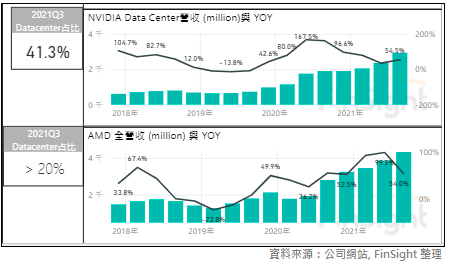
Across the US HPC chip vendors, data center gross margin, growth and share of revenue are all rising. Intel is the only one that put out a set of numbers that worried people.
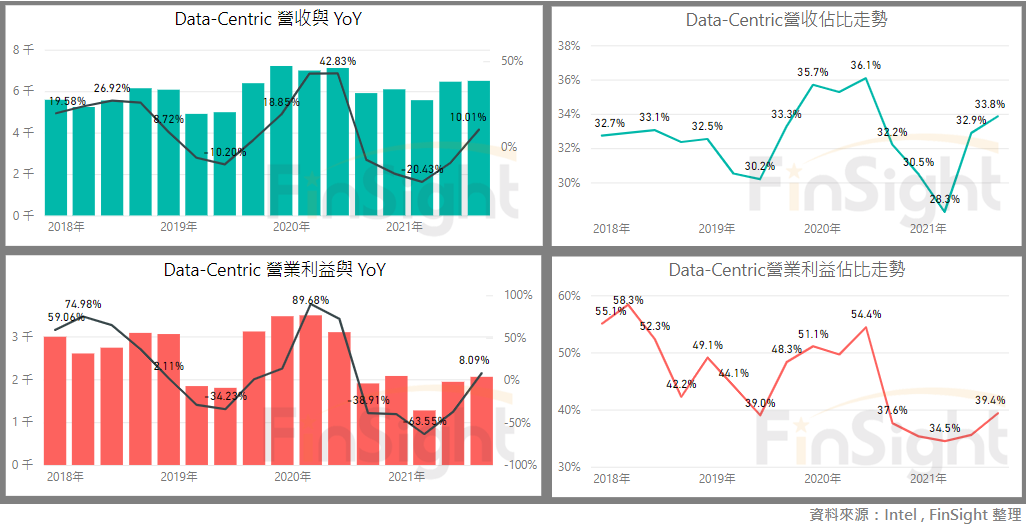
Intel is positive on long term data center demand and expects leading edge nodes to pass half of all semiconductors. Even so, it guides to no revenue growth in 2022, and it expects gross margin over the next two to three years to fall from 57% today into a 51% to 53% range as it rolls out products on new nodes and spends on capacity.
On the call, several analysts worried that the data center competition management described could make the next two to three years of earnings harder still. Intel named three problems on the call: competition in data center, Chinese government regulation of gaming, and component shortages. None of the three came up much anywhere else.
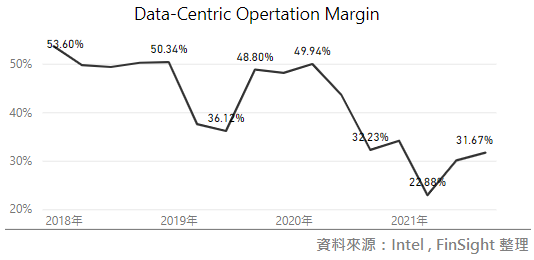
Intel's data center operating margin of 31.6% is low against the segment's own history, and the segment's contribution to company profit keeps falling. In an era when enterprises are moving to the cloud and every vendor is raising cloud investment, data center profitability at Intel should not be going backwards.
Taiwan's Institute for Information Industry forecasts that ODM direct shipments will keep taking a larger share of cloud data center shipments, and that AMD's share will rise from 10% in 2020 to nearly 25% in 2023. It also expects ARM based chips to reach 9% of the market in 2023, helped by in house designs at the large clouds, the rise of Ampere Computing's server processors and NVIDIA's Grace CPU.
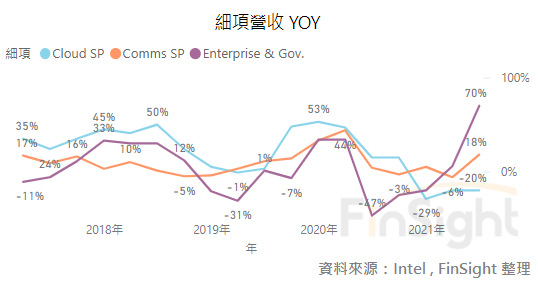
On that forecast Intel loses more than 10 points of share in 2023, the steepest single year decline it has seen in some years. Intel's own data center numbers point the same way. Revenue from cloud customers, the part of the business that matters most, fell 20% year over year in the latest quarter with no sign of a turn, which tells you competitors are still taking share in large cloud.
The high performance computing market is being reshuffled, and the winner takes a large advantage
With cross chip integration now the trend, a semiconductor company can build a moat either through the network scale effects of a platform or through capital spending that buys a clear technology lead. The companies that do it well tend to show a winner takes most pattern in their technology, their cash flow and their gross margin.
That is clearly not happening at Intel, and 2023 is the checkpoint on whether it gets there. If Intel cannot put a product in front of data center customers that they actually want by then, the pressure from competitors only builds.
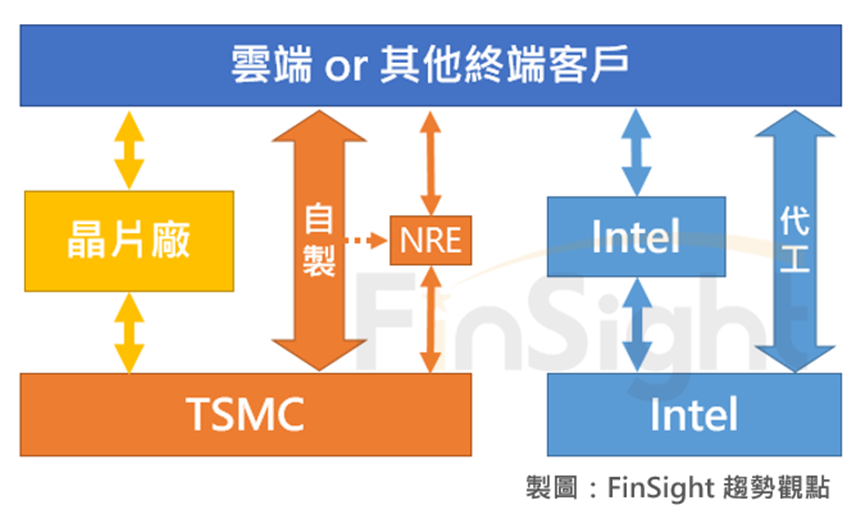
On the other side of that trade sit the chip designers that build at TSMC, the group we call the TSMC alliance. They are in the right position on the data driven build out of high performance computing inside the enterprise, they are taking share and growing fast, and their financial estimates are being revised higher. They have a chance to gain a lot more ground as this semiconductor trend runs.
The next post covers the company doing this best: NVIDIA. We will also explain why we think the semiconductor arms dealers that enable this technology deserve a higher multiple as data driven computing and hardware software integration take hold.