
Intel's IDM 2.0 puts $20 billion into a foundry business from 2024. The read on cloud customers designing their own chips is right; the evidence is not.
The Data Driven Tech Revolution, Part 1, our April 2021 post on Applied Materials' analyst day, argued that the data driven tech revolution creates the biggest semiconductor opportunity of the next ten years. To process an exploding volume of data, high speed computing chips become the main growth line in semis, and delivering the compute to match makes data-centric high speed computing the ground everyone is fighting over.
Key takeaways
- Intel's IDM 2.0, the second act of its integrated device manufacturer (IDM) model, announced on March 23, 2021, keeps most products in Intel fabs, widens outsourcing to third-party foundries from 2023, and commits $20 billion to a foundry business offering sub-7nm process and packaging after 2024 across x86, ARM and RISC-V.
- The logic is customer lock-in. In a cloud world the x86 CPU share keeps shrinking, and x86 is where Intel makes its core profit, so it has to open a new front to get the next generation of customers' business.
- Intel sizes the foundry market at $100 billion by 2025, a compound annual growth rate (CAGR) of 8%, with most of the growth in high performance computing (HPC). Gartner expects 90% of integrated circuits (ICs) to use heterogeneous integration by 2030 against less than 5% in 2020, which is why leading-edge process plus 3D packaging is now the standard kit.
- Demand is not the binding constraint: Intel says 20 to 30 cloud customers are already in talks. Execution is. The evidence that Intel can run leading-edge process, 3D packaging and service work for XPUs, meaning CPUs, GPUs, field programmable gate arrays (FPGAs) and accelerators combined into one system, is not there yet, and 2016 to 2020 is the cautionary case.
Over the past month, Intel's move into foundry and NVIDIA's AI product firepower at GTC have made the competition hotter and the direction of travel clearer.
Broadly, data-centric computing moves value along the HPC supply chain. Different compute needs push chip manufacturing toward 3D packaging and cross-die integration, and they also push end customers to design more of their own silicon.
We see two main ways for the semiconductor supply chain to lock those customers in:
- Be the fabless designer of heterogeneous multi-die chips: buy your way to better XPU performance.
- Be the foundry that can actually build them: leading-edge process plus heterogeneous 3D packaging.
This post works through why Intel is going into foundry, and what that tells us about the trend. When semiconductors change structurally, where the value lands along the chain sets the long-run multiple each vendor gets.
Intel goes into foundry: what the new CEO sees
Pat Gelsinger, Intel's new chief executive, used his first webcast on March 23, 2021 to lay out the company's new strategy, IDM 2.0:
- Most products keep being built in Intel's own fabs. The 2023 CPU lineup, Meteor Lake for consumer and Granite Rapids for the data center, is on 7nm and, per the company, on track.
- Wider production partnerships with third-party foundries. More outsourcing makes production more flexible and lets Intel optimize the roadmap against cost, performance, schedule and supply chain shifts. The products involved include consumer and data center compute die from 2023.
- A new foundry service. Intel plans to invest $20 billion and, after 2024, offer sub-7nm process and packaging on a foundry basis across x86, ARM and RISC-V, serving mainly US and European customers. The unit will operate standalone and report directly to the CEO, and it will pair advanced process and packaging with x86 cores plus ARM and RISC-V ecosystem IP.
Intel's view of the market still centers on the growth it sees coming from cloud, AI, the intelligent edge and connectivity. More varied and more complex customer workloads are what force the industry to change:
- CPU to XPU: advanced packaging and 3D cross-die integration are the key to more performance.
- Single die to package: Intel's packaging technologies are Foveros (3D) and EMIB (2.5D).
The company also sees a large addressable market in foundry: $100 billion by 2025, an 8% CAGR, with most of the growth coming from leading compute technology (HPC), which Intel says is its specialty.
Build the main products in house, outsource more, and open a foundry business too?
The moves look contradictory. They are the bet a CEO who came over from VMware is making on where the cloud goes next.
We wrote in January 2021 that the chip ecosystem is changing. To cope with the volume of data, HPC is the main growth line in semis for the next few years, and a chip architecture built around data is displacing the traditional compute-centric way of thinking.
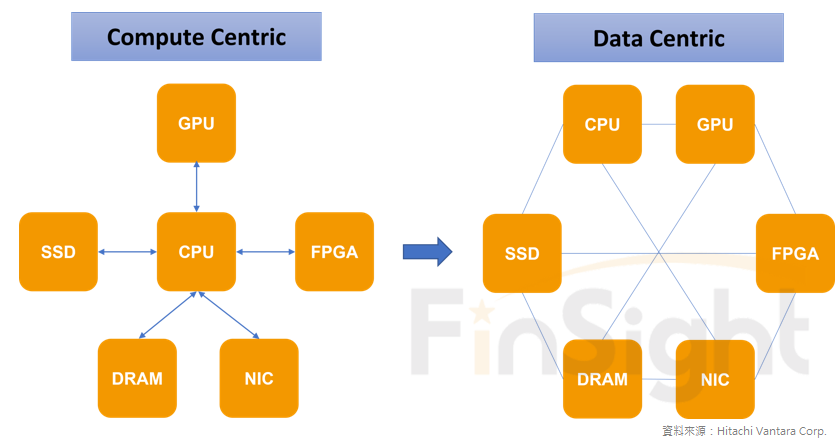
Under that new architecture, making high speed computing chips demands leading-edge process and 3D packaging. HPC, advanced nodes and 3D packaging are also the three areas TSMC said on its earnings call would grow faster than the company average.
What HPC demand looks like now
- The chase for energy efficiency makes cloud customers the main buyers of HPC.
- As applications land in the field, the chipmakers' customer base fragments quickly, and vertical industries are now more than half of that customer base.
- Edge data centers will be specified like the cloud, with software defined infrastructure as the standard.
Why leading-edge process and 3D packaging now go together
- Data driven chips live on fast links between compute and memory. With Moore's Law slowing, leading-edge process plus 3D packaging is the standard kit for high speed computing.
- The large chip vendors are buying their way into data driven silicon, NVIDIA and AMD among them.
- Heterogeneous integration penetration rises sharply: Gartner expects 90% of ICs to use heterogeneous integration by 2030, against less than 5% in 2020.
The bigger point: because data driven chips cover such varied use cases and data types, they create demand from customers to design chips themselves.
Demand changed in kind, and value is moving along the semiconductor chain
Chips exist to serve end customers, so a change in the kind of end demand is what moves value.
Once processing huge volumes of data becomes the industry's focus, end customers built around clouds, platforms and ecosystems create different chip demand in their own domains.
Consumer (business to consumer, or B2C): platform ecosystems pull chip design in house
- The large consumer names are building ecosystems and shifting toward software. Consumer hardware has a price ceiling, so in recent years the big consumer vendors (Apple, for example) have moved toward software. Once building the ecosystem is the first priority, the hardware exists to improve the user experience, mainly by adding compute performance and delivering better software services.
- That raises the pull to design chips in house: to build the platform ecosystem, improve the experience and widen the gap with competitors. Apple's M1 is meant to create one experience across devices, Tesla's in-car chip keeps the key technology in its own hands, Amazon has its voice chip, and so on.
- More and more edge silicon: as cloud applications mature, edge chips start to take off. End products have to be small and light, run specific AI instructions, and draw little power for long standby.
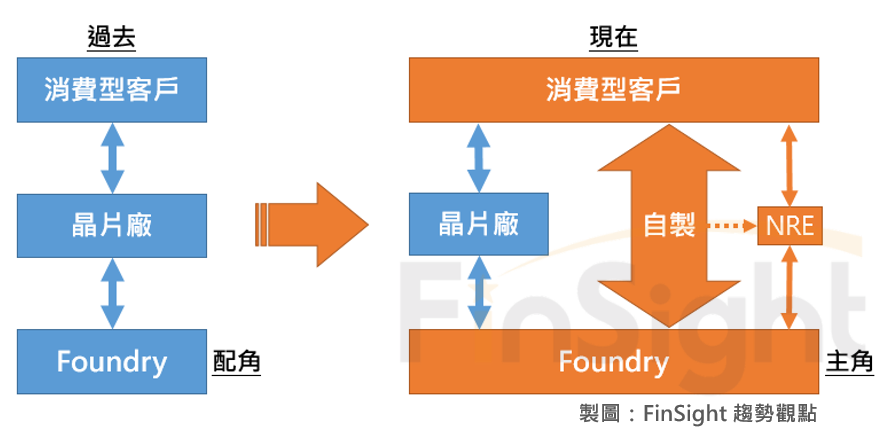
Enterprise (business to business, or B2B): HPC growth sits in the cloud, and the hunt for energy efficiency never stops
- Digital transformation drives cloud demand. Since 2020, enterprises have moved to the cloud noticeably faster, vendors have raised their cloud demand and accelerated the related capital spending (capex). A software defined data center needs high performance, low power compute products, and performance per watt is the binding constraint.
- The chip vendors' main battlefield is the cloud. A booming cloud business means more data driven silicon and more customers designing their own.
- The big HPC chip vendors: cloud has always been their high price, high margin, high growth business (more than 30% of revenue, growing above 30% a year, gross margin at least 10 points better than their other product lines). Because cloud runs on software defined infrastructure, chip demand turns data driven, which is what sent AMD and NVIDIA down the acquisition path.
- Cloud vendors: to serve varied customization needs, and with cloud a rising share of profit, they have started designing some of their own chips to add performance while cutting power (Google, Microsoft, Amazon and Chinese players). They can do the work in house or hire a design services house on a non-recurring engineering (NRE) contract.
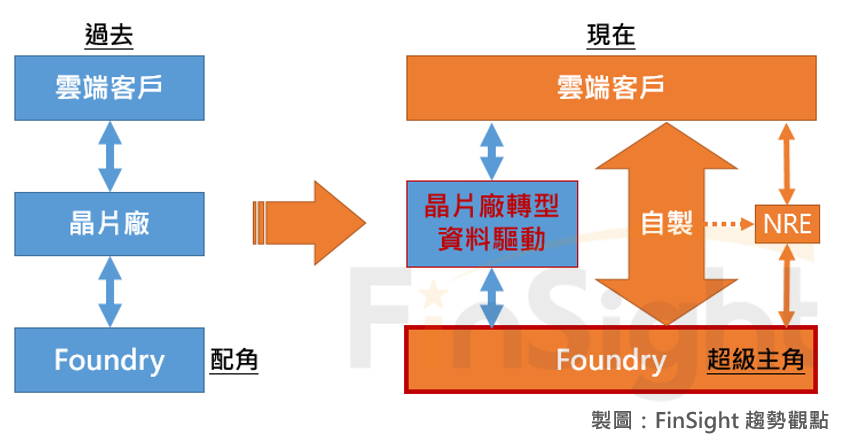
As the large chip vendors buy their way toward data driven silicon and end customers start wanting their own designs, the pool of customers that needs leading-edge process and 3D packaging expands a lot. For an Intel built around x86, that shows up as the pressure of being eaten away by XPUs and the ARM architecture.
So against an HPC trend that does not reverse, there are two ways to keep customers:
- Foundry: when customers want to design their own chips, you cannot ignore the foundry market if you want to keep them, especially in cloud. That path is extremely hard. The capex is staggering, and leading-edge process and packaging are very difficult to execute, with cross-die integration required.
- Build out the data driven XPU: put the XPU at the center, buy and integrate the pieces data driven computing needs, and deliver a more efficient product from a platform position. AMD and NVIDIA are already using acquisitions to sharpen their products, and NVIDIA's GTC this year was an excellent display of firepower.
Standing pat is not an option. Looking out at the cloud world, the x86 CPU share keeps getting smaller, and that share is the core of Intel's profit, so it has to open a new front to win the business of tomorrow's customers. Of the two paths, Intel may have weighed the current politics, which favor local production, plus real confidence in its own advanced packaging, and picked the business of manufacturing other people's in-house designs.
Look again at the foundry strategy Intel laid out: sub-7nm (extreme ultraviolet lithography, or EUV, plus 3D packaging), serving US and European cloud customers and governments, launching in 2024, reporting straight to the CEO. It fits the market trend and steps around the conflict with the existing business.
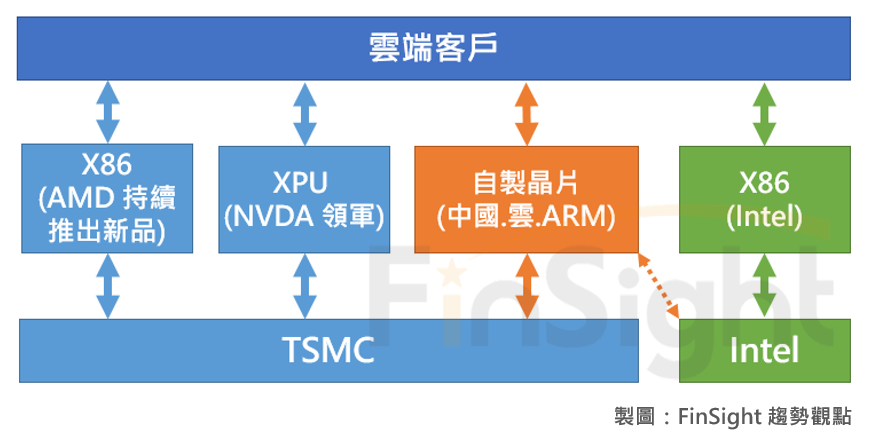
The strategy is right. The execution record is not.
This is actually a decent moment for Intel to put foundry on the table. Semiconductors are in the fiercest shortage on record, so cloud vendors and US and European governments are bound to be interested in supporting it, because everyone wants supply chain diversification. That is why the company said 20 to 30 cloud customers have started talks.
What still has to be proven is Intel's technology in leading-edge process, 3D packaging and serving XPU chips.
Management stressed that it is very positive on its own progress in leading-edge process and 3D packaging, and said it has found over this period that its packaging technology is exceptionally strong. It plans to use Foveros 3D packaging in the CPUs due in 2023.
One more data point: on its latest earnings call, in April 2021, TSMC said SoIC, its front-end 3D packaging, goes into small volume production in 2022 and will be used for very high speed computing. We think that with Moore's Law slowing, front-end 3D packaging opens a new era for high speed computing and will decide who wins. We are confident in TSMC's technology roadmap.
Intel was in fact the first company to read the trend right, back in 2016. For the data driven era it bought Altera in FPGAs, Mobileye in automotive and Habana in AI, among other chip assets, and reshaped its revenue mix, then manufacturing problems dragged the related products down and it lost share.
As things stand, the evidence that Intel can run a foundry business well is not there yet, and time is not on its side. The HPC market is expanding faster, competitors are widening their own advantages quickly, and if the capex going into foundry does not turn into clean volume production, Intel ends up with the worst of both: the spending without the business.
We think Intel's new CEO has read the trend correctly and has the resolve to reposition the company for the data driven era. Even so, the company still faces a brutal set of facts.
The next post takes up how hard that competitive environment actually is.