
Applied Materials' 2021 analyst day: data compounding 88% a year to 2025, and wafer fab equipment up from $28B in 2013 to over $70B in 2021.
Step back and look at the trend, and the last month in tech has been genuinely exciting. Intel announced IDM 2.0, its strategy as an integrated device manufacturer (IDM) moving into foundry, ARM launched the V9 architecture, its first new architecture in ten years, Applied Materials used its analyst day to lay out where the semiconductor industry is going, NVIDIA rolled out another round of AI platform products at GTC (its GPU Technology Conference), and TSMC raised its capital spending plan again, to $30 billion. All of it landed within roughly four weeks, and all of it circles the same theme: the data driven tech revolution.
Key takeaways
- Applied Materials expects data volume to compound at 88% a year from 2020 to 2025, and by 2025 humans will generate only 1% of the total. Data is growing far faster than compute, and that gap is what pulls semiconductor demand higher.
- Wafer fab equipment (WFE, the tools that make chips) stopped being a purely cyclical business in 2013. Spending has more than doubled in eight years, from $28 billion in 2013 to over $70 billion in 2021, a compound growth rate above 12%, and WFE intensity, wafer fab equipment spending divided by industry revenue, is back up from 8.9% in 2013 to 13.7% in 2020.
- The spending revisions are broad, and logic leads them. TSMC has raised its 2021 budget to $30 billion, with 80% going to 3nm, 5nm and 7nm and 10% to advanced packaging, and management says 3nm and 5nm demand is stronger than it was a quarter ago.
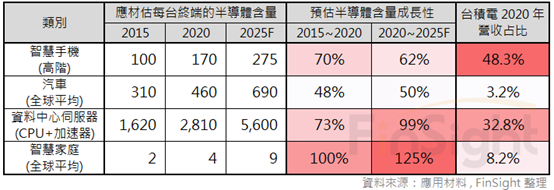
- Semiconductor content per device keeps climbing, and data center servers have the most room left: up 70% from 2015 to 2020, with another 99% expected from 2020 to 2025. We think AI is confirming semis as a long-term growth industry, and that should change how the market values them.
The AI megatrend is not news to us. We have written about it since 2016. But over the past stretch it has become obvious that both the technology roadmap and the vendors' own actions have moved into a faster phase. On top of that, governments now treat semiconductors as a scarce strategic resource, which will change the industry again. So we are starting a series to set out how we think the data driven tech revolution reshapes the industry. We begin with Applied Materials' 2021 analyst day and the opportunity the chip industry is gearing up for.
Chip capital spending is being revised up hard. What do the buyers see?
Over the past six months the large chipmakers have raised capital spending one after another, with logic the standout. In the latest quarterly estimates, 2021 capital spending is running 58% above the year-earlier quarter, and for the full year it is set to come in 39% above 2020.

What do they see that justifies revisions of that size?
Part of it is already known: a short-term supply shortage, a deliberate move by customers to carry structurally higher inventory, and governments pushing local production. The bigger piece is the megatrend created by AI and 5G, which puts semiconductors into a virtuous cycle, where more data needs more compute and more compute needs more chips, and lifts the whole demand curve.
On its latest earnings call, TSMC raised capital spending to $30 billion, with 80% going to advanced nodes (3nm, 5nm and 7nm) and 10% to advanced packaging. Management kept coming back to the same point: the spending is aimed at the long-term 5G and high performance computing (HPC) megatrend, and compared with a quarter earlier, customer demand at 3nm and 5nm is stronger.
For the industry picture behind that spending, we think Applied Materials' analyst day gave the clearest explanation available.
The data opportunity is what puts semiconductors in a virtuous cycle
Digital transformation is driving an explosion in data, and it will reach into every sector. The core driver for semiconductors is simple: data is growing much faster than compute. Every HPC vendor is preparing for that market.
Of everything in this trend, this is the chart that matters most.
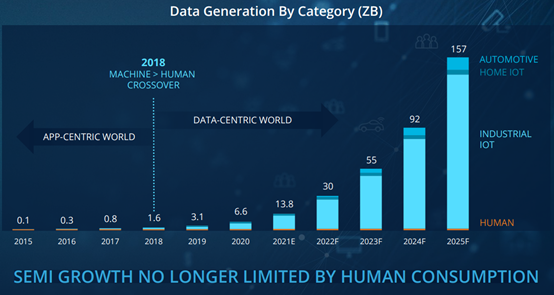
Applied Materials expects data volume to grow explosively over the next several years:
- Data generated in 2021 is more than 150 times what it was six years earlier.
- From 2020 to 2025, data volume should compound at 88% a year.
- Since 2018, machines have created more data than humans. We have moved from an app centered world to a data centered one.
- By 2025, human generated data will still be growing, but it will account for only 1% of the total. Growth in this industry is no longer capped by how much data people can create or consume. As everything from phones to cars to homes gets smarter, the semiconductor content in each of them rises.
That rising data volume is what drives the virtuous cycle in semiconductors. Applied Materials expects semiconductor content to keep climbing in every category of end device, with data center servers holding the most room: after growing 70% from 2015 to 2020, content is expected to grow another 99% from 2020 to 2025.
As AI gets applied to those data sets to pull out the insights that matter, the whole chain, from cloud to transport to endpoint chips, moves into a virtuous cycle.
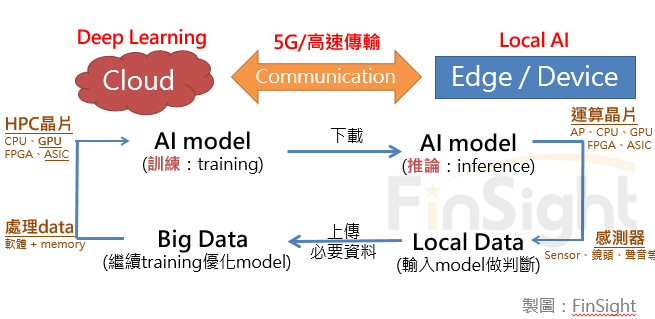
The major players (TSMC, Applied Materials, Intel and NVIDIA) all describe the same loop: AI models get trained in the cloud and deployed at the endpoint, the endpoint collects data that improves the model, and as data volume, compute and model capability all rise together, semiconductors get upgraded end to end, from cloud to edge.
A senior Samsung executive, speaking at the same Applied Materials analyst day, made a related point: 5G, autonomous driving, the industrial internet of things and hyperscale computing are all driving AI usage, but only 2% of data is actually being processed and used today, and 80% of that data is unstructured and still not handled properly. Semiconductors need new compute architectures to deliver the energy efficiency this requires.
A data driven era needs new semiconductor solutions
Applied Materials believes the AI era that started in 2018 will be the largest wave yet. Looking back across the industry, from PCs to the internet to mobile devices to AI, every era raised semiconductor usage, with demand more than double the era before it.
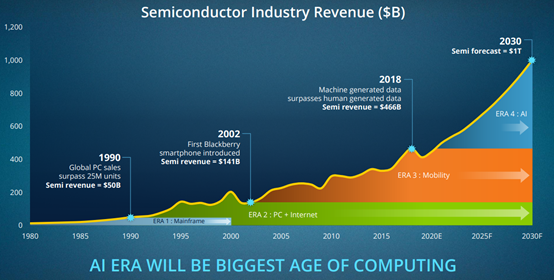
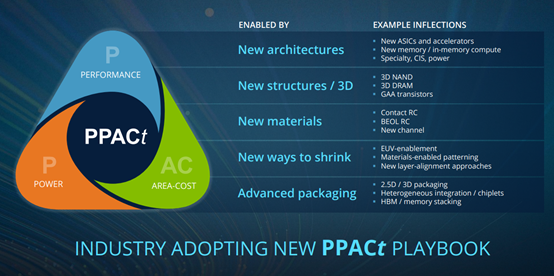
Getting there is hard. The industry faces rising design complexity, rising cost, and a slowing Moore's Law. Applied Materials' answer is the PPACt framework (power, performance, area-cost and time to market), the set of goals it expects the industry to organize around. On that basis the company guides to 13% compound revenue growth from 2020 to 2024, expects industry semiconductor revenue to reach $1 trillion by 2023, and is optimistic on the next five years.
The technology paths it points to are the ones the industry has been pushing for a while: new ASICs (application specific integrated circuits), in-memory compute, 3D architectures, new materials, heterogeneous integration and advanced packaging.
Equipment spending has started a ten year cycle and is in its key growth phase
Semiconductors are a long-term growth industry. Equipment spending has not been, at least not until recently.
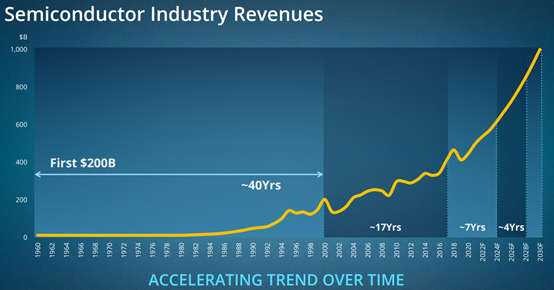
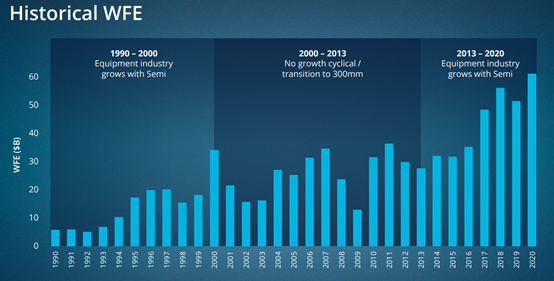
History splits equipment spending into three phases. WFE intensity peaked before 2000, then fell all the way to its trough in 2013. From 2000 to 2013, semiconductor equipment was a cyclical business and nothing more.
Four structural changes worked against equipment spending in those years:
- Manufacturing moved from 8-inch wafers to 12-inch wafers, raising productivity by 2.3 times.
- Equipment could be reused: the same systems came with more automation and higher output.
- Consolidation. During the financial crisis, smaller players exited and sold their fabs, so the survivors could buy existing capacity instead of building new fabs.
- The foundry model let many chip companies outsource manufacturing and stop buying equipment altogether.
From 2013 onward, semiconductor equipment turned from a cyclical business into a growth business. Equipment spending has more than doubled in the past eight years, from $28 billion in 2013 to over $70 billion in 2021, a compound growth rate above 12%. WFE intensity, wafer fab equipment spending divided by industry revenue, has climbed back from 8.9% in 2013 to 13.7% in 2020, putting the industry back on an accelerating investment track.
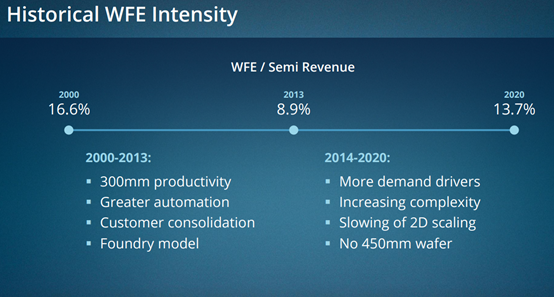
Applied Materials points to several things that are different from the 2000 to 2013 stretch: chip designs are more complex and need more process steps, Moore's Law has slowed the pace of scaling, there is no obvious upgrade to 18-inch wafers, and governments are pushing production onshore.
So equipment keeps its cyclical character. But Applied Materials expects equipment revenue to keep setting new records over the next five years.
Shortage plus structural change: a growth driver, not just a cycle
Applied Materials had several things to say about the worst shortage the industry has ever seen:
- Semiconductor demand is stronger than at any point in history, driven mainly by the biggest wave yet, which is AI.
- This wave is durable because companies do not get to opt out of it. Digital investment now decides whether a business survives. The companies that embrace digital transformation first become the winners, which changes the basis of competition, so for most companies going digital is not optional.
- Semiconductors are increasingly strategic. Every advanced country wants guaranteed supply, because without it you cannot have an advanced economy.
- The market should rethink how it values semiconductors. For a long time chips were treated as a commodity and most of the value was assigned to software. Applied Materials argues the shortage has taught a clear lesson: great software has to run on powerful hardware, and Moore's Law is slowing.
- Customer profits are at record highs. Even with investment at record levels, Applied Materials' customers are earning record profits. The industry is investing with discipline, aimed at the growth it expects over the coming years.
Put it together and the explosion in data means semiconductors have to deliver the matching compute, which is a very large HPC opportunity. NVIDIA CEO Jensen Huang framed it at GTC this way: of the 30 million data center servers shipped each year, one third go to software defined data centers, and those workloads are growing much faster than Moore's Law. Unless we find ways to accelerate, less and less compute will be left for the actual work.
The new era needs new compute architectures, and it changes the business logic of both hardware and software. That is why we have spent so much time on advanced nodes and packaging, on the fast growing cloud market, and on how tech platform business models are changing.
In our view, doing business now means enabling your customers, staying neutral, being the platform they build on, and earning subscription revenue over time. That model is not limited to software as a service (SaaS) companies. Applied Materials and NVIDIA are both raising the subscription share of their revenue too.
Our view: semiconductors are going through a structural change under the AI trend. The long-term growth trend is confirmed, and a megatrend this strong should change how semiconductors are valued over the long run.
We will keep adding to this data driven tech revolution series. The next few pieces stay on hardware: Intel's foundry strategy, NVIDIA's new products from GTC, and the structural change in semiconductors set against the inventory cycle.