
Hyperscale capital spending turns back up and grows 13% in 2021, but enterprise spending stays weak. Only Intel among the chip makers feels the correction.
Data center demand held up better than expected in the first half of 2020. The pandemic pushed companies to move to the cloud faster, and the components that go into data centers grew ahead of forecast. In the second half, as the chip supply chain moved into an inventory correction, the industry started to show a clear structural split.
Key takeaways
- Hyperscale spending is turning back up. We expect capital spending (capex) back on an upward track by the first quarter of 2021 and full year 2021 spending up 13%. This quarter the 2020 numbers were revised higher by 7.6% rather than cut.
- Enterprise spending is not following. Suppliers tied to the hyperscale upgrade have a clear growth path and should bottom in the fourth quarter of 2020, while suppliers selling into the broad data center market are likely still destocking into the first half of 2021.
- Amazon and now Microsoft have extended server depreciation from three years to four. That lifts reported cloud profitability and spreads the cost of each server over more years, which should make vendors more willing to commit to scale-out architectures, meaning capacity added by adding more machines rather than bigger ones.
- Among the chip makers only Intel is feeling the correction: data center revenue fell 8% year over year and operating margin fell 17 points to 32%, a record low. TSMC, NVIDIA and AMD all still grew, and inventory days fell across the group.
Beyond those numbers, three things in the vendors' commentary are worth pulling out.
- The pandemic pushed the large software platforms, the large cloud companies we call the hyperscalers, into new lines of business, and that will pull investment with it. Beyond Amazon's expansion in e-commerce logistics this year, Facebook's capex outlook this quarter came in ahead of what the market expected. Even with a group of companies boycotting Facebook advertising, Facebook is seeing resilience among new small and midsize customers: a lot of offline selling moved to e-commerce after the outbreak, which drove strong growth in that customer base. To build out its e-commerce ecosystem, Facebook will raise related capital spending sharply in 2021.
- Cloud equipment depreciation is going from three years to four, so useful life is getting longer. In January 2020, Amazon was first to announce it was extending the useful life on cloud spending from three years to four, arguing that servers already last more than four years and that this was simply an accounting change that matched the facts. Microsoft followed this quarter, also moving data center depreciation from three years to four. Besides lifting reported profitability at the public cloud vendors this year, a longer useful life cuts the annual cost of each server, which makes invested capital more efficient and vendors more willing to commit to scale-out architectures.
- Scale-out architecture will move from the cloud out to the edge, and data-centric integrated chips will keep changing the rules of the chip market and demand from telecom. Data center chip makers this quarter mostly emphasized how important integrated service across transport, compute and storage has become to their business. They also emphasized that AI is shifting where data center demand sits, pushing it from the cloud out to compute centers at the edge, which greatly expands the market for the high performance computing vendors.
Cloud capex is turning back up, and we estimate 13% growth in 2021
Compared with the prior quarter, cloud company capital spending was not cut this quarter. It went the other way, revised higher by 7.6% for the full year. The main driver is Facebook expanding its capital commitment to e-commerce. On that basis we expect the inventory correction at the large cloud companies to bottom in the fourth quarter of 2020, with spending recovering through 2021.
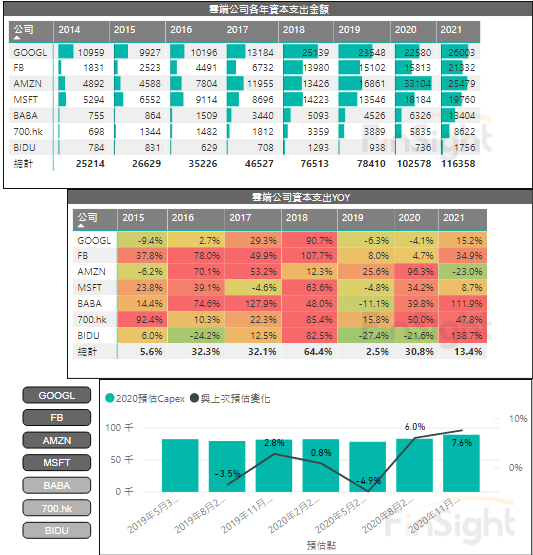
Here is what each company said about that business on its earnings call.
- Facebook: 2020 capex of about $16 billion, unchanged from its prior estimate. For 2021, investment in data centers, servers, network infrastructure and office facilities, including construction work delayed by the pandemic, puts capex at $21 billion to $23 billion, up 31.3% to 43.8% year over year.
- Microsoft: commercial cloud is still growing a healthy 31% and now accounts for 40.9% of company revenue, a share that keeps rising. Capex next quarter should be flat with this quarter, supporting rising use of and demand for cloud services. The company also changed its accounting, moving data center depreciation from three years to four, which added 3 points to commercial cloud gross margin.
- Amazon: the sharp increase in spending is going mostly into logistics and warehousing, while AWS growth stays healthy. The company expects fulfillment square footage to grow 50% this year, most of it opening between the end of the third quarter and the fourth quarter to handle year end peak demand.
- Google: investment growth slowed year over year this quarter, mainly because the company slowed the pace of real estate acquisition early in the pandemic. Servers were still the largest driver of investment in the third quarter of 2020, followed by data centers. Full year capex guidance is unchanged, still targeting a modest decline from 2019. The company says it will keep investing behind growth, especially in cloud.
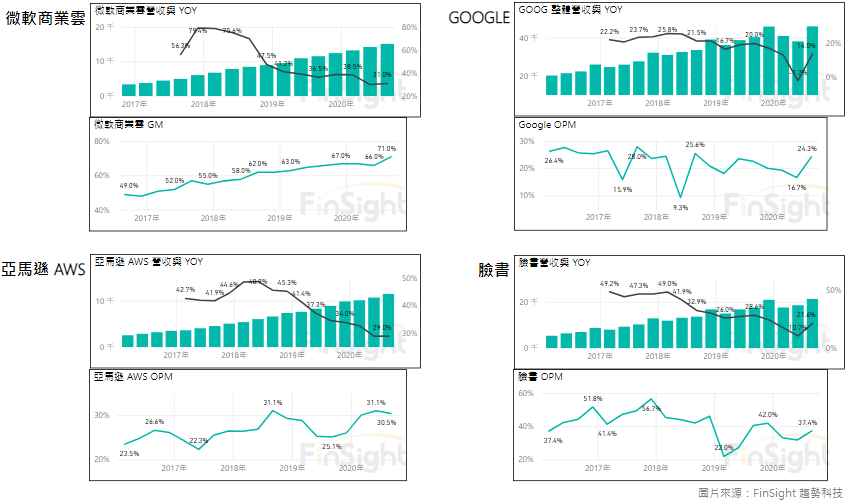
Growth at the cloud vendors themselves was very healthy this quarter, and that is the important driver behind the recovery in cloud spending.
The caveat: the large cloud companies are less than half of the total data center market, and enterprise capital spending shows no clear sign of recovering yet. So what is working right now is components tied to the hyperscale technology upgrade, not the data center market across the board.
One more thing to watch. Even with the recovery we expect in 2021, 13% growth is still slower than 2020's.
In chip makers' data center revenue, the gap between winners and losers is widening
Not every chip maker is feeling the inventory correction. Across the major US high performance computing (HPC) vendors, essentially only Intel is seeing a serious one. The rest are still growing strongly.
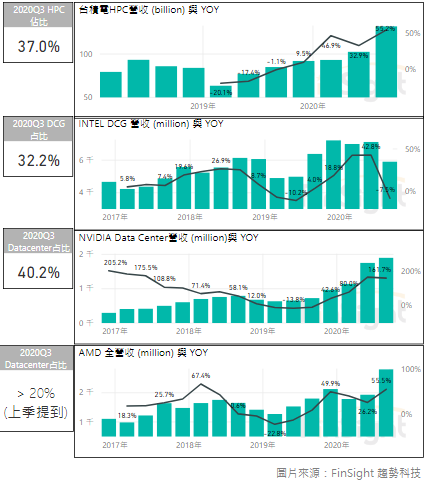
Here is a summary of what the major HPC vendors said.
- TSMC: the businesses that will grow faster than the company as a whole over the long run are HPC, 3D packaging and advanced nodes.
- NVIDIA, the quarter: record revenue on strong growth in the A100 platform, continued growth at Mellanox and record T4 shipments. Management guided to a slight sequential decline next quarter, mainly because one Chinese Mellanox customer will stop taking product.
- NVIDIA, inference and networking: AI demand keeps shifting toward inference. T4 inference chips keep setting shipment records, and the company said that across the seven largest public cloud providers, GPUs now handle more inference work than CPUs do. In applications such as voice AI, where low latency matters, GPUs have proven better on both performance and cost, which should push data center demand for inference GPUs higher. Increasingly complex AI applications are driving strong demand for Mellanox high performance interconnect, because those workloads need faster, smarter, more scalable networks.
- NVIDIA, the longer arc: as the data center becomes the new unit of compute in the AI era, Mellanox networking becomes the base layer of modern scale-out architecture, and every computer ends up built like a data center, so every server needs a data processing unit (DPU), a network card that offloads transport and security from the CPU. Within the data center business, the accelerated computing piece has nothing to do with destocking, and with the company's new product cycle on top of that, NVIDIA does not feel the broader data center inventory correction at all.
- AMD: server revenue hit an all time high this quarter on growth in cloud computing and enterprise adoption, up double digits sequentially and more than double year over year. With the enterprise adoption rate accelerating, AMD expects to win more customers in vertical markets and take more share. Milan, the Zen 3 server CPU, starts going to cloud customers this quarter, and demand is strong: the customer base is broader than it was for second generation EPYC. AMD does not see the data center inventory correction Intel sees, because its share is still small, because it keeps gaining share on new products, and because AMD has committed to customers that it will ship on its roadmap consistently, which is the opposite of an Intel that keeps delaying. Management's line is that the single chip era is over and that HPC belongs to 3D packaged chips. The company expects the Xilinx acquisition to create synergies, accelerating workloads across the board from AI compute to smart networking and software defined infrastructure (CPU plus GPU plus SmartNIC, a network card with processing of its own, plus FPGA, or field programmable gate array). The two customer bases are highly complementary, both companies use TSMC's 3D packaging process, and their technology development and their need for advanced nodes look very similar.
- Intel: data center revenue fell 8% year over year, below what the market expected, and operating margin fell 17 points to 32%, a record low. The drivers are a decline in enterprise and government contract business, more competition in the data center market, and a higher mix of 5G system on chip (SoC) products that pulled average selling prices down 15%. Profitability dropped sharply as a result. The company expects the data center to still be correcting inventory in the fourth quarter, with a recovery only in 2021, and Ice Lake ramping from the first quarter of 2021.
Outside Intel, inventory days at all of these chip makers kept falling this quarter, which says none of them is carrying much product and that their growth stays strong.
Overall, high speed compute and high speed networking are the core of the cloud data center upgrade, which is why the vendors tied to that upgrade do not feel the correction. But Intel's commentary makes clear that the data center market as a whole is still working through inventory in the fourth quarter of 2020, with no clear sign of a recovery yet.
What we care about most is that data driven compute is changing chip specifications, and that will create the leaders of the next era. When the next stage arrives and open cloud specifications start moving out to edge compute at the carriers, the addressable market for the vendors involved gets much bigger.