
Cloud capex estimates for 2019 and 2020 each came down 3% from last quarter. Only Amazon's estimate went up, and the data center share is falling.
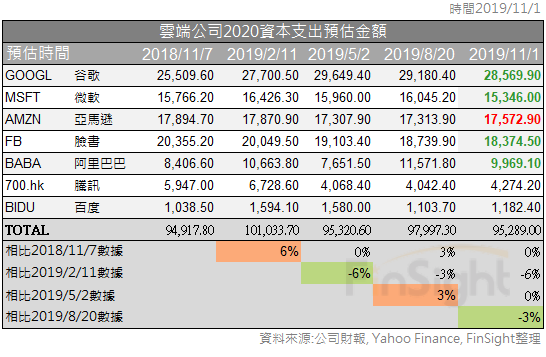
Third quarter 2019 earnings season is done, so we have refreshed our capital spending (capex) estimates for the large cloud companies (the hyperscalers). Both years came down. The 2019 total and the 2020 total each sit 3% below the estimates we carried a quarter ago.
Key takeaways
- Combined capex estimates for the hyperscalers fell for both years: 2019 and 2020 are each 3% below last quarter's estimate.
- Amazon is the only one whose estimate we raised this quarter, and we raised it on management's comments: the money is aimed at machine learning and algorithms. Amazon does not break the number out, so there is no way to tell what share is data center.
- Less of the total is going into data center servers. Alphabet (Google) moved office facilities from 30% to 40% of its capex mix this quarter, and Facebook added office facilities to its 2020 capex line, so the share that is not direct data center spending is rising.
- Growth is still there: combined capex is up 11% year over year in 2019 and 13% in 2020, with Google, Microsoft, Amazon and Facebook all running 10% to 12% for 2020.
Why we track cloud capex
Our November 2019 note on TSMC's Q3 2019 call, published the same day as this one, covered the capex increase that came with it, driven by 5G, which is providing near term growth. 5G demand splits into 5G handsets and HPC (high performance computing), and HPC in turn shows up in data centers and in base stations and other compute and connectivity equipment. Taking cloud capex apart tells us how that piece of demand is changing. Cloud capex is also the demand signal that shows up first in the Taiwan listed semiconductor supply chain, and it points to how inventory may move along that chain.
Estimates came down from last quarter everywhere except Amazon
On our numbers, combined capex at the hyperscalers grows 11% year over year in 2019 and 13% in 2020. Within that, Google, Microsoft, Amazon and Facebook each land in a 10% to 12% range for 2020.
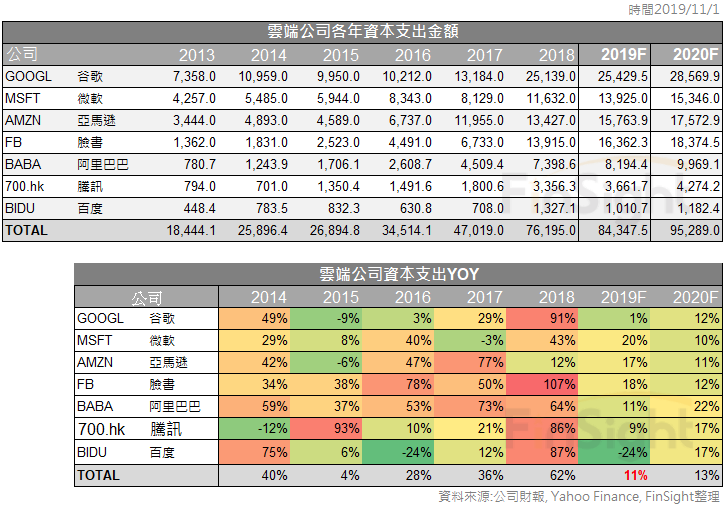
Second half 2019 capex is higher and the chipmakers say orders are good, but the 2019 total is still 3% below last quarter
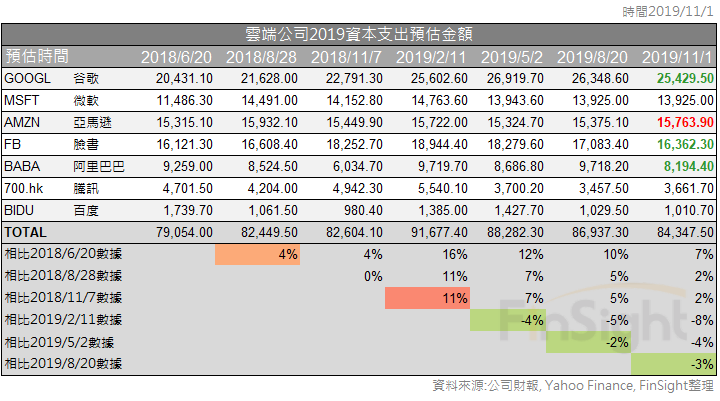
The 2020 total is 3% below last quarter as well, mainly because Facebook and Google are spending conservatively
What the companies said
- Google: heavy depreciation has weighed on profit for several quarters, and our read is that the company is now under pressure to spend capital more efficiently. Spending on servers is not growing much, and the mix has shifted: technical infrastructure (data centers) against office facilities moved from 70:30 to 60:40. Data center spending grew 5% against last quarter.
- Microsoft: capex will track the pace of cloud growth, and the company expects it to fall in the fourth quarter of 2019. In 2018 Microsoft said 94% of its capex goes into data centers, which makes it the company whose capex is most tightly tied to the data center.
- Amazon: capex keeps going into machine learning and algorithms (the expense growth this quarter was shipping, not compute). Amazon is still expanding capex to chase growth, but the spending covers both compute (data centers) and the transportation and logistics network, and the company is also adding people and expense to build out its enterprise cloud, so there is no way to separate out how much of it is data center.
- Facebook: capex estimates for both 2019 and 2020 came down 5%. Compare what the company itself lists: for 2019 the items are 1) data centers 2) servers 3) network infrastructure, and for 2020 they are 1) data centers 2) servers 3) office facilities 4) network infrastructure. Office facilities is the addition, so the dollars actually going into data centers may be lower. Facebook still guides 2020 above 2019; our 5% cut is against the higher estimate we had been carrying.
Facebook's guidance, quoted from the call. Unlike Google and Microsoft, it gives no mix:
"We expect 2019 capital expenditures will be approximately $16 billion compared to our prior estimate of $16 billion to $18 billion. Our capital expenditures are driven primarily by our ongoing investments in data centers, servers and network infrastructure."
"We expect that 2020 capital expenditures will be approximately $17 billion to $19 billion driven by investments in data centers, servers, office facilities and our network infrastructure."