
2020 cloud capex estimates are back up 5% to their pre-pandemic level and 2021 points to 7% growth, so the coming inventory correction looks small.
In May 2020 we argued that the capital spending (capex) cuts at the large US cloud companies, Microsoft, Amazon, Google and Facebook (the hyperscalers), would push the related electronic components into an inventory correction in the second half of 2020. An inventory correction is the stretch where buyers stop ordering and work down the parts they already hold, so supplier revenue falls faster than end demand does.
Key takeaways
- Analyst estimates for 2020 capex at the four hyperscalers are back up 5%, roughly where they sat at the start of 2020, and 2021 estimates now point to 7% growth.
- Management language on the second quarter 2020 calls was much better than a quarter earlier. Facebook took its 2020 capex to $16 billion, the top of the $14 billion to $16 billion range it gave last quarter.
- Data center components still go into an inventory correction in the second half of 2020, but with capex estimates repaired we think the correction stays small and is over in about two quarters.
- The risk we are watching is public cloud growth easing on a larger base: Google Cloud revenue growth slowed to 43% on $3 billion in the quarter. Alphabet backlog of $14.8 billion, most of it Google Cloud, sits behind that.
Over the past few months a number of chip and component makers, Intel, Samsung and Aspeed Technology (the Taiwan supplier of server management controllers) among them, said the cloud buyers needed to work down inventory after three or four quarters of heavy ordering. Intel still saw a decent third quarter, but guided full year data center growth to only 10%, which implies a clear step down in data center revenue in the fourth quarter.
This quarter, though, the US cloud companies sounded better than they did last quarter, and the estimates have come back up with them. With long term cloud demand still healthy, we expect this inventory correction to be modest in size.
Cloud capex guidance is better than it was last quarter
On analyst estimates, capex at the US cloud companies is back to the level assumed at the start of 2020. What management said on the earnings calls was also a little better than a quarter earlier.
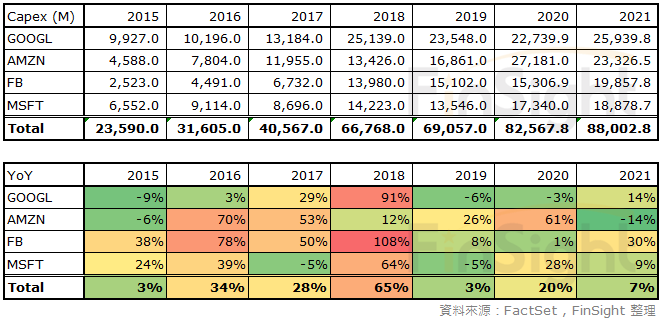
- First quarter of 2020: capex estimates were cut a clear 5%. Google and Facebook came down, though server spending was still expected to hold at or above 2019 levels, with the cut falling on fixed asset investment. Amazon and Microsoft went the other way and were revised higher, because their core businesses gained from the pandemic and they spent into it.
- Second quarter of 2020: the tone was far better than last quarter. 2020 capex estimates are back up 5%, almost exactly where they sat before the pandemic. Most of these companies stressed that as cloud usage rises, they will keep expanding data center capex alongside revenue growth. Estimates now have capex at these four companies growing 7% in 2021.

One detail stands out. 2020 capex is only back to the level estimated in February 2020, while 2021 spending now sits above that February estimate. After the shock of the pandemic, spending more is something these companies have decided they have to do. One caveat on Amazon: a good part of its spending goes into logistics, which makes it different from the other three.
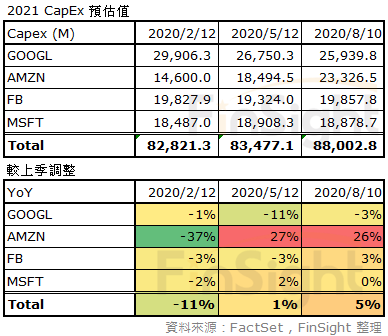
Company by company, the capex commentary has gotten more confident
Microsoft: it expects to keep capex next quarter at about the same high level as last quarter. With cloud revenue still growing and the company seeing strong consumption and usage demand, cloud capex will grow to match. Its commercial cloud is currently growing 30% year over year.
Amazon: capex grew 65% year over year last quarter, driven by both logistics and data center investment, and the company expects next quarter to run at roughly the same level. Separately, while AWS growth is slowing as the base gets bigger, backlog is also up 65% year over year with an average contract length of more than three years, so the company still reads demand as strong.
Google: the language is unchanged from last quarter. Total 2020 capex will be below 2019, but that is mostly a slower pace of office building purchases. Technical infrastructure will hold at roughly the 2019 level, and within it server spending will run above data center construction. On the cloud side, revenue of $3 billion grew 43%, down from prior quarters. Backlog stands at $14.8 billion, most of it tied to Google Cloud, and the company thinks the product is winning large customers willing to sign long contracts.
Facebook: effectively a small raise. 2020 capex is now guided to $16 billion, the top end of the unchanged $14 billion to $16 billion range given last quarter. Second quarter capex fell 11% year over year because of the pandemic, but the company says operations are back to normal and it expects to catch up on the delayed capex in the second half of 2020.
But public cloud growth is slipping a little, and that needs watching
Capex is only justified by how many cloud customers these companies serve and how fast the matching revenue grows.
Management said on the calls that the public cloud is still growing steadily and that backlog is strong. In the numbers, though, growth rates are coming down as the base gets bigger, and that bears watching.

Taken together, data center components go into an inventory correction in the second half of 2020, but cloud capex has been repaired back to the level assumed at the start of the year. So we think this correction is shallow and probably done in about two quarters.
What individual suppliers see, though, varies a lot. AMD is gaining share and has not been hit by the inventory correction at all: its data center revenue is still very strong, the second half of 2020 should come in above the first half, and data center has now officially crossed 20% of AMD revenue. The same pattern, new products taking share, is also playing out at TSMC and NVIDIA.
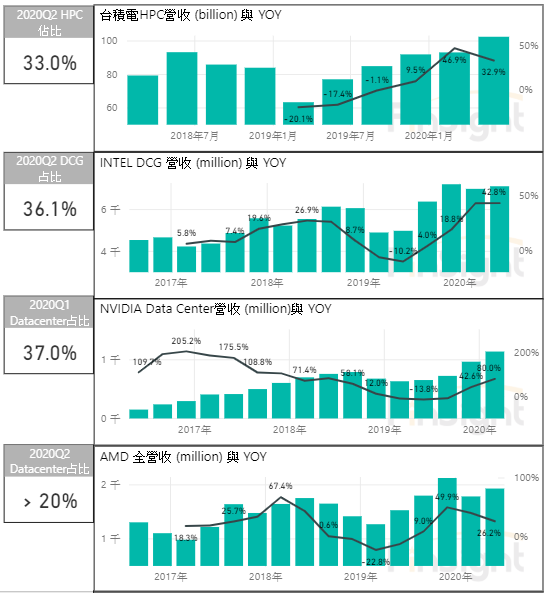
The slight slowdown in public cloud growth is the potential risk we care about, and we will keep watching it in next quarter's results.