The four hyperscalers cut 2020 capex growth to 7.6% from 13.6%, while 2021 estimates barely moved. Data center chips may face an inventory test.
In our earlier post on what the chipmakers' fourth quarter 2019 results said about data center demand (February 2020), we saw a clear pickup in demand for high performance computing chips. This earnings season most technology companies are still guiding their data center businesses up, and yet the estimate for 2020 capital spending (capex) growth at the US cloud companies has been cut to 7.6% from the 13.6% assumed a quarter ago, a reduction of about 6 points.
Key takeaways
- Estimated 2020 capex for the four large cloud companies (the hyperscalers), Alphabet (Google), Microsoft, Facebook and Amazon, fell to $74.7 billion from $78.9 billion, taking growth to 7.6% from 13.6%.
- The 2021 estimate barely moved, from $86.6 billion to $85.2 billion, so the market still reads data center demand as a steady long term grower.
- The split runs along business models: the advertising driven names, Google and Facebook, cut the most, while Microsoft and Amazon, helped by remote work and ecommerce, were revised slightly higher. Azure grew 59%, and AWS grew 33% with operating margin back to 30%.
- The timing risk is what we would watch. After the 2018 capex surge slowed in 2019, the chipmakers went into an inventory correction from the fourth quarter of 2018 and did not return to growth until the third quarter of 2019. Data center customers have now been pulling orders forward for three quarters since the third quarter of 2019.
Our earlier post on the risk of a semiconductor inventory build in the second half of 2020 (April 2020) reached the same conclusion about a second half inventory correction, from what the big chipmakers said on their own calls. Taiwan technology stocks, which sit in the supply chain that builds most of this hardware, are also having a good second quarter of 2020, but from the second half we think investors need to keep watching for an inventory correction.
The US cloud companies as a group have cut 2020 capex
Data center demand is pulled by the cloud companies. Their data center investment serves two kinds of business. One is growth in their own operations, such as advertising at Facebook and Google. The other is selling public cloud, or infrastructure as a service, such as Amazon's AWS and Microsoft's Azure.

Adding up the capex estimates for the four large US cloud companies (Google, Microsoft, Facebook and Amazon), total 2020 capex has come down to $74.7 billion from the $78.9 billion assumed a quarter ago, and growth has been cut to 7.6% from 13.6%, a reduction of about 6 points.
The 2021 estimate tells a different story. Even with the sharp cut to 2020, 2021 came down only slightly, to $85.2 billion from $86.6 billion. The market still believes data center demand grows steadily over the long run.
Company by company, the capex outlook varies a lot
Each company is adjusting its capex outlook to fit its own business. The advertising driven names, Google and Facebook, are cutting more this year and expect to get back on the original investment growth track next year.
Microsoft, a beneficiary of remote work, and Amazon, a beneficiary of ecommerce, went the other way: capex was revised slightly higher and steps up steadily each year. This quarter's results back that up. Public cloud growth at both held steady, with Azure up 59% and AWS up 33%, and AWS operating margin recovering to 30%.
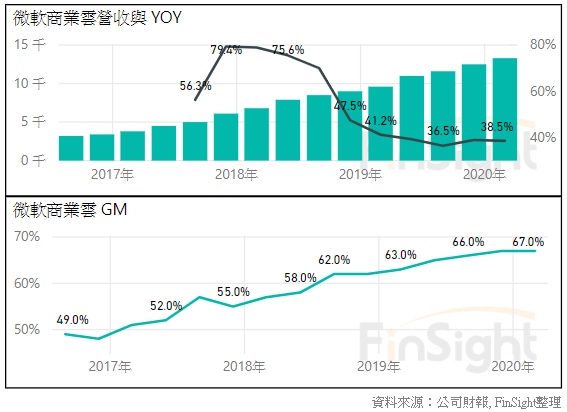

Here is what each of the cloud companies said about capex on this quarter's earnings calls.
Google: last quarter it said investment in both technical infrastructure and office facilities would rise versus 2019. This quarter it expects full year capex to fall from the prior year, with technical infrastructure spending slightly below last quarter's estimate but roughly level with 2019 overall, with more of that going to servers than to data center facilities. It will also slow the pace of office building purchases.
Facebook: 2020 capex guidance came down to $14 billion to $16 billion from the $17 billion to $19 billion given last quarter, a cut of 20% at the midpoint. The company says this reflects the large hit to the business from the pandemic, but that with user growth strong and the need for infrastructure investment still there, the 2020 reduction should be seen as spending pushed into 2021 rather than money saved.
One caveat on that: Facebook's 2021 capex estimate was not revised up. It simply returns to the normal track.
Microsoft: the drop in capex last quarter was only supply chain delay caused by Covid-19. As the supply chain problems ease, the company expects capex to grow sequentially in dollar terms to meet rising usage and demand for its cloud services.
Amazon: total spending was revised higher, but the call suggests more of it may go into logistics, since the company thinks its picking and packing speed in the warehouses still needs work. On data center, after changing the depreciation life from three years to four last quarter, it has seen the profit benefit from lower depreciation and will keep working to run data centers for more years, which it calls a joint hardware and software challenge.
What the capex cut means for the chipmakers
The new habits created by the pandemic accelerate technology adoption over the long run and keep cloud spending rising, which is the case we made in our April 2020 post on life after lockdown and the disruption and innovation that follows. The near term adjustment in the pace of capex is a different matter, and it can drive an inventory correction in semiconductors within a year.
History is the guide here. After the big jump in cloud capex in 2018, total spending slowed in 2019. The large chipmakers went into a visible inventory correction starting in the fourth quarter of 2018 and did not get back on a growth track until the third quarter of 2019.
At the start of 2020 the market expected cloud capex growth to recover to 14% from 8% the prior year. Chipmakers' data center businesses had already posted three straight quarters of fast growth from the third quarter of 2019, and the guidance is still strong today.

Intel said on its call that it sees enterprise and government demand weakening in the second half of 2020, while cloud demand should hold through the third quarter of 2020. Because data center customers have been pulling orders forward for three quarters since the third quarter of 2019, an inventory correction in the second half is possible.
AMD said the opposite: compared with a quarter ago it has better visibility on data center orders, the second quarter of 2020 is its strongest order quarter, and it can hit its 10% server share target on the original plan.
Either way, one thing is now settled: the cloud companies as a group have cut capex. The long term cloud trend is intact, but the cut can still hit near term industry demand. And on past form, about four quarters of pulled forward orders are usually followed by an inventory correction.
Data center results are strong right now. What would change our view is the 2021 capex estimate starting to come down alongside the 2020 number, or cloud demand at the chipmakers fading after the third quarter of 2020 instead of holding up. Either would say the second half inventory correction has begun.