
Q3 2022 auto earnings: OEMs held guidance, Tier 1 suppliers kept improving, and auto chip estimates started coming down, cut 5% to 10% in 60 days.
Third quarter 2022 earnings are done, so here is our pass through the global auto supply chain: what the carmakers (the OEMs), the Tier 1 suppliers (the companies that sell parts and systems directly to those carmakers) and the automotive chipmakers actually said.
Key takeaways
- The OEMs beat more often than they missed this quarter and stopped cutting their financial numbers. Only the Japanese makers cut full year volumes again, and guidance for the fourth quarter of 2022 and for 2023 is flat to conservative everywhere.
- Tier 1 suppliers, the auto parts and tire makers, split down the middle: LKQ, Aptiv and BorgWarner beat, Denso, Autoliv and Goodyear missed. Supply chain and cost pressure keep easing, and full year 2022 growth is still mid to high single digits.
- Automotive semiconductors are where the numbers are turning. December quarter guidance came in below consensus at most of them, from Wolfspeed 12% below to STMicroelectronics 1% below, and the group guides to a mid single digit sequential decline.
- Sell side estimates for the whole auto chain are 5% to 10% lower than they were 60 days ago on revenue, operating income and net income, and automotive semiconductor revenue is now forecast to decline in 2023.
OEMs are walking on thin ice
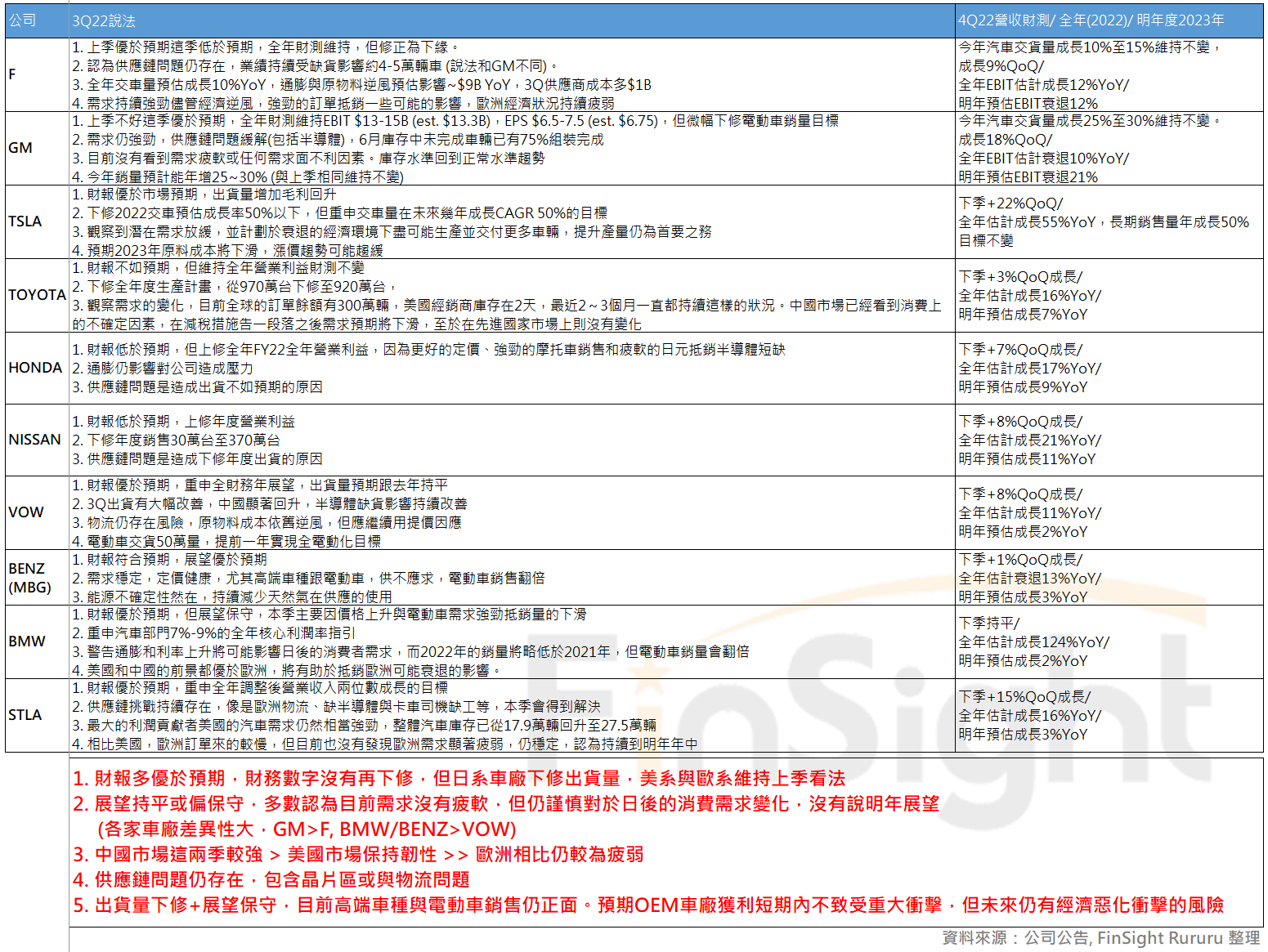
In our review of second quarter 2022 earnings we wrote that the recovery at the OEMs was coming in fits and starts. Look back across the whole year and the makers that expected a strong post pandemic recovery spent it instead waiting on supply chains that the war in Ukraine and China's strict lockdowns kept breaking. After several quarters of adjustment, though, this set of results mostly beat, and the financial numbers were not cut again.
Apart from the Japanese makers, who cut full year volumes again, the US and European makers kept the shipment view they gave last quarter. With 2023 demand unreadable, their comments on the next quarter and on 2023 are flat at best and more often cautious, and all of them say they are watching consumer demand closely. The bright spot is still strong sales of premium models and electric vehicles. By region, China turned stronger as subsidies fed through, the US market held up, and Europe was the weak one.
Ford and GM told opposite stories this quarter. Last quarter Ford looked better than GM; this time it flipped. Ford said supply chain problems are still there and took its full year targets down to the low end. GM said demand is strong and supply chain problems have eased, including the semiconductor shortage. It sees no demand weakness, says inventory is back to normal levels, and held its full year guidance. Tesla's EV business is still strong, but it has seen demand slow: it cut its 2022 delivery growth estimate to below 50% while restating the 50% compound annual growth rate it targets longer term.
The Japanese makers are relatively conservative. Toyota and Nissan both cut full year volumes again, both said they are watching how demand develops, and both said inflation is still pressuring production. Supply chain problems were the main reason for the cuts.
Among the Europeans the difference is in the outlook. Mercedes-Benz guided better than expected and again pointed to strong demand for premium models and EVs. Volkswagen said logistics is still a risk and raw material costs are still a headwind, so it expects volumes flat versus 2021. BMW was the conservative one, warning that inflation and rising interest rates will weigh on consumer demand later.
This quarter at the OEMs came in line with what the market expected, and we do not expect a major hit in the near term. The risk from here is that the economy deteriorates. If instead it lands the way the optimists expect, a soft landing rather than a recession, the car market still has room to grow in 2023, especially in the US and Europe where the base is low.
Tier 1 suppliers: no shocks, and still improving
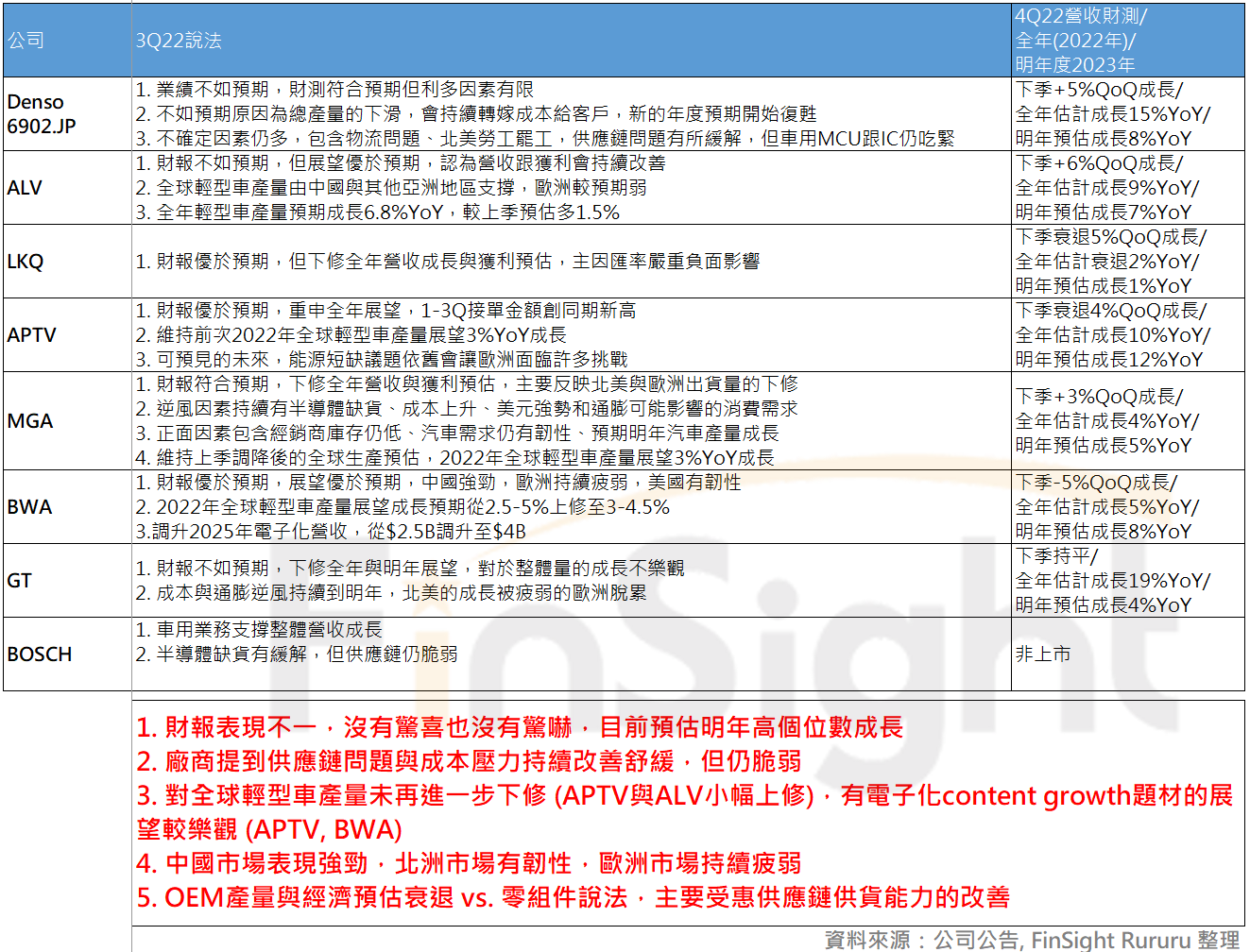
The Tier 1 suppliers, the auto parts and tire makers, delivered no surprises in either direction. Half beat (LKQ, Aptiv, BorgWarner) and half missed (Denso, Autoliv, Goodyear). All of them said supply chain problems keep improving and cost pressure keeps easing, and shipments improved meaningfully this quarter. The chain is still fragile, and the group still guides to mid to high single digit growth for the full year.
The regional read matches the OEMs: China strong because the subsidies worked, North America resilient, Europe still weak. Nobody will commit to a 2023 number yet, though consensus sits in the high single digits. Nobody cut global light vehicle production again either, and Aptiv and Autoliv nudged theirs up. The companies with an electronics content growth story guide better, Aptiv and BorgWarner in particular. The macro is what to keep watching: if a recession does arrive, cuts to OEM volumes hit the Tier 1 suppliers directly and none of them escapes it.
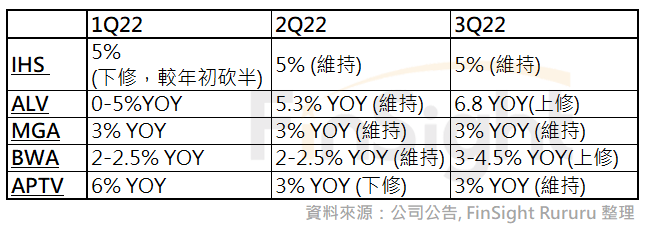
We also updated the global light vehicle outlook each company gave this quarter. It is not much different from last quarter: Autoliv and BorgWarner raised their 2022 full year numbers slightly and the rest held. Global light vehicle shipment growth for 2022 is still 3% to 5%.
Automotive semiconductors: the clouds rolled in and the cuts have started
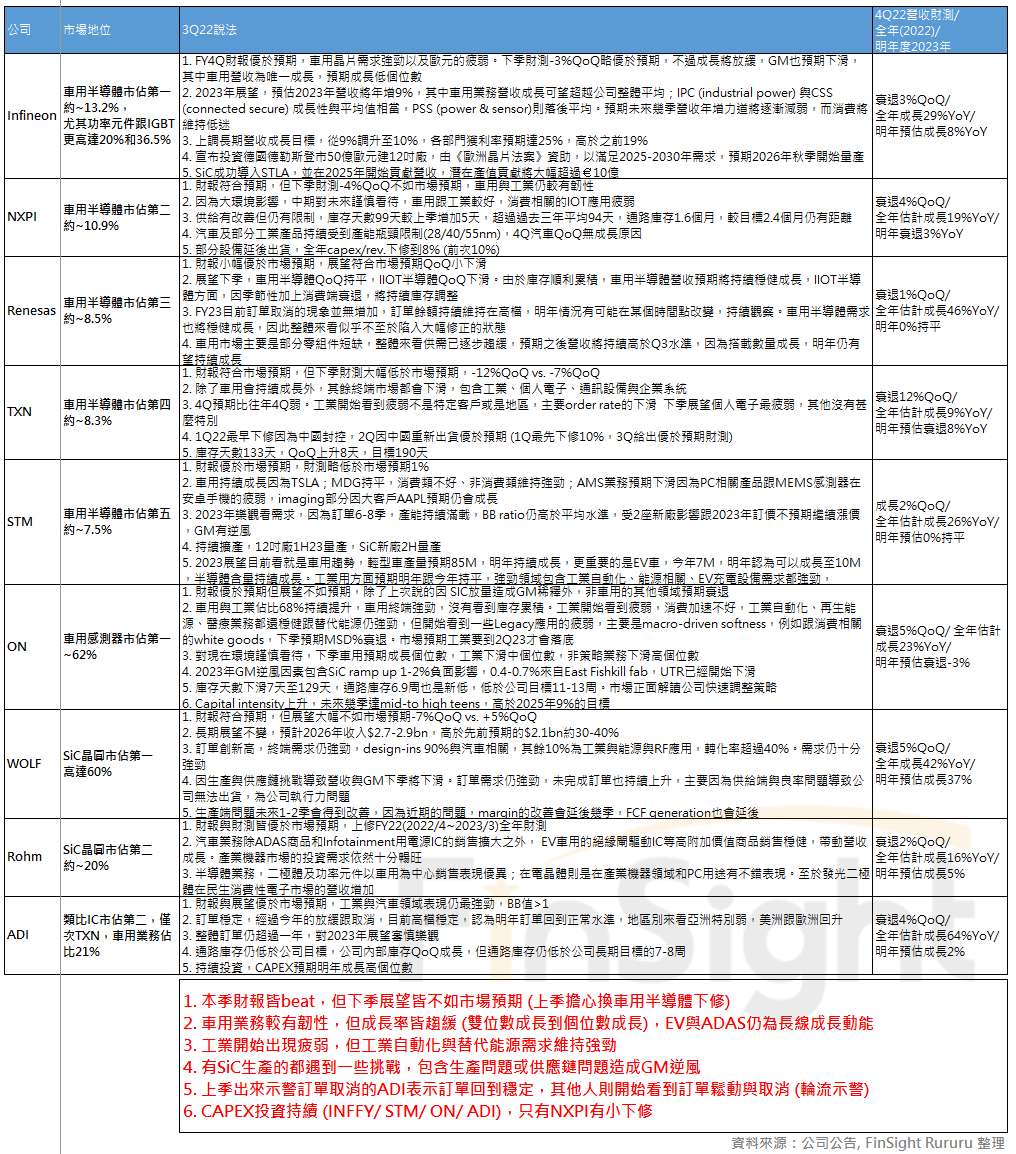
Last quarter Analog Devices flagged order cancellations, which is why we worried that automotive semiconductors could start getting cut too. This quarter confirmed it. Reported results were mostly in line with a few beats (STMicroelectronics, onsemi, Analog Devices), but December quarter guidance came in below consensus at most of them: Wolfspeed was the worst at 12% below and STMicroelectronics the mildest at 1% below, with only Infineon, Rohm and Analog Devices guiding above. On average the group guides to a mid single digit sequential decline. Full year growth is still strong year over year, but 2023 estimates now sit between flat and down.
Automotive is holding up better than the other end markets, but its growth rate has come down from double digits to single digits. Infineon, Texas Instruments, onsemi and STMicroelectronics all said automotive will still grow next quarter. NXP said some of its products are still capacity constrained and will not grow next quarter. On applications, EVs and advanced driver assistance systems (ADAS) are still the long term drivers and that trend keeps playing out.
For 2023 the tone across the group is cautious optimism. Infineon expects automotive to grow faster than the company average. STMicroelectronics is optimistic on demand, with its order book stretching six to eight quarters out. onsemi says the automotive end market is still strong and it sees no inventory building. Analog Devices says that after last quarter's cancellations and adjustment its orders are stable at a high level, that it expects 2023 to come back to normal levels, and that its backlog is still more than a year.
What is different this quarter is that each company now has its own problems. Wolfspeed will see revenue and gross margin fall next quarter on production and supply chain challenges: execution has slipped, the improvement in profitability is pushed out by a few quarters, and the free cash flow target it gave on an earlier call slips with it. STMicroelectronics has a gross margin headwind from two new fabs and from not expecting to keep raising prices in 2023. onsemi has a 2023 gross margin headwind too: the silicon carbide (SiC) ramp costs it 100 to 200 basis points of gross margin, the East Fishkill fab another 40 to 70, and its utilization rate has started to fall. NXP is still capacity constrained in automotive and parts of industrial (28, 40 and 55 nanometer), some equipment deliveries have slipped, and it cut full year capital spending to 8% of revenue from 10%.
SiC was last quarter's highlight and had less to show this time, though demand is still running hot. Infineon won Stellantis for its SiC and will start booking revenue in 2025, with a potential revenue contribution well above 1 billion euros. STMicroelectronics kept its earlier line that its new SiC fab ramps in the second half. Wolfspeed has problems on the production side, but SiC end demand is still strong and its orders keep setting new highs. As a reminder of the market estimate we have cited before, the SiC total addressable market goes from $2 billion in 2021 to $6.5 billion in 2026, a compound annual growth rate of roughly 33%, which is why this is still the part of automotive semiconductors to watch.
Estimates are coming down, but the long term trend clearly runs in this group's favor, so we still like where it goes. Demand is still strong, and orders shift around from time to time. If one or two quarters of modest adjustment on either the supply side or the demand side is what it takes to avoid the kind of large overbooking that hit consumer electronics, that is not a bad outcome. The clouds are here. Keep the umbrella by the door and wait for the sky to clear.
Estimates for the whole auto industry are still in a cutting cycle
Looking at sell side estimates, revenue, operating income and net income for the auto industry as a whole are all 5% to 10% lower than they were 60 days ago.
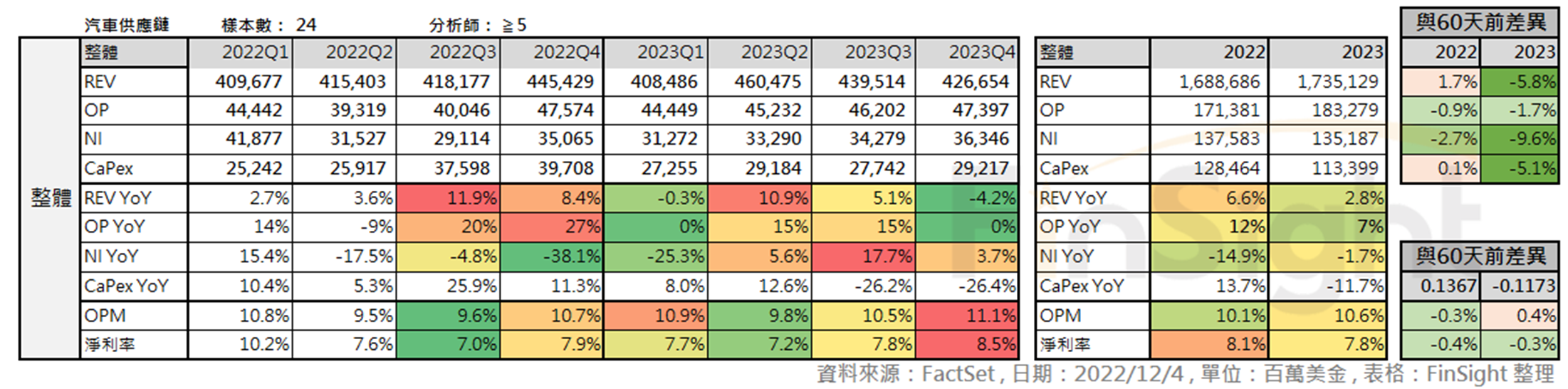
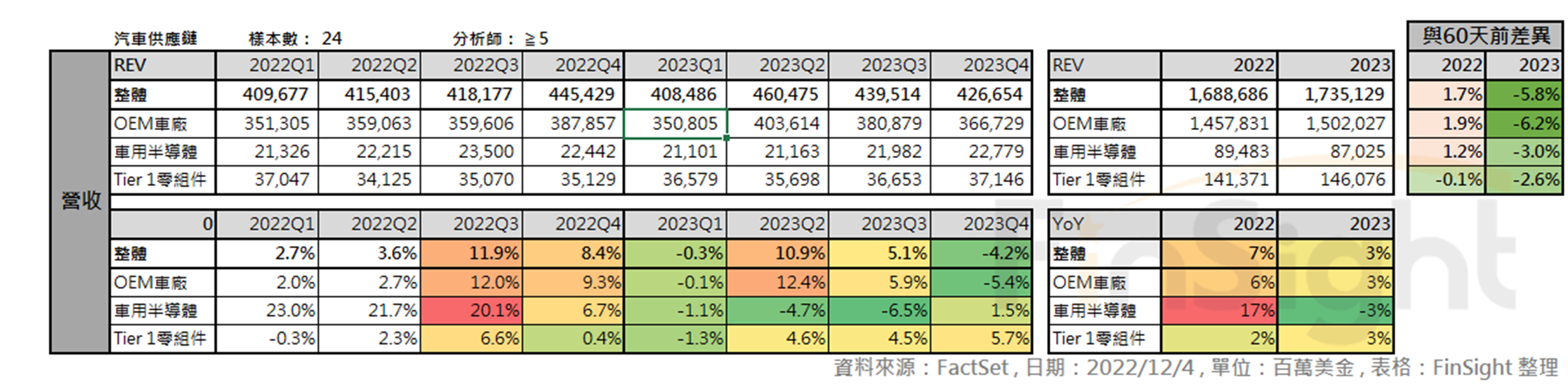
Break it down and, on revenue, automotive semiconductors are forecast to decline in 2023 while the rest still grow, and even those growth rates are 0% to 5% lower than they were 60 days ago.
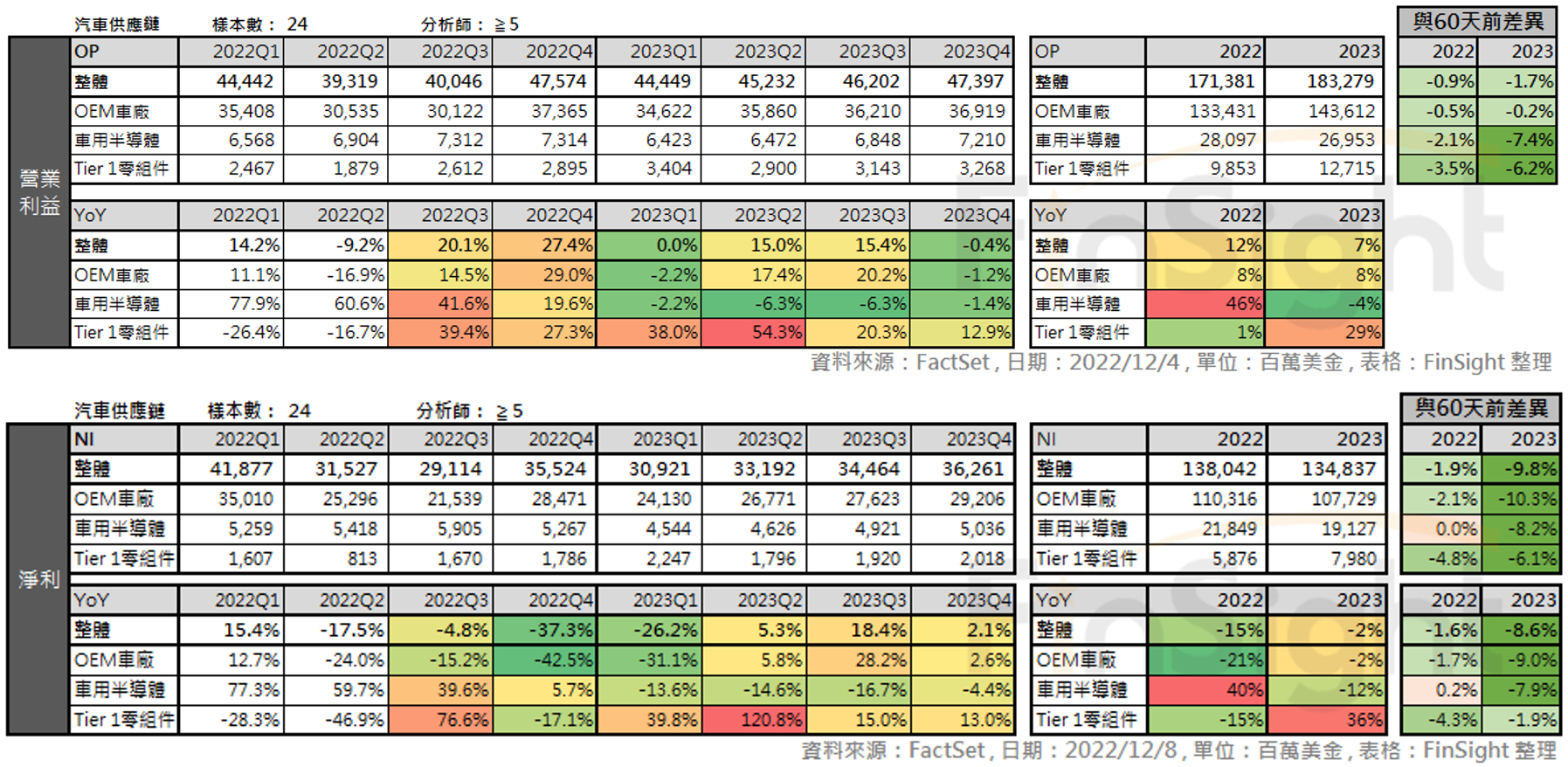
On operating income and net income, the Tier 1 suppliers jump the most in 2023 and the rest run from small growth to decline. Here too the estimates are lower than they were 60 days ago.
Nobody can call the economy from here. Estimates will keep moving as different analysts publish different numbers, so we keep watching.
Bottom line on this quarter in the auto supply chain
What we watch next quarter: whether consumer demand holds up for the OEMs, whether the Tier 1 suppliers keep improving as supply chain and cost pressure ease, and how much further automotive semiconductor estimates have to come down.