
Q3 2021 auto earnings: supply chain capex expands sharply, auto semis get both revenue and profit revised higher, and Infineon's auto book-to-bill hits 2.5.
Two themes have led this run in the Philadelphia Semiconductor Index (SOX): high performance computing chips and auto semiconductors. When we compare analyst revenue estimates after this earnings season with the estimates that stood before it, those same two areas got the largest upward revisions.
Key takeaways
- Capital spending (capex) is the standout in this quarter's numbers. Revenue growth across the auto supply chain was not revised up much, but profitability improved and capex estimates rose sharply, which is what a chain rebuilding itself for electric and software driven cars looks like.
- Auto semiconductors are the only group with both revenue and operating profit revised higher. Infineon's auto book-to-bill ratio, orders received divided by orders shipped, went from 2.3 to 2.5, STMicroelectronics has 18 months of auto order visibility, and NXP does not expect supply and demand to balance until 2023.
- The one thing to watch is Texas Instruments, which guided next quarter down 5% quarter over quarter and said customers have moved from a frantic scramble for parts to more selective ordering. Renesas agreed with that reading.
- The OEM automakers, the vehicle makers themselves, say the worst of the chip shortage is behind them. Guidance across the OEMs implies anywhere from 4% to 42% quarter over quarter growth, inventory is still low, and Nomura now sees 2021 auto production up 6% year over year and 2022 up 10%.
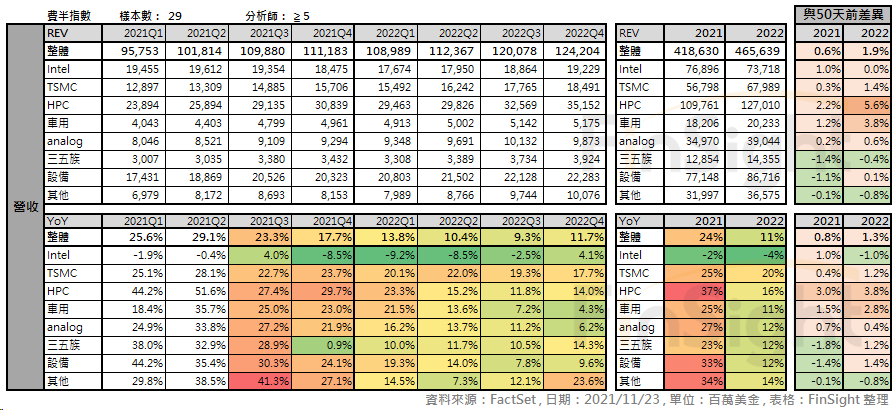
What ON Semiconductor reported for the third quarter pointed the same way for auto semiconductors: the group broadly beat on both results and guidance. Order visibility is high and profitability is improving, and these companies are riding a long term shift toward electrification and more intelligence in both industrial and automotive end markets.
Third quarter results are now largely in, so today we take the next step and walk through what companies from the top to the bottom of the auto supply chain actually said on their calls.
This quarter's signature: capex expands sharply
We pulled together the important names in the auto supply chain and put the consensus estimates for each into the table below. After this earnings season, revenue growth estimates were not revised up much, but the profitability of the chain as a whole improved, and the striking part is that capex estimates moved sharply higher.
We read that increase in capex as a signal of how much the auto industry itself is changing:
- On the demand side, electric vehicle and advanced driver assistance system (ADAS) penetration is rising fast. With autonomous driving as the long term destination, in-car entertainment and platform based selling will change today's business model, and as the intelligent share of the car rises, the amount of electronics in a vehicle goes up a lot with it.
- On the manufacturing side, labor and material shortages are now a production constraint for every automaker, and electric vehicles change the production model itself. So the automakers are all pushing to convert to smart factories that use digital technology to raise efficiency.
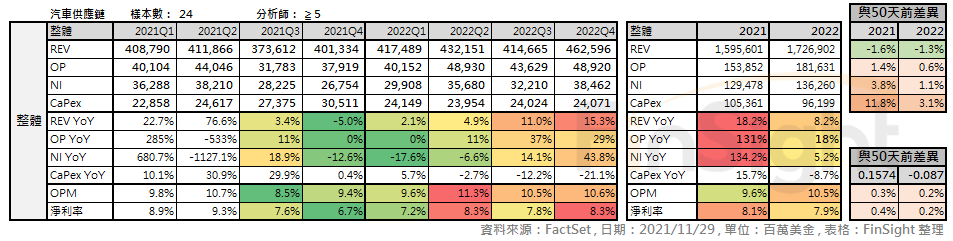
An industry changing this fast will produce clear winners and losers over the next few years, and capital markets have a particular appetite for long term trends with that much growth still ahead. Splitting the earnings into three groups, auto semiconductors, Tier 1 auto components (the suppliers that sell complete systems straight to the automakers) and OEM automakers, makes the picture sharper.
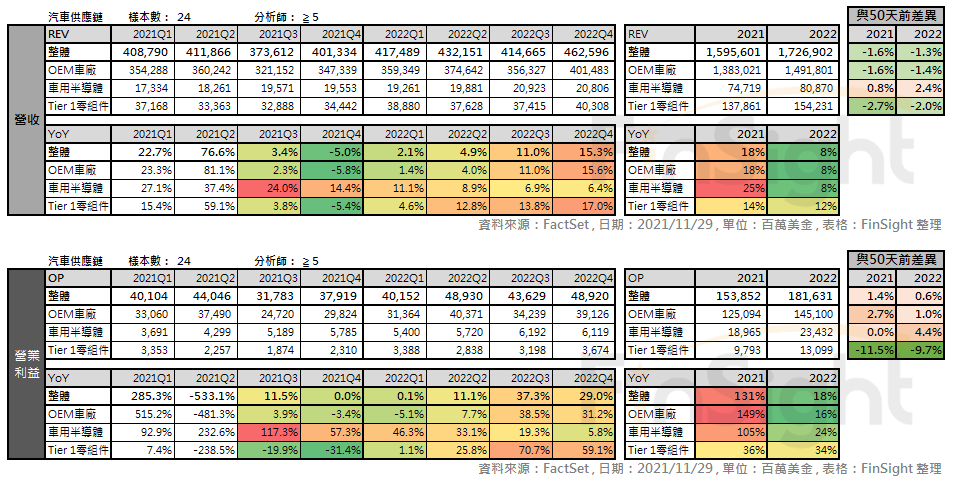
The group with both revenue and profit revised higher is auto semiconductors, where electric vehicle and ADAS penetration is climbing fast. Tier 1 component makers are held back by shortages and show no clear growth momentum yet. OEM automakers are starting to improve profitability and expect the worst to be behind them. Below we go through the important commentary in each group.
Auto semiconductors: strong auto revenue and an optimistic outlook
Start upstream. The table below summarizes what the auto semiconductor chipmakers said.
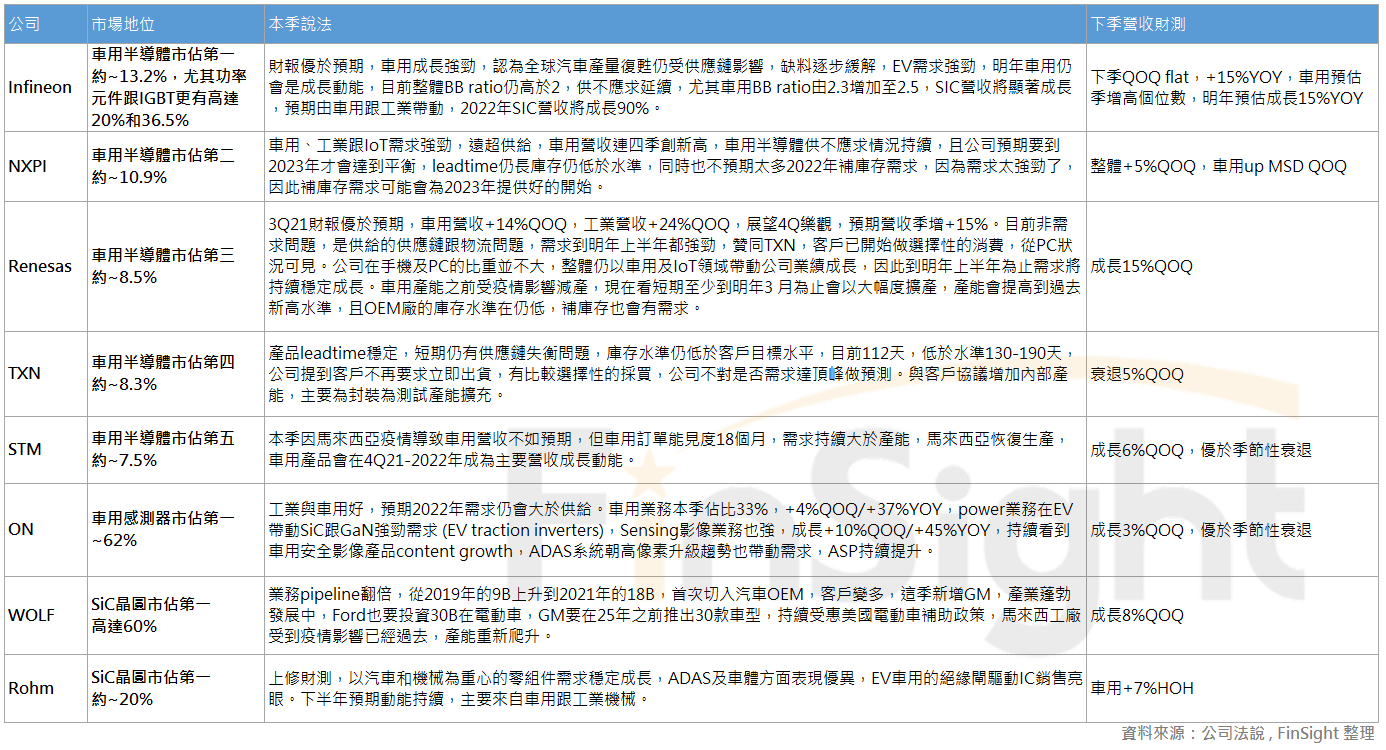
Across the top five, auto revenue grew strongly this quarter. On next quarter guidance, every company expects further quarter over quarter growth except Texas Instruments, which guided down 5% quarter over quarter.
In the detail: Infineon's auto book-to-bill ratio rose from 2.3 to 2.5. STMicroelectronics has 18 months of order visibility in auto. NXP Semiconductors said auto chip demand continues to run ahead of supply and that the two will not balance until 2023, and that restocking demand will give 2023 a good start. Renesas said it will expand auto capacity substantially through 2022 to meet strong demand, and that demand should keep growing steadily at least through the first half of 2022.
Wolfspeed, called Cree before the name change, makes the silicon carbide (SiC) wafers that go into wide bandgap semiconductors, a key material for electric vehicles. It said the electric vehicle boom has doubled its business pipeline, from $9 billion in 2019 to $18 billion in 2021. ROHM said sales of its electric vehicle integrated circuits (ICs) are strong and that demand for auto components is growing steadily.
Texas Instruments used this call to start flagging risk. The company said customers no longer ask for immediate shipment, and that buying behavior has moved from a frantic scramble for parts to more selective ordering. Renesas agreed with that reading on its own call. Asked whether the shift is a sign of a cycle peak, both companies said they cannot predict it and need to keep watching. Customer buying behavior is therefore one of the things we will keep tracking.
Tier 1 components: supply is still the problem, but the 2022 outlook is good
We summarized the Tier 1 component makers the same way.
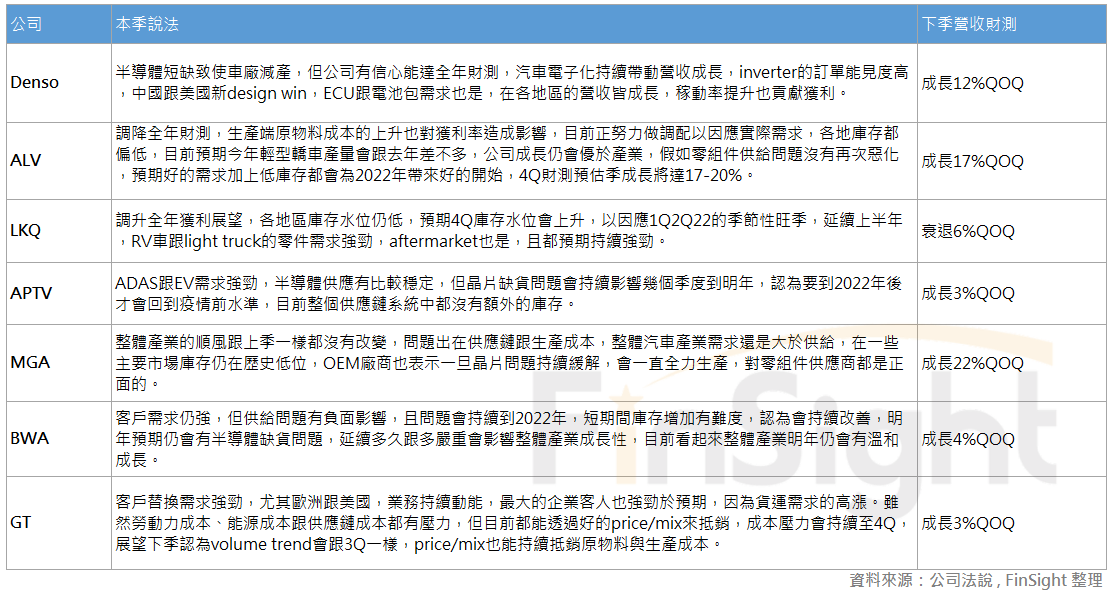
LKQ, a distributor of replacement auto parts, guides next quarter revenue down 6%, and only because this quarter was so strong. Every other company guides next quarter revenue up 3% to 22%.
Denso, the bellwether Japanese supplier, said the electrification of the car keeps driving revenue growth, with new design wins in both the United States and China. Demand for electronic control units (ECUs) and battery packs is strong as well. The chip shortage forced automakers to cut production, but Denso still grew revenue in every region this quarter.
The common thread is that supply problems are disrupting business in the near term, and that once supply clears these companies will be running flat out. Good demand plus low inventory should give 2022 a good start.
OEM automakers: inventory is low, the worst is over, and next quarter turns better
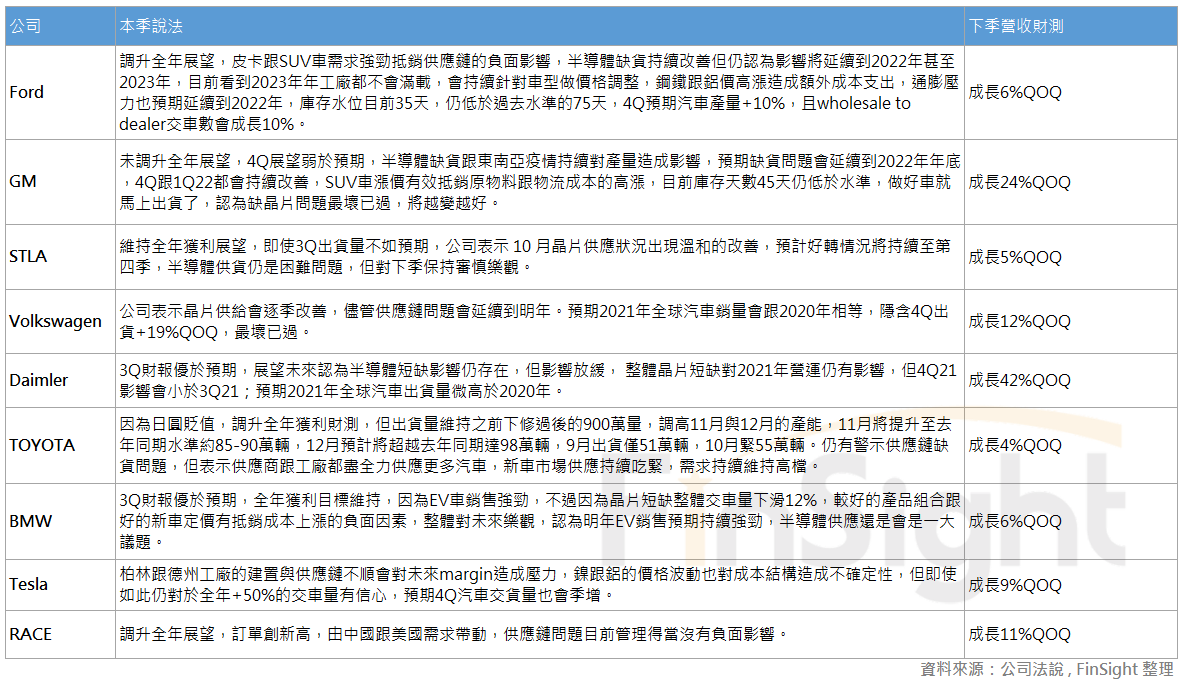
Last quarter every OEM in our group was hit by supply chain shortages and production stoppages. Looking out over the next few quarters, though, General Motors, the Volkswagen Group, the Mercedes-Benz Group and Stellantis (formerly the PSA group) all said the worst of the chip shortage has passed and that conditions keep improving from next quarter.
Guidance across these companies implies 4% to 42% quarter over quarter growth. Backing into volumes from the numbers and guidance given on the calls, Ford expects next quarter production up 10% quarter over quarter, and Volkswagen Group guidance implies volumes up 19% quarter over quarter. Toyota announced it is raising November and December output to 850,000 to 900,000 units or more, back to the year earlier level. Tesla, the leader in electric vehicles, said that even with supply chain problems slowing construction at its Berlin and Texas plants, it remains confident in 50% year over year delivery growth for the full year.
Inventory levels at the automakers are also still low, the overall tone is optimistic, and they continue to expect strong electric vehicle sales in 2022.
Nomura's latest work on overall auto volumes shows monthly auto sales growth year over year declining every month since July 2021. Its latest production forecasts are 2021 up 6% year over year and 2022 up 10% year over year. At the start of 2021 the same forecasts were up 10% for 2021 and up about 4% for 2022, so this year's production has been cut and next year's raised. The current view has fourth quarter 2021 production still down 5% year over year, with 2022 growing quarter by quarter. After the decline the parts shortage caused, the market's production forecast for the coming year is turning up off the bottom.
Bottom line: the first real break for the industry, and we stay positive on auto semis as content doubles
From the second quarter of 2021 the auto industry took one hit after another from the chip shortage and supply chain problems, volumes were cut repeatedly, and profits came in below expectations. This quarter's earnings are the first real break the industry has had. From the chipmakers upstream to the component makers and automakers downstream, the growth outlooks given were broadly better than the market expected. The strongest conviction is in auto semiconductors, where electric vehicles are doubling the chip content of a car, and we will keep tracking the group for investment opportunities.