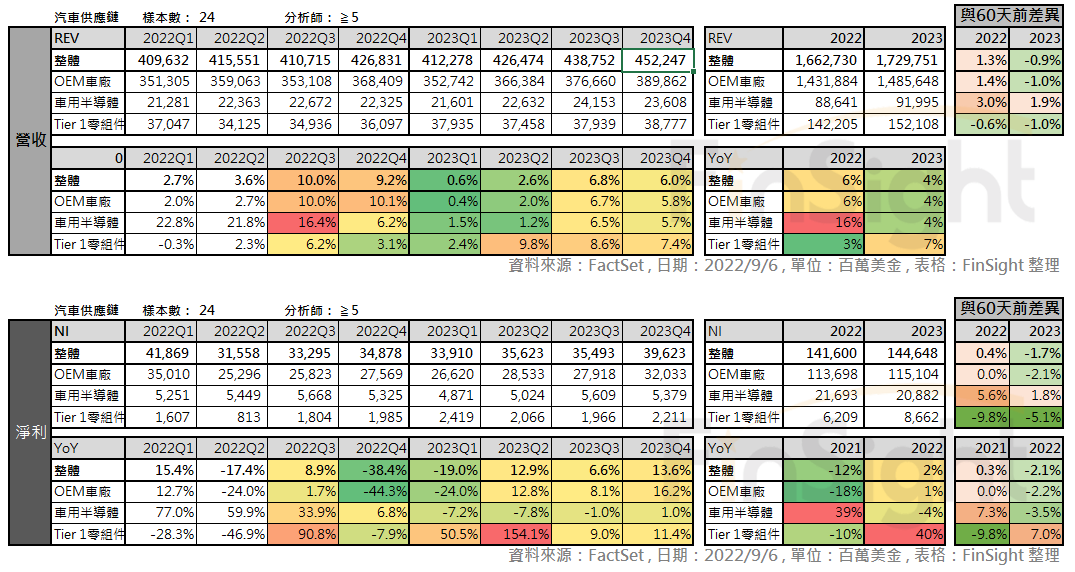
Q2 2022 auto earnings: OEMs mostly held guidance, BMW and Stellantis aside. Tier 1s stayed split, auto semis raised again. Light vehicle growth still 3% to 5%.
This is our roundup of second quarter 2022 earnings across the global auto supply chain: what the OEMs (original equipment manufacturers, the carmakers themselves), the Tier 1 component makers (the suppliers that sell finished systems straight to those carmakers) and the auto semiconductor names each said about demand, supply and the rest of the year.
Key takeaways
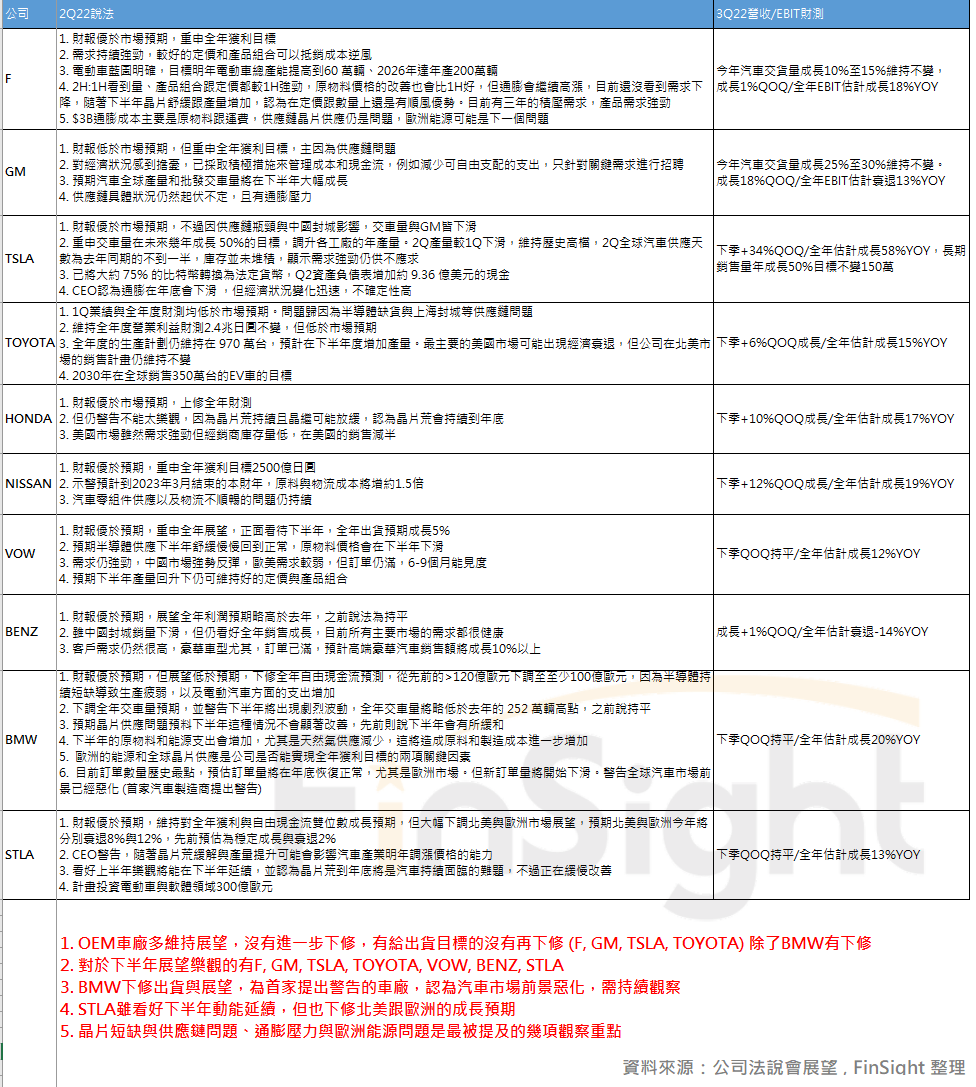
- Most OEMs held the guidance they gave in the prior quarter with no further cuts. BMW was the exception and the first company to warn that the industry outlook is deteriorating, cutting both its outlook and its volumes. Stellantis also cut North America and Europe.
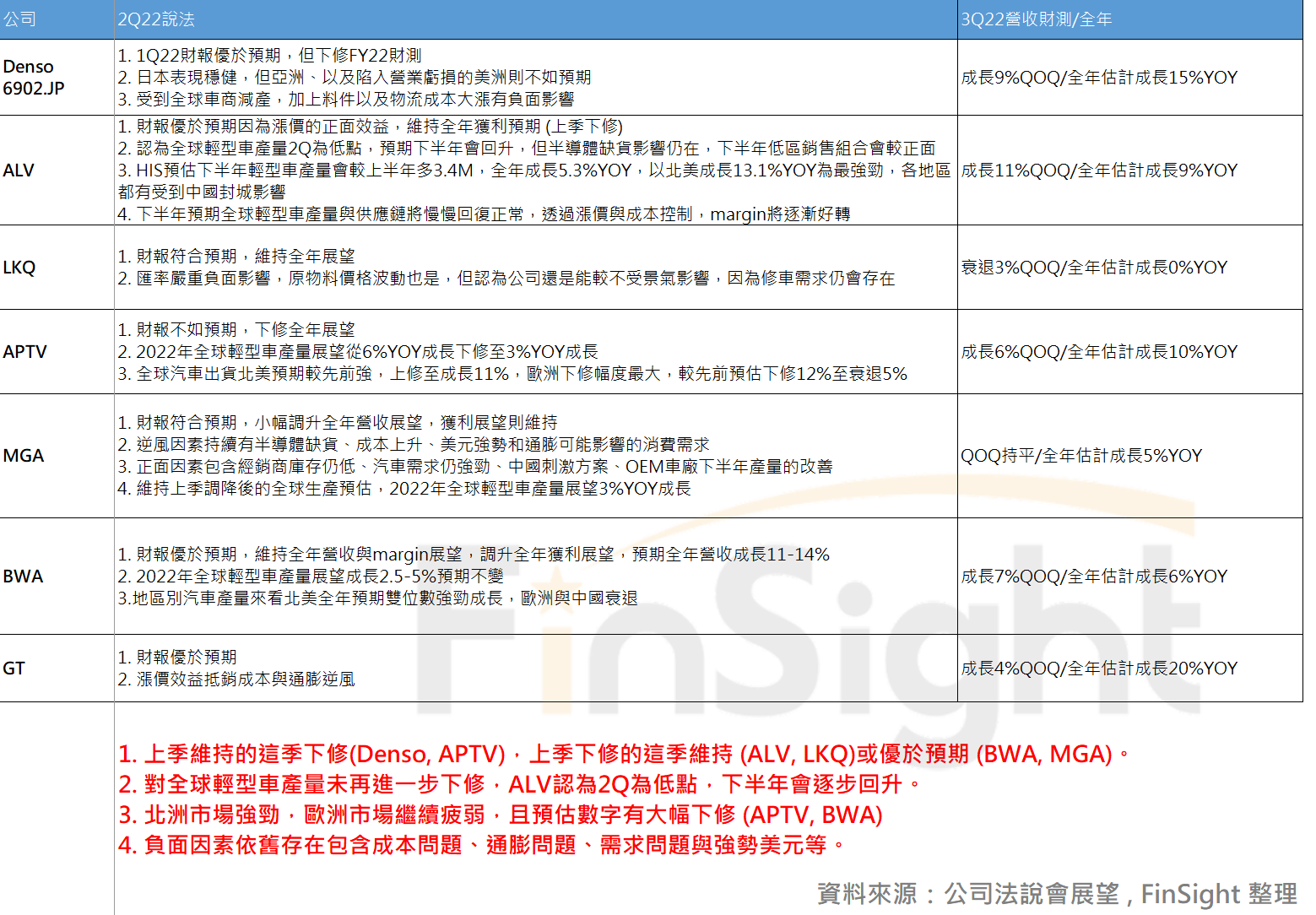
- Tier 1 components remain mixed and the spread between companies is wide: Denso and Aptiv cut after holding last quarter, while Autoliv and LKQ held after cutting, and BorgWarner and Magna came in ahead. The group still sees 2022 global light vehicle volume growth of 3% to 5%.
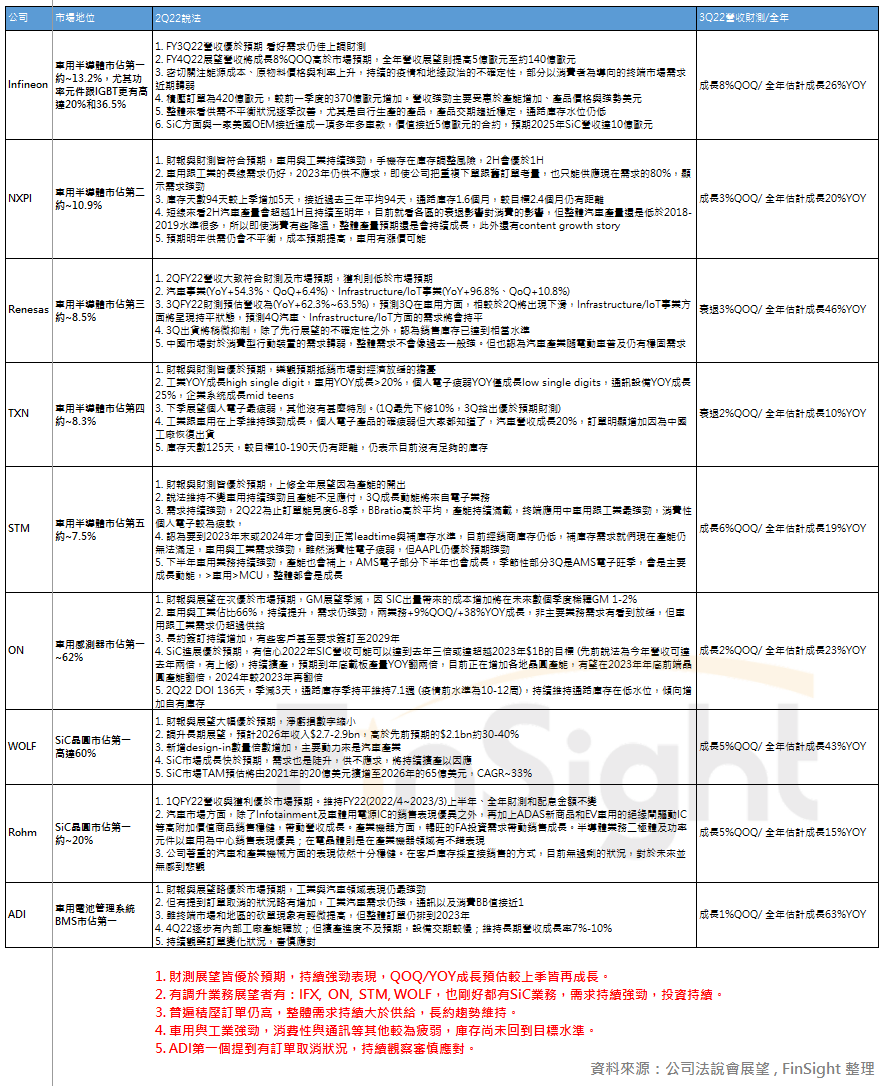
- Auto semiconductors are the standout. Infineon, ON Semiconductor, STMicroelectronics and Wolfspeed all raised revenue, earnings or business outlook, and all four said silicon carbide (SiC) demand is doubling year over year. ON Semiconductor now says 2022 SiC revenue could be three times the 2021 level, up from its earlier line of two times.
- The one warning light: Analog Devices said on this quarter's call, for the first time, that order cancellations have picked up slightly across regions. Over the trailing 60 days, analyst estimates were revised clearly higher for auto semis and clearly lower for Tier 1 components.
OEMs mostly held their outlooks, with no further cuts
The OEMs absorbed the worst of the pandemic, and just as the market thought early 2022 would bring a recovery, the war and China's lockdowns broke the supply chain again. The road back has been anything but smooth. This quarter most of them held the revenue, profit or volume guidance they gave last quarter, with no further cuts, BMW aside. Quarter over quarter the group ran flat to up, and year over year, everyone except Mercedes-Benz still grew at double digit rates.
Ford, General Motors, Tesla and Toyota did not cut volume targets again. Ford did the best against expectations: the company said demand is still strong, the order backlog is full, and better pricing and mix can keep offsetting the cost headwind, with second half volume, mix and pricing all stronger than the first half. Tesla is still the leader in electric vehicles. China's lockdowns hurt deliveries and gross margin, but the full year volume and growth targets are unchanged.
The Japanese makers did not get a lift from the weaker yen, because the supply chain bottlenecks are still there. Toyota held its full year volume target but flagged the risk of a downturn in the US market. Honda warned against getting too optimistic and expects the chip shortage to run through the end of 2022.
In Europe the commentary splits two ways. Volkswagen and Mercedes-Benz both take a constructive view of the second half. Volkswagen pointed to a strong rebound in China; Europe and the US are softer, but the order book overall is full, with six to nine months of visibility. Mercedes-Benz said demand in its main markets is healthy, with luxury demand especially strong.
The one to note is BMW, the first company to warn that the outlook for the auto industry is getting worse. It cut both its outlook and its volumes. It does not expect the supply chain problems to ease meaningfully, sees Europe's energy problem adding to costs, and is watching new orders start to fall. Stellantis also cut, taking North America from growth to a slight decline and Europe from a slight decline to a double digit decline.
Beyond the familiar list of chip shortages, supply chain disruption and the pressure inflation puts on both costs and the consumer, the OEMs added one new item to watch this quarter: Europe's energy problem. None of the older problems has actually been solved, and now there is a new one on top. Europe carries a stack of problems, energy and extreme weather in particular. Manufacturing is a large share of Europe's economy and autos are the core of that manufacturing, so the road back for the auto industry now looks harder still.
Tier 1 components are mixed, and the spread between companies is wide
Tier 1 component makers stayed mixed. The pattern is mostly a swap: the ones that held guidance last quarter cut it this quarter, such as Denso and Aptiv, while the ones that cut last quarter either held, such as Autoliv and LKQ, or came in ahead, such as BorgWarner and Magna.
Quarterly and full year growth were both little changed, and the group is still carrying its earlier growth estimates. By region the story is different. Companies described North American demand as strong but Europe as in a sharper decline, with both Aptiv and BorgWarner calling out European weakness. The negatives on the component side are also still in place: high costs and the question of where demand goes. This quarter every company added the FX loss from a strong dollar to that list. So the component group stays split, and the run of large upward EPS revisions is going to have to wait.
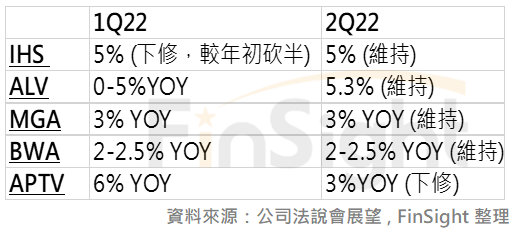
The global light vehicle volume outlooks the group gave this quarter are also little changed. Aptiv cut its estimate; everyone else held the volume growth estimate from last quarter. The current view is 2022 global light vehicle volume growth of 3% to 5%.
Auto semiconductors are the only thing working, with guidance and outlook both ahead
That leaves auto semiconductors, the strongest group last quarter and the standout again this quarter, with both guidance and outlook ahead of expectations. Nearly every company still guides quarter over quarter growth above last quarter, and year over year growth stays strong at double digit rates.
Infineon, ON Semiconductor, STMicroelectronics and Wolfspeed all raised revenue, earnings or business outlook, and all of them cited a large backlog, high order visibility and demand still running ahead of supply. NXP Semiconductors did not raise its outlook, but said the second half will be better than the first, and that even counting duplicate and stale orders in its backlog it can fill only 80% of order demand. Demand remains strong, supply is short, and inventory is still below company target levels, a point made by Infineon, NXP, Texas Instruments, ON Semiconductor and STMicroelectronics alike.
On end markets, auto and industrial held the strong language from last quarter, but every other business showed some degree of weakness, consumer and communications in particular. STMicroelectronics was the only one to keep its usual third quarter seasonal peak commentary, on shipments to a large customer. Everyone else said the other businesses will not be as strong as they were.
The other bright spot is silicon carbide. Infineon, ON Semiconductor, STMicroelectronics and Wolfspeed all have SiC businesses, all of them performing well, and all of them say SiC demand is doubling year over year. ON Semiconductor's SiC business is running ahead of plan: the company said outright that it is confident 2022 SiC revenue can reach three times the 2021 level, or meet and beat the $1 billion target set for 2023. That is a raise from its earlier line that this year's revenue could double last year's. Wolfspeed cut its loss sharply and raised full year guidance by 30% to 40%, saying the SiC market is growing faster than expected, demand has stepped up steeply, and supply is short. Every one of them is adding SiC capacity, and the growth outlook from here stays good. The SiC total market is expected to expand from $2 billion in 2021 to $6.5 billion in 2026, about 33% a year.
There is one thing to watch carefully. On this quarter's call, Analog Devices said for the first time that order cancellations have picked up slightly across regions, and that it is seeing order cuts in every end market. Supply is still short and the backlog runs into 2023, but the company will keep watching how orders change and will respond carefully. Consumer demand is relatively weak now, and the tightness in auto semiconductor supply should ease quarter by quarter. Watch the broader demand picture closely: if demand drops sharply and supply is no longer tight, Analog Devices will not be the only company talking about cancellations.
Bottom line on this quarter in the auto supply chain
- The OEMs are having a rough ride. On top of the chip shortage and the supply chain blockages, Europe's energy problem is now in the way as well, and the road back is a long one. Keep watching whether they can hold the full year growth and volume targets they say they can hold.
- Tier 1 components stay split, driven by negatives that are still in place: high costs and the question of where demand goes. This quarter every company also named the FX loss from a strong dollar. The run of large upward EPS revisions for the component group is going to have to wait.
- Auto semiconductors are the only thing working, helped by the electrification of the car. Most of these companies like the long term growth in the auto end market, backlogs are still large as of this quarter, and order visibility is still strong. The ones with a foot in silicon carbide have the best growth ahead of them and are the ones worth staying with. Watch the risk of order cancellations.
Looking at analyst estimates after this earnings season, auto semiconductors got the clearest upward revisions over the trailing 60 days and Tier 1 components the clearest cuts.