Applied Materials beat on its January 2021 quarter: revenue $5.162B, up 24% year over year, and it sees 2021 WFE above the $65B to $70B consensus.
Applied Materials, the largest semiconductor equipment maker in the world, reported its fiscal first quarter of 2021 last week. Both the quarter and the guidance came in ahead of expectations, and management sounded about as positive as we have heard them. With chipmakers expanding capital spending, we think Applied keeps benefiting from here.
Key takeaways
- The quarter: revenue of $5.162B, up 24% year over year and 10% quarter over quarter, gross margin of 45.9%, and EPS of $1.39. Guidance for the next quarter implies 36% revenue growth year over year at the midpoint, with the semiconductor business up about 50%.
- Semiconductor systems was 69% of revenue and grew 26% year over year. Across 2020, Applied's NAND revenue grew 34%, DRAM 27% and foundry 23%, all above the market, and etch, deposition and CMP all hit record levels.
- WFE (wafer fab equipment) spending ran about $60B in 2020, up 16% year over year, against 26.5% growth in Applied's semiconductor business. Consensus puts 2021 at $65B to $70B, and Applied says its internal number is higher.
- The push to build fabs in the US and Europe is a net positive for Applied. Those fabs will be smaller and less efficient than Asian ones, which means more tools per unit of output, and more customers in more regions means more service demand.
Three things from the call stood out.
- Applied is very positive on the semiconductor business. New products are landing and it keeps taking share. Foundry spending stays strong, and within memory, DRAM runs ahead of NAND. Its view on total WFE spending is above both peers and the Street.
- The company expects to benefit directly from the drive to expand chip manufacturing in the US and Europe, including US subsidies for the industry. Management is optimistic about what that means for equipment demand.
- An analyst meeting is scheduled for April 2021, with more detail on this year's WFE estimate and the company's growth outlook. We think that meeting is a positive catalyst.
The fiscal first quarter of 2021 and the segment detail
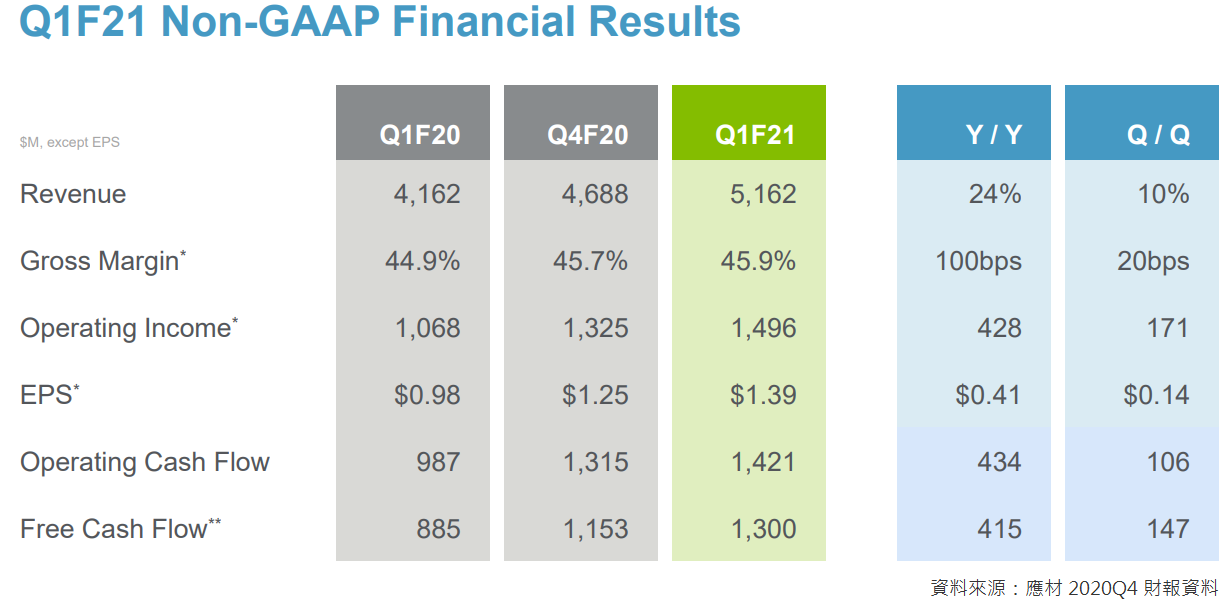
Reported results: revenue of $5.162B, up 24% year over year and 10% quarter over quarter, gross margin of 45.9%, and EPS of $1.39.
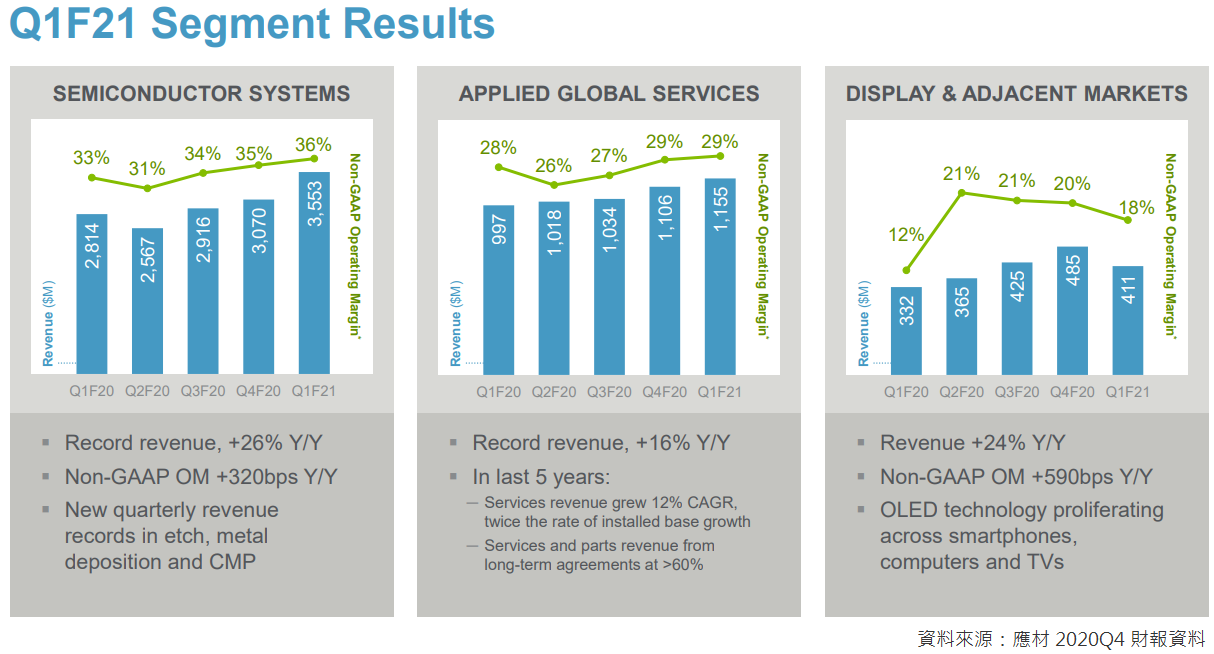
- Semiconductor systems: 69% of revenue, up 26% year over year and 16% quarter over quarter. Within that, foundry and logic grew 8% year over year and 16% quarter over quarter, and memory grew 66% year over year and 16% quarter over quarter.
Over the trailing four quarters (fiscal Q2 2020 through fiscal Q1 2021), memory beat foundry across the market. Equipment spending on NAND grew at close to twice the rate of the overall market, DRAM also grew faster than the market, and foundry grew slower than the market while still accounting for 55% of total spending.
Applied's own business did better than all of that: NAND up 34%, DRAM up 27% and foundry up 23%, each above the overall market's growth rate. On top of last quarter's strong growth, etch, deposition and CMP (chemical mechanical planarization) all set records.
Guidance for the next quarter has the semiconductor business growing more than 50% year over year at the midpoint, again ahead of the industry. Management credits the breadth of its applications, its customer and product base, and rising adoption of new products. Applied also holds the largest share in advanced packaging, the fastest growing area in 2020, and expects that momentum to carry into 2021. Integrated Materials Solutions, a newer line that combines several process steps in a single system, should add revenue and take share. Mature node tools, sold into internet of things (IoT), communications, automotive, power and sensor customers, should add $3B of revenue in fiscal 2021.
The segment detail:
- Metal deposition: the company thinks physical vapor deposition (PVD) can grow more than 40% year over year, with revenue above $3B. Chemical vapor deposition (CVD) grew 32% year over year in 2020 and stays strong this year.
- Etch: grew 32% year over year in 2020 on share gains and new applications, with further share gains expected.
- Inspection: grew 45% year over year in 2020 and should grow another 25% year over year this year, because adoption of the new products is still early and share keeps rising.
- Packaging: the fastest growing area in 2020, and management expects the momentum to hold, with 2021 growth better than last year at up to 50% year over year.
- Applied Global Services (AGS): 23% of revenue, up 16% year over year. The five year compound annual growth rate is 12%. Within service and parts revenue, the service portion has gone from 40% to 60%, and the renewal rate is above 90%.
- Display: 8% of revenue, up 24% year over year. The 2021 outlook is the same as the one given on the prior call, a recovery off the bottom, and management stays positive on the long run. OLED adoption is rising beyond phones, with more applications in computing and TVs.
Applied expects all three businesses, semiconductor systems, AGS and display, to keep setting records over the next two quarters (the second and third quarters of 2021).
Guidance is strong, and above the market's growth rate
Applied expects strong growth this year, ahead of the industry, with further share gains. Foundry and logic spending stays strong, and DRAM spending grows faster than NAND.
"This 2021 mix expectation plays particularly well to AMAT's technology innovations and strong product road map. We would expect to significantly outperform the market again this year." (Applied Materials earnings call, fiscal Q1 2021)
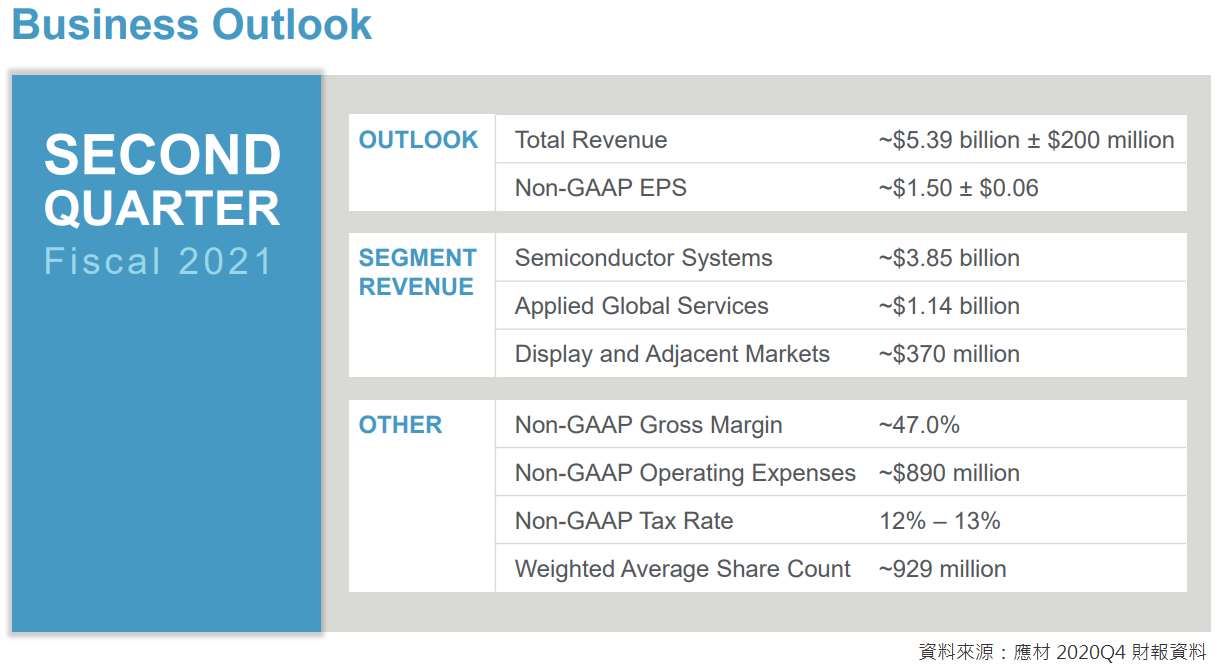
- Next quarter guidance is good: revenue at a midpoint of $5.39B (up 36% year over year), EPS at a midpoint of $1.50 (up 70% year over year), and gross margin around 47%. Within that, the semiconductor business is guided to grow 50% and AGS 12%.
- The second half should grow faster than the first: management thinks second half momentum runs ahead of the first half, which differs from what peers KLA and Lam Research have said, that the first half runs ahead of the second. The reasons are the breadth of its end applications, an even spread across foundry, NAND and DRAM, and the fact that Applied runs on a fiscal year, so its fiscal 2021 second half maps to the second and third quarters of calendar 2021. Management's bottom line: strong and meaningful growth all the way into 2022.
- Display: 2021 looks similar to 2020 and should build quarter by quarter. On a cycle view, management thinks 2022 is an exciting investment opportunity, and on orders, growth returns in the second half.
- Long run megatrends: the multiyear semiconductor growth story is intact, with digital transformation and AI still building. Display recovers in part, driven by large screen TVs and OLED.
"As we look beyond 2021, we see from an overall market standpoint and a company specific momentum standpoint, we see continued strong performance into 2022. We like how well we're positioned." (Applied Materials earnings call, fiscal Q1 2021)
A positive industry view, and more manufacturing in the US and Europe means more equipment
- On WFE spending: the 2020 WFE market was around $60B, and Applied's semiconductor business grew 26.5% against it, well ahead of the market. The 2021 WFE number gets a firmer figure at the April 2021 analyst meeting. The market currently sees $65B to $70B, and Applied's internal view is more optimistic and a bit higher than that. None of these estimates cover shipments that need export licenses. China invested about $10B in 2020, and this year could be a little more as it steadily builds out its own ecosystem.
- On expanded chip manufacturing in the US and Europe: Applied has been in close discussion with companies, customers and government officials. From where the company sits, when these large chipmakers put fabs in different locations, those fabs are smaller and less efficient, and the more small fabs get built, the better it is for Applied. On top of that, having different customers set up in different regions makes service demand stronger. From every angle the company looks at it, demand is very strong.
Our view: after this round of the chip shortage, governments have understood how much semiconductor capacity matters. Building fabs in many places is less efficient, but for the equipment vendors it is an excellent growth opportunity, and it should create meaningful momentum for some time.