
US tech profits stalled after the smartphone, then turned up from 2016. The growth sits in semiconductors and software, driven by exponential data growth.
We have followed NVIDIA since 2016, and the trend we have liked best ever since is the data driven technology revolution: data volumes grow exponentially, and that growth pays the companies that supply the picks and shovels. Since 2016 the profit engine of US tech has moved out of hardware and into software and semiconductors, and the reported financials show it plainly.
Key takeaways
- US tech revenue, EBITDA (earnings before interest, taxes, depreciation and amortization) and capital spending (capex) have grown clearly from 2017 through 2022, after a long stretch in which the group's earnings stalled once the smartphone cycle matured.
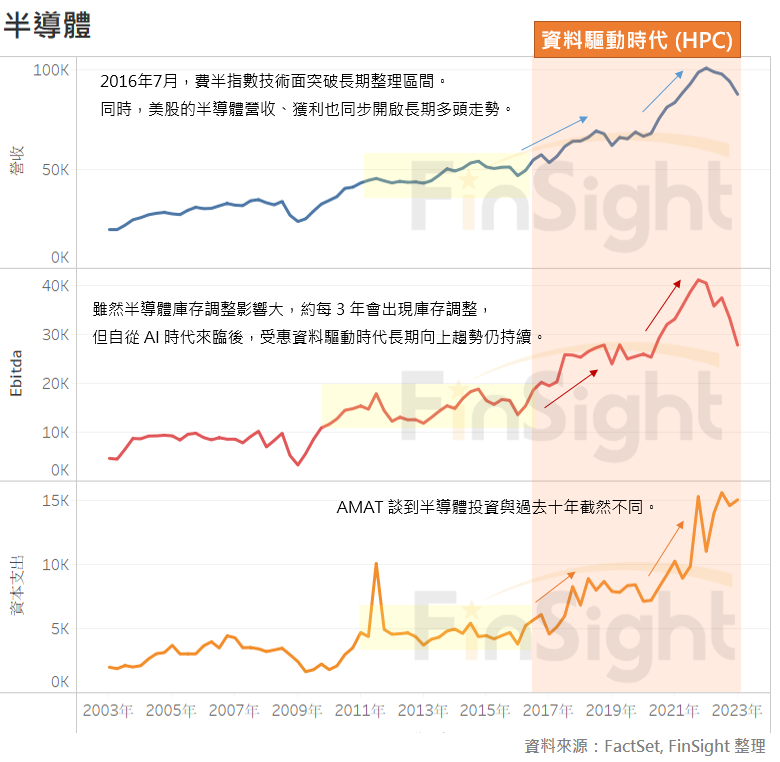
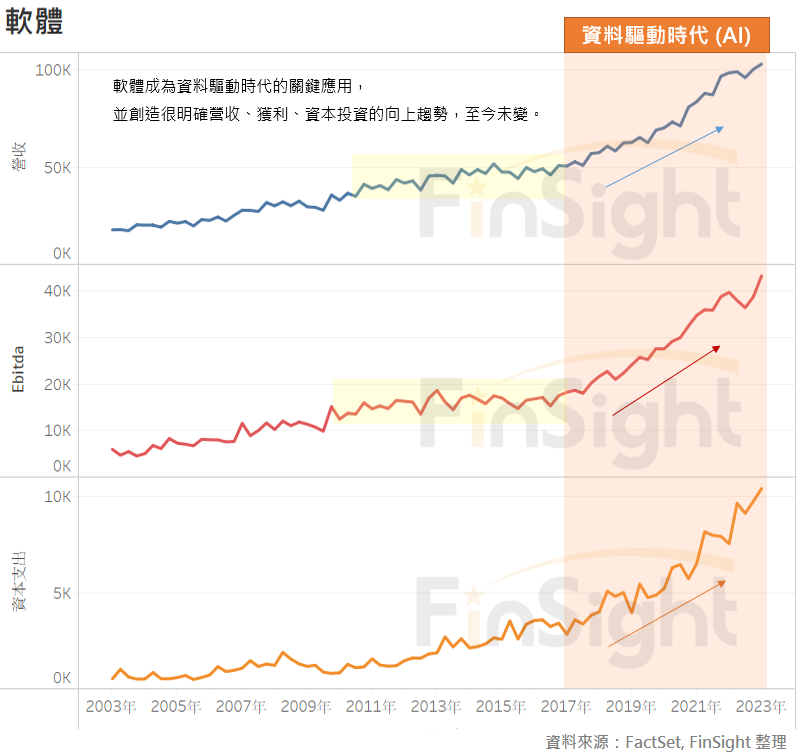
- The growth is not coming from hardware. Hardware financials were flat from 2015 to 2019 and only picked up in 2020 on work from home demand. Semiconductor profits turned up first, from the middle of 2016, and software followed with structural growth in 2017.
- The trigger was data. NVIDIA launched the Pascal architecture and the P100 for the data center in 2016 and began breaking out data center revenue, and by the fourth quarter of 2016 TSMC (Taiwan Semiconductor Manufacturing Company) was telling investors that high performance computing customers, not smartphones, would drive more of its growth after 2019.
- Six shifts define the next decade: hardware to software and semiconductors, consumer to enterprise, products to services, organizations to crowds, a cloud-centered world that needs new solutions, and rising technical difficulty that widens the leaders' advantage. In past industrial revolutions the profit has concentrated hard, call it 80% to the top 20% of companies, and everyone behind spends out of fear of being written off.
For long-term buy and hold money, this is the megatrend we like most. If the trend holds, the strong get stronger, so the companies that already sit in the absolute lead as technology arms dealers, selling the shovels, are the names that matter right now: NVIDIA, TSMC and Microsoft.
ChatGPT launched at the end of 2022 and set off the current wave. Generative AI pushes AI into its next phase. The near-term imagination is enormous, but we think the number of players who can build a large open platform ecosystem and capture most of the value is getting smaller, not larger. The other side of that is a wave of new businesses built on top of those platforms. The question for any company is whether it has picked the right side.
Look back at how the whole trend developed and you land on the photon analogy NVIDIA CEO Jensen Huang used in May 2017. Because AI develops exponentially, the race keeps widening the leader's advantage. He framed it in innings. The calendar dating is ours, not his: the first 2016 to 2018, the second 2019 to 2021, the third 2022 and after. Any company too slow to get on board the deep learning train is out.
Huang put it this way in May 2017. If AI is a baseball game, we are only at the start of the first inning, and most people can still sit there eating their peanuts. But every inning after this one will be shorter than the one before, and what keeps each inning accelerating is exponential growth. On the dating we use, that first inning is long behind us and we are in the third.
From the outside, reaching the third inning feels like watching people travel past you at the speed of light. If you are one of the photons, you are fine. Reach the second or third inning without deep learning and you are out.
Tracking AI from 2016 was the turning point in our own research career, and one of the reasons we started FinSight in 2019. In our earlier post on how an individual should face an industrial revolution (December 2021), we argued there are two things a person can actually do: learn data driven skills fast enough to keep up with the era, and build on the ecosystems that already exist, whether that means trying something new on an open platform someone else built or owning the technology arms dealers with the clearest lead.
So we are spending some time on this series about the AI industrial revolution, to record how our own thinking developed: first by going back to the source of the trend to work through what has changed, and why the trend deepens the leaders' advantage the way Huang described, and then by looking at how a megatrend that will run for decades keeps changing our lives and the way companies do business.
For the long-term trend of exponential data growth, and for the semiconductor competition in the second inning of the AI game (2019 to 2021), our Data Driven Tech Revolution series (April to December 2021) still reads correctly today.
The data driven AI megatrend has been driving software and semiconductors for years
Since the arrival of the computer and the internet, growth in tech has depended on whether a killer product shows up: the PC, the notebook, the smartphone. Each one produced years of demand and pulled the whole supply chain along with it. As devices went mobile, software applications came with them, the internet worked its way further into daily life and changed how people live, and the financials of the whole tech sector revolved around consumer hardware.
After the smartphone, the market went a long time with no next killer application, and the earnings of US tech companies visibly stalled. That held until 2016, when NVIDIA launched the Pascal architecture and the P100 for the data center and started reporting data center revenue as its own line. From that point the financials of US tech moved back into a clear growth trend.
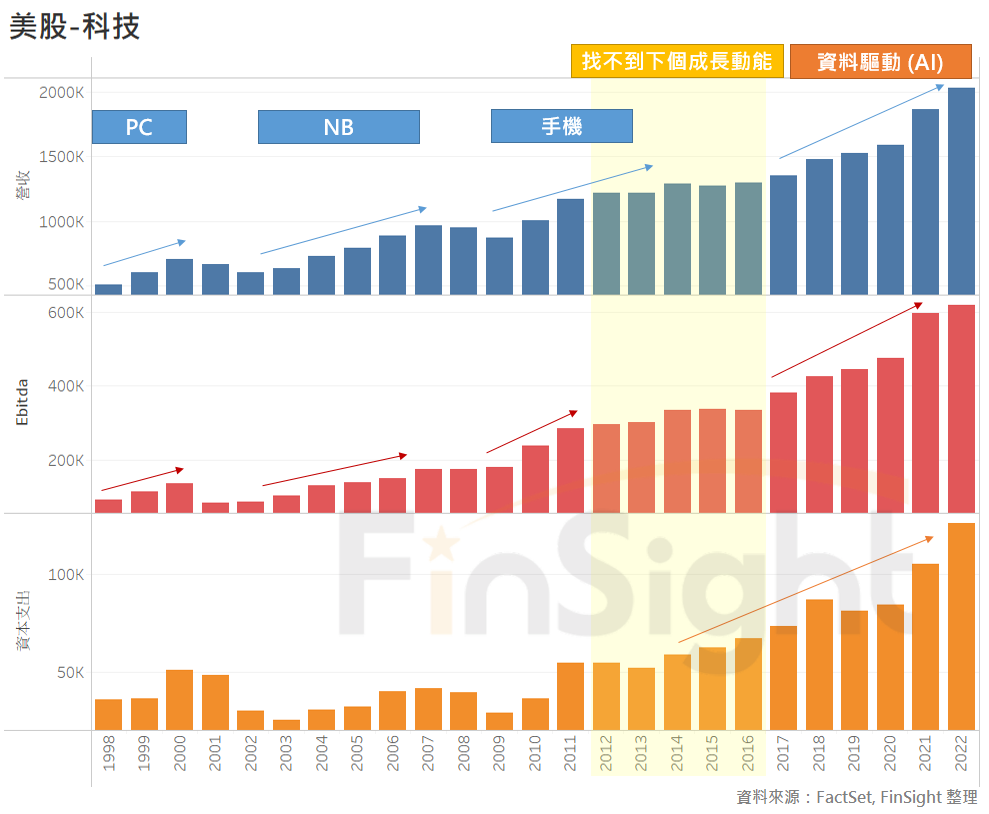
The chart above aggregates the reported financials of US companies classified as technology, including delisted ones, and plots annual revenue, EBITDA and capital spending from 1998. Tech financials grow clearly from 2017 through 2022, and capital spending across the group rises quickly over the same stretch.
Revenue and profit do not rise like that without real applications and real demand behind them.
Break the group into its parts and the engine behind the growth after 2017 turns out not to be hardware, which is where most people still look. Hardware financials showed no real growth from 2015 to 2019 and were essentially flat, until 2020, when the pandemic and the stay-at-home wave that came with it produced another replacement cycle.
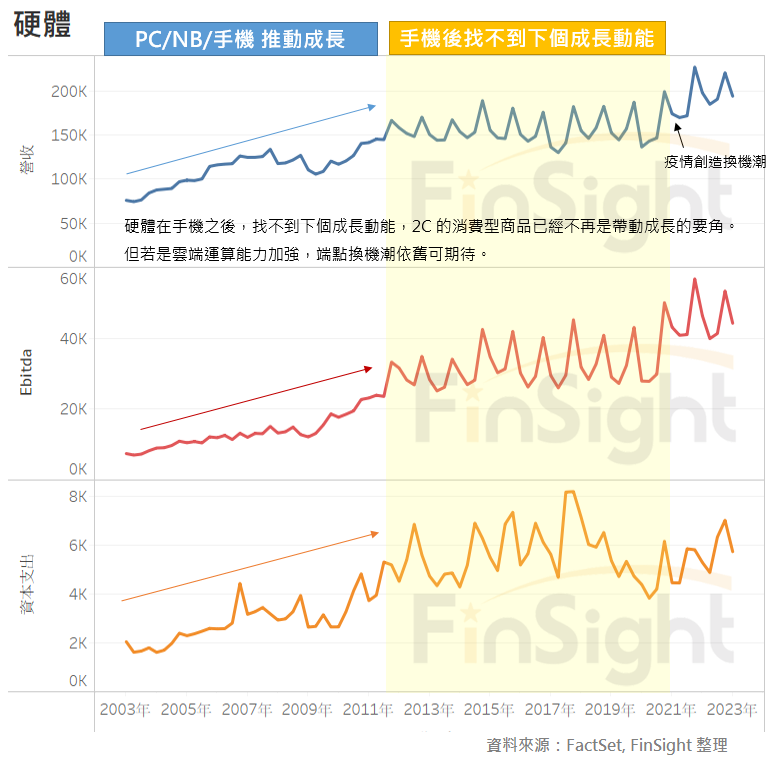
Since 2017, the growth in tech has moved clearly from hardware to software and semiconductors.
Pulling the US semiconductor and software financials the same way, semiconductor profits turn up very clearly first, from the middle of 2016, and software financials follow with structural growth in 2017.
What was happening when the trend started
In July 2016 the Philadelphia Semiconductor Index (SOX) broke out of a two-year range and started a bull run. Semiconductor mergers were arriving one after another, and with no next consumer growth driver in sight, the worry was that ever more expensive leading-edge processes would have no end demand to support them.
Four months earlier, in March 2016, AlphaGo had beaten Lee Sedol, then the strongest Go player in South Korea. NVIDIA used its GPU Technology Conference (GTC) to push deep learning as an AI revolution, launched the P100 for high performance computing after two years of development, and redrew its revenue reporting to break out data center revenue on its own. From the second half of that year, first at the Applied Materials analyst meeting and then on the TSMC earnings call, high performance computing (HPC) moved into the open, and the market found the driver that would push semiconductors for the next ten years. On its fourth quarter 2016 earnings call, TSMC said demand for leading-edge processes was no longer driven by smartphones alone: 7nm, still unreleased at the time, was picking up more and more HPC customer designs, and the company expected HPC to contribute more growth than smartphones after 2019.
The reason ever more expensive and more difficult HPC chips could create a new growth trend comes back to the data. Explosive growth in data volumes drove the software applications built on it and the profits those vendors earned.
From 2007, when the phone created the mobile era, mobile internet penetration rose and time spent rose with it. People did more and more online, and internet services replaced physical businesses one category at a time: Google and Meta in advertising, Amazon in e-commerce, Netflix in streaming video. Their share kept climbing, at the expense of traditional advertising, retail and video.
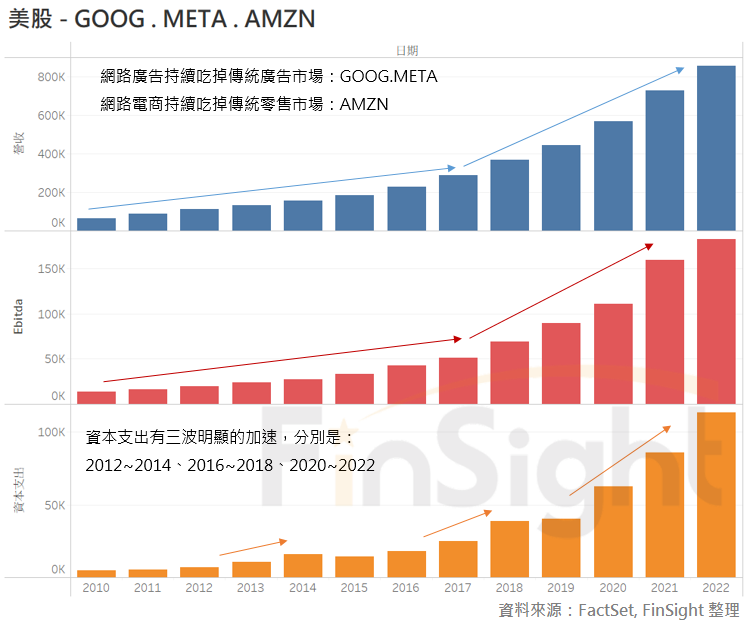
Fast growth in mobile data let these companies collect far more data on how people behave, and analyze it to deliver better services. That same data became the feedstock for AI. Deep learning needs three things working together to train well: huge volumes of data, algorithms, and high speed compute chips. All of that data runs in the cloud, which is what created the cloud's enormous demand for HPC silicon.
At the same time, enterprise, or business to business (B2B), software as a service (SaaS) shifted gradually to subscription after 2013. That produced steadier cash flow, and for vendors that used to sell software outright, the cloud also became the place where data is stored. Collecting that data and the user feedback with it let them ship new services faster and better, help customers get more done, and strengthen the competitiveness of their own products in the process.
Companies doing business in the cloud came out of the mobile internet era holding more data, which is the ideal ground for growing AI. So in 2017, one large software vendor after another used its annual conference to declare it was going into AI. As Huang put it, AI is eating software and will end up in every part of it. With AI pulling more value out of the data, software vendors could deliver more efficient services and hold customers more tightly, entering a virtuous cycle where revenue and profit grow together and pushing them to spend more on cloud capacity.

The AI industrial revolution created new business models and a new set of winners
History has three important industrial revolutions (steam, electricity, information technology). Each lifted productivity sharply and set off enormous social and economic change. What decided the outcome each time was who mastered the rules of the new era. Those rules change not only how business is done but how work flows and what jobs exist, and they produce a new set of winners standing on the right side of the trend.
To us, AI is the fourth industrial revolution, the one that follows the internet.
The pattern of the past few years is already clear. Around exponential data growth, a range of different business models appeared, and they moved the profit center of tech from hardware to software and semiconductors. If you accept that AI is an industrial revolution, then the work is to identify the business models and the drivers that fit the new era, because only the groups and companies that fit it will be paid by the trend.
Worth reading alongside this: our December 2021 post on the electricity revolution, where the process redesign that came with it meant fewer than 20% of the companies alive at the start were still standing at the end, even though electricity raised productivity for everyone.
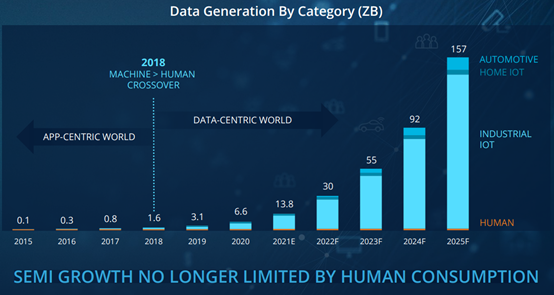
Under the data driven AI trend, we would keep six shifts in mind.
- 1. Tech profit growth moves from hardware to semiconductors and software. Doing business in the data driven era works differently. Software has to enable something the customer actually wants done before the customer pays for it. And once a software company is in a virtuous cycle, the growing volume of data processing from cloud to edge pulls semiconductor applications and specifications into a virtuous cycle of their own.
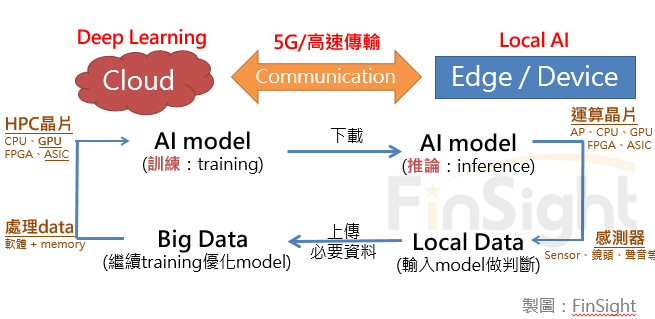
- 2. Demand moves from consumer, or business to consumer (B2C), to enterprise (B2B). For software and for semiconductors alike, end demand now sits with businesses. In that shift, what the customer cares about is no longer the price of one product but whether the whole system costs less to run and gets the job done more efficiently. In a data center, energy efficiency, compute and the ability to scale matter more than the price of any single part, so a very expensive leading-edge product can be the better deal for the customer. When NVIDIA launched the DGX line for the data center in 2018, Huang kept coming back to a single accelerated platform that is backward compatible and scales out: flexible for customers in an exponential era, and at the system level, the more you buy, the more you save.
- 3. Vendors move from selling products to selling services, which in practice means building platforms. The center of the sale shifts from the good to the service, and that changes how companies and consumers think. Facing fast change in the data era, companies lean toward buying services from cloud vendors for the flexibility, turning capital spending into operating spending. Consumers are more willing to use shared platforms to get more efficient use of their money and their things. At the same time, because what is being sold is a service, whether the product itself delivers value matters more than ever. This applies to software and semiconductors both. We have argued before that semiconductor companies are no longer traditional hardware sellers but platforms providing an integrated service, and that shift can support a higher multiple.
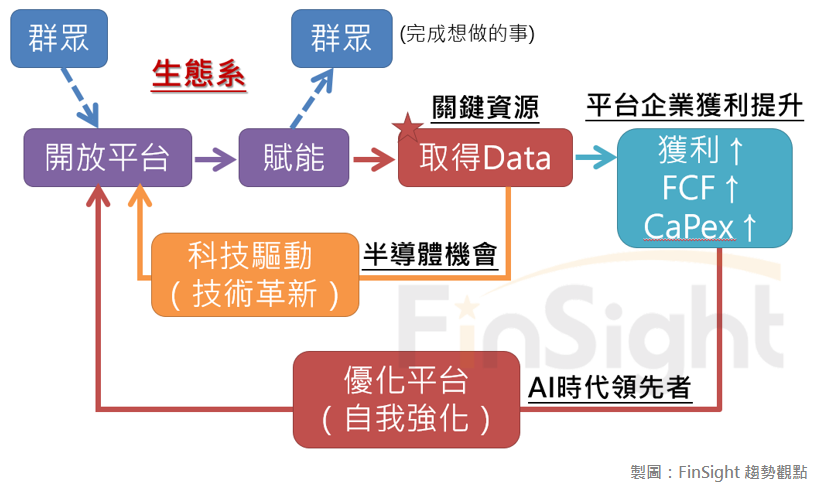
- 4. Innovation moves from the organization to the crowd, open and shared. New products used to come out of the inside of an organization. Data now grows too fast for that, and the internet makes human knowledge from all over the world available and usable. Pooling data and knowledge from a large crowd in a decentralized way can produce something genuinely useful. Technology moves so fast that organizations, for all their advantages, tend to get in the way of their own innovation, while the knowledge of the crowd does not. Build a neutral, open platform that other people can get their own work done on and you attract more users, along with the information you need to keep improving the product.
- 5. A cloud-centered world needs new solutions. Everything above plays out in the cloud, and moving to the cloud helps companies cut costs and work more efficiently. Getting there means replanning workflows. The cloud, handling data that grows this fast, also needs a scalable architecture built around data processing, and semiconductors need entirely new solutions.
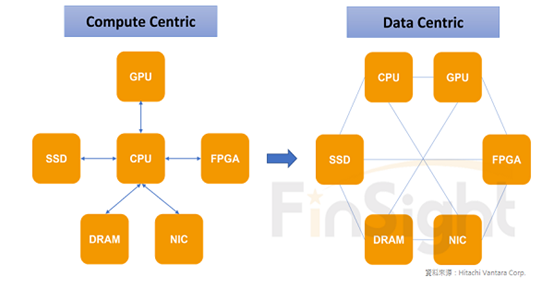
- 6. Rising difficulty creates an absolute advantage for the leaders. Deep learning needs huge volumes of data, algorithms and high speed compute chips together. Technical difficulty and the cost of entry keep rising, and data volumes keep growing exponentially, so this is a game that keeps getting harder, with fewer core participants over time. When the profit in an industrial revolution concentrates that hard, roughly 80% of it going to about 20% of the companies, everyone behind gets afraid not to invest, spending first to avoid being written off and worrying later about whether the spending earns anything. We think that is exactly the process we are in now.
One clarification on that last point: the participants getting fewer are the vendors building the open platforms everyone else builds on. For companies building new businesses on top of those platforms, the opportunities are plentiful.
Bottom line: use the core of the AI industrial revolution to find the companies whose advantage keeps widening
A new era needs a new way of doing business.
Open, neutral, shared, and a platform other people build on. That describes the companies that can create a virtuous cycle around their own ecosystem in the AI industrial revolution and take 80% of the industry's profit. They are the ones selling shovels in a gold rush, the technology arms dealers pushing the AI industrial revolution forward.
The next post in this series goes back to NVIDIA's photon analogy and reviews what has happened since this industrial revolution began.