
Taiwan's sell signals have not fired, but information and communication technology export order growth fell to 7% and the diffusion index hit 37.7.
This cycle traces back to US goods consumption, and that spending is about to turn down in a visible way. That change will put real pressure on the Asian supply chain, which has spent the past year living off the boom in personal goods spending.
Key takeaways
- Neither sell signal has fired. Electronic component and information and communication technology (ICT) exports are still growing year over year, and the new orders and inventories sub-indices of Taiwan's manufacturing purchasing managers index (PMI) are still holding up.
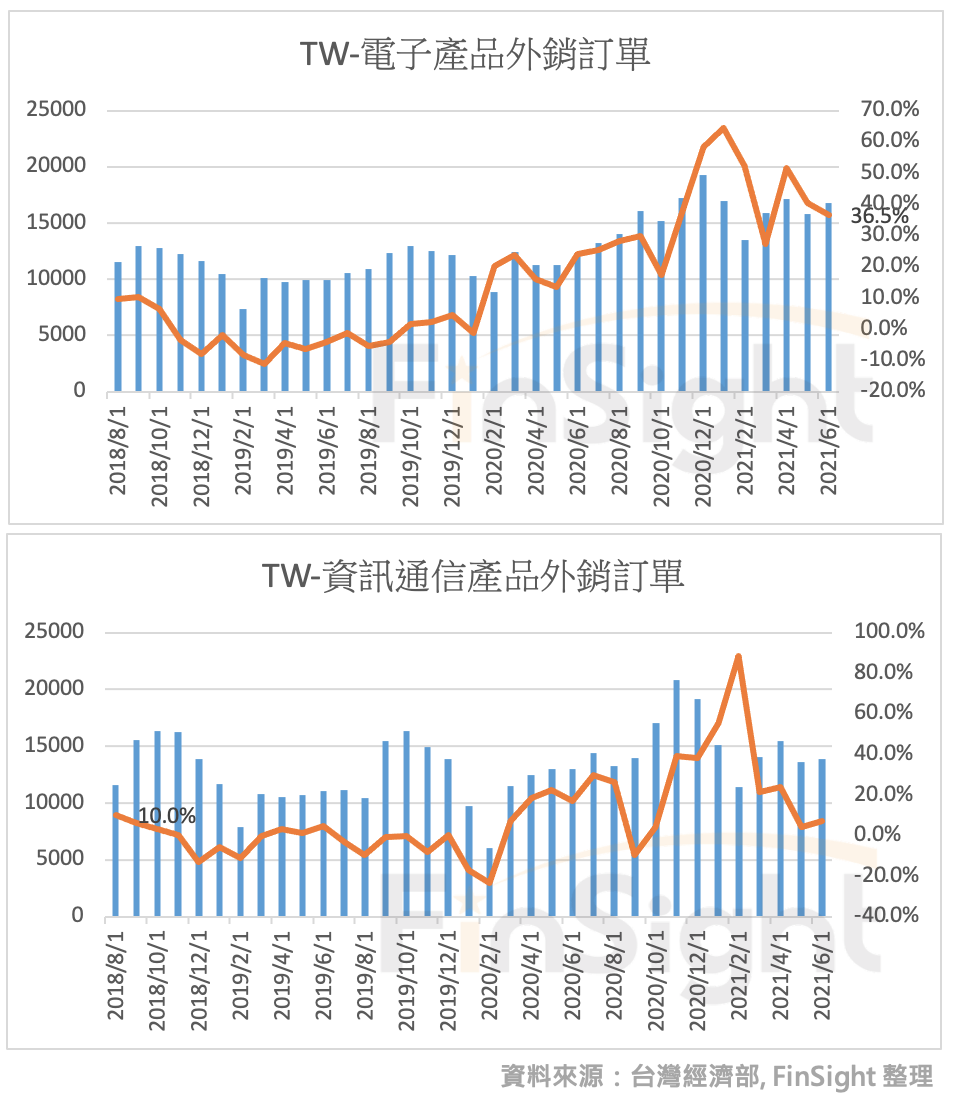
- The negatives keep adding up. ICT growth in Taiwan's export orders dropped to 7% in the latest month and the forward orders diffusion index fell to 37.7, so year over year growth could turn negative starting this month.
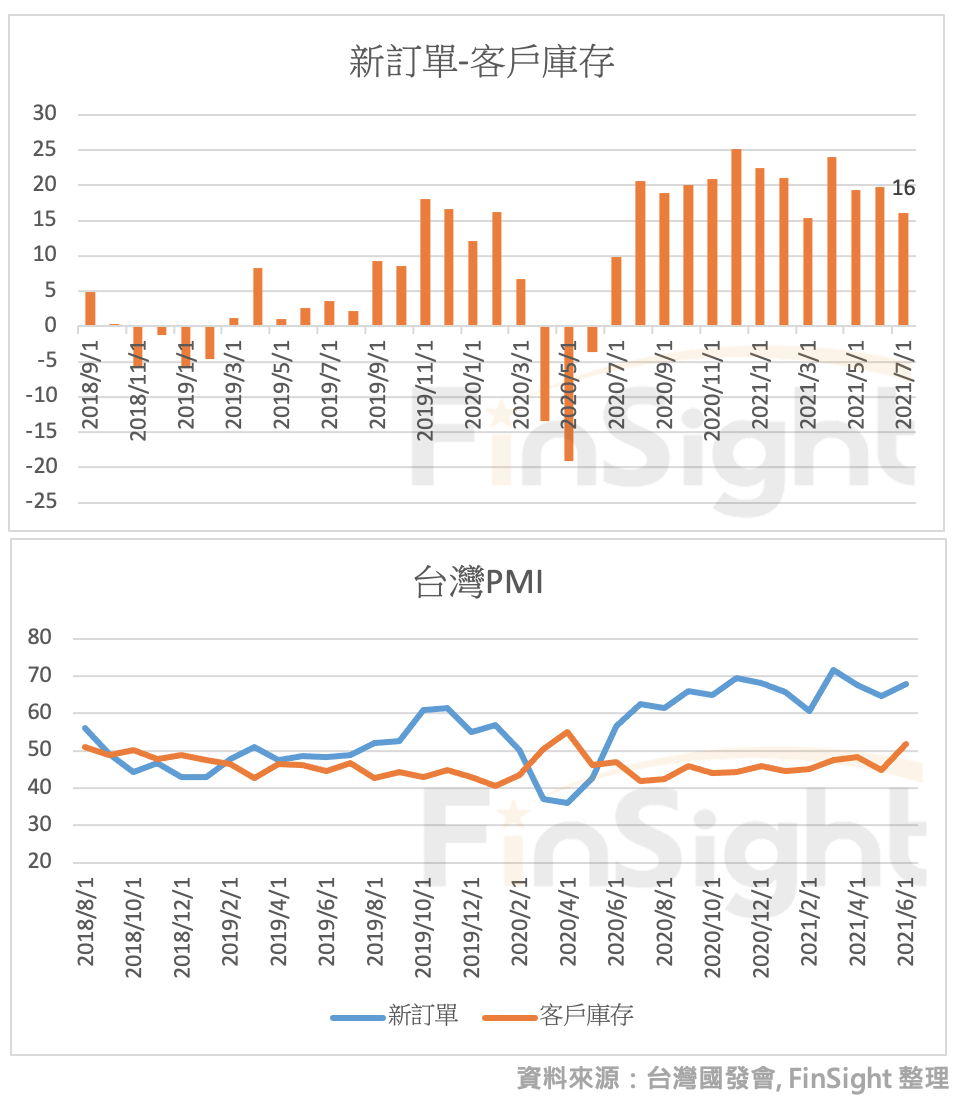
- Customers' inventories in Taiwan's PMI have crossed above 50 for the first time in two years outside the pandemic distortion, and ASUS said US channel inventory is back to a normal 10 to 12 weeks.
- We prefer US semiconductors and high performance computing (HPC) tied to capital spending (capex) to the Asian supply chain. In May 2018 Taiwan corrected first and the companies in the Philadelphia Semiconductor Index (SOX) did not start cutting guidance until October, and when correction pressure appears the multiple de-rates first, meaning the price to earnings ratio falls before earnings do.
At the same time, US corporate results show companies spending more on digital transformation. When corporate capex expands and the productivity cycle takes hold, it brings long-term structural change for the ICT companies sitting on the 5G and AI megatrend.
So we are at a point where electronics may be entering an inventory correction in the short run while digital transformation keeps accelerating in the long run. When the short term and the long term are out of sync, the market usually chops until the size of the inventory correction is clear. Only once the two line up again does it pick a direction.
This post works through the electronics inventory cycle data to explain why we think the numbers could turn negative next, following the turn in goods consumption.
Taiwan's inventory signals have not turned yet, but the negatives keep adding up
Our October 2020 post on the Taiwan electronics inventory cycle, which argued the bull leg could run into the first half of 2021, went back through the history and settled on two indicators as the key sell signals: a hard one, electronic component and ICT exports year over year, and a soft one, the new orders and inventories sub-indices of Taiwan's manufacturing PMI.
Taiwan's manufacturing PMI is published monthly by CIER (the Chung-Hua Institution for Economic Research). Like ISM, its sub-indices are diffusion readings centered on 50, so a reading above 50 means more firms report an increase than a decrease, and new orders minus customers' inventories is a spread, not a level. Taiwan's export orders, reported monthly by the Ministry of Economic Affairs, are booked before shipment and lead actual exports; the report also carries a forward diffusion index for what firms expect next month, on the same 50 centerline.
On the data as it stands, neither indicator has given a negative signal. But the negative inputs are piling up.
- US personal goods consumption is about to lose momentum. That spending is what created very strong demand for ICT products over the past year. US commercial demand is recovering, but overall demand for the ICT products inside durable goods is going to slow markedly against a high base.

- Taiwan's ICT export orders will turn down first. Offshore demand shows up in Taiwan's export orders, and in the latest month ICT growth within those orders fell sharply to 7% while the forward orders diffusion index dropped to 37.7. Year over year growth could turn negative starting this month, which would then feed through to electronic component demand, where growth is still decent.
- Supply chain inventory is slowly rebuilding. Customers' inventories in Taiwan's PMI came in above 50 in the latest month, and our own tally of inventory at Taiwan's electronics makers has clearly turned up as well. On top of that, ASUS said on its earnings call last week that while channel inventory outside the US is still less than half of pre-pandemic levels, US channel inventory is back to a normal 10 to 12 weeks, clearly different from the prior quarter. Every company sees a different picture, of course, and once this earnings season is over we will look at inventory through the reported financials too.
The indicator we really care about, Taiwan PMI new orders minus customers' inventories, is still high. But export orders are starting to look tired, so PMI new orders could fall quickly. And customers' inventories have now crossed 50 for the first time in two years outside the pandemic distortion. The spread between the two could converge fast over the next few months.
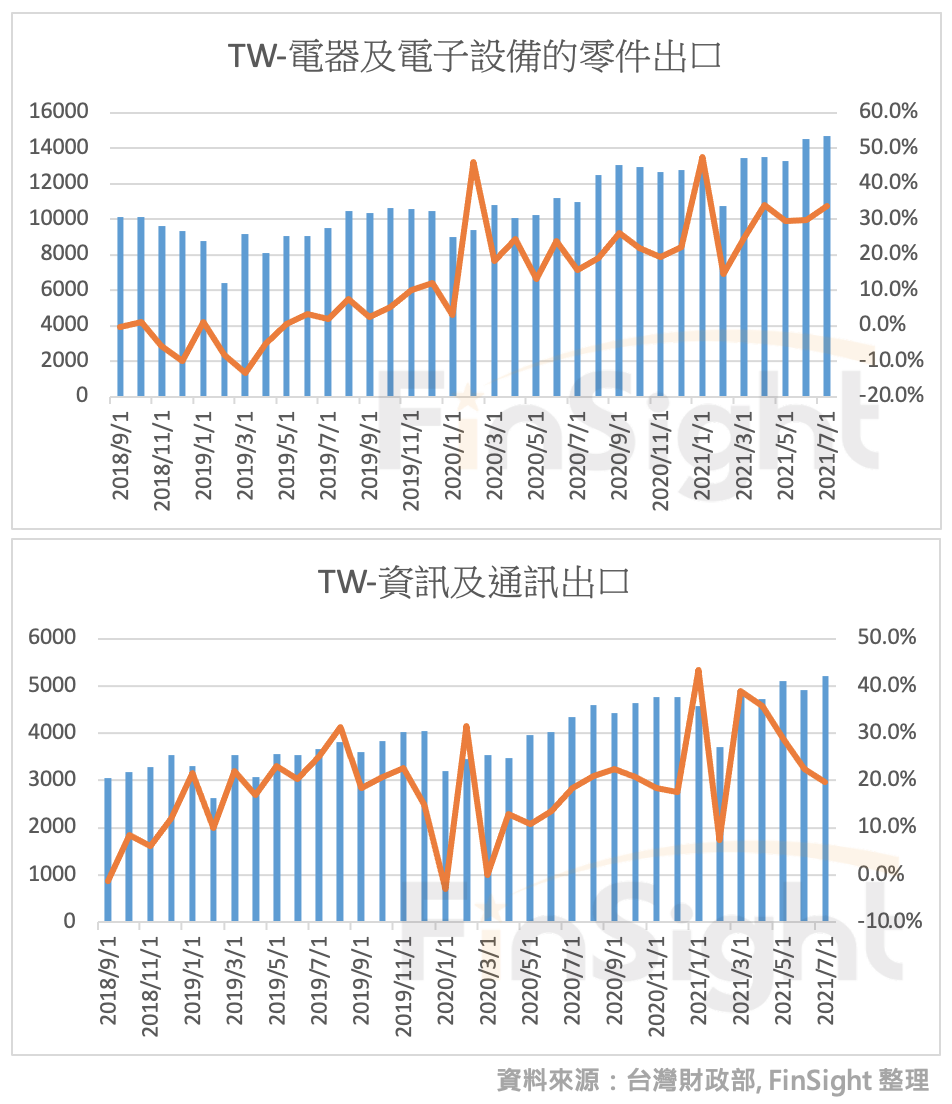
Taiwan's export growth year over year is of course still very strong. The catch is the high base from the second half of 2020: if order values cannot make new highs, it is easy to see year over year export growth converging quickly in the fourth quarter of 2020.
Tight parts versus loose parts is the biggest variable
After a run in electronics inventory this long, an inventory correction here would be entirely normal.
But this leg followed the longest boom we have seen, with the US China trade war, a pandemic scramble for parts in every country, and the long-term digital transformation trend all pushing at once. Companies have not only kept building inventory, they have also spread supply chain risk across regions. That makes this correction very complicated.
Early in the correction you have to split the picture three ways: by product, by region, and by whether a part is still tight (in shortage) or already loose (in ample supply).
- Product: commercial demand is up on higher US spending, while anything tightly linked to personal goods consumption is down. As Europe and the US reopen, demand for consumer electronics may fall. But government and corporate capex rises in the second half, and US data center and 5G base station investment should recover sharply. HPC stays relatively strong, so the effect differs a lot by company depending on the mix.
- Region: the US is up, the rest of the world is down. Taiwan mostly builds consumer products, while the US is more tied to HPC, autos and industrial. The US bull cycle also started a full year later than Taiwan's. Even with Taiwan about to enter an inventory correction, US semiconductor revenue can keep growing faster into 2022.
- Tight against loose: the tight parts upstream stay tight into 2022, while the loose parts downstream are going into correction. The differences across products will be large this time. The shortage runs from foundry through to integrated circuits (ICs), and because it is tied to enterprise digital transformation demand that has yet to pick up, we expect it to last into 2022. So even as the inventory correction arrives, the hit to tight parts will be smaller than the hit to loose ones. What happens on the tight side is that the supply demand gap narrows, and the thing to watch is whether price increases still come through at the level the market has priced in.
For US semiconductors, the first half of 2021 combined tight capacity, a scramble for chips and strong consumer end demand, which gave distributors plenty of room to raise prices. GPU retail prices rose sharply in the first half of 2021, for example, while NVIDIA, the company making the chips, was supply-constrained.
Now that supply is gradually easing, the US chipmakers that were held back by capacity in the first half of 2021 should move back onto a clear path of upward revisions. So for the second half of 2021, even with the Asian supply chain heading into an inventory correction, we still prefer US semiconductors and the areas tied to rising capex: HPC data centers, networking and data transmission, and high speed compute.
One caveat from past cycles: the US usually reacts later than Taiwan. In May 2018 Taiwan went into its inventory correction first, and the SOX companies did not start cutting guidance until October. Whether this correction ends up reaching the US depends on the data from here. What is certain is that when inventory correction pressure shows up, the multiple de-rates first, so we stay cautious on the Asian supply chain.
Trend and cycle both apply, and which one matters more depends on how you trade
On one side is the productivity cycle created by a long-term explosion in data volume. On the other is the inventory correction the electronics supply chain is about to enter. Does the correction get serious enough to reach the parts that are still very tight? Or is digital transformation across US industries stronger than people think, so the correction turns out to be a small one?
We cannot answer either question yet. It has to be updated as new data comes in.
Our work has always had two parts: the medium-term cycle and the long-term trend.
- Medium-term cycle: work from consumption to orders to inventory to see where we are in the electronics cycle.
- Long-term trend: work from the digital transformation megatrend created by 5G and AI to identify who benefits most from a trend that is heading up.
When the long-term trend and the medium-term cycle disagree, how you respond comes down to your own approach.
If flows do rotate out of the Asian markets that benefited from the goods boom, as we expect, then buying the long-term trend companies into the pullback during the coming inventory correction should be a good trade. On the other side, we do see digital transformation accelerating across US industries, so a long-term investor who only cares about the long trend can hold the megatrend names fully, ignore the short-term swings, and over a long enough horizon will not be disappointed. The condition is that you picked the real beneficiaries of the long trend.
We are doing both. We have cut most of our Asian positions and added to US holdings, while keeping the structural winners we write about repeatedly, the companies we think win outright from this wave of technology change. But the important part is how each person thinks about position sizing and asset allocation.
That is what makes trading interesting. You take a view, you act, and you resize as new information comes in, looking for the setups where both the odds and the payoff are on your side. There is no rule that says you have to be invested at all times. The point is to compound capital over the long run, not to trade every day.