
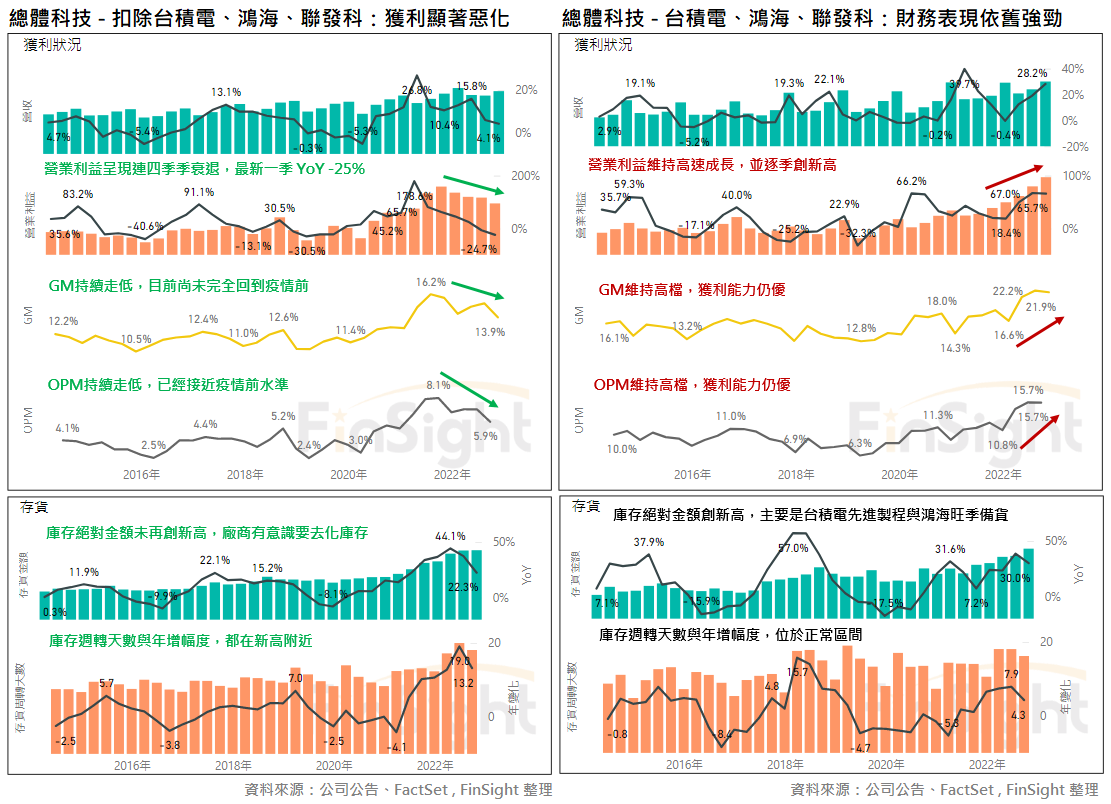
Third quarter 2022 filings: excluding TSMC, Hon Hai and MediaTek, Taiwan tech operating profit fell 25% year over year. We put the buy signal in mid-2023.
Last earnings season, the Taiwan filings showed destocking pressure across electronics at its worst in a decade. They also showed that the pressure was not spread evenly: across the electronics supply chain, profit was tilting hard toward foundry, and that is not a normal state for the chain to be in.
Key takeaways
- Excluding the three largest technology names by operating profit, TSMC, Hon Hai (Foxconn) and MediaTek, Taiwan technology operating profit fell 25% year over year in the third quarter of 2022. The growth in the headline aggregate belongs to those three, not to the sector.
- The absolute inventory balance hit another record, but inventory days have started to slip. On base effects, we put the buy signal, inventory days falling below their year-earlier level, in the second quarter of 2023, confirmable with the filings on August 16, 2023.
- Chip designers and memory makers, and hardware brands and distributors, are still the worst hit and need at least two more quarters of clearing. Foundry, which here also covers semiconductor manufacturing equipment, looks the healthiest today, which is exactly why we think it adjusts last and recovers last, with lower utilization in the first half of 2023 doing the most damage to profits.
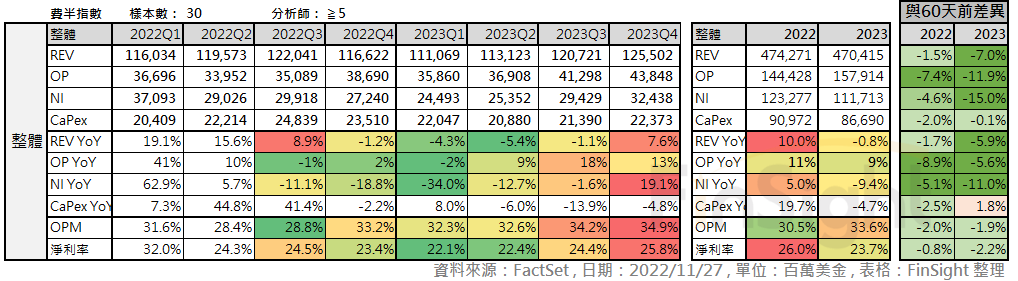
- Consensus for the Philadelphia Semiconductor Index (SOX) now has 2023 revenue flat with 2022 and net income down close to 10%, and of the SOX's three growth engines, high performance computing, automotive and TSMC, only TSMC is still getting upward revisions. Our stance stays defensive: no buy signal has fired and liquidity indicators are still in the warning zone, so we keep watching and waiting.
This quarter we want to know how the financials changed now that every company has clearly recognized the inventory problem and started acting on it, and whether an adjustment more violent than expected could pull a buy signal forward. This post pulls together the financials of Taiwan and US electronics stocks.
Third quarter 2022 in Taiwan: the split gets sharper, and ex the big three the sector is already shrinking
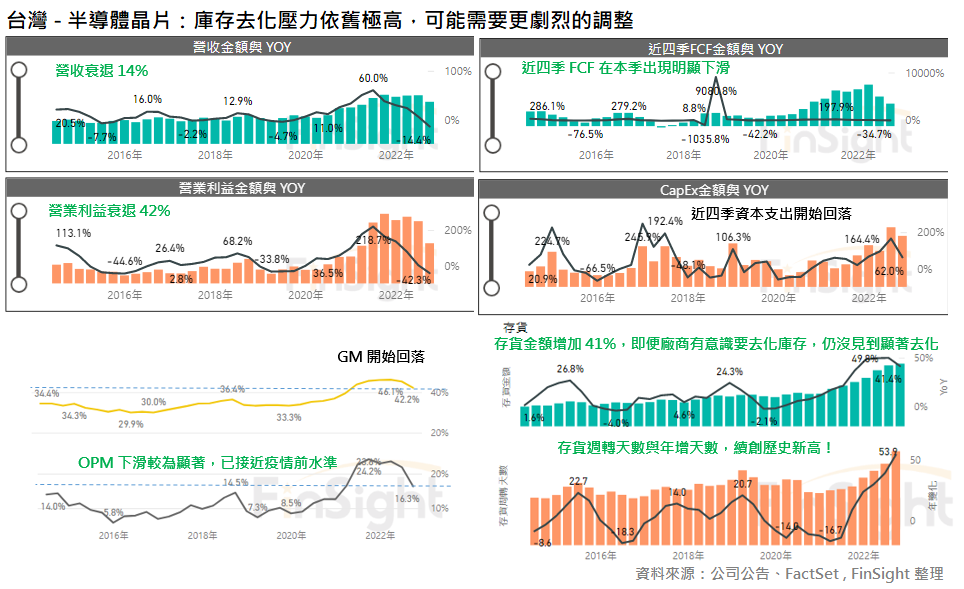
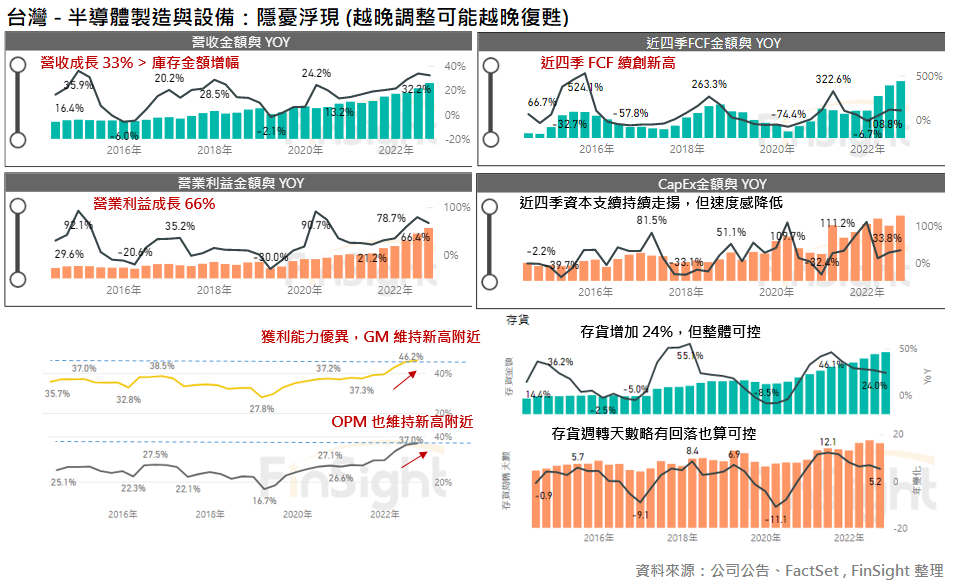
Across Taiwan-listed technology companies, revenue and profit are still growing, gross and operating margins are holding at high levels, and while the absolute inventory balance hit another record, inventory days have already started to come down. Now that companies have recognized the inventory problem, the odds of another rapid build from here are falling.
The usual seasonal pattern is that inventory days fall further in the fourth quarter peak season, because revenue rises and cost of sales rises with it, then go back up in the first quarter lull. Combine that with the high base that inventory days started building in the second quarter of 2022, and our view is that the second quarter of 2023, confirmable with the filings on August 16, 2023, is the more likely window for inventory days to fall below their year-earlier level, which is the buy signal.
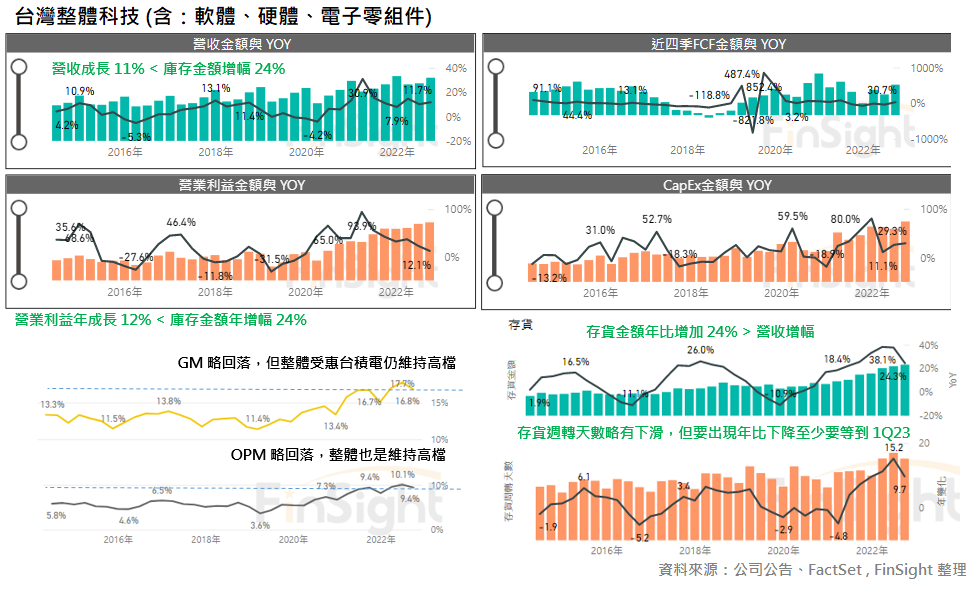
The charts in this post aggregate the quarterly filings of Taiwan-listed companies, summed in absolute New Taiwan dollars (NT$, roughly 30 to 32 per US dollar), so the totals are dominated by the largest names. Taiwan-listed companies file on a fixed quarterly calendar, which is why the dates we use for signals are filing dates: second quarter numbers are confirmable on August 16. The PMI we use for the sell signal is published monthly by CIER, the Chung-Hua Institution for Economic Research, and like ISM its sub-indices are diffusion readings around 50, so new orders minus customers' inventories is a spread between two diffusion readings, not a level.
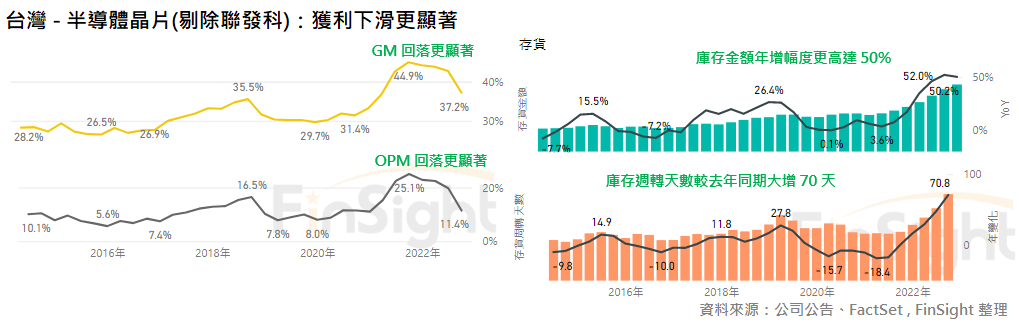
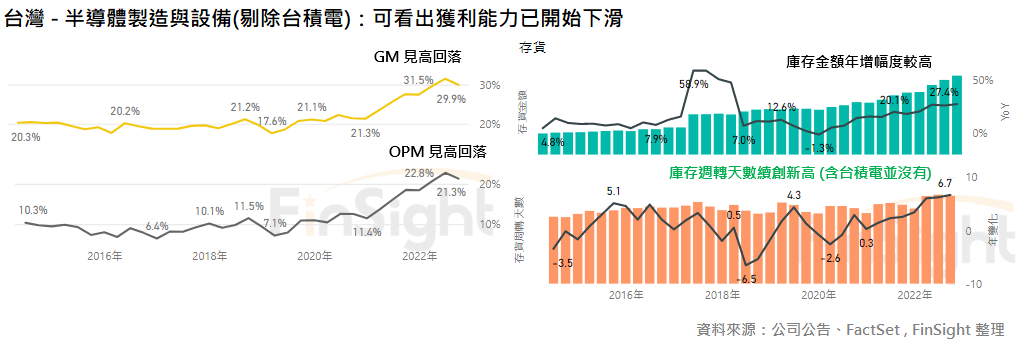
One caveat on the aggregation: we sum absolute amounts, so the result is easily swayed by the largest companies. This time we also ran a version that strips out the three largest technology names by operating profit, TSMC, Hon Hai and MediaTek. What looks good in Taiwan's technology numbers turns out to be concentrated in those three. Excluding them, operating profit for Taiwan technology is already down 25% year over year.
The two versions differ most in profit trend and inventory level. Ex the big three, Taiwan technology has falling gross margin, an operating margin back near pre-pandemic levels, and inventory days that jumped visibly. The top three, by contrast, show revenue, operating profit, gross margin and operating margin all trending up, with inventory days still in a normal range.
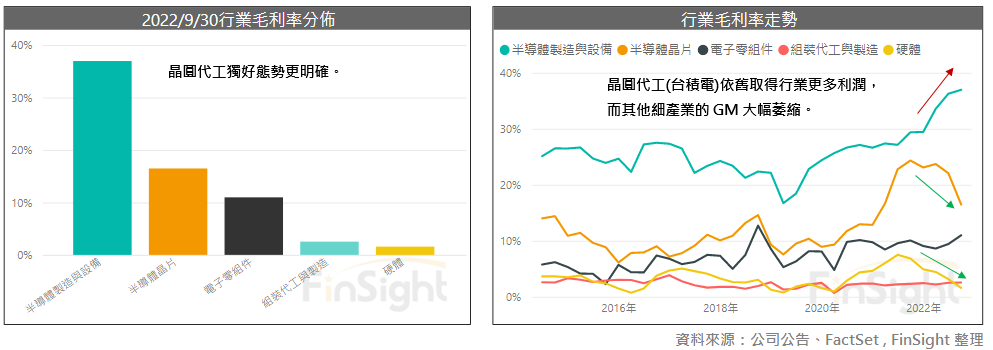
Our August 2022 post on the second quarter filings flagged that industry profit was tilting toward foundry. This quarter's filings make it clearer. Hardware brands and distributors and chip designers and memory makers, the two areas we said were carrying the heaviest destocking pressure, both saw gross margin fall this quarter as they cut prices to move product. At the same time, foundry gross margin kept climbing, pulled up by TSMC. Foundry keeps taking a bigger share of the chain's profit.
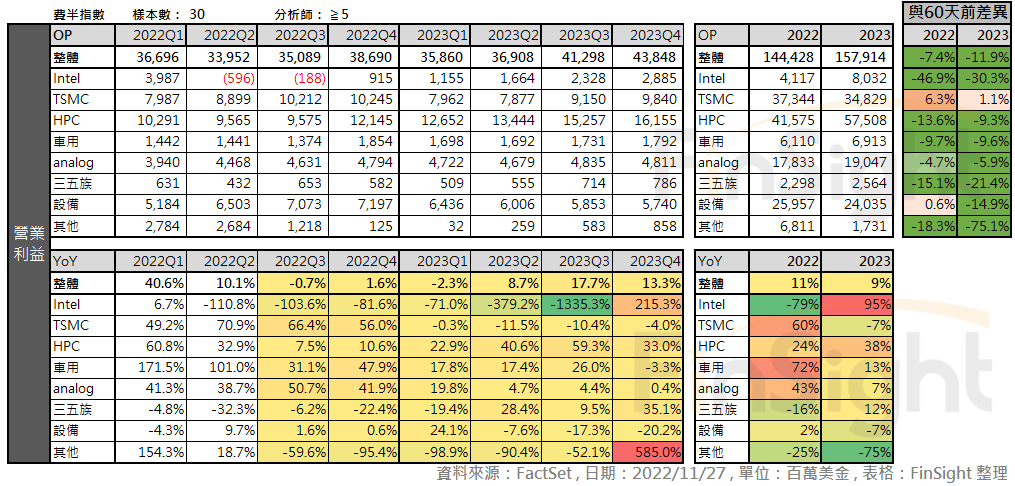
This is not only a Taiwan problem. Earnings estimates for the constituents of the Philadelphia Semiconductor Index (SOX) have been cut steadily over the past 60 days. Consensus now has 2023 revenue flat with 2022 and net income down close to 10%, and operating margin estimates are still being revised lower.
The SOX had three growth engines: high performance computing (HPC), automotive and TSMC. Last quarter we saw the HPC names take large downward revisions to earnings. This quarter, estimates for automotive semiconductors have been trimmed as well. TSMC is the only one left still getting upward revisions.
Destocking is running at different speeds by sector, and the clear-out is still not visible
Back to Taiwan's electronics supply chain. Here is the summary before we go through it piece by piece.
- Hardware brands and distributors, and chip designers and memory makers: the second quarter filings showed inventory adjusting at a scale not seen in a decade. This quarter, even with companies actively destocking, there is still no clear improvement. Base effects give these two badly hit areas the better chance of producing a destocking buy signal in the second quarter of 2023 (August 16).
- Foundry: the numbers still look strong because of TSMC. Excluding TSMC, profitability is already falling. Looking at where the industry is, we do not think foundry can stay uniquely healthy. As revenue falls, inventory days will rise, and on the view that this group adjusts last, it could also be the last industry to recover next year.
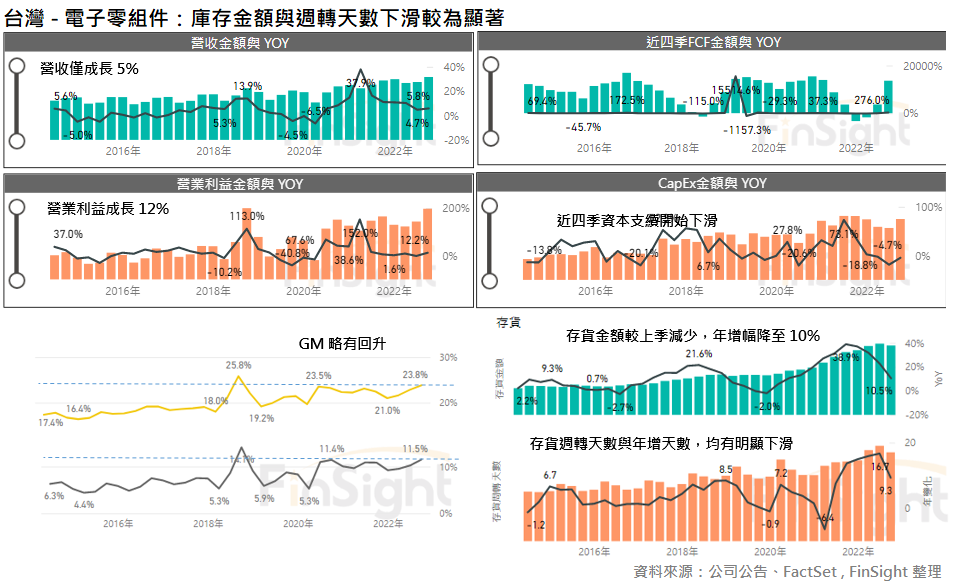
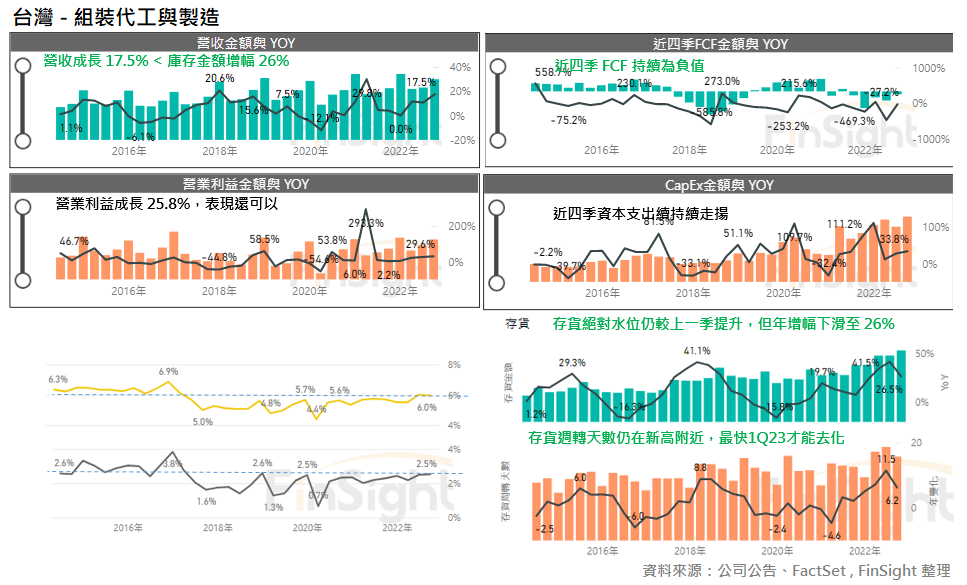
- Components and contract assembly and manufacturing: neither was badly hit in this inventory build. What stands out this time is that the absolute inventory balance in components has improved, with destocking visible at PCB and power-related companies. Whether that continues depends on end demand.
Chip designers and memory makers: the epicenter, still under destocking pressure
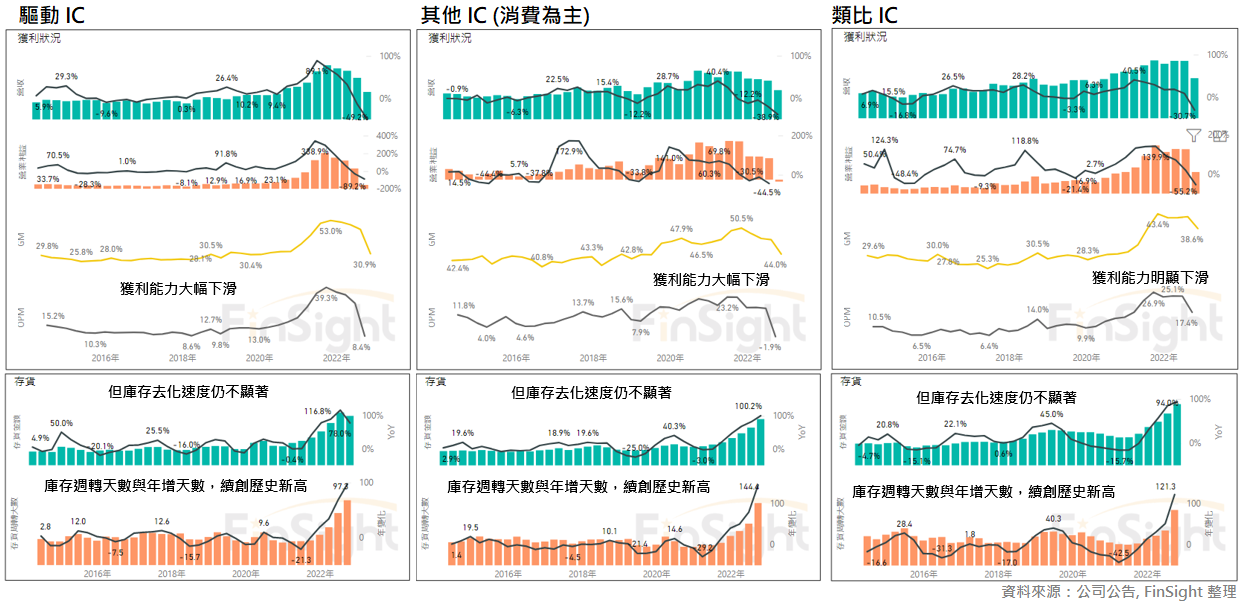
Revenue and profit fell sharply. Destocking has started, but the absolute inventory balance still went up, and with operations deteriorating, inventory days kept making new highs. Looking ahead, with business not yet improving and inventory not yet cleared, we do not expect inventory days to fall. That said, inventory days over these past few quarters are at extremes, so after two more quarters of heavy clearing we think the second quarter of 2023 has a chance of turning.
Excluding MediaTek, the drop in gross margin among chip designers and memory makers is sharper still. Display driver ICs, other consumer ICs and analog ICs all still look very poor: gross margin is already down a lot and inventory days have not meaningfully improved, which says the inventory adjustment has at least two more quarters to run. Semiconductor IP licensors are the exception, with gross margin still rising and results holding up.
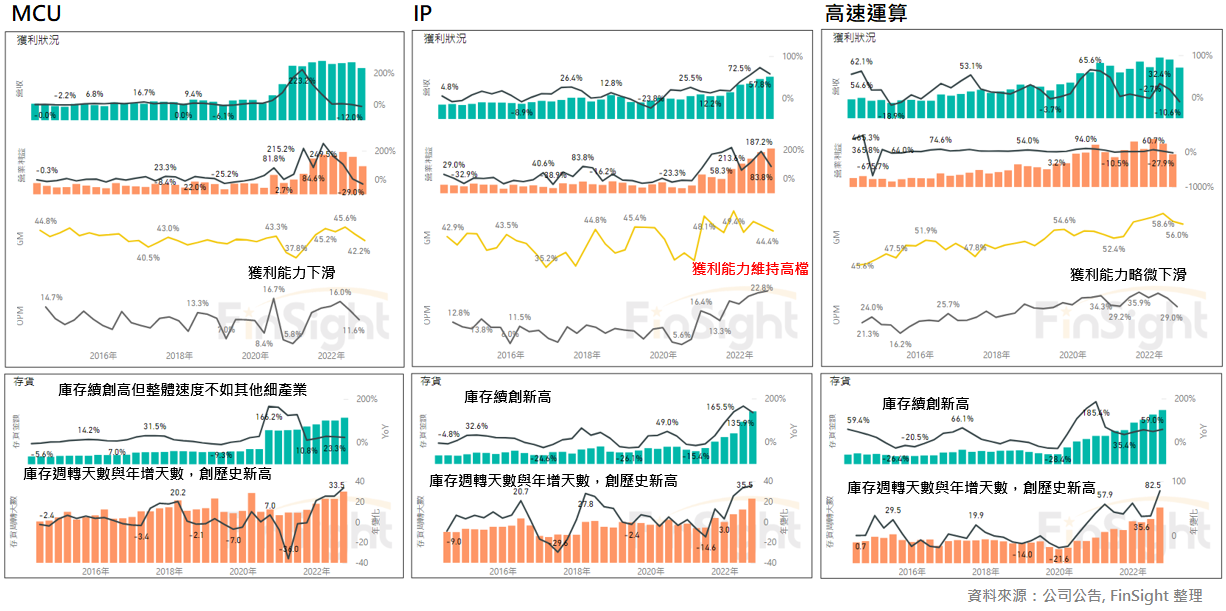
Hardware brands and distributors: still the worst of it, but the adjustment started last quarter and inventory value has stopped making new highs
The absolute inventory balance stopped rising, which is the part that looks better than chip designers and memory makers. Inventory days are still on a plateau, with cost of sales up sharply. If price pressure eases or the absolute inventory balance keeps coming down, there is a good chance of a buy signal, inventory days below their year-earlier level. On base effects, the earliest that can happen is the second quarter of 2023.
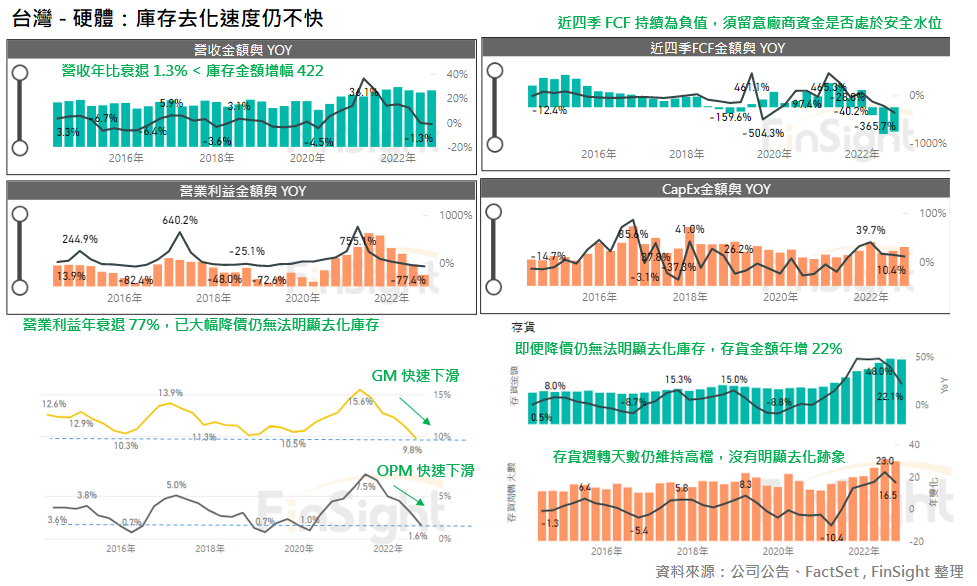
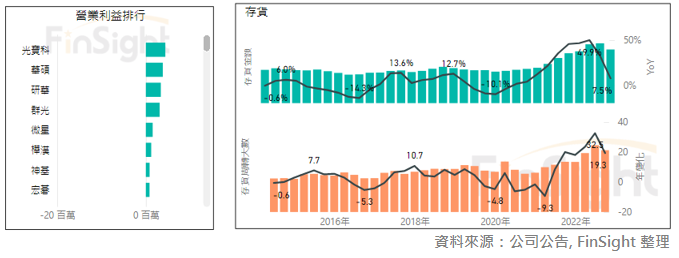
A few companies said channel inventory has come down. Looking at Taiwan and US hardware makers, that trend is not so clear. Take Taiwan's PC and storage brands: inventory value fell, but inventory days are still high. The most we can say is that it has stopped getting worse. There is no clear improvement signal yet.
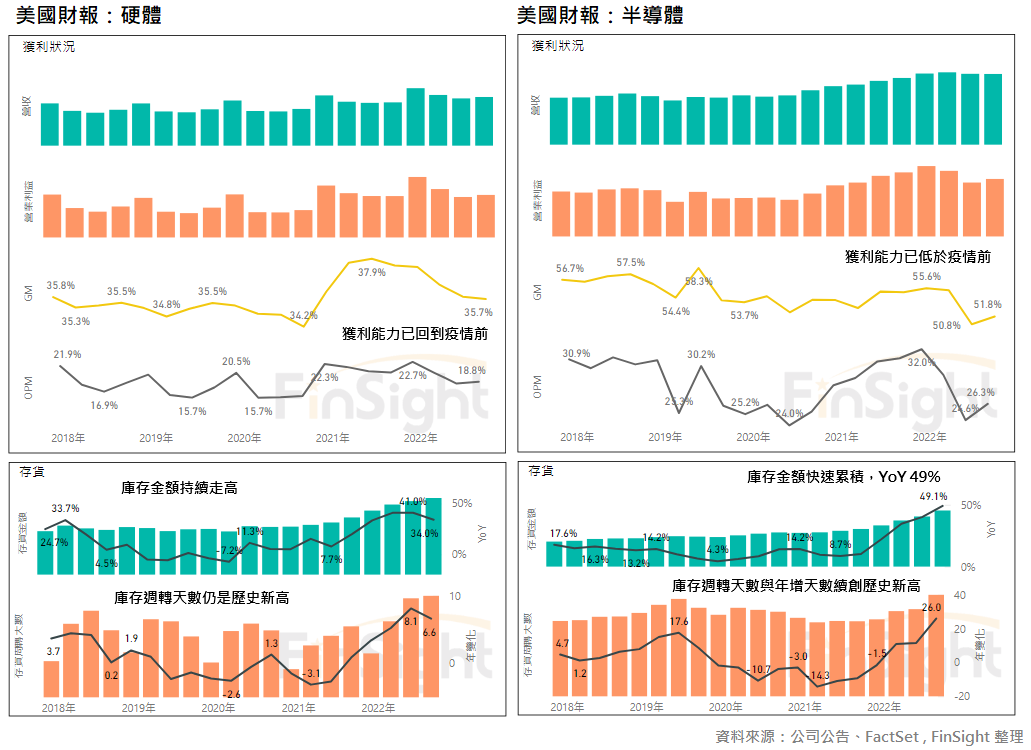
In US hardware filings, inventory value and inventory days are both still rising fast. Hardware was the first area to have an inventory problem and the first to start competing on price, but destocking is not actually running quickly.
The bigger thing to watch is that inventory is still building further up the chain. Inventory value and inventory days at US semiconductor companies are climbing sharply, to a ten year high. We have to keep watching end demand: if it stays weak, destocking could take considerably longer.
Foundry: the numbers still look good, but the cracks are showing
This is still the healthiest of all the electronics sub-industries, with revenue, profit and operating margin all being revised up. Strong profitability is what is holding inventory days down, but the same math cuts the other way: when revenue falls next year and cost of sales climbs, the pressure on inventory days in this group builds. So our view is that foundry may adjust last and recover last, and that lower utilization rates in the first half of next year will do the most damage to its profits.
Excluding TSMC, gross margin has already started to roll over. Demand tied to mature nodes adjusts first, and inventory days there keep making new highs. Worth watching.
Components: better in the near term, inventory value falling, but demand still needs watching
Components is the group with the shortest visibility, but this quarter inventory value came down, and with revenue and profit rising, inventory days fell further. Even if companies still cannot see demand, lower inventory gives a decent chance that near-term ordering normalizes. PCB and power-related names are the examples.
Contract assembly and manufacturing: the numbers are under control, with nothing unusual
Inventory value kept rising, but that is mainly stocking for the peak season, and inventory days are under control.
Bottom line: the destocking signal has not arrived, so we keep watching and waiting
On the electronics inventory cycle as we track it, the sell signal in this cycle fired on May 2, 2022, when Taiwan's PMI new orders minus customers' inventories turned negative. At the same time, the second quarter filings put inventory value at levels not seen in a decade. Our call then was that the whole industry would move quickly into an inventory adjustment, and that adjustment is what is happening now.
What this quarter's filings add is that while companies are consciously cutting prices to clear inventory, the pace of destocking is not that fast. On the current numbers we think at least two more quarters of adjustment are needed, and our best estimate is that the buy signal shows up no earlier than the second quarter of 2023 (August 16, 2023).
We trade with the trend, which in Taiwan is called right-side trading: we buy the trend once the turn is confirmed, while a left-side trader buys the turn itself. Taking no view and waiting for the buy signal is where conviction and win rate are highest, and by the Kelly criterion, which turns win rate and payoff ratio into a position size, that is where we would size up and go properly long. None of the buy signals we track have fired yet, and our liquidity indicators are still in the warning zone, so our stance is to keep watching and waiting, pass on counter-trend bear market rallies, and wait for the next trend to show up.
History has a catch, though. The price low in electronics usually lands in the window between the sell signal firing and the buy signal appearing. Put another way, the inventory buy and sell signals will not get you the exact bottom. So our advice is the same as before: long-term investors can start scaling in slowly once the sell signal has fired, but do not rush it, because next year brings plenty of problems that follow from high rates, and with the world cutting debt you still want a safe cash buffer.
In the next post we will take the discussion above and look at how the TWSE electronics sector index (the electronics index) behaved in the stretch between the electronics inventory sell signal and the buy signal. One more thing to watch: US retail inventories are piling up fast. It looks to us a lot like watching electronics inventory build a year ago, in late 2021. If sales weaken from here, the inventory-to-sales ratio could rise quickly.