
Taiwan electronics inventory days hit a post-2010 high in Q2 2022, up 15 days from a year earlier, while foundry took close to 60% of sector operating profit.
Our April 2022 post on Taiwan's first quarter filings flagged how extreme inventory levels had become across the electronics supply chain and said a correction was coming soon. It also went back through the previous destocking cycle in 2018 to see how the major suppliers' financials trended and what they told investors on their earnings calls quarter by quarter.
Key takeaways
- Inventory days across Taiwan electronics hit their highest level since 2010 in the second quarter of 2022, up 15 days from a year earlier, with inventory dollars up 36%.
- The damage is concentrated. Hardware brands and distributors grew inventory 40% while operating profit fell 58%, and chip designers and memory makers grew inventory 50%. Both are destocking on a scale not seen in ten years.
- Profit has tilted to foundry. Foundry, which here also covers semiconductor manufacturing equipment, now takes close to 60% of Taiwan electronics operating profit, and it is the only one of the five groups where revenue and profit grew faster than inventory.
- On the historical pattern, the earliest a buy signal could appear is in the second quarter 2023 financials, filed August 15, 2023. It will not happen in 2022, so there is no need to rush.
This quarter every company is saying it has formally entered an inventory correction, but they do not agree on how broad or how long it will be. Some think this is a normal correction on the scale of 2015 or 2018 (TSMC). Others think consumer customers are destocking at a pace not seen in ten years (Intel). Some argue the weakness is confined to the consumer end and will not necessarily spread to enterprise and commercial demand, while others argue that if the second half revenue decline and the speed of destocking both run ahead of expectations, the correction could end sooner.
This post does one thing: read the inventory levels in Taiwan electronics financials to work out where we are.
The second quarter 2022 filings say Taiwan electronics inventory is very stretched
The key to reading Taiwan electronics financials is placing where we sit in the inventory cycle. Historically the TWSE electronics sector index (the electronics index) has tracked inventory days at Taiwan component makers very closely, and we built buy and sell signals on the electronics inventory cycle from that history. Taiwan's manufacturing PMI, published monthly by CIER, fired a formal sell signal in early May 2022, when new orders minus customers' inventories turned negative. Like ISM, its sub-indices are diffusion readings around 50, so the signal is a spread rather than a level. Since then our attention has been on the buy signal: whether inventory days fall below their year-earlier level.
In this quarter's filings, both inventory days and the year-over-year increase in inventory days are the highest since 2010. We already thought last quarter's numbers were extreme. This quarter is worse. Inventory is piling up harder than in any prior cycle. At the same time the sector is extremely uneven, with profit concentrating in a very small number of companies, which leaves the whole chain in an unstable position going into destocking.
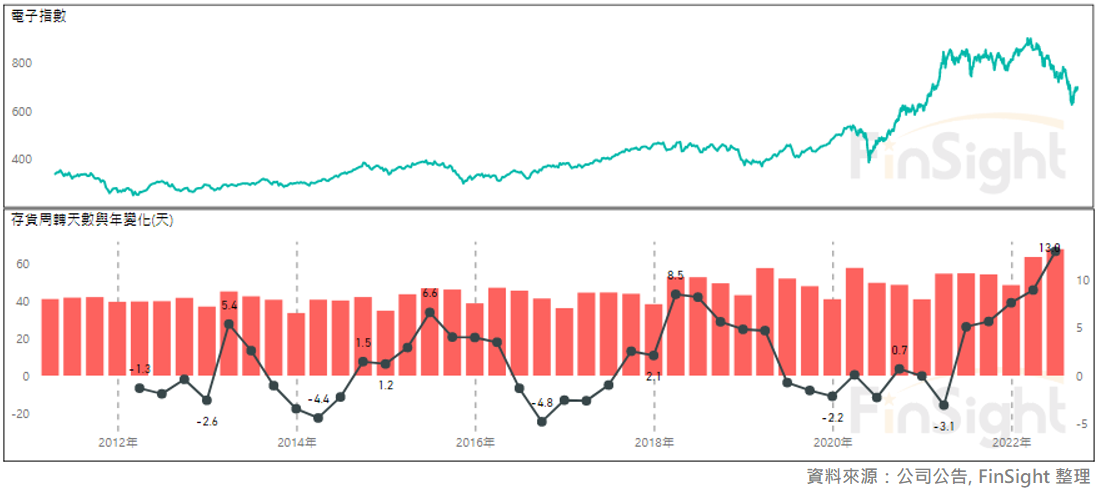
Across the whole supply chain, history says that after the year-over-year increase in inventory peaks, it still takes two to four quarters before a buy signal shows up. The bullwhip effect is why the swings get this large: a small change in end demand is amplified at every step up the chain, because each link orders for its own safety stock as well as for its customer. Separately, the length of the correction tracks the absolute size of the year-over-year increase in inventory days. The more days a company has added versus a year earlier, the longer the destocking is likely to run.
Through last quarter, the filings only told us a correction was starting. This quarter they show inventory days at Taiwan electronics still making new highs, far above any historical level, and that makes us worry this correction will not be a small one. Extrapolating from the timing of past cycles, the earliest a buy signal could appear is the second quarter 2023 financials, filed August 15, 2023. But the cycle can shorten or lengthen depending on end consumption and on how fast companies work inventory down, so we would rather watch inventory days in the filings directly and only judge the buy signal once they fall clearly. It will not happen in 2022, so there is no need to rush.
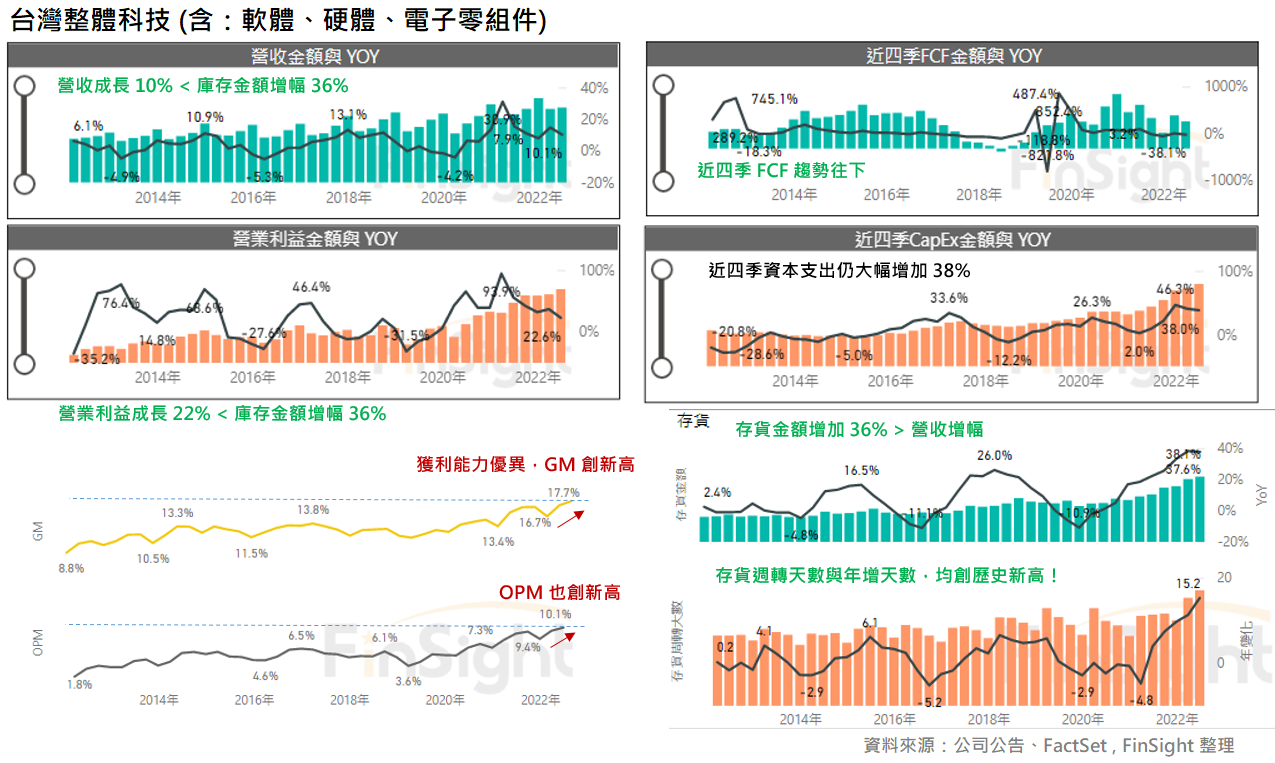
Here is what the Taiwan electronics financials (software, hardware and components) show:
- Revenue growth is down to single digits, but profit is still up 21% year over year. Growth is slowing, and the numbers are still good: gross margin and operating margin both hit ten year highs.
- Capital spending (capex) keeps expanding, up 38% from a year earlier. Free cash flow is slightly lower, though, and without more borrowing the pace of that capex expansion is likely to slow.
- Inventory is up 36%, and inventory days are 15 days higher than a year earlier, the highest in more than a decade. Destocking is already under way. If revenue falls further from here, on top of inventory at this level, this could turn into the most severe inventory correction in ten years.
The gap between the groups is enormous
At the aggregate level inventory has climbed to an extreme. One level down, the groups look nothing alike: some are running hot, some are already cold.
We work through five parts of the Taiwan supply chain, from upstream to downstream: foundry (which here also covers semiconductor manufacturing equipment), chip designers and memory makers, components, contract assembly and manufacturing, and hardware brands and distributors.
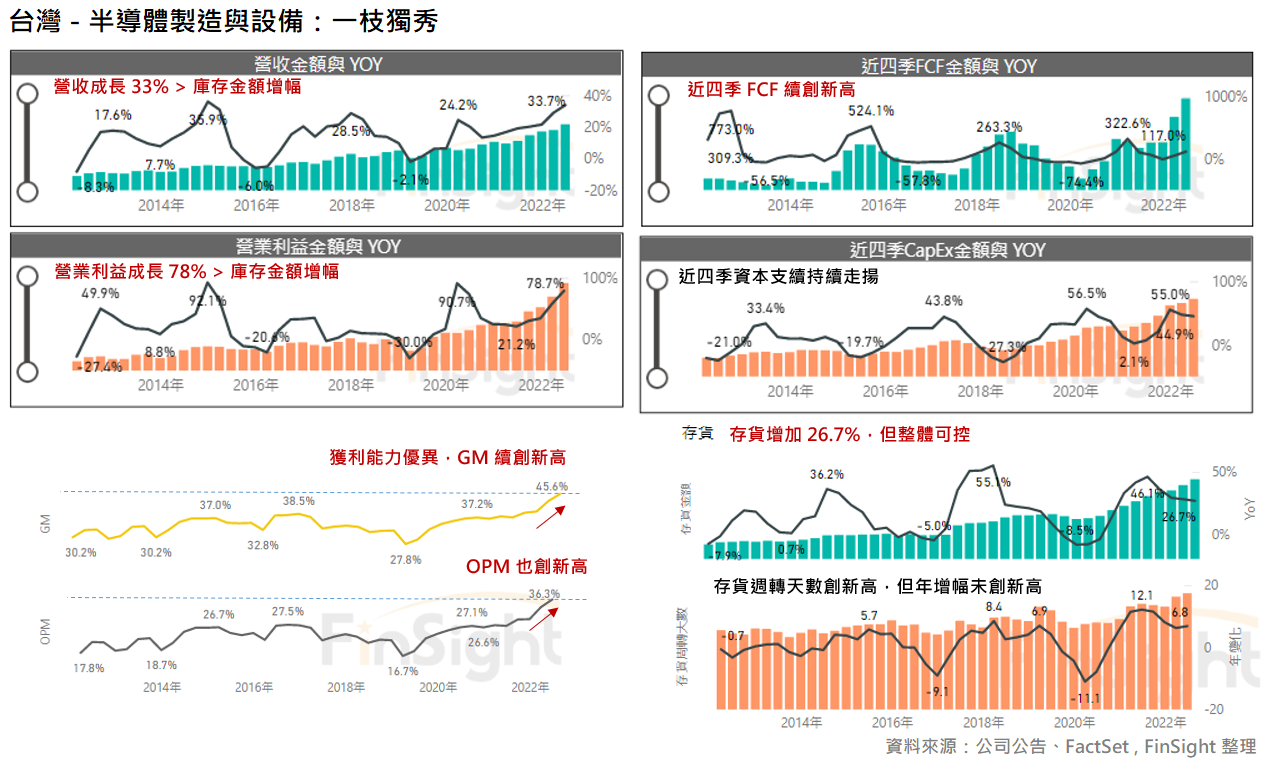
Foundry: the standout, strong on revenue, profit, operating margin and cash flow
This is the only one of the five groups where revenue and profit grew faster than inventory, and trailing four quarter free cash flow keeps setting records. Inventory days are 7 days higher than a year earlier, which is not bad at all against its own history.
In its second quarter 2022 results, TSMC said this inventory correction would be on the scale of 2015 and 2018. Beyond the strength of its own position, the foundry manufacturing numbers themselves give no evidence that this correction will be worse than expected.
Chip designers and memory makers: the epicenter, and the correction will be long and deep
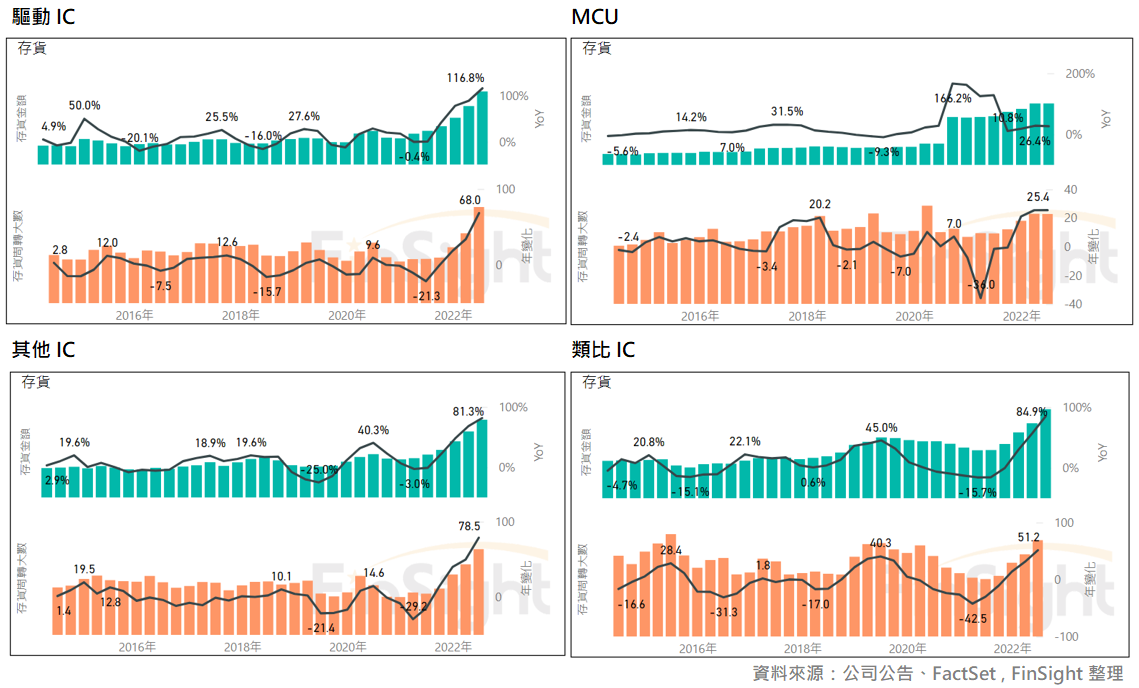
Taking chip designers and memory makers as one group, revenue grew 5.9% and profit grew just 2%, while inventory grew 50% and inventory days rose 37 days from a year earlier. The weaker results are already showing up in cash: trailing four quarter free cash flow is down roughly a third from the prior period.
Inventory days at chip companies have always been more volatile than at the rest of the chain, but even allowing for that, these numbers are abnormal. With end sales already cooling, the depth and scale of the destocking ahead should not be underestimated. It is no surprise that Intel described consumer customers working down inventory at a pace not seen in ten years.
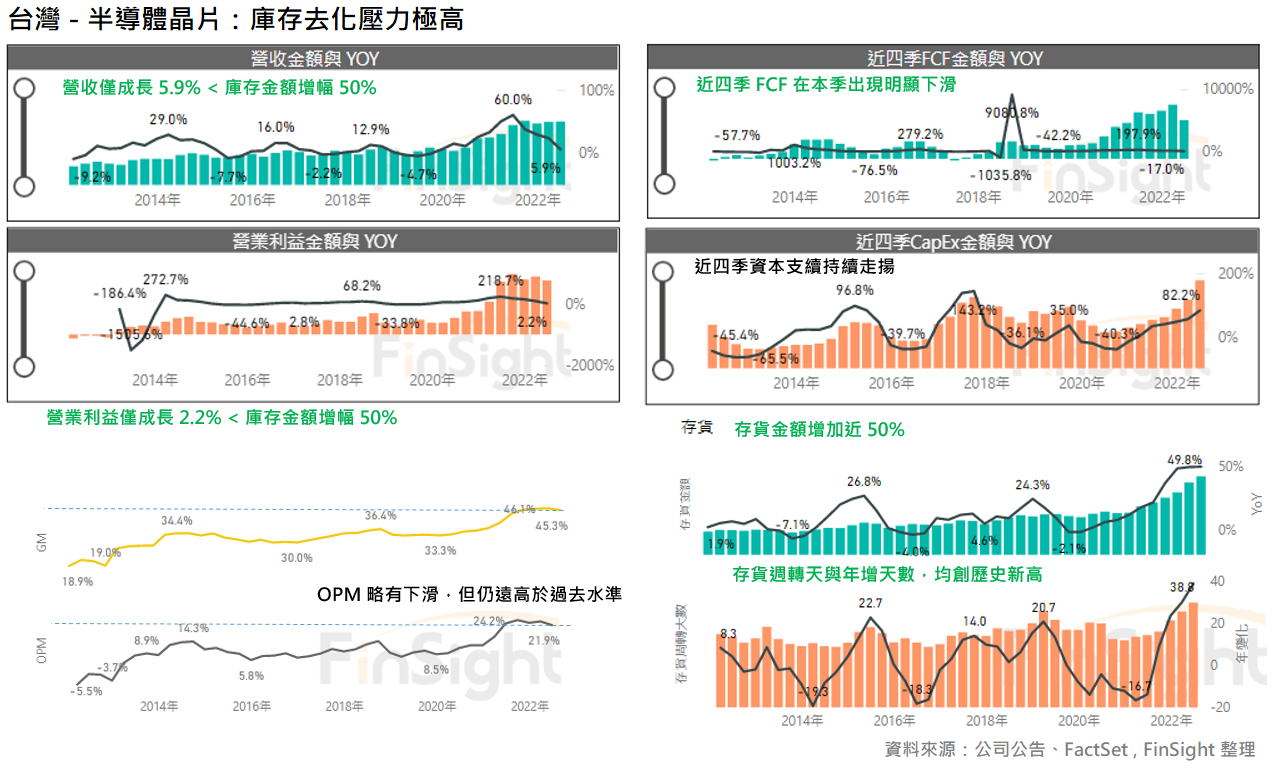
Within this group, results vary a lot by end application. The inventory build this time is concentrated in display driver integrated circuits (ICs), other consumer ICs and analog ICs. On the end market side, consumer products are the worst hit in this correction: phones, PCs and notebooks, and panels.
Components: the largest increase in inventory days on record, and profit is shrinking
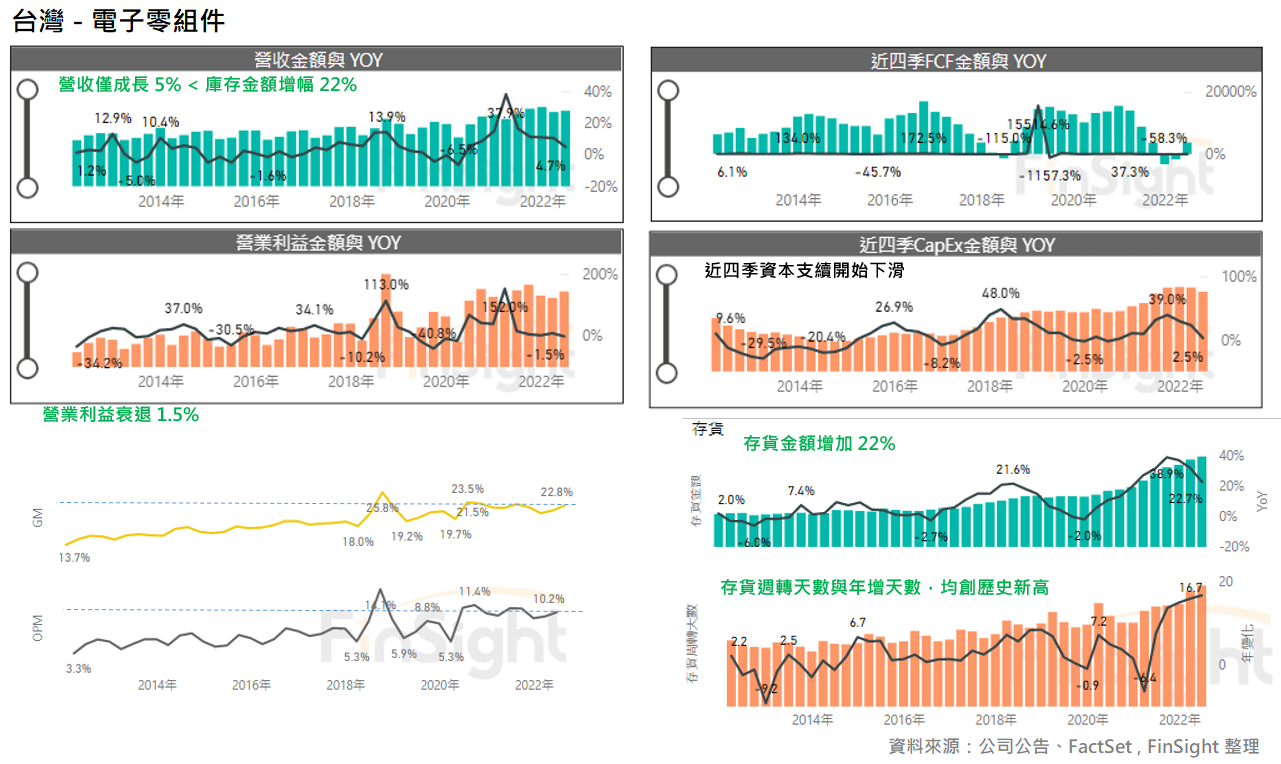
Components have been the long lead-time parts of this cycle, so 2021 was already not a strong year for them. Inventory grew only 22% this quarter, which is not high, but operating profit growth has already turned negative, so inventory days stay elevated.
Contract assembly and manufacturing: inventory days up 11, but less pressure than hardware
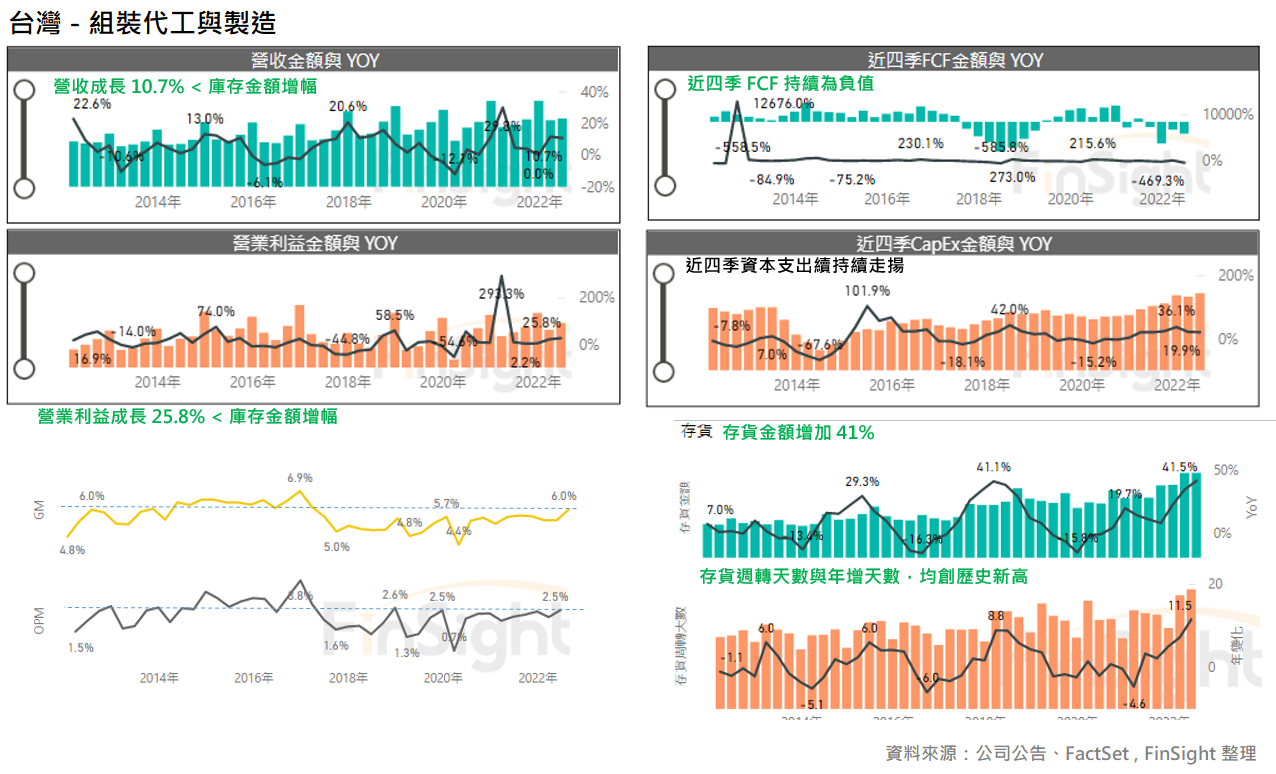
Compared with hardware, the overall numbers for contract assembly still look manageable: revenue up 10%, operating profit up 25%, inventory up 41%, and inventory days 11 days higher than a year earlier.
Hardware brands and distributors: the other epicenter, destocking on a scale not seen in ten years
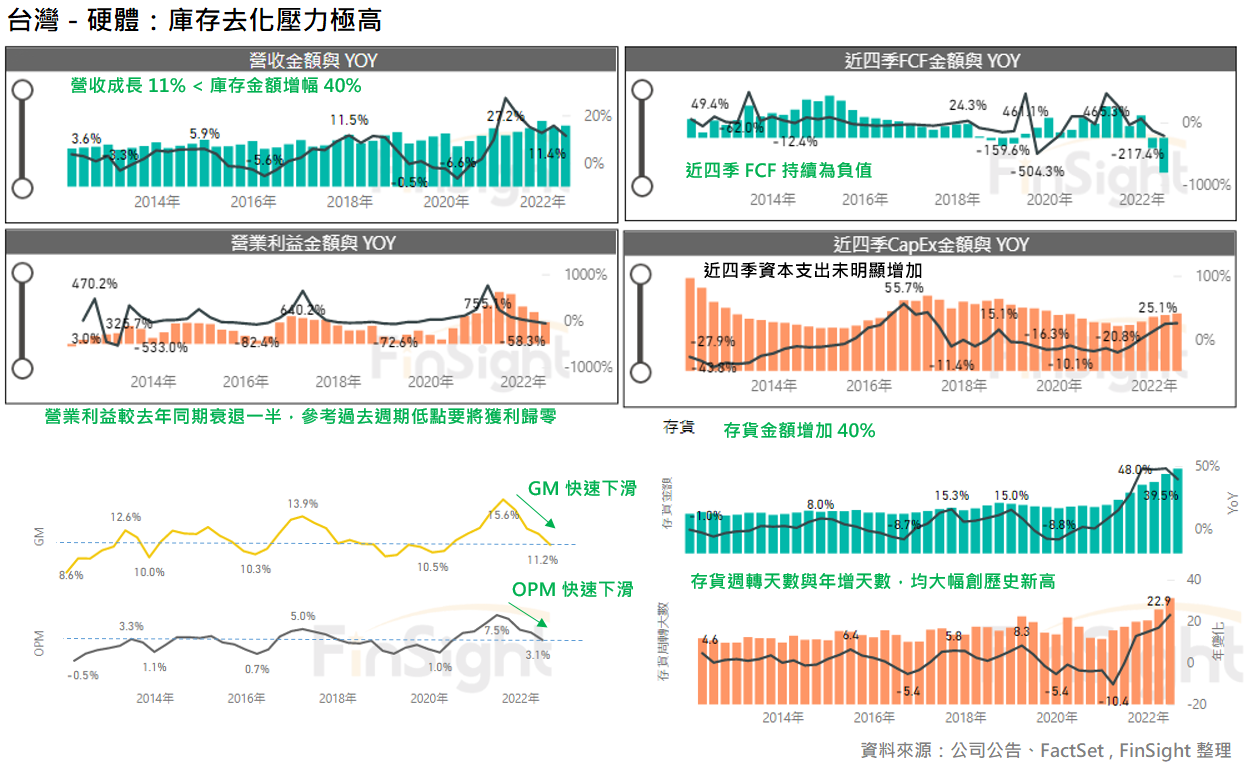
Revenue grew 11% while operating profit collapsed 58%, and profitability is deteriorating fast. Operating margin has fallen for five straight quarters, back to close to pre-pandemic levels, and free cash flow is still negative. Inventory grew 40%, far faster than revenue, and inventory days jumped 22 days to a record high. The hardware makers that rode the goods boom after the pandemic are now carrying severe inventory pressure.
Pulling the inventory build together across the chain, it splits into two extremes:
- Very high destocking pressure: hardware (inventory up 40%, operating profit down 58%) and chip designers and memory makers (inventory up 50%, revenue flat). Both are facing destocking pressure on a scale not seen in ten years.
- Inventory is high but this is a normal cyclical adjustment: foundry (inventory up 26%, and the only group where revenue growth outpaced inventory growth).
A supply chain this lopsided is not normal
Step back to the sector level and the very high inventory says a sizable correction is coming, but aggregate profitability has not deteriorated much. The gap between the good groups and the bad ones is huge, which made us ask whether an imbalance like this has been normal in the past. So we pulled several years of financials for each group.
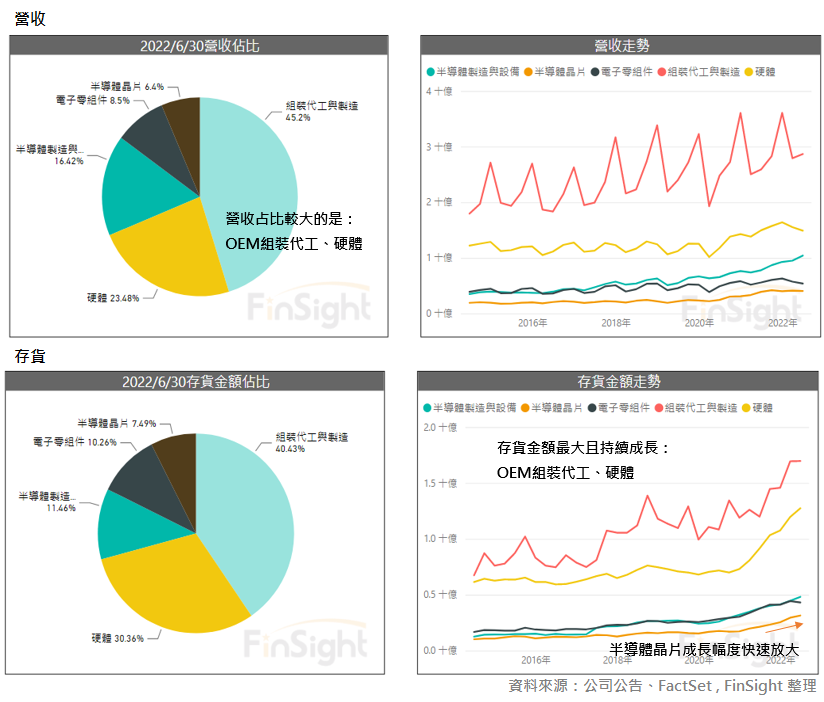
- Sector revenue has grown steadily, and foundry's share of it has been rising over the past few years.
- The groups where the inventory ratio rose most: hardware, chip designers and memory makers, and contract assembly.
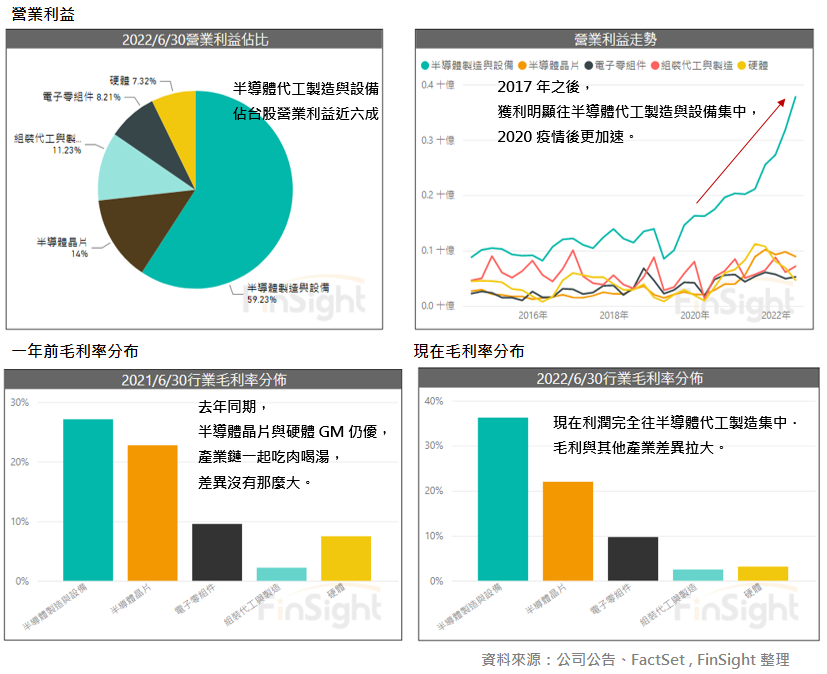
- On profit the gap is much wider. Measured by operating profit, close to 60% of all Taiwan electronics profit now goes to foundry. The profit mix has never been this extreme in the past.
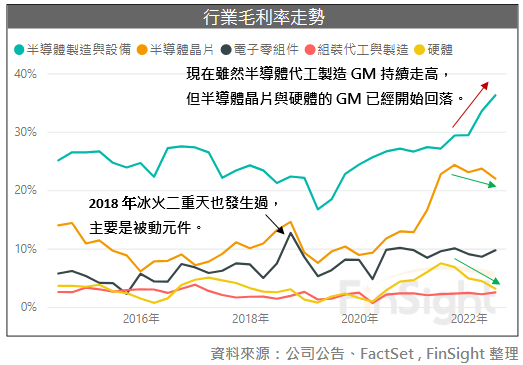
- Gross margin shows it even more clearly. A year earlier, gross margins across the chain sat on a far more even curve. In this quarter's filings, profit has concentrated entirely in foundry, and the gap versus every other group has widened sharply.
Foundry's advantage here is real. Since 2016, rising data volumes have created endless demand for high performance computing, and at the same time wafer manufacturing has become harder to do. That leads us to believe TSMC, with its moat in advanced process technology and advanced packaging, will have stronger pricing power and will raise foundry's standing within the chain.
That case rests on customers staying reasonably profitable. Right now end demand is weakening, gross margins at hardware companies and at chip designers and memory makers are falling noticeably, and wafer manufacturing gross margin is still going the other way, up. Looking at history, an imbalance like this is not a steady state.
In 2018 passive components went through a structural improvement that let them capture a larger share of the chain's profit and a higher gross margin. But once end demand turned weaker, even a genuine long term structural story got hit.
On inventory levels, hardware and chip designers and memory makers face a violent correction. The setup was a surge in goods demand after the pandemic combined with a supply chain that could not keep up, which pushed companies into stockpiling at extreme levels. When the bullwhip cracks back this hard, the pressure and the scale of the destocking will be larger than most people imagine.
Does it reach foundry, the one group doing well? End demand is the thing to watch, because the single most important variable in how broad and how long an inventory correction runs is whether end demand weakens clearly. We think China and Europe are under heavy economic pressure right now, and the United States is the only large consumer market still running strong. But in our data, once household balance sheets shrink for two straight quarters, retail sales follow. If that is the script, it will be hard for foundry to stay untouched.
This post worked from the numbers in the Taiwan filings. Next we will use what individual companies said and the latest financial estimates to judge how broad and how long this inventory correction will be.