
Taiwan electronics inventory days rose 8.9 days year over year in Q1 2022, a record, and export orders just turned negative for the first time this cycle.
In April 2022 we went through Taiwan's fourth quarter 2021 filings and flagged how high inventory had already become. Our view then was that with end demand weakening, that inventory would keep adding pressure across the supply chain. Now the first quarter 2022 filings are out.
Key takeaways
- Inventory days across Taiwan electronics rose 8.9 days from a year earlier in the first quarter 2022 filings, the most extreme reading since we began compiling these filings. An inventory correction is coming soon.
- The damage gets worse the further downstream you go. Hardware brands grew inventory 49% against revenue growth of 13%, operating profit fell 15%, and inventory days rose 17. Semiconductors are still the healthiest group, with revenue up 26% and operating profit up 58%.
- Taiwan's export orders reported in May 2022 turned negative year over year for the first time in this cycle. Information and communication technology (ICT) here means PCs, notebooks and networking gear. ICT and electronic products together fell close to 8%, with ICT alone down 21%, and the weakness was spread across the United States, Europe and China.
- Analyst estimates now put 2022 Taiwan revenue growth below 4% and net income at roughly zero growth. We expect visible cuts next earnings season, starting with end hardware brands and long lead-time electronic components.
The first quarter 2022 numbers are striking to us. Inventory across Taiwan electronics has deteriorated to the most extreme level in our history of compiling these filings. Downstream destocking pressure is especially heavy, and an inventory correction has to arrive soon.
At the same time, the Taiwan manufacturing purchasing managers index (PMI) reported in May 2022 has already given a sell signal, with new orders minus inventories turning negative. The export orders released on May 20 were worse: the first month of negative growth in this cycle, with the main ICT markets (the United States, Europe and China) all down sharply. End demand is weakening while hardware inventory rises and profits fall, and all of that says the pressure to cut prices and clear inventory is very high.
Taiwan's manufacturing PMI is published monthly by CIER (the Chung-Hua Institution for Economic Research). Like ISM, its sub-indices are diffusion readings around 50, so new orders minus inventories is a spread, not a level. Taiwan's export orders are a monthly survey from the Ministry of Economic Affairs that counts orders booked with Taiwan companies, including product manufactured offshore.
This post walks through the filings using three data sets we track: Taiwan company financials, Taiwan analyst estimates, and Taiwan export orders.
The Q1 2022 filings: Taiwan's electronics inventory numbers got much worse
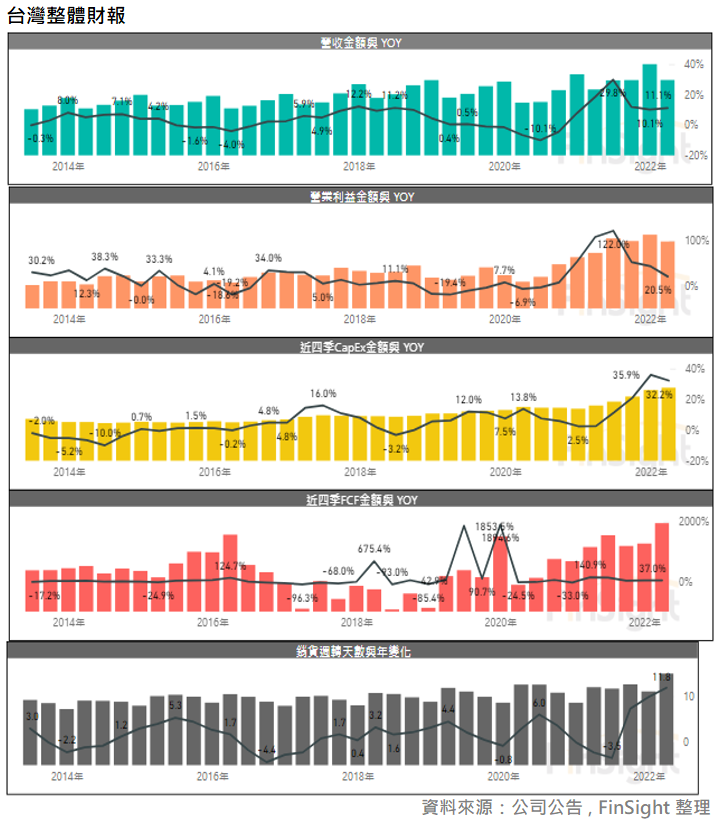
Taken as a whole, the first quarter 2022 results Taiwan companies filed are still decent.
Base effects pulled down the growth rate of operating profit, but it still held a strong 20%. Capital spending kept expanding quickly, up 30% year over year, well ahead of profit growth. Inventory kept deteriorating: both inventory days and the year-over-year increase in days set records.
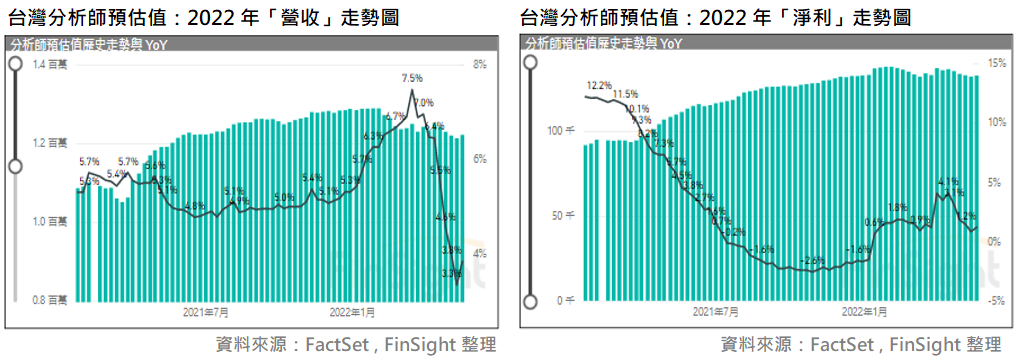
Switching to analyst estimates for the full year, this earnings season saw Taiwan revenue growth marked down step by step, and the estimate now sits below 4% growth for 2022. Net income has not been cut as sharply as revenue, but the estimate now implies close to zero growth this year.
On the number we care most about, electronics inventory, this quarter's filings show a historical extreme. Inventory days rose 8.9 days from a year earlier. Past cycles say inventory this high cannot hold, which points to an inventory correction starting soon.

We then split Taiwan electronics from downstream to upstream into four groups: hardware brands, contract assembly and manufacturing, electronic components, and semiconductors. The further downstream you go, the worse the deterioration.
Hardware brands: inventory and profitability both deteriorated sharply, which says the brands can neither raise prices nor move product.
- Profitability fell noticeably. Operating profit dropped 15%, and operating margin is back to mid-2020 levels.
- Inventory rose a lot, up 49% year over year against revenue growth of 13%.
- Inventory days hit a record in our data, up 17 days from a year earlier.
Contract assembly and manufacturing: inventory rose as well, but not by as much as at hardware brands.
- Revenue and operating profit are still growing fast, and operating margin is holding up.
- Inventory rose 33% from a year earlier, still ahead of revenue growth of 12%.
- Inventory days set a record, up close to 7 days from a year earlier, which is still manageable next to the other groups.

Electronic components: profitability is unremarkable and inventory days jumped, so this is one of the groups carrying heavier destocking pressure.
- Revenue and operating profit both grew in the single digits, and operating margin stayed low.
- Inventory dollars rose 33%, far above revenue growth of 8%.
- Inventory days hit a record in our data, up 18 days from a year earlier.
Semiconductors: inventory rose, but profitability held, so we expect this to be the last group to correct.
- Revenue grew 26% and operating profit grew 58%, with operating margin at another record.
- Inventory is 34% higher than a year earlier, not far off revenue growth of 26%.
- Inventory days also hit a record in our data, up 12.5 days from a year earlier.

Export orders fell hard, which makes the inventory correction heavier
High inventory on its own is not a problem. It becomes one when end demand weakens and new orders drop, because then the inventory has to be worked off. Taiwan's PMI new orders minus inventories already gave a sell signal in early May 2022, and the export orders released on May 20 confirm that overall order momentum is weakening.
Through this cycle the hard data on Taiwan electronics has been excellent, especially export orders and exports, both growing steadily. The export orders reported in May 2022 broke that: growth turned negative year over year for the first time. Adding ICT and electronic products together, the decline is close to 8%, worse than the drop in total export orders.
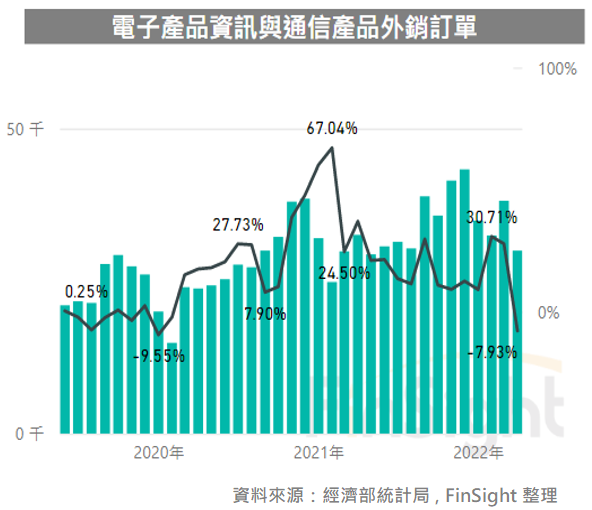
Split ICT and electronic products apart and the two look very different. ICT export orders fell 21%, while electronic product export orders still grew 4% year over year. That says destocking pressure is heaviest at the end product level, in PCs and notebooks, and has not yet clearly hit the strong demand for electronic parts and chips. Put that next to the Taiwan filings, where the fastest deterioration is at the end hardware brands, and both point to the same place: the destocking pressure sits at the end of the chain.

Pulling out the four main markets for ICT export orders, the United States, Europe and China all show clear declines, and only ASEAN is holding its momentum. The weakness in ICT orders is coming broadly, from several regions at once, and that is not a good signal.
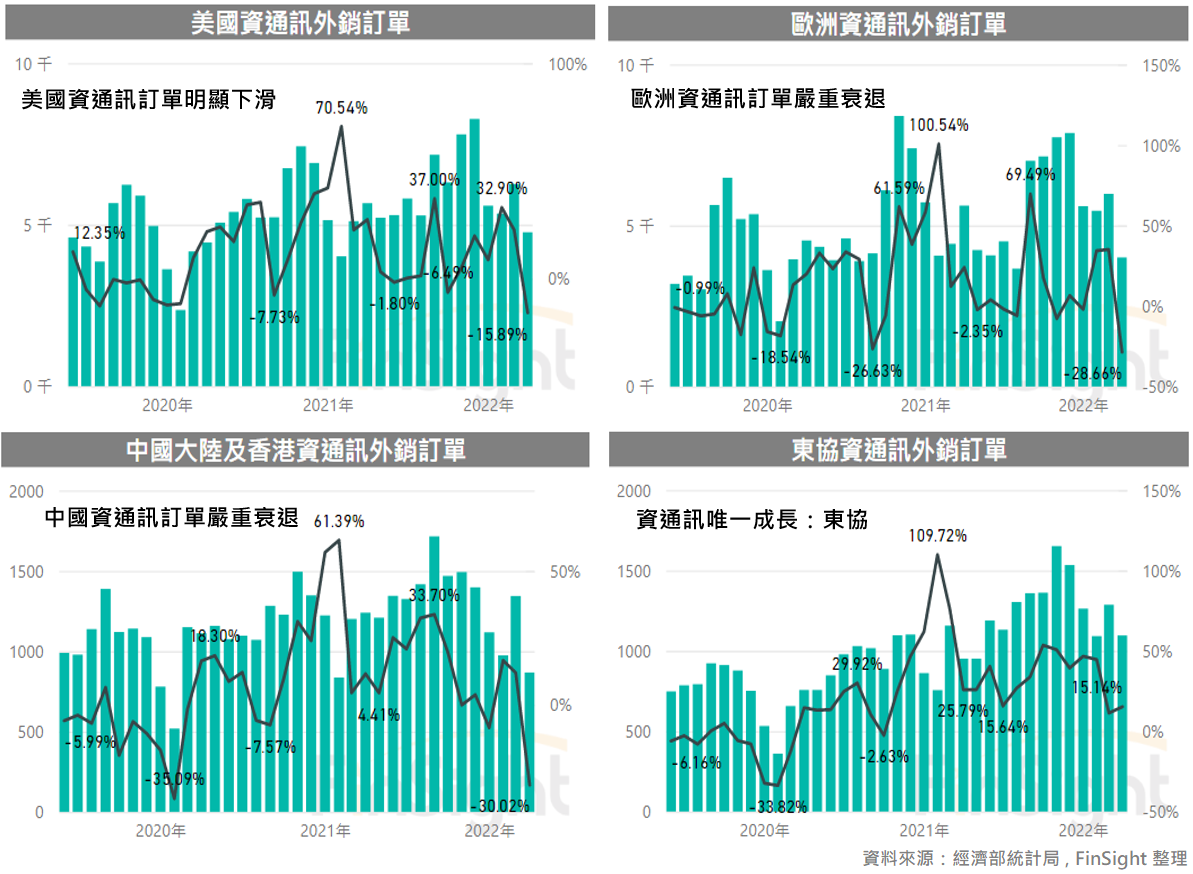
For electronic product export orders, only Europe and China are down clearly, while the United States and ASEAN are still growing strongly. With ICT demand weakening, though, we think that eventually feeds through to the supply-constrained chip names that have been the strongest part of this cycle. We expect electronic product export orders to turn clearly negative over the next few months.

The warning lights keep coming on, and EPS cuts are next
From inventory at an extreme level to new orders rolling over, we think an inventory correction is now unavoidable, and the pressure on earnings per share (EPS) estimates in these industries will keep building. It starts with end hardware brands and long lead-time electronic components, and it eventually reaches semiconductors, the group performing best.
Could the drop in orders be temporary? We think that is a stretch.
For one thing, the weakness in ICT orders is not confined to a single region: several major markets are declining at once. For another, US disposable income is down 20% and durable goods within US personal consumption are down 10% from a year earlier. Both say weaker end demand is going to persist. What has to correct is the goods boom that has run since 2020.
We expect analyst estimates to be cut visibly next earnings season. Current estimates are already close to zero growth, so the next round of cuts could put them into negative growth, and the pace of those cuts is what to watch from here.