
Electrification cut factory coal bills 20% to 60% and still killed most incumbents. In the data revolution, process redesign is what sorts winners.
Our Data Driven Tech Revolution series (Parts 1 to 5) has been built around data and semiconductors, and what those trends mean for the chip makers involved. The part we actually enjoy arguing about is the business model change underneath it, and the mindset a company needs to get through an industrial revolution. If data is the oil of the new era, then process redesign is the problem every established company now has to solve.
Key takeaways
- Electrification let factories cut 20% to 60% off their coal bill, and most of the industrial giants of that era still did not survive it. They swapped steam for electricity and left the production line alone.
- The argument at the time was group drive versus unit drive. The winners rewired the plant around individually switched motors. The losers kept the central shaft and only changed the power source.
- The same test applies to cloud migration in 2021: lifting the current architecture into the cloud does not work. The workflow has to be rethought with data and cloud at the center, which means redrawing who owns what across departments.
- What we want to own is the neutral enabling platform: foundry (TSMC putting up roughly $30 billion of capital a year), marketplaces (Amazon, Shopify), public cloud, enterprise software (Microsoft, Salesforce, ServiceNow, Workday), payments (Square), and AI and the metaverse (NVIDIA).
History repeats, and the hinge is process redesign
In their book Machine, Platform, Crowd, Andrew McAfee and Erik Brynjolfsson tell the story of the companies that failed to make the transition during the second industrial revolution, when electric power went into mass use.
Once electricity arrived, running a plant on it was simply the more efficient choice. Factories switched because it took 20% to 60% off their coal costs. A saving that large should have translated into enormous profit. Instead, most of the industrial giants of the day did not survive. Why?
Two designs were in contention:
- Group drive: copy the steam layout and run the whole plant off one main generator.
- Unit drive: rewire the power distribution so that each machine has its own motor and its own switch.
Unit drive looks obvious today. At the time it filled the trade literature with argument. An electric machine is more efficient precisely because each one can be switched on only when it is needed, and yet many operators kept their existing layout and simply changed the power source from steam to electricity.
Put in front of a genuinely new technology, incumbents run into the curse of knowledge and status quo bias, and they fail to see the trend coming straight at them. It happens most often to the companies whose people are the most seasoned, know the industry best, and are the most committed to how it works today. Clayton Christensen worked through many versions of this in The Innovator's Dilemma.
Two things are worth taking from the electricity story:
- What decides a technology shift is the new business model it brings with it. Electrifying a factory required organizational change, and beyond that a conceptual change in how work and products were defined and structured. The largest gains did not come from replacing the steam engine with an electric motor. They came from redesigning and rebuilding the production process around it.
- Early movers put brutal pressure on everyone else. The plants that moved first are what brought the industrial giants down. A factory that could not electrify intelligently eventually could not stay in business: it lost on price, it could not get products to market quickly, and it could not switch nimbly from product A to product B.
So an industrial revolution tends to arrive with leaders excited about a huge new market and laggards afraid of how far behind they are. As competition intensifies, everyone rushes to move faster on the transition, because not changing today means being replaced tomorrow.
Our December 2021 post on rising US corporate capital spending made the point that the clearest trend of the second half of 2021 is US companies raising capital spending to accelerate digital transformation. Process redesign is the hinge of this revolution, and it will overturn a lot of industries at the root.
Look at your own life. You own less outright and subscribe to more than you used to, and younger consumers are readier still to share rather than own.
The same thing shows up inside companies. Plenty of them find, once a cloud migration starts, that moving the current architecture into the cloud is extremely hard. The whole workflow has to be rethought with data and cloud at the center. That cuts across existing departments, and if a company will not redraw who owns what, it loses the point of the transformation. So an industrial revolution destroys a lot of existing jobs and creates the jobs of the new era at the same time.
That is why, in our technology research, what we care about most is the business model and the culture behind a company, and whether it can make the decisions the new era calls for. It is the cleanest way to judge whether a company is standing on the right side of the trend.
The core of the data driven revolution: neutral, enabling open platforms
In the data era, a neutral platform that enables its users speeds up digital transformation across every industry, cuts cost sharply, and raises efficiency.
Information is piling up faster, so a business has to stay flexible, and product specs keep getting harder to hit. Few companies can do all of it in house, so the efficient answer is to buy the hard parts from specialists.
For example:
- Foundry: advanced process nodes and 3D packaging keep getting harder, few companies can do them at all, and not every chip company can put up the roughly $30 billion a year of capital that TSMC does. Better to use the foundry supply chain as a platform and get products out fast to take share.
- Marketplaces: building an online marketplace with real traffic is hard, and building one in house means starting with IT headcount. A merchant can join a centralized platform such as Amazon, or keep its own identity and outsource the storefront and logistics to Shopify.
- Public cloud: a startup is under cash flow pressure from day one. Testing a business on elastic public cloud capacity rather than building a data center leaves more room to operate. Public clouds also push hard on data center energy efficiency, so that investment is better left to the specialists.
- The same idea covers enterprise software (Microsoft, Salesforce, ServiceNow, Workday), payments (Square), and AI and the metaverse (NVIDIA).
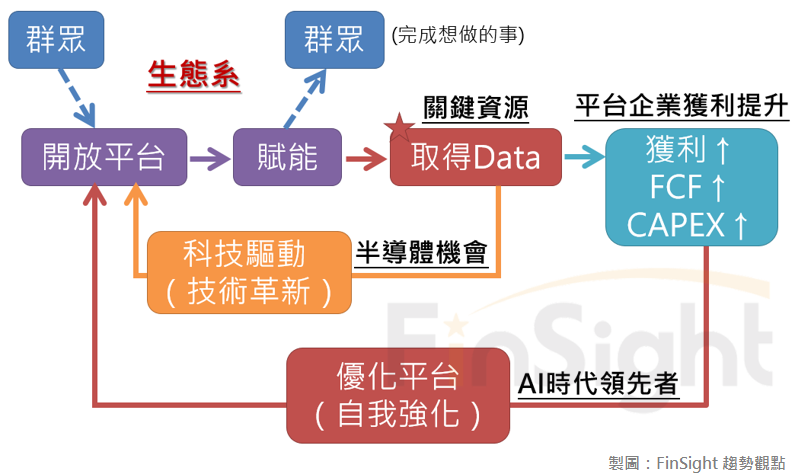
An open platform sells other companies the piece they cannot build themselves, then builds a full ecosystem around it. The platform uses that ecosystem to collect more data, improve its own product, and give the people and companies inside the ecosystem better service.
A good platform company carries a few financial signatures: rising profitability, improving cash flow, and capital spending or R&D spending that keeps climbing. Putting profit back into the platform makes its own product stronger and builds a moat that later entrants struggle to cross.
Consumer platforms (business to consumer, or B2C) usually monetize by monopolizing data. Facebook lets users on for free and earns advertising profit through precise targeting. Centralized platforms like that may face a real challenge from decentralization in the future, but for now the large data monopolies still generate excellent cash flow, and their position is not one to underestimate.
A good enterprise enabling platform (business to business, or B2B) has to stay neutral, and this is the area we prefer to invest in at this point. For a non-tech company, an enterprise platform is the fastest route to digital transformation. For the platform itself, being open and neutral makes the pie bigger. From semiconductors to software, everyone is stressing the same point. They are the ones selling shovels in a gold rush.
The first mover advantage of the enabling platforms keeps getting clearer, and it has been especially visible in the last few quarters of earnings.
The Data Driven Tech Revolution, Part 1, our April 2021 post on Applied Materials' analyst day, said the volume of data is growing exponentially. The technology platforms that enable it are growing the same way. As the logic of one industry after another changes, digital transformation keeps widening the leaders' advantage and raising the pressure on everyone behind.
What has to change is the mindset
Technology raises productivity over the long run, and it reshapes supply and demand in the short run. When cars replaced horse drawn carriages, transport supply rose sharply, but a lot of carriage drivers lost their jobs and there were nowhere near enough car drivers. It took time to reach a new balance.
Since starting this research on the data driven industrial revolution four years ago, in 2017, we have kept asking ourselves the same question: the revolution may move faster than anyone imagines, so how do you adapt to a world changing at that speed?
At the time, these were the things we thought we could do:
- Learn faster and keep up with the data era, which means picking up data driven skills.
- Build on the companies that have already created an ecosystem. First, use the open enabling platforms to do the work in new ways and raise our own value, and our own data work here is one attempt at exactly that. Second, own the companies with a leading position, which are the ones we keep writing about here.

There is no tidy answer to that, and the reminder we keep coming back to is simple: the hard part is never the technology, it is the mindset that will not change.
In an era where data drives the industrial revolution, embracing innovation is the only way to build a new moat. With industrial change compounding exponentially, the question we keep putting to ourselves is whether we have done enough.