
In Taiwan index futures from 2001 to 2014, a 30 point stop turned a losing day trade profitable, at the cost of a win rate falling to 39%.
We said a while back that we would open a running memo series for the thinking that sits outside our published views. For the first post we want to start with the thing that matters most to how an individual trades: money management.
Key takeaways
- The Martingale, doubling the bet after every loss, is a winning system only for someone with unlimited capital: ten losses in a row costs 1,023 units against an opening bet of one.
- On one minute futures data on the TAIEX, Taiwan's main market index, from January 2, 2001 to August 8, 2014, buying the open and selling the close is a losing strategy. Add a 30 point stop, roughly 0.5%, and both that strategy and its mirror image turn profitable.
- The stop cuts the win rate from 50% to 39% and cuts the average loss from 56 points to 27. You are trading how often you are right for how much you lose when you are wrong.
- Ranked over the full history: stop and add beats stop only, which beats stop plus profit target and the baseline. A Monte Carlo run of 100,000 paths gives the same order when fills are perfect, and lifts the payoff ratio from 1 to between 2 and 5.
- Apply realistic slippage and stop and add no longer reliably beats the baseline, though the payoff ratio still separates the same way.
We think money management is the first lesson anyone has to learn on entering the market. Right or wrong on the market, good money management is what keeps you in the game long enough for the edge to show up. Making money in trading means getting a lot of variables right at once. Most of the time we write about the view, the industry and market research behind it. There is a second thing that decides trading results and gets far less attention: the method, meaning how much capital you put behind the view.
The work in this post is a report one of us was asked to write in 2014 as a junior analyst, when the boss wanted research on the Kelly criterion. It is eight years old, and it is still the most valuable piece of research anyone here has produced. It helped us build a trading framework, and we are sharing it here in the hope that it changes how you think about money management.
Money management takes two posts. This one is about the trading mechanics that raise your payoff ratio, the average win divided by the average loss.
One caveat: this is written for ordinary people with finite capital, not for the very rich with effectively unlimited capital. Someone with unlimited capital can double down until the position comes back. Someone with finite capital has to stay solvent first and maximize return second.
When you are losing: double down or cut early?
The first question we wanted to settle back then was exactly that. Take a series of independent bets. The famous winning system for doubling down into losses is the Martingale: start with one unit, double the bet after every loss, and go back to one unit after any win.
When a win finally comes, you recover every prior loss plus one unit. But through a run of losses the stake grows very fast.

Take the table above. Ten straight losses is a 1 in 1,024 run, which is to say you will eventually see it, and by then the cumulative loss reaches 1,023 units against the one unit you started with. Put differently, even if the initial bet is only one thousandth of total assets, ten losses in a row is enough to bankrupt you. The Martingale looks like a winning system, but only for the super rich with unlimited capital. It does not work for ordinary people with finite capital.
If doubling down when you are wrong is out, how much does cutting the loss in time actually help?
We looked for a strategy with no edge and tested it.
- Backtest: one minute bars on TAIEX futures from January 2, 2001 to August 8, 2014.
- Strategy: intraday day trading. Version one buys at the open and sells at the close. Version two sells at the open and buys back at the close.
The outcome is what you would expect. Before transaction costs, neither version makes money over the long run. And because the two do exactly opposite things, their profit and loss curves are symmetric around zero.
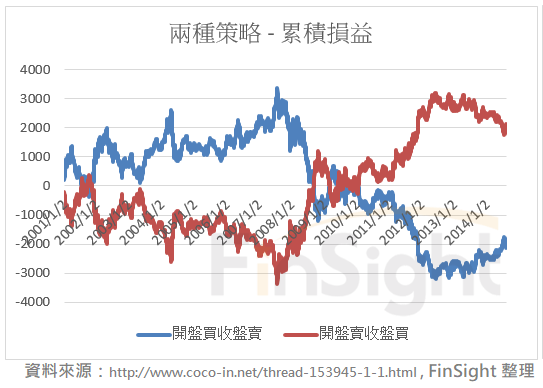
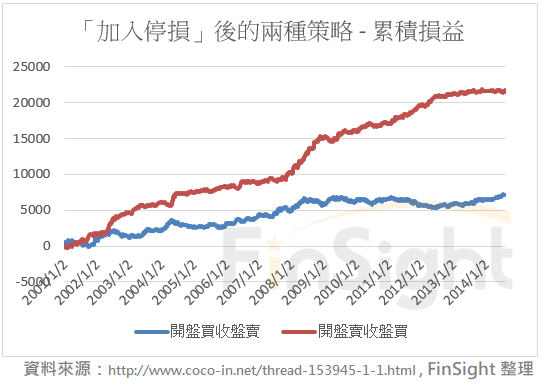
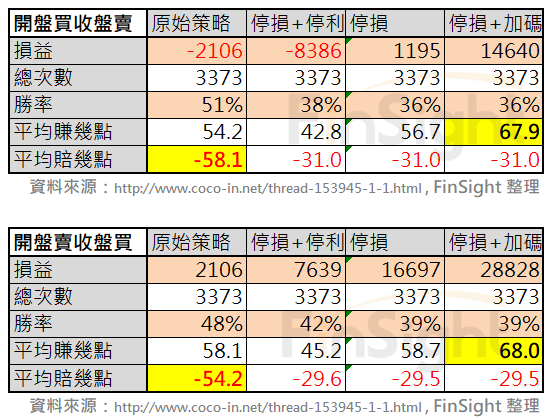
Then we added a stop at a 30 point loss, roughly 0.5%, to the same strategies, and the result was better than we expected. Long at the open or short at the open, both turned profitable once the stop was in. (These numbers do not include slippage. We come back to slippage in the Monte Carlo work below.)
The stop lifts long run performance, but the distribution of wins and losses shows what it costs. The win rate falls from 50% in the original strategy to 39%. What we buy with the lower win rate is a smaller average loss: with a 30 point stop, the average losing trade is about 27 points, less than half the 56 points without a stop.
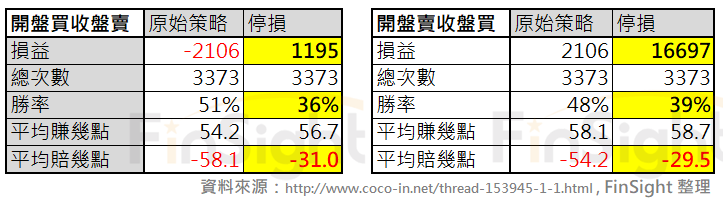
So cutting the loss when you are wrong avoids the deep drawdowns and helps compound assets over time, at the cost of a lower win rate. When your win rate goes from five in ten to four in ten, it feels like you are wrong most of the time. Our advice is to lengthen the horizon you judge it on and think about the strategy in terms of maximizing long run asset growth.
When you are winning: take the profit early or press the trade?
We took the same two mirror image strategies, buy at the open and sell at the close, and sell at the open and buy at the close, and split each into four stop and target rules, then ran the historical profit and loss before slippage. Same data: one minute bars on TAIEX futures from January 2, 2001 to August 8, 2014.
Strategy 1, long at the open:
- Baseline: sell at the close.
- Stop and target: stop out on a 30 point decline, take profit on a 60 point gain, otherwise sell at the close.
- Stop only: stop out on a 30 point decline, otherwise sell at the close.
- Stop and add: stop out on a 30 point decline. If the trade gains 30 points, add one unit and exit the added unit at the price you added it, while the original unit keeps the 30 point stop or is sold at the close.
Strategy 2, short at the open:
- Baseline: buy back at the close.
- Stop and target: stop out on a 30 point rise, take profit on a 60 point decline, otherwise buy back at the close.
- Stop only: stop out on a 30 point rise, otherwise buy back at the close.
- Stop and add: stop out on a 30 point rise. If the trade gains 30 points, add one unit and exit the added unit at the price you added it, while the original unit keeps the 30 point stop or is closed at the close.
Adding into a winner produced the most striking result of the lot. Ranked by cumulative performance: stop and add first, then stop only, then stop and target roughly level with the baseline.
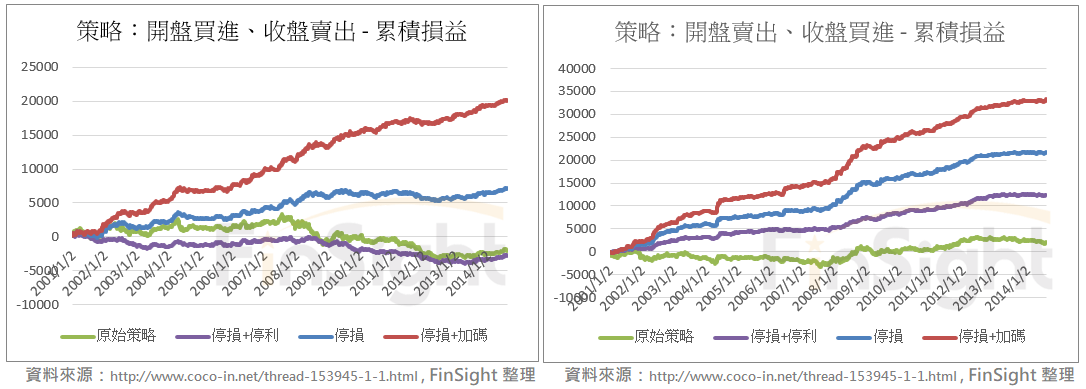
Look at the distribution of wins and losses and you can see what adding into a winner does: it cuts the win rate hard in exchange for many more points on the trades that work. The next post covers the Kelly criterion, where you can see that raising the payoff ratio in the trade and raising the win rate through research together produce big wins and small losses over time. Cutting the loss when you are wrong and adding when you are right lowers the win rate on each trade and raises the payoff ratio. As long as we can lift the win rate through research, that is still the better setup over the long run.
One note on the TAIEX futures backtests: Mu Ching-hua, writing at Bituzi, ran the same history with different methods and reached the same ranking, with stop and add ahead.
Beyond the historical backtest we ran at the time, we also had a colleague run a Monte Carlo simulation to check the result again.
- Simulation: Monte Carlo with annualized sigma at 15% and 30% and annualized drift at 0%, 0.5% and 1%, 100,000 paths, 300 nodes per path, each node one minute, so one path is one trading day.
Strategy, long at the open:
- Baseline: sell at the close.
- Stop and target: stop out on a 0.5% decline, take profit on a 1% gain, otherwise sell at the close.
- Stop only: stop out on a 0.5% decline, otherwise sell at the close.
- Stop and add: stop out on a 0.5% decline. If the trade gains 0.5%, add one unit and exit the added unit at the price you added it, while the original unit keeps the 0.5% stop or is sold at the close.
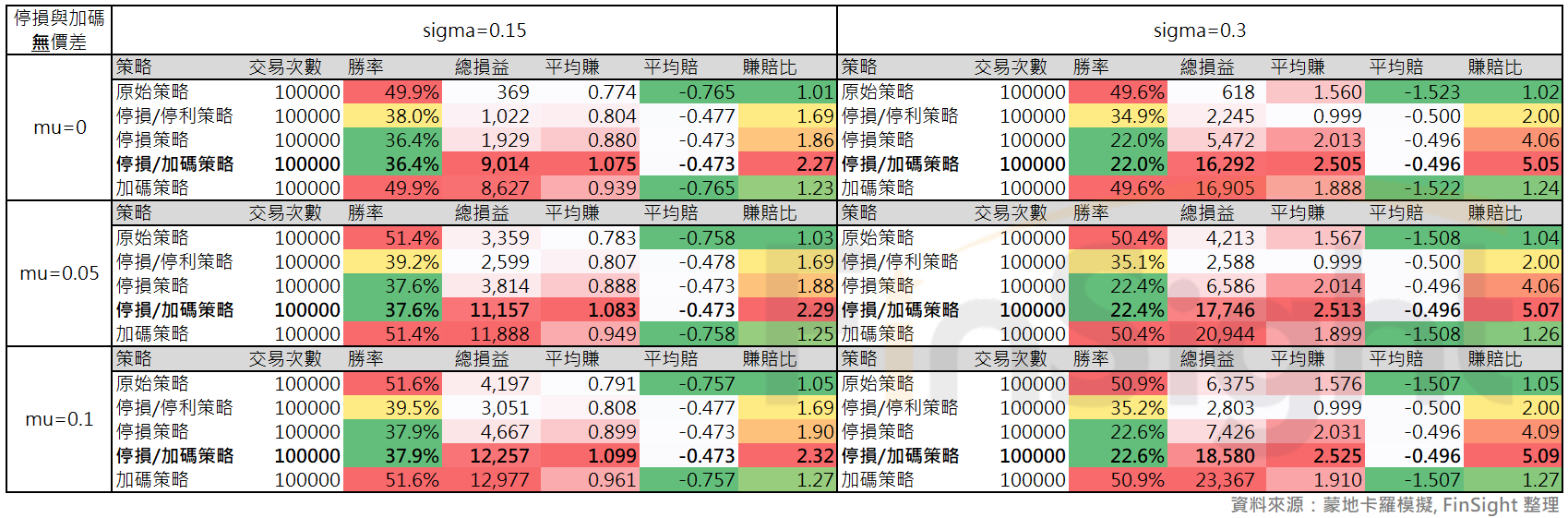
With stops and adds filled perfectly, at no slippage, we get the same answer as on TAIEX futures: stop and add is best over the long run, stop only is next, and the baseline is worst. The distribution lines up too. Stop and add cuts the win rate sharply but lifts the payoff ratio from 1 in the original strategy to between 2 and 5. In the simulation, the more volatile the market, the wider the gap in payoff ratio, because the stop and the add trigger get hit more often.
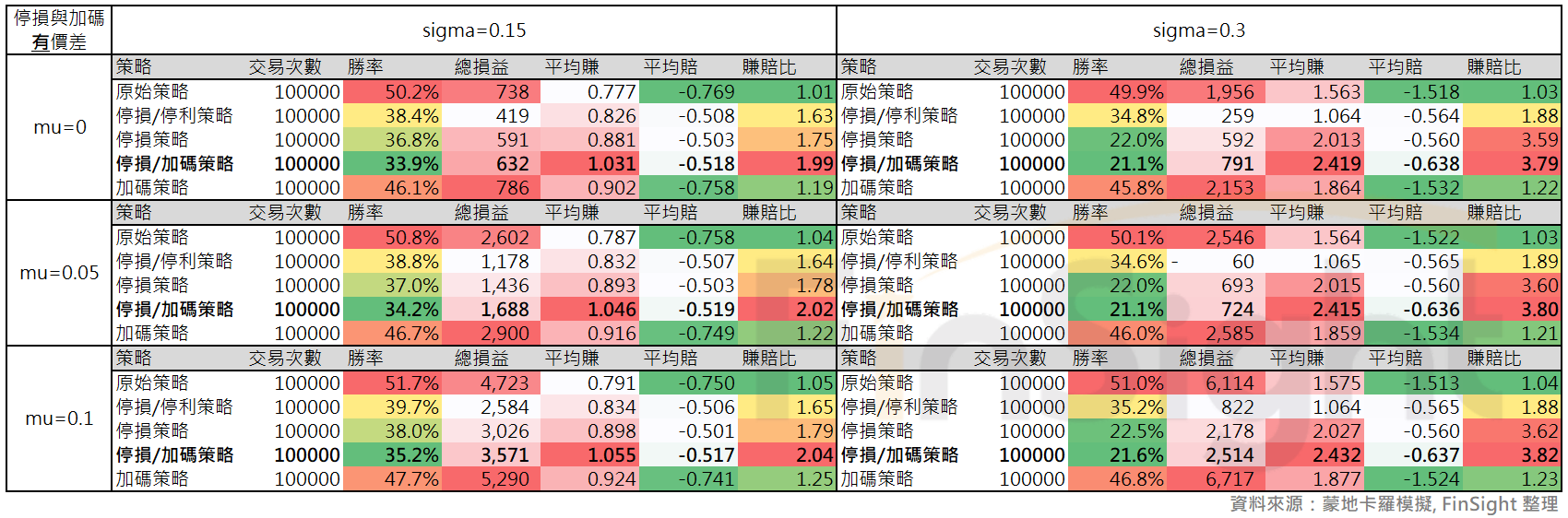
Real life rarely fills stops and adds with no slippage, so we ran it again using the close of the bar in which the stop or the add level is touched as the exit price. On that basis the stop and add rule does not always beat the baseline over the long run, though the payoff ratio still separates the same way. To run this in the real world, you have to keep raising the win rate through research to get better long run performance.
Bottom line: use trading mechanics to raise the payoff ratio and long run performance
Trading mechanics give two people running the same strategy completely different profit and loss distributions. To optimize the long run, cutting the loss when you are wrong and adding when you are right raise the payoff ratio on each trade. For anyone whose style is trend following, that matters even more.
In practice the lower win rate is what hurts. You will often feel you have been stopped out at the low, and the self doubt follows. That is the moment to work on your judgment and lift the win rate, which makes big wins and small losses much easier to achieve.
Where you put the stop changes the distribution, and risk tolerance differs from person to person, so pick the rule that fits your own tolerance. Weigh the size of your capital and your style too. Someone with unlimited capital who buys pullbacks basically needs neither stops nor adds.
Our usual advice: use the stops. Whether you add into a winner is optional, because it depends on what kind of investor you are.
Part 1 of money management covered the trading mechanics that raise the payoff ratio. Part 2, Position Sizing With the Kelly Criterion, takes on what we think is the most important piece of money management: how much capital to put behind each bet.