
In 2022 prices fell while EPS held up. We break share prices into four forces: fundamentals, valuation, monetary policy and risk appetite.
Since the start of 2022, plenty of companies have watched their share prices and their multiples fall hard while the fundamentals have not changed. That has started a debate: this is a macro-driven tape rather than a stock picker's tape, and doing fundamental work in a tape like this is useless.
Key takeaways
- A share price is EPS times a multiple. Over long horizons EPS wins, but in a year like 2022 the multiple does almost all the work.
- The four forces we track are fundamentals, valuation, monetary policy and risk appetite. The multiple is the hardest of them to call, and since 2008 it has been set mostly by whether central banks are easing: 2020 delivered a P/E expansion, 2022 a P/E collapse.
- The Federal Reserve has guided rate expectations with forward guidance for roughly thirty years. At the July 2022 FOMC meeting it decided to give less of it, so expectations should now flip with each data release and volatility should rise.
- When macro and micro point the same way, the win rate and the payoff ratio both improve and the Kelly criterion, which turns win rate and payoff ratio into a position size, says to size up. When they conflict, expect no big index move, only structural alpha in a small group of names.
- Trends and cycles are different problems. Trends reward a long horizon, and the leaders in a structural shift typically take about 80% of the profit pool. Cycles reward timing. Every good trend still has a cycle inside it.
We respect both top down and bottom up, so the question we find useful is not whether the market is macro driven or micro driven. It is which of the four forces is doing the most work right now.
This memo collects some of the organizing work we did on our own trading research over the years. When we were greener, these same questions bothered us, and once we had clear definitions for the four elements of a stock market, a lot of them answered themselves.
The four forces behind stock prices, and the man walking the dog
Before connecting fundamentals to share prices, sort out which one is the owner and which one is the dog.
Fundamentals and share prices work like an old man walking his dog in the park. The dog darts around, sometimes far out in front, sometimes stopping or circling, and it does not keep the owner's slow pace or direction. However far it roams, it stays around the owner, and in the end it goes where the owner goes. The parable comes from André Kostolany, the Hungarian born investor who used it to describe the gap between the economy and the market.
The market (price) is the dog and the fundamentals (EPS) are the owner. What separates them is that the market also carries a multiple (P/E). Stretch the horizon out and, once the multiple returns to where it started, the two paths match. Over short windows a change in the multiple can pull the market away from the fundamentals.
Research exists to make money in markets. Fundamentals are very useful for judging where a stock is going, but you cannot look only at fundamentals and ignore everything else pushing on the price. In our own work, the multiple the market is willing to pay is the hardest call of all. Under different conditions that number moves a lot.
The multiple can be broken down further, into monetary policy and risk appetite, and both usually work through market expectations. When events run past what the market could imagine, sentiment goes to an extreme and the multiple goes with it. When expectations are already reasonable, sentiment stays inside the range and the multiple is unlikely to be what drives the tape.
For roughly the past thirty years the Federal Reserve has used forward guidance on rates to steer those expectations. At the July 2022 FOMC meeting it decided to give less of it. Our concern is that expectations now flip with every new data release, and that widens the swings in the market.
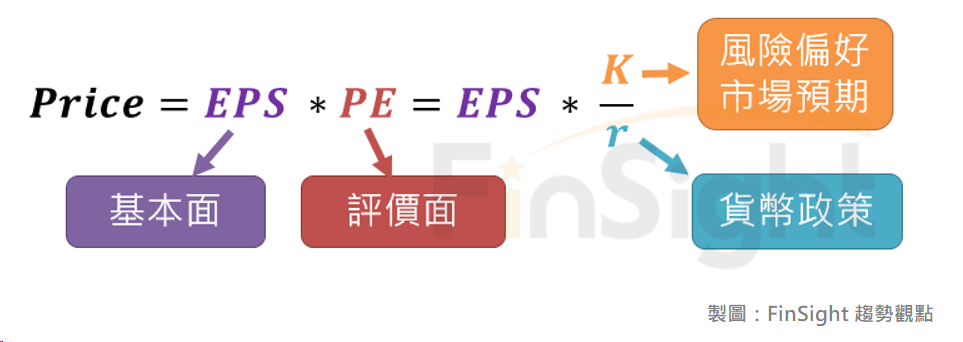
Here is how we break the four forces down.
- Fundamentals: for the index, the fundamentals are the macro trend; for a single stock, they are the change in EPS. Earnings estimates usually adjust slowly, which is the owner in the story, and over short horizons the multiple still moves the price more.
- Valuation: the multiple tends to move ahead of the fundamentals. For a single stock it depends on the industry it sits in, its position in that industry, how stable the business is, ROE and similar factors. For the index, the base for the multiple splits again into monetary policy and market expectations.
- Monetary policy: rates are the critical input to the multiple. Rates anchor every other price in the market, and the multiple moves inversely to them, so the absolute level, the direction from here and what the market expects all move it a lot. Since 2008 the amount of liquidity in the market has been set by whether central banks are easing, so how you read each Fed statement feeds straight into valuation. An example: in 2020 heavy central bank easing produced a P/E expansion, and in 2022 central banks pulling liquidity back produced a P/E collapse. Monetary policy does plenty of work on where the market goes.
- Risk appetite: market expectations and the flow of money between asset classes both move risk appetite. A few things to watch when judging it are market estimates for inflation and for earnings, the dollar, yields and risk indicators. Both the multiple and volatility stretch furthest while the story is still unfalsifiable. A risk you can already picture is not a black swan. An example: the VIX usually peaks before stocks bottom, because panic about the unknown puts sentiment at an extreme. For single stocks, the multiple expands fastest while it is still a story, and by the time the fundamentals confirm growth the peak P/E is often well behind you.
Blending top down and bottom up, and telling trends apart from cycles
In research, macro and micro help each other.
Sometimes macro speaks first and the companies have not seen it yet. Sometimes the companies are right and macro is overreacting. Micro is the tree and macro is the forest, and you cannot read one without the other.
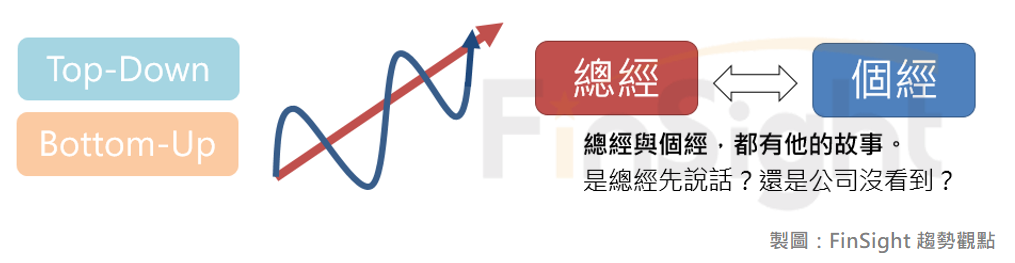
So what do you do when macro and micro conflict? In our experience, when they disagree the market rarely produces a big move. At most you get structural change that creates alpha in a small group of companies, and as conditions and the data develop, one side ends up moving toward the other.
When macro and micro point the same way, both the win rate and the payoff ratio improve, and the Kelly criterion says that is the moment to size the bet up. So when the two line up, we press harder, and we use macro indicators to judge when the cycle ends.
There is one more thing to get right when you blend top down and bottom up: telling trends apart from cycles.
- Trend: a megatrend, a structural change. Under that kind of industry revolution, ask who benefits most from a trend that is going up and rewriting the rules of the game. The leaders in that shift typically take about 80% of the profit pool, and their multiples get marked up on top of it. Once the market accepts the trend, the rerating comes fast.
- Cycle: read the cycle from the top down. History does not repeat itself, but it rhymes. Cycles come in types: inventory, capital spending, real estate, credit and others. Macro data, central bank liquidity policy, company earnings and inventory levels together show you the regular pattern.
A cycle is not a question of whether it arrives, since it always does. It is a question of when, because cycles can shorten or stretch. To know where you are in one, set indicators from company filings and macro data and track them.
For trends, think on a long horizon. For cycles, try to time them well. Sometimes the cycle moves the trend and sometimes the trend moves the cycle, but either way, every good trend still has a cycle inside it. Keep that in mind.
Bottom line: pick the research and trading model that fits you
Which driver you weight most depends on how much capital you run and what style you invest in.
Not everyone needs to master all four forces. There are many ways to make money in this market, and as long as the research behind it is honest over time, you can make a different kind of money from fundamentals, technicals, macro, positioning data or relative price strength. What matters is knowing which kind of money you are making, and trading in the way that matches it.
What the market rewards changes from regime to regime, though, and anyone who trades a single style will run into a headwind in some environments. In the first half of 2022, EPS did not move much and prices were clearly driven by the P/E correction that came with rate hikes, which is exactly when people who do fundamental work start saying fundamentals are useless. Fundamentals stay useful in every environment: EPS is half of what makes up a share price, and it sets the owner's long-term direction.
Against that background, we have two suggestions.
- If you have decided to trade one style only: know which environments do not suit you and stay away from the tape at those moments, or understand where you lose money and accept the short-term loss because you are working toward a long-term result. Someone who believes in the long bull in equities, for example, only needs to keep buying on a fixed schedule and does not need to dodge this drawdown, because over time equities remain an excellent way to earn high returns.
- Or build a research process with more than one leg: keep the four forces in mind at all times, judge which one is moving prices in the current environment, and bring out the tool that matches it. Keep sharpening each of them, fundamentals, macro, technicals, news flow and the rest, and the win rate goes up. On money management, the Kelly criterion tells us that raising the win rate and improving the payoff ratio both lift long run performance by a lot, and a research process with several legs is what makes that possible.
We have clearly chosen the second path. That is why, through 2022, we have written less about single stock fundamentals and put the weight on monetary policy and shifts in risk appetite. We will keep using these four forces as the main basis for our judgment, and as the driver of the tape moves, we will keep adjusting where the research goes.