
The Kelly criterion turns win rate and payoff ratio into a position size: a 2 to 1 coin flip says stake 25%, and 50% is twice Kelly, where growth goes to zero.
Part 1 of this pair, on stop losses and adding to winners, covered how to raise the payoff ratio on a trade, meaning the average win divided by the average loss. This one answers the other half of money management: once you have a bet with positive expected value, how much capital do you put behind it? The Kelly criterion gives you a number.
Key takeaways
- The Kelly criterion is the bet size that maximizes the long run growth rate of capital on a repeated bet with positive expected value. Bet the size it recommends and you can never lose everything.
- On a coin flip with a 50% win rate that pays 2 to 1, Kelly says stake 25% of capital. Bet 10% and you make money too slowly. Bet 50%, which is exactly twice Kelly, and the long run growth rate falls to zero: two losses in a row take 75% of your capital, so you carry all the volatility and get none of the compounding. Anything above 50% grinds capital down for real.
- Applied to Largan Precision (the Taiwan lens maker that supplies Apple's iPhone) in 2014, the same framework called for a 73% position on May 8 (80% win rate, 3 to 1 payoff ratio) and a 10% position on August 30 (55% win rate, 1 to 1 payoff ratio), on the same stock.
- Where it has helped us most is total exposure rather than single names. In 2008 the Taiwan market fell 46% and only 49 stocks rose, 10 of them trading below NT$10 (New Taiwan dollars, roughly 30 to 32 per US dollar). When we judge the odds at 50/50, we pass on the hand.
The Kelly criterion is the formula for the bet size that maximizes the long run growth rate of capital on a repeated bet with positive expected value. It assumes the bet can be played an unlimited number of times, and at the size it recommends you will never lose your entire stake. What follows is the logic behind it, the places it breaks down when you point it at a stock, and how we actually use it. We find it genuinely useful. The rough edges are real, but the idea behind it is what keeps the wins large and the losses small.
Sizing the bet with the Kelly criterion
Start with a simple coin game and work out how much capital belongs on it. Assume the win rate and the payoff ratio look like this.
- Win rate: heads and tails each come up 50% of the time.
- Payoff ratio: heads pays 2 times your stake in profit, so you get back 3. Tails loses the whole stake.
Before taking any bet you check the expected value to see whether the game is favorable. Here it is 50% times $3 plus 50% times $0, or $1.50 on a $1 stake. That beats the $1 you put up, so of course you play. The question is how much.
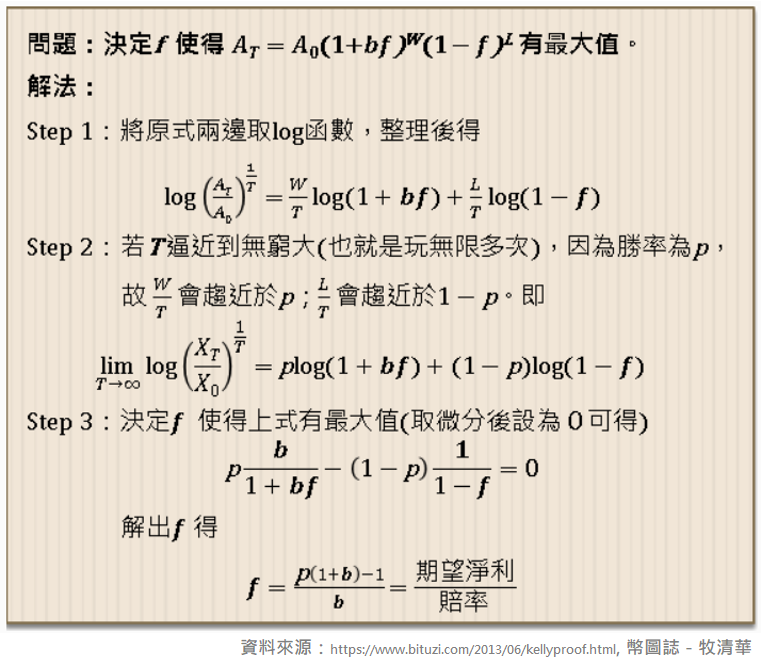
Kelly says the amount to stake is expected net profit divided by the payoff ratio. On this coin game, expected net profit is the $1.50 expected value less the $1 stake, or $0.50, and the payoff ratio is 2. So Kelly puts 0.50 divided by 2, which is 25% of assets, on every play.
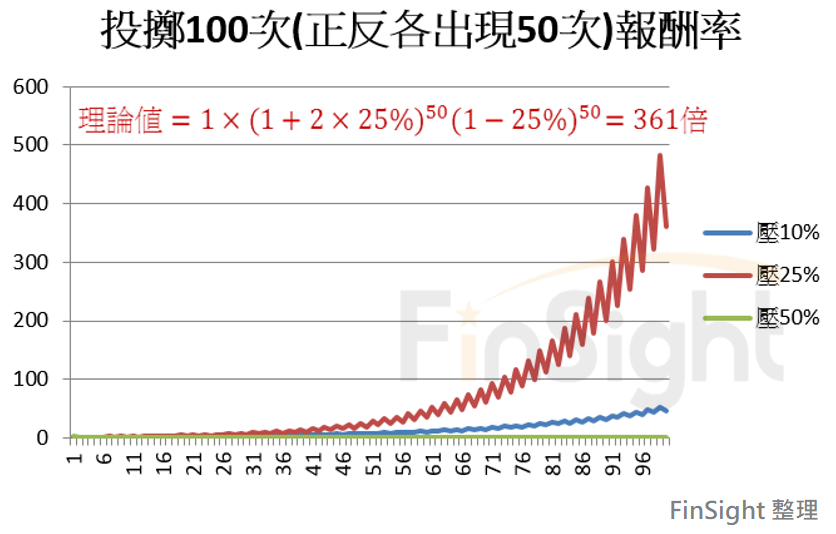
Run the game 100 times and compare sizes above and below what Kelly recommends. What happens?
- 25%: the size Kelly recommends. Capital compounds fastest.
- 10%: below what Kelly recommends. The bet is still favorable so you still make money, just too slowly.
- 50%: exactly twice what Kelly recommends, which is the zero growth point. Even on a favorable bet you take all the volatility and none of the compounding, and anything above 50% grinds capital down for real. Two losses in a row take 75% of the stake, and the hole gets harder to climb out of after every one.
One caveat. Kelly only tells you how to bet once you are confident in what you think you know. You are betting on your own beliefs, and nobody, not even someone with inside information, can be sure the probability distribution in their head is the right one.
Where Kelly breaks down on a real stock
In a defined game the answer is clean. In the market it is not, because too many things move a share price: fundamentals, technicals, ownership and flows, timing, what the market already expects, valuation, where the price sits in its range, the general mood, and more.
Strip Kelly back and it is telling you one thing: win rate plus payoff ratio equals bet size. The steps we can actually execute are these.
- Decide whether the bet is favorable. If it is not, do not play.
- Bet the probability and the payoff ratio your research supports. How good those numbers are depends entirely on how good your own judgment is.
- Adjust as new information arrives. Trading is a continuous sequence of bets running through time, so at every point, as new information lands, you recompute Kelly and resize the position.

When we wrote this up at the time, we ran Kelly on the hottest name in the market, Largan, to see how large the position should have been at different moments.
Largan notes, May 8, 2014
- Fundamentals: industry up, market share up, ASP up, so there is room for EPS estimates to be revised higher.
- Story: the next iPhone is coming, and the seasonal upturn from the third quarter gives the story cover.
- Valuation: estimated EPS of NT$110 at a 17 times P/E.
- Technicals and environment: moving averages in full bullish alignment, and the tone of the broad market is fine.
- Call it an 80% win rate on the long side, a target of NT$2,200 to NT$2,500, and a worst case pullback to NT$1,750, the low of the gap up. Put p = 80% and b = 3 into Kelly and it says hold a 73% position.
Largan notes, August 30, 2014
- Fundamentals: brokers have already revised EPS higher, so another round of upward revisions gets harder, and the risk now sits on the bad news side.
- Story: the iPhone has launched, expectations have come down, and we are waiting on actual sales numbers.
- Valuation: estimated EPS of NT$130 at a 17 times P/E, and the share price has already reached the target zone we set earlier.
- Technicals and environment: the 20 day and 60 day moving averages are tangled together, and the older bars dropping out of the moving average window are low ones, so the averages should keep rising. Still a bull setup.
- Call it a 55% win rate on the long side, a target at the prior high of NT$2,600, and a worst case pullback to NT$2,050, the low of the big up candle. Put p = 55% and b = 1 into Kelly and it says hold a 10% position. The win rate and the payoff ratio here were our judgment at the time, not a calculation off the price levels above.
Doing this for real, we found that Kelly can be used to set a position, but it comes with limits.
- Kelly handles one independent event. It does not tell you how to allocate capital across several positions at once.
- Assigning the win rate and the payoff ratio is very hard. You are betting on your own beliefs, which is exactly why building the ability to judge those two numbers matters so much.
Plenty of well known investors work with a simplified version of the formula, and concentrated position sizing is often described in these terms: assume the payoff ratio is always 1, and Kelly collapses to 2 times the win rate minus 1. Bet big when the probability of success is high. That is Kelly stripped to one line, and it is close to how concentrated value investors describe their own sizing.
The whole thing comes down to one line: bet as hard as your conviction.
- You cannot bet at all until the win rate is above 50%: 2 times 50% minus 1 is 0%.
- At a 100% win rate you put everything on the table: 2 times 100% minus 1 is 100%.
- In practice most people halve the answer, to cut the risk of having misjudged the win rate.
- Probabilities move with where the price sits (valuation) and with new information (earnings calls, and in Taiwan the monthly revenue release, which every listed company files), so resize as you go.
In a bad tape, correlations go to one: judge the environment, then set total exposure
Kelly works. Not everyone knows how to use it. The place it has helped us most is not a single position, it is the size of the whole book: form a subjective view on the environment, then let the formula set how much of your capital is invested at all.
The environment moves the win rate more than anything else. Take 2008. The Taiwan market fell 46% that year. What happens if you spend it hunting for longs?
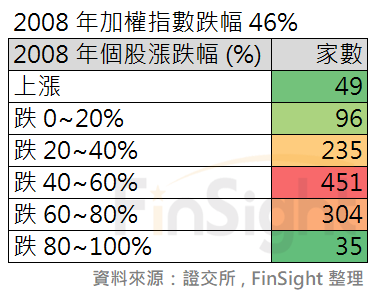
The count says 49 stocks rose that year, and 10 of those traded below NT$10, the speculative low priced end of the market. The other 1,121 could not escape. Making money on the long side when the environment is against you is genuinely hard.
So how do you use Kelly to set total exposure? Make a rough judgment on the probability the market rises versus falls. If both sit near 50% and the expected size of the move is about the same either way, the bet is not favorable, and Kelly says do not play, because playing is a pure gamble.
Since finishing that piece of work, any time we judge the win rate at 50% we leave, cleanly. We pass on the hand, and we stay off the screens. That time goes into research and into getting better, so we are ready to catch the next real opportunity.
Money management wrapped up: raise the win rate, raise the payoff ratio
Set your view of the market aside for a moment. What kind of money management raises the odds of making money?
- Cut when you are wrong, press when you are right. Stopping out on mistakes and adding to winners is what raises the payoff ratio.
- The better you know the name, the more capital it gets.
In practice the order runs like this.
- Judge the environment first, and use Kelly to set total exposure.
- Then judge how well you know the individual name, and set the capital committed to it, using Kelly for an objective number where it fits.
- Finally, use execution to raise the payoff ratio: press the winners and cut the losers.
Improving what Kelly hands back means improving your own research and judgment, because that is what raises the win rate. Weigh several inputs at once, fundamentals, technicals, ownership and flows, valuation, plus the mood of the market, and the number the formula returns gets better too.
That is the money management framework that has helped us most. Use it.