
Markets are paying for a sharp fourth quarter 2023 earnings rebound and SOX at 22x forward. The inventory buy signal has not fired and credit keeps tightening.
In markets you get things wrong, and sometimes you read something correctly and the tape disagrees. Whenever that happens we write down what we missed so a future version of us can look it up. This memo is that record. Our top-down view took a beating over the first quarter of 2023, so we want to go back through what the market is actually paying for, and what we decided to do in a stretch this uncertain.
Key takeaways
- The inventory correction that started in the second quarter of 2022 has run three full quarters through the end of 2022, and on the ten year pattern three is usually enough. Our buy signal has still not fired, so on our own rules there is nothing to buy yet.
- The market has already paid for the recovery anyway: analysts covering the Taiwan electronics supply chain model a strong fourth quarter of 2023, and the Philadelphia Semiconductor Index (SOX) trades at 22x forward twelve month earnings, against a 24x plateau set in the quantitative easing (QE) era before this hiking cycle.
- The second leg of the bull case, a Fed that is done being hawkish, has a crack in it: analyst estimates for core PCE were revised higher over the month to late March 2023.
- We think the bigger clock matters more here. We are inside a longer downswing, the 8 to 15 year kind, covering both credit and housing, and both are turning down. Recession is getting closer and the market has not priced it. At the tail of a long cycle with valuation this high, the Kelly criterion, which sizes a bet off your odds of winning and the payout, says a low conviction bet does not deserve size.
One caveat before we start: this piece is entirely our own view and our own notebook, written as a record rather than as advice.
The short inventory cycle the market wants has not given its signal
Looking back at the whole first quarter of 2023, the economy sat in an air pocket with no decisive direction. Because uncertainty about the path ahead was so high, expectations swung violently between a hard landing, a soft landing and no landing at all, and expectations for Fed hikes and cuts kept changing with them.
The pandemic changed a lot of things, and nobody can call the path from here with any confidence. Against a backdrop of extremely easy policy through the pandemic, some macro signals did turn worse in 2022, and yet the economy stayed resilient for longer than expected.
With no clear recession signal, the market has landed on two claims.
- Corporate earnings: read through the inventory adjustment cycle, the worst is the first quarter of 2023, followed by a V shaped recovery in the second half.
- The Fed has already been at its most hawkish, cuts are coming, and with no further downward pressure on multiples, valuation re-rates higher.
Take the earnings claim first. Across the past ten years of electronics destocking, the inventory cycle has run roughly every three years, and it usually bottoms and turns up after about three quarters of adjustment. This wave started in the second quarter of 2022. There is still no clear pickup in end demand, but with ChatGPT adding a new application and a long term growth story, and with the absolute dollar value of inventory no longer climbing fast, the market expects a strong recovery in the second half of 2023, especially the fourth quarter, and treats the first quarter as the likely low point for fundamentals.
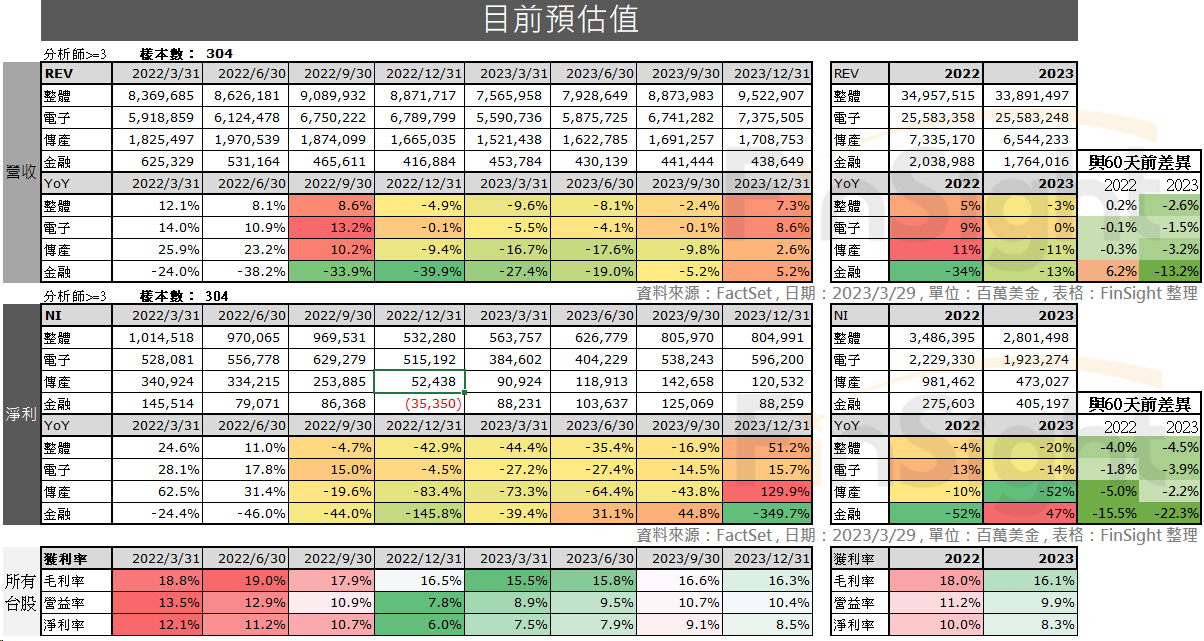
Now the Fed claim. Over the past 40 years, when there was no inflation pressure, the Fed usually cut early and preemptively as soon as the economy started to crack. On current market inflation estimates, if inflation falls the way the consensus expects, the Fed may stop getting more hawkish and could even ease, which lifts multiples. The catch is that the latest analyst estimates for core PCE have been revised higher.
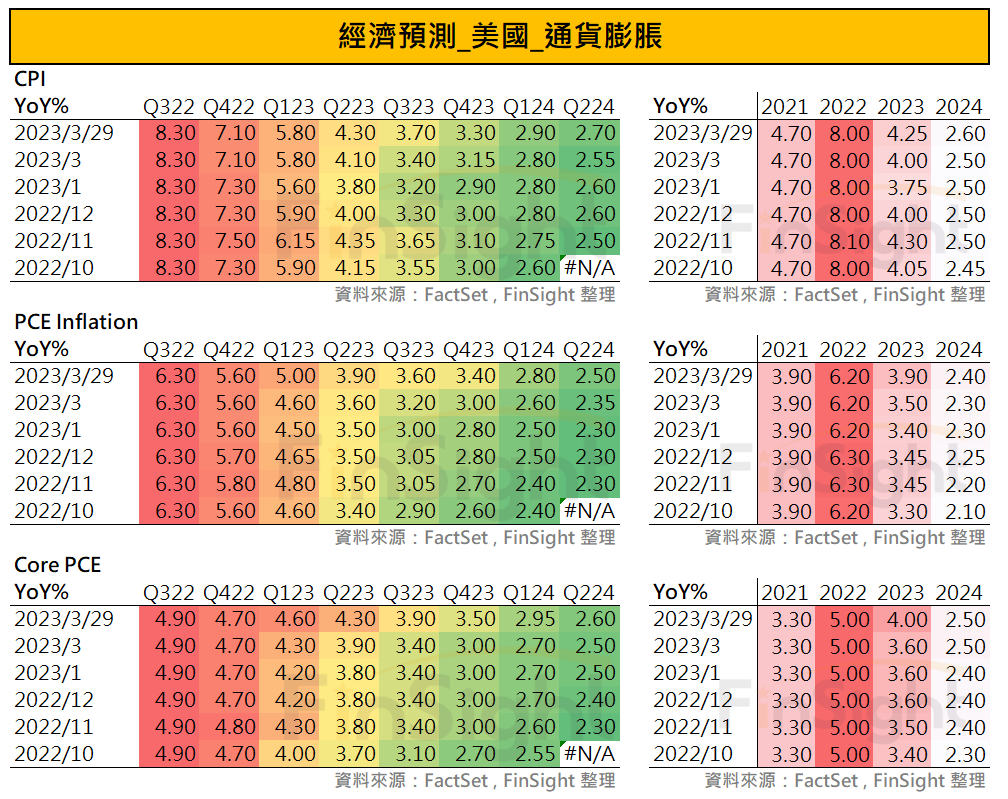
On those expectations, valuation has already recovered a long way. Take the Philadelphia Semiconductor Index (SOX): forward twelve month P/E is now 22x, not far from the 24x plateau it held during the flood of liquidity before this hiking cycle began.
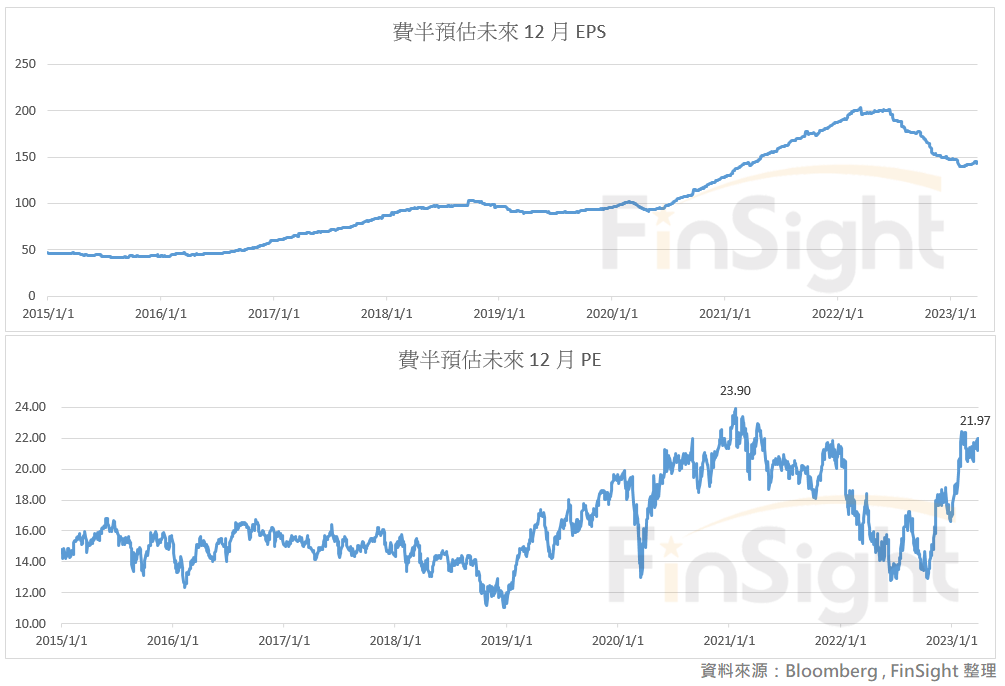
Our own buy signal on the inventory adjustment has not fired. But the market does get better at this. Every cycle people learn something and position earlier the next time around. Over the past ten years of electronics destocking, the price low has kept arriving sooner: in 2018 the last good entry was the moment the best company in the group cut guidance, and once everyone knows that is the last entry, somebody moves first.
The risk in that thinking is that it leans almost entirely on the experience of the past few cycles. If this one does not rhyme, the valuation that early positioning has already pushed up becomes the pressure later.
On the calendar, the short inventory adjustment may well be finished. But we are also standing at the point where the long credit cycle and the housing cycle are turning down, and with core PCE estimates still being revised higher, whether the Fed starts cutting quickly is an open question.
We are at the tail of the long cycles: credit and housing
Step back to the level of economic cycles and we are inside a much longer downswing, the 8 to 15 year kind, covering both credit and housing. On that clock a recession keeps getting closer, and on current pricing the market clearly has not discounted one.
Start with credit, where the canary in the coal mine has already stopped singing. Ray Dalio's How the Economic Machine Works makes the point plainly: total spending drives the economy, the system runs by exchanging money and credit for goods, services and financial assets, and credit is the single most important piece because it drives the short cycle.
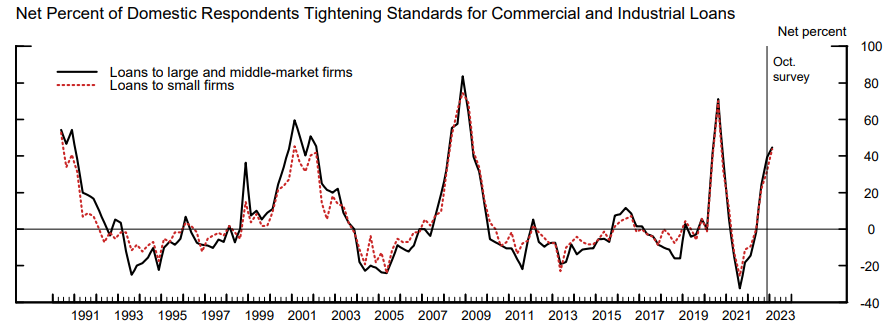
After the collapse of Silicon Valley Bank, and alongside the Fed's 2022 senior loan officer survey on bank lending, you can see lending standards tightening steadily. The most important fuel in the economy is being rationed. As time passes, if credit cannot keep expanding, the drag on growth becomes significant, and the bank survey data says that process is already under way.
Housing is pointing the same way, on timing and on volumes and prices. Based on Bureau of Economic Analysis data at the US Department of Commerce, the average housing cycle runs about 17 years, and taking 2006 as the peak of the last one, this peak was originally expected to land in 2023.
Instead, the rapid rate hikes since 2022 pushed mortgage rates up, affordability fell, transaction volumes shrank, building permits and housing starts declined, and home prices peaked in 2022 and rolled over. On the latest data, year over year price growth has already turned negative in some series, which has not happened since the last long cycle turned down.
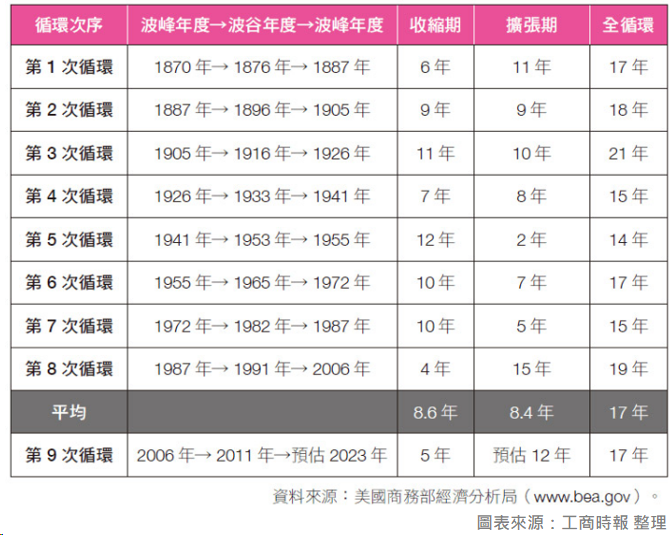

Seen on the long clock, the cooling is unambiguous, which is why most top-down investors are worried about a recession in the second half of 2023. And if banks tighten credit faster from here, the odds of a hard landing when that recession arrives go up with it.
Trade the last few inventory cycles, or respect where we are in the long cycle?
The first quarter of 2023 was an air pocket. The long cycle downturn is still being confirmed, the short cycle buy signal has not arrived, and the market chose to trust 40 years of experience and push multiples up. In a world of low rates plus QE we would not call this valuation unreasonable. But the base environment is clearly different from the past decade or so, and using 2024 earnings to justify target prices from this starting point means the market has run well ahead of the evidence.
So why is everyone willing to extrapolate from 40 years of history?
We think it comes down to inertia in human behavior and to path dependence, which is the tendency for what you decide now to be constrained by what you decided before, even when the earlier conditions no longer apply. We do not much like acting on the experience of the past few years, particularly when the underlying environment has changed this much, but until something is proven different the market normally assumes it is the same.
Which produces a genuinely odd split. Top-down economists are flagging recession risk from the second half of 2023 into 2024, while bottom-up equity analysts model a strong rebound in corporate earnings in the fourth quarter of 2023. If a recession actually shows up, can earnings snap back that hard in the fourth quarter? And if company guidance turns out to be right, does that mean the long cycle after this credit tightening really is different after the pandemic?
Bottom line: what you trade comes down to what you want to prove
For anyone who does not have to be measured against a benchmark, the answer here is easy. For anyone carrying annual performance pressure, it is a much harder call. Do you take part in the rally through the air pocket, or do you respect the risk in a long cycle that is turning down? That is the question that has been bothering us.
At the tail end of a long cycle, the risk reward for anyone trying to time the market is simply not attractive. With this much uncertainty and valuation back at a relatively high level, the Kelly criterion says that when conviction is low you do not need to press. Long-term holders and anyone dollar cost averaging do not have this problem.
There is a personal reason we take this seriously: we came into this market because a family business was hit hard in the 2008 financial crisis, and we learned early what it feels like when the banks pull the line in a deleveraging.
So facing our first long cycle downturn since we started, we do not want to force ourselves into a short-term bull run. If our research says the economy is cyclical, that credit is the fuel, and that the market never prices a recession in advance, then we have to respect that research and trade accordingly.
How many fifteen year cycles does anyone get? Right or wrong is one thing, but if we did not trade our own research at a moment like this, we probably would not forgive ourselves.
In the end, making money or losing money is secondary. Being able to trade the thesis you actually want to test is the luxury. On the first quarter of 2023 rally we did not catch, we are grateful to our teammates and our mentor for their patience. There is a lot to learn in a market like this, so we will keep doing the research we like and wait for the setup that suits us.
Charlie Munger: mimicking the herd invites regression to the mean.