
Buy and hold, buying the turn and buying the trend each need different research, different sizing and a different size of book.
Our December 2022 post on how a trend follower trades Taiwan's electronics inventory signals made one point clear: any piece of research has to be discussed together with the trading logic behind it, or you end up with a gap between what you know and what you actually do.
Key takeaways
- Three styles work on a single asset: long-term investing, left-side trading (buying the turn, before it is confirmed) and right-side trading (buying the trend, after the turn shows up). All three make money over time, but only if you follow one of them all the way through.
- Buy and hold fits any size of book and is the most elegant way to compound, but the real risk is not the market: it is being forced out by living expenses or by a stop-loss rule at your firm.
- Left-side trading suits books above NT$10 billion, roughly US$320 million, because building that much size takes time, and it demands deep company work, since you are buying while fundamentals are still bad.
- Right-side trading gives you the best capital efficiency and never gets run over by a cycle that lasts longer than you expected, but it never buys the low or sells the high. The bigger the book the harder it is to run, and below about US$100 million it is easy.
That post covered trend following only. There are many ways to make money, the styles differ a lot, and the research that matters differs with them. Whether you are debating a view with someone else or writing the rules for your own book, knowing what each kind of research is actually good for under each style is the critical piece.
When you argue about the market with someone, understanding the logic behind their style keeps the two of you from talking past each other. Once you can respect a style that is not yours, you also have a chance to learn something from it. And because different frameworks imply very different position sizing, understanding this is what lets your research show up in your own book: the return you expect, at a risk you can carry.
This memo is our record of how we think about the different trading styles.
Three trading styles and what each one needs
There are many ways to make money. Start with a single asset and three styles: long-term investing, left-side trading and right-side trading. Left side means buying the turn, before it is confirmed; right side means buying the trend, after the turn shows up in the data. All three make money over the long run, on one condition: you follow the style through, and you match the research view and the execution to the trade you have chosen.
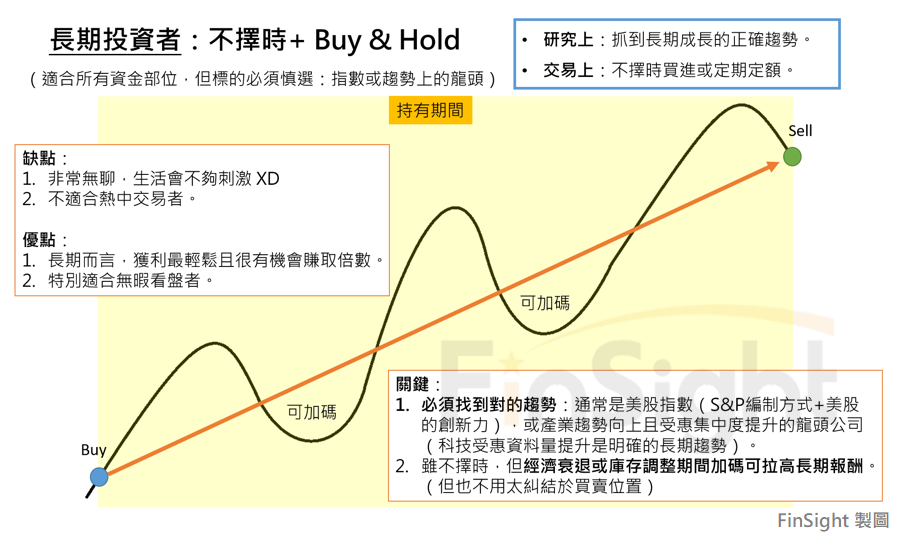
1. Buy and hold: long-term investing, no timing
Buy and hold fits any size of book, but the holding has to be chosen with care, because the wrong pick costs a lot of performance. Usually the best answer is an index ETF or the leading stock in a structural trend.
- Research that matters: identifying the right long-term growth trend.
- How you trade it: buy without timing, or contribute a fixed amount on a fixed schedule.
The upside: over the long run this is the easiest way to make money, and multiplying your money several times over is a realistic outcome. It suits everyone, and especially people with no time to watch the market or do the work.
The downside: it is very boring. If you want the thrill of trading, some excitement in your life, or the feeling that you can beat the market over time, this style is not for you.
What makes it work:
- You have to find the right trend. Look for something structurally rising: US index ETFs, or companies in an industry trend that also benefit as the industry concentrates. The way the S&P 500 is constructed gives you long-term exposure to US corporate innovation; technology benefiting from the growth in data is another clear long-term trend, and TSMC is the company that benefits most from it.
- Check that the money behind the position can actually stay long term. The biggest risk in this style is not being able to hold. Keep your capital at a safe level: if a bad environment forces you to sell the position to cover living costs, the strategy stops working. If you run it inside an institution with its own rules, watch the stop-loss policy and your boss's tolerance, and do not buy on a long-term thesis only to get forced out on a short-term one. Inside a fund, position sizing is the thing you settle before you enter.
- To improve returns, consider adding through recessions and inventory corrections, or raising the scheduled contribution when the holding drops hard. That can lift the long-run return. If you cannot do that, do not agonize over entry and exit levels: executing the long-term strategy is still the first priority.
2. Buying the turn (left side): timing the market by anticipating it
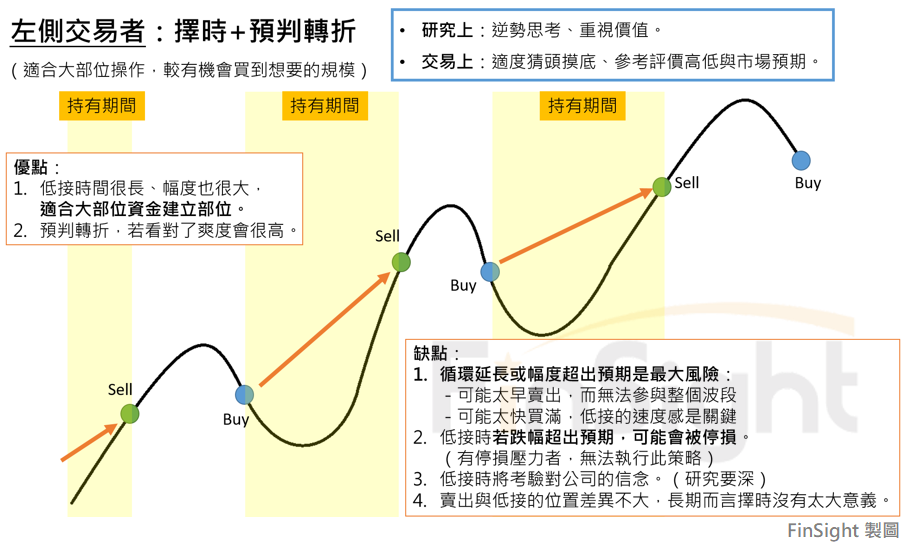
Left-side trading usually suits large books, above NT$10 billion, because building a position that size takes time and starting on the left side gives you a better chance of getting the scale you want. It also suits professionals with deep industry or company research behind them.
- Research that matters: contrarian thinking, a focus on value, and a firm grip on the industry cycle and on company fundamentals.
- How you trade it: pick tops and bottoms within reason, guided by valuation levels and by what the market already expects.
The upside:
- You start buying before the bottom shows up. The accumulation window is usually long and the pullbacks are deep, which is exactly what large capital needs to build a position slowly.
- You have to call the turn, and calling it right feels very good. People like to win, but remember that the payoff matters as much as the hit rate.
The downside:
- A cycle that runs longer or deeper than expected is the biggest risk. You may sell too early and miss the rest of the move, or fill up too fast and have no ammunition left to add. The pace of accumulation and position sizing are the whole game.
- If the decline overshoots while you are buying, you can get stopped out. Anyone carrying stop-loss pressure will find this strategy harder to run.
- It tests your conviction in the company. When a left-side trader starts buying, fundamentals have not turned yet and the stock is still volatile. Only deep fundamental work and a real feel for the cycle give you firm conviction.
3. Buying the trend (right side): timing the market by following it
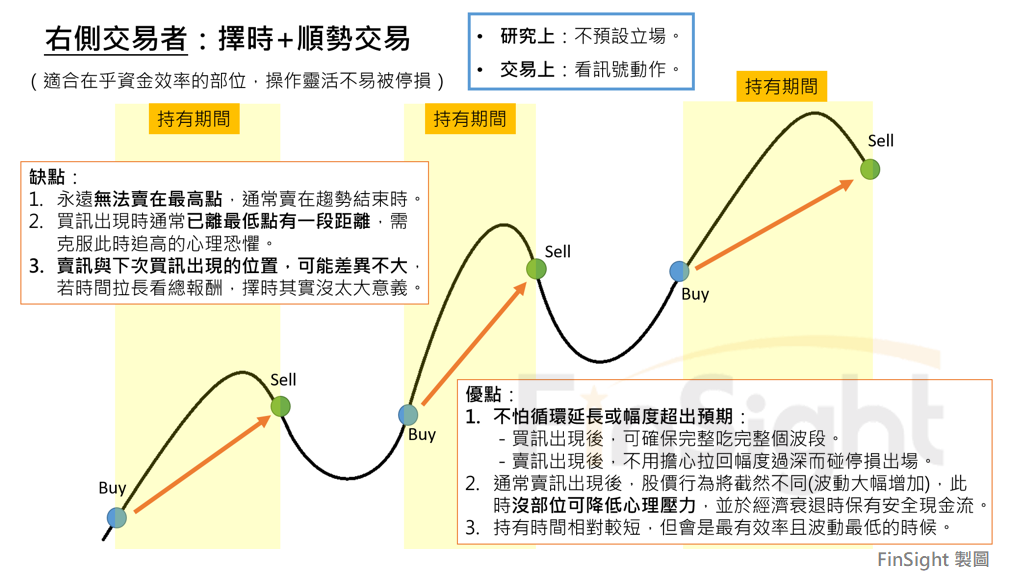
Right-side trading fits books that care about capital efficiency, because it is flexible, you only bet big once your confidence rises, and you rarely get stopped out. What it can never do is catch the exact high or the exact low.
- Research that matters: understanding what is actually happening without a preset view, and setting up indicators to track where the market goes next.
- How you trade it: monitor the indicators and act on the signals. Following the Kelly criterion, which sizes a bet off your odds of winning and the payout, you only size up when more signals line up and your confidence goes up with them.
The upside:
- A cycle that lasts longer or runs further than expected does not hurt you. Once the buy signal fires you capture the whole move, and once the sell signal fires you do not have to worry about a deep pullback taking you out at a stop.
- After a sell signal, price behavior is usually completely different, with volatility much higher. Being flat at that point lowers the psychological pressure and keeps your cash flow safe through a recession. Running this inside an institution also lowers the odds of blowing through your stop and having your book pulled.
- The best capital efficiency. You hold for less time, but the time you do hold is when the trend is clearest, volatility is lowest, and the money is working hardest.
The downside:
- Trading on signals, you never sell the high. You sell on the first move down after the trend ends.
- By the time the buy signal fires, the price is usually well off the low, so you have to get past the discomfort of buying strength.
- When the buy signal fires, the trend often develops within a very short window, so the bigger the book the harder it is to build enough of a position. Below about US$100 million it is easy to run.
Do not judge a decision by its outcome, and do not admire success that came down a high-risk path
All three of these make money if you execute them precisely over a long enough period.
At this stage we happen to be most interested in long-term investing and trend following, largely because of the size of the money we run. But the one we admire most is long-term investing, which we think is the most elegant and most efficient way to invest.
Long-term investing carries a lot of hidden advantages. Our June 2022 post on cutting losses and adding to winners made the case for cutting the position when you are wrong and adding when you are right, and buy and hold does that for you in market value terms. Winners grow into a bigger position on their own, which is adding to a winner without you having to do anything, and losers shrink the same way. If the holding is a market-cap-weighted index ETF, it also puts more of your money into the companies whose value is compounding fastest, which is adding when you are right again. The rules of the game are doing the work of maximizing your long-run gains.
The catch is what happens when we suggest it. Every time we tell someone around us to hold TSMC or an index ETF for the long run, whether a US index ETF or the Taiwan 50, which tracks the 50 largest listings on the Taiwan exchange, we get an eye roll, as if you do not understand investing unless you have a hot tip. Most people want whatever looks like the fastest money right now, and after two years of young traders posting big numbers, it seems like you have to trade on margin to earn the returns other people envy.
That brings to mind The Art of Thinking Clearly by Rolf Dobelli, which walks through 52 situations where human thinking goes systematically wrong. Two of them belong here.
- Alternative paths. Recognize the success that came down a high-risk alternative path, and value the success earned on the boring one. Every outcome that could equally have happened and did not is an alternative path. A path that worked out may have carried risk nobody counted, so whenever you make a choice, ask what alternative paths you were facing and what risk you were carrying.
- Outcome bias. Never judge a decision by its result. We tend to grade a decision by how it turned out rather than by the process at the time it was made. A bad result does not necessarily mean a bad decision, and the reverse is just as true. Do not pile on decisions that only look wrong in hindsight, and do not applaud decisions that worked out purely by accident. What you should do is look hard at why you or someone else made that decision. If the reasons were rational and workable, keep doing the same thing next time, whatever bad luck you ran into on the last one.
As for timing, left side and right side both take real skill, and only precise execution gets you to the level of a long-term hold. Asset allocation across markets is also a form of timing, but that is a separate discussion. If the entry or exit shows up and you do not act on it in the book immediately, long-run performance can drop noticeably.
That is the flaw both timing styles share: the level where you sell and the level where you buy back may not be far apart, so over a long enough stretch timing adds little to total return. It still has a purpose, though. Trend following is really about capital efficiency and smoothing out the swings in P&L: you give up some long-run return in exchange for smaller losses. Given the rules some desks operate by, timing is a good way to stay in business.
Bottom line: act inside your circle of competence, learn outside your comfort zone
For all the ways of making money we just went through, you do not need to be able to run all of them. You only need to know what kind of money you want to make and what kind of trades you want to put on, do the research that matches your own style, and write out a checklist for the execution. Keep doing the right things, keep doing them simply, and over time the results will be good.
As Warren Buffett put it: you don't have to be an expert on every company, or even many. You only have to be able to evaluate companies within your circle of competence. The size of that circle is not very important; knowing its boundaries, however, is vital.
The investing world is interesting and varied, and a trading style is really a choice about what you value in life. Knowing the different frameworks tells you what each research view is good for, and sorting out and respecting the styles that are not yours keeps your thinking open enough to widen the circle.
Compounding works the same way in learning as it does in investing, and people underrate both.
What we want for ourselves going forward:
- Know our own circle of competence, and act inside it.
- Work to widen that circle, and require ourselves to learn outside the comfort zone.
One reminder: this is what we have taken from our own trading experience, and investing is not a single model, so other people may well feel differently. Our own advice is to learn from other people's strengths but to compare yourself with them as little as possible, because too much comparison pulls you into thinking errors, such as putting too much weight on short-term results instead of cumulative long-term P&L. Investing and growth are your own business and have nothing to do with anyone else. What matters most to us is watching our own pace and whether we can stick to investing that still makes money over the long run once the alternative paths are accounted for.