
US cloud capex swung hard: cut in the third quarter of 2018, revised up 8% for 2018 and 11% for 2019, then down 11% year over year.
Part 1 of this review, our June 2022 post on NVIDIA in 2018, went back through NVIDIA's 2018 to 2019 history. There was no early warning before the inventory correction, and when consumer GPUs had clearly entered one, the company still said it would not touch capital spending (capex) at the large cloud companies. A quarter later it changed its story and said data center visibility had dropped noticeably.
Key takeaways
- Across 2018 and 2019 the seven large cloud companies (the hyperscalers) cut, raised and cut again inside four quarters. Capex here moves in steps, and each turn moved semiconductor demand with it.
- The swing factor is corporate profits, not the cloud story. In the fourth quarter of 2018, consensus capex estimates went up 8% for 2018 and 11% for 2019 from the prior quarter. Then in the first quarter of 2019 capex fell 11% year over year, the first outright decline of the run.
- A longer depreciation life on its own says little about capex. Amazon extended server lives in the fourth quarter of 2019, Microsoft followed in the third quarter of 2020 and Google in the fourth quarter of 2020, and capex still expanded sharply once the pandemic hit.
- As of this quarter, June 2022, nobody has cut data center spending, but the upward revisions have stopped, and profit estimates for the customers who buy the cloud are coming down: aggregate 2022 net income estimates for the constituents of IGV, the US software ETF, are 15% below where they stood 60 days ago.
In our Data Driven Tech Revolution series we argued that the explosion in data volume that comes with the AI era creates an enormous opportunity for semiconductors, and that the demand shows up in the cloud first. That is why we have watched every chip maker reorganize its strategy around the cloud.
Going back through the history, though, we found something different from NVIDIA, where the bad news came out one quarter at a time. The hyperscalers kept changing their minds about capex. With a hit to near-term profits on one side and a long-term trend on the other, what actually decides which way they go? This post walks through what happened to the hyperscalers in 2018 and 2019. Two notes on definitions before we start. The capex figures below are consensus estimates for the seven large cloud companies we track, not company guidance, and we do not list the basket here. All quarters in this post are calendar quarters.
Cloud demand comes down to corporate profits
Here is how cloud capex and what management said lined up at the time.
- Second quarter of 2018: capex stopped being revised up. Facebook missed profit expectations badly that quarter, and the large software names stopped trading as a bloc through earnings season, with the dispersion between winners and losers widening. (At the same time, NVIDIA only said inventory was building, and that it still felt end demand was strong.)
- Third quarter of 2018: cloud results split into consumer weakness (digital advertising, Amazon retail spending) and enterprise strength (corporate cloud spending). With the consumer softening, managements started stressing more efficient capex and paying attention to how much depreciation was eating into profit. Amazon and Google both said they would be careful with capex, which produced the first quarter-over-quarter cut to the capex estimate in our records. (From 2016 to 2018 capex estimates only went up, so a cut against that trend was highly unusual. Meanwhile NVIDIA still described the cloud as healthy and put the correction mostly in gaming.)
- Fourth quarter of 2018: capex estimates went back up. The estimate for 2018 was raised 8% from the prior quarter, and the estimate for 2019 by 11%. The earlier view had been that if consumer demand did not recover, enterprise would be hit sooner or later, but cloud was still the fastest-growing part of the business, so the annual budget process forced capex for 2018 and 2019 higher. (This is the quarter NVIDIA found the data center going into a correction. Google and Microsoft talked about long-term cloud contracts building up, and said they had to keep investing alongside revenue growth.)
- First quarter of 2019: capex reversed and was cut again. Spending fell 11% year over year, the first outright drop of the run. With profits under pressure, companies stressed investing more efficiently, leaned toward software solutions, and shifted more of the capex dollar into land and buildings rather than electronic components. That was bad for semiconductor demand that had been pulled forward hard. (NVIDIA posted its first negative year over year data center quarter, and the correction ran three quarters.)

Why did the large cloud companies change their story so much between the fourth quarter of 2018 and the first quarter of 2019? We think the answer is corporate profits.
Cloud spending funds a lot of different businesses: software, advertising, retail, and a long list of automation projects that make operations more efficient. Over the long run cloud demand compounds and the market keeps getting bigger, and management knows it. So when profits get hit, the first instinct is to trim capex, and then management quickly remembers this is a trend it cannot afford to sit out. That is why the attitude flips back and forth.
But if the macro turns down and corporate profits keep falling, even a long-term megatrend gets postponed, or gets built out in a more efficient way. We think that is what happened in the first quarter of 2019. Companies had not expected the macro to hit end demand that hard, so they cut again, and what they did keep spending went mostly into software-led solutions.
So when companies are fighting for profits, quarterly capex decisions get erratic, and a period like that can hit component demand and produce a short inventory correction. Over the long run, cloud capex still trends up.
Does extending data center depreciation lives change the investment?
The other question people are asking now is what Amazon's change in depreciation life does to capex.
On its April 28, 2022 earnings release Amazon said the drop in AWS cost was tied to a change in the estimated useful life of servers, worth close to $1 billion in the first quarter. The AWS operating margin in the filings shows the same thing: a longer depreciation life helps margin in the short run, but with cloud competition as intense as it is, it does not do much for margin over time.
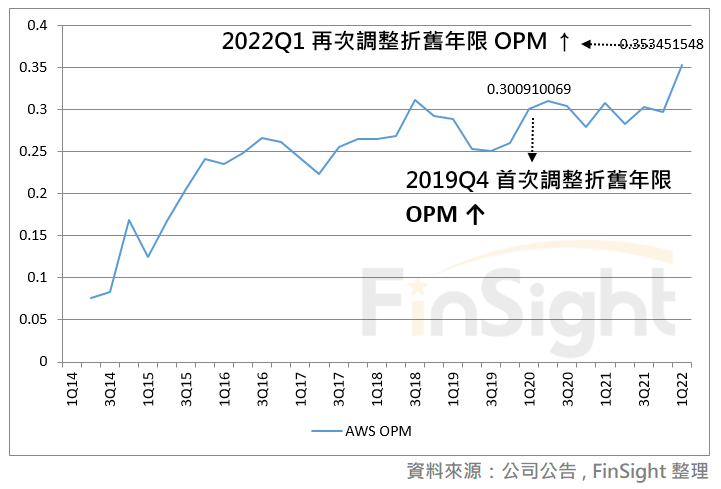
This is not the first time it has happened. Amazon fired the first shot back in the fourth quarter of 2019. One note on scope: the quarter by quarter cloud numbers we track here were last updated in 2021, and what follows comes from that work, which shows how each company was talking about capex.
- Amazon changed the accounting useful life in the fourth quarter of 2019 and said it was running data centers more efficiently, and that the change would also affect the pace of future capex.
- Microsoft followed with its own useful life change in the third quarter of 2020, and Google followed in the fourth quarter of 2020.
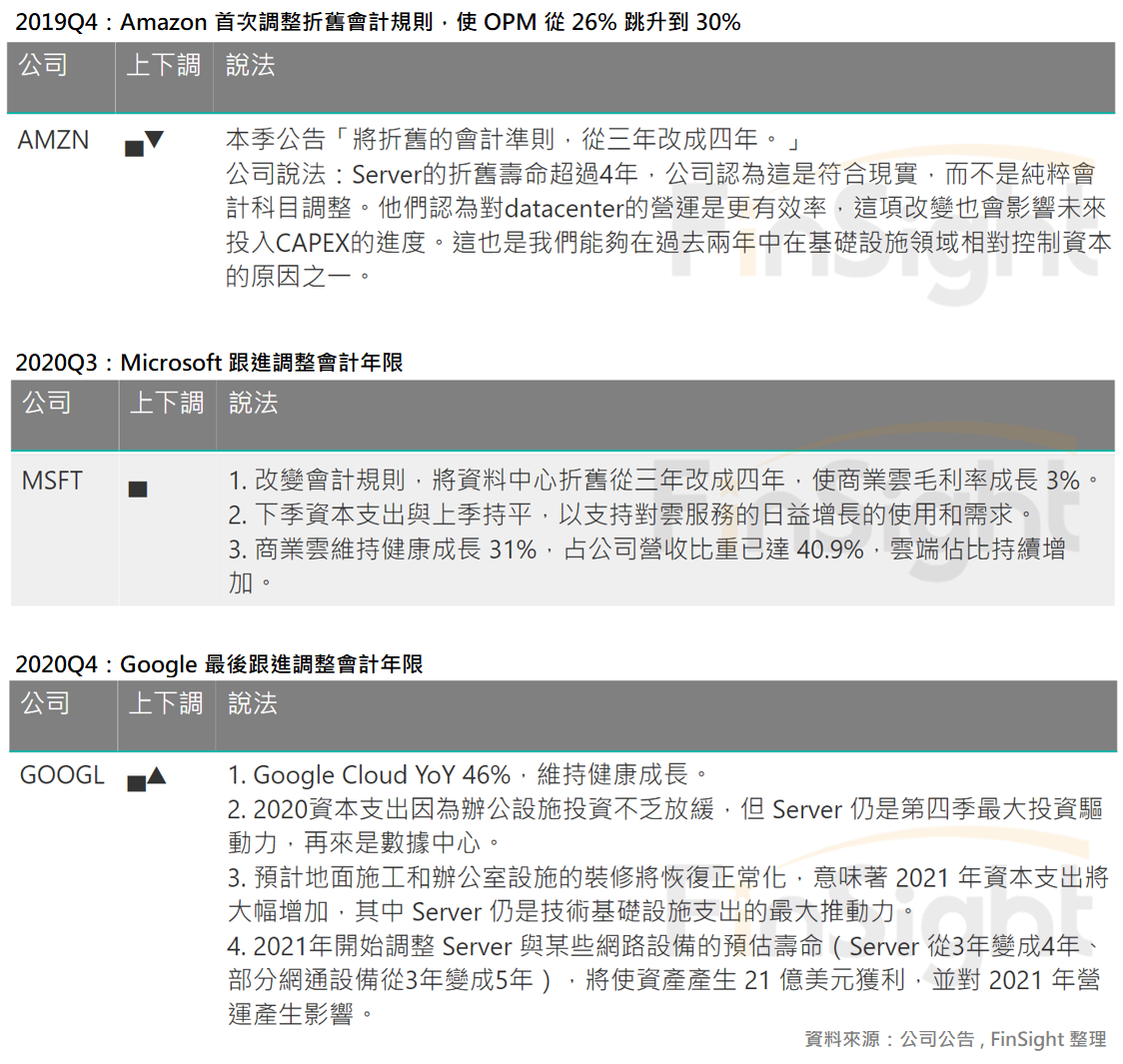
When Amazon first extended depreciation life in the fourth quarter of 2019, it did set off worries that capex would be cut, and management said as much at the time. But the pandemic hit in 2020, cloud demand exploded, and even with longer useful lives these companies still had to expand capex sharply.
So the driver of data center investment growth is demand, and the source of that demand is corporate profits. When companies can pull more value and more profit out of cloud data, they keep spending. Once profits at those companies turn, that is very likely the start of a turn in cloud capex.

Data center capex right now: no cuts yet, but there is a concern
The market worries that weaker end demand will eventually hit data center deployment. Through this quarter at least, we do not see that signal in what companies are saying. What we do see is that the upward revisions have stopped. Most of them stress that they will keep investing in the cloud, and even Amazon, the one that changed its depreciation accounting, says data center infrastructure spending in 2022 will be higher than in 2021.
In this earnings season, though, we did see some software companies put up weak results, and digital advertising demand fell noticeably. Using IGV as our sample, we compared current estimates against estimates from 60 days ago: aggregate 2022 net income estimates for the IGV constituents are 15% below where they stood 60 days ago. Software companies are one of the biggest customer groups for cloud services. If that trend continues, it is a problem for future cloud spending.
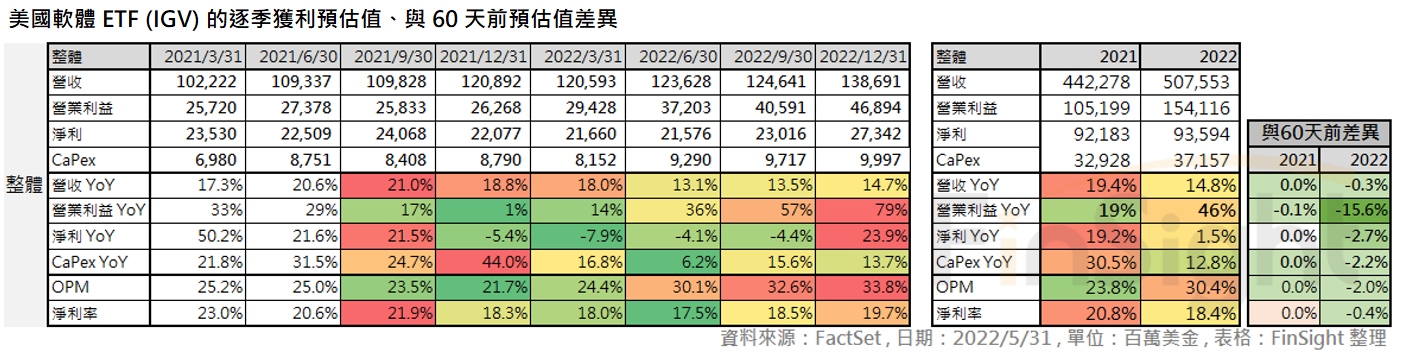
And it is not only software. Analysts have also cut net income estimates for the consumer names sharply. With profits shrinking, retailers have less room to spend on accelerating their digital transformation.

We are still worried that weak end demand hits data center capex in the second half of 2022. What companies have disclosed so far does not yet support a call, but corporate profit estimates turned down materially this earnings season, and that is the leading indicator we are watching.
We stopped updating that work because when NVIDIA broke out data center revenue in 2016, the customers were mostly hyperscale cloud. By 2020 the company found that large cloud and vertical industries were roughly half and half, and in 2021 it said the hyperscale cloud share had fallen to 30%.
Once data center demand no longer leans heavily on hyperscale cloud deployments and comes instead from a wider set of vertical industries, reading cloud demand off the big companies' capex alone is no longer complete. Since then we have paid more attention to the growth in total compute that comes with corporate digital transformation. Demand is no longer only cloud. Endpoint and edge compute are growing too. We also care more about whether profit, cash flow and capex numbers are changing at the other verticals that might run a digital transformation of their own.
For a long run exponential trend like this one, the best thing to do is add on the correction and buy the pullbacks. But if capital efficiency matters to you, we think there is another indicator to watch on data center investment: the growth rate of each company's public cloud business.
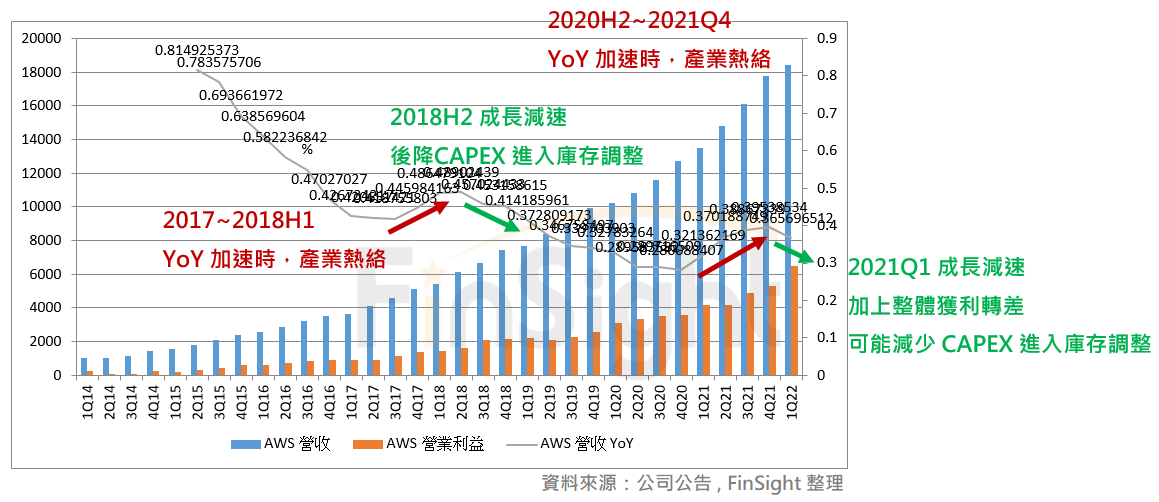
History says public cloud growth slows gradually as the base gets bigger. If growth instead accelerates, the industry is running hot and companies will spend harder, because the addressable market is growing faster and spending faster is the rational response. When year over year growth falls back to a normal path, though, watch for capex to stop being revised up, and for a short inventory correction to follow.