
Taiwan's preliminary sell signal fired in September 2024. Past cycles say the electronics index falls 18% to 26% over the following five to nine months.
The electronics inventory cycle is a buy and sell rule we keep working on and refining. In our March 2024 post on the Taiwan electronics inventory buy signal, which tested the rule against ten years of data, we wrote that the buy signal of mid-November 2023 should, on the historical pattern, run three quarters into July 2024 without much trouble.
Key takeaways
- The preliminary sell signal has fired. Taiwan's September 2024 purchasing managers index (PMI) put new orders minus inventories below zero, and manufacturers' six-month outlook dropped below 50. The sell is marked at the next trading day, October 4, 2024.
- On past cycles, from the sell signal to the eventual low Taiwan's main market index, the TAIEX, fell 13% to 24% and the TWSE electronics sector index (the electronics index), which makes up the bulk of Taiwan's market cap, fell 18% to 26%, over 167 to 276 days. That puts the low between late March and the end of July 2025.
- We split the sell rule in two. The preliminary sell signal (new orders minus inventories) fires first and avoids an 18% to 27% drawdown on the electronics index. The final sell signal (new orders minus customers' inventories) fires 2 to 8 months later and avoids 9% to 25%.
- This rally was the second largest in our sample, behind only the 2019 to 2022 leg, which topped in 2021. The final sell signal has not fired yet.
But our review of second-quarter Taiwan electronics results found that this AI-led electronics bull had not pulled non-AI demand up with it. Once inventory starts piling up, the worry shifts to a sell signal that can show up at any time.
Then Taiwan's September PMI, published in early October 2024, rolled over in a single month: new orders minus inventories went below zero, which is the sell signal, and manufacturers' six-month outlook dropped below 50. At the time we only flagged it on our social feed.
In mid-October, though, US earnings showed GenAI-driven cloud demand running ahead of expectations, with no damage to margins. As we argued in our July 2024 post on what GenAI insiders expect, as long as scaling laws hold and companies can see revenue growth at the end market, strategic investment can keep going. So we followed up on the large cloud providers' AI strategy in their 3Q24 results: capex guidance keeps getting revised higher and looks set to run into 2026.
This electronics bull is an atypical recovery led by AI. Over the past two years we have kept rethinking what counts as a trend and what counts as a cycle, and that work has sharpened how we see this. So with the sell signal now on the board, we want to write about how we read it when our two main tracks point in opposite directions. Today we start with the sell rule itself.
Taiwan's electronics sell signal has fired, and the historical record still holds
Our earlier work on the three to four year cycle in the electronics index found that it tracks inventory levels closely. Taiwan's manufacturing PMI comes from CIER (the Chung-Hua Institution for Economic Research), and like the ISM index in the United States its sub-indices are diffusion readings around 50, where a reading above 50 means more companies report growth than decline, so new orders minus inventories is a spread, not a level. The buy and sell signals we defined then were:
- Buy signal: destocking, meaning inventory days at Taiwan component makers fall below their year-earlier level in the quarterly reports.
- Sell signal: Taiwan's PMI new orders minus inventories (the preliminary sell signal) or new orders minus customers' inventories (the final sell signal) goes below zero.
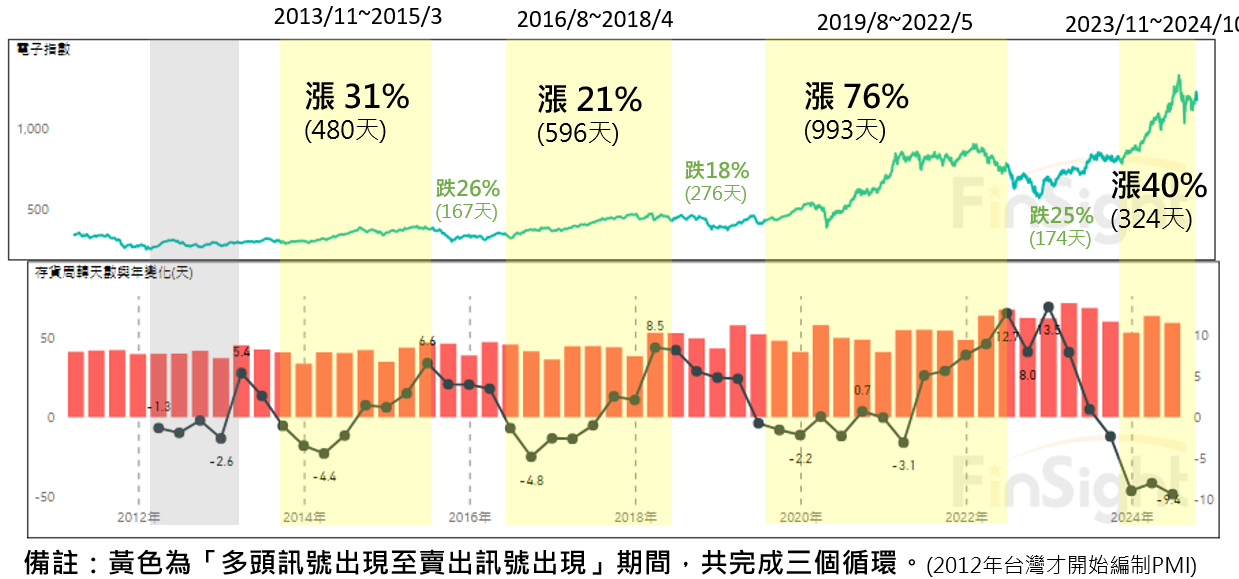
Marking this cycle's buy and sell against that earlier work:
- The bull run was shorter than usual but not outside what we expected. Our mid-August earnings review already implied a sell signal was possible within six months. What surprised us was how fast the September print rolled over.
- The move was the second largest in our sample, behind only the 2019 to 2022 leg, which topped in 2021.
- On past cycles, from the sell signal to the low the TAIEX fell 13% to 24% and the electronics index fell 18% to 26%, over 167 to 276 days. That puts the low somewhere between late March and the end of July 2025.
Working through it, though, we found a hole in our own rule. Do we use PMI inventories or PMI customers' inventories? If the definition is fuzzy, the call is hard to make in real time.
So this time we updated the Taiwan electronics inventory buy and sell strategy, reran the history, and split the sell signal in two, scoring each separately:
- PMI new orders minus inventories
- PMI new orders minus customers' inventories
Trade convention for both series: when a signal prints on a given day, the trade is marked at the next trading day's close.
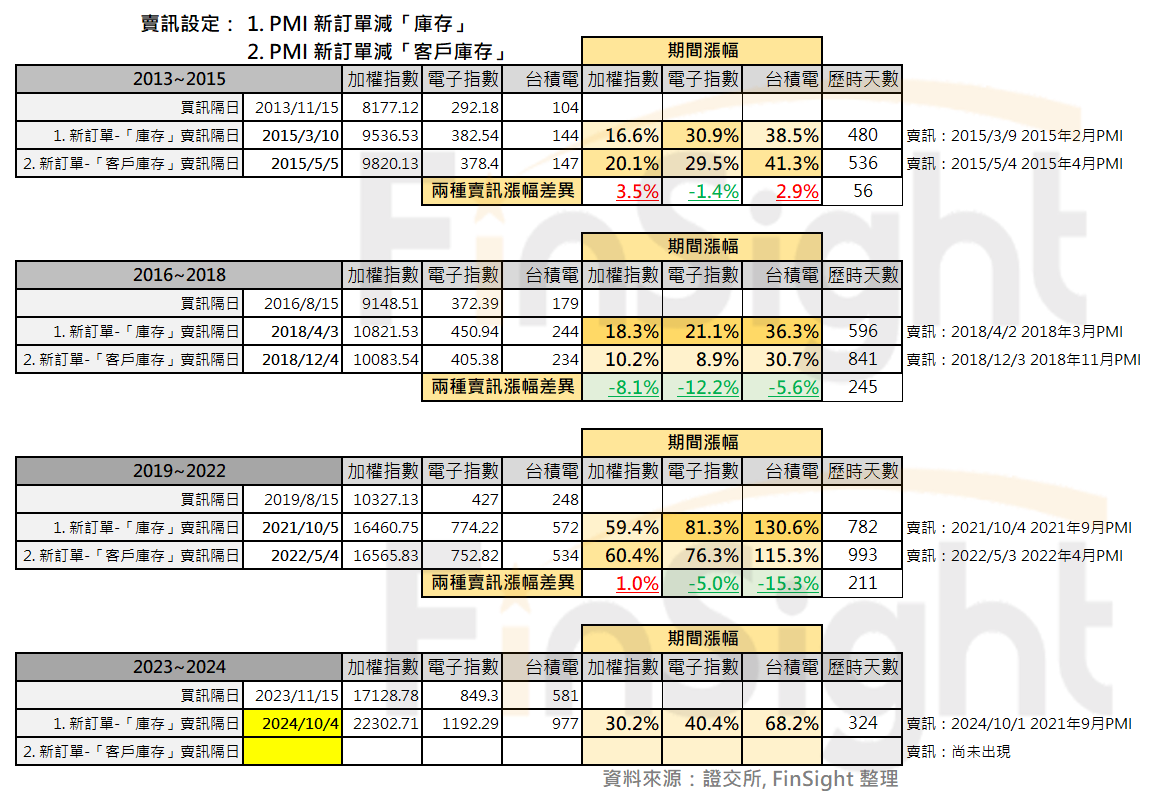
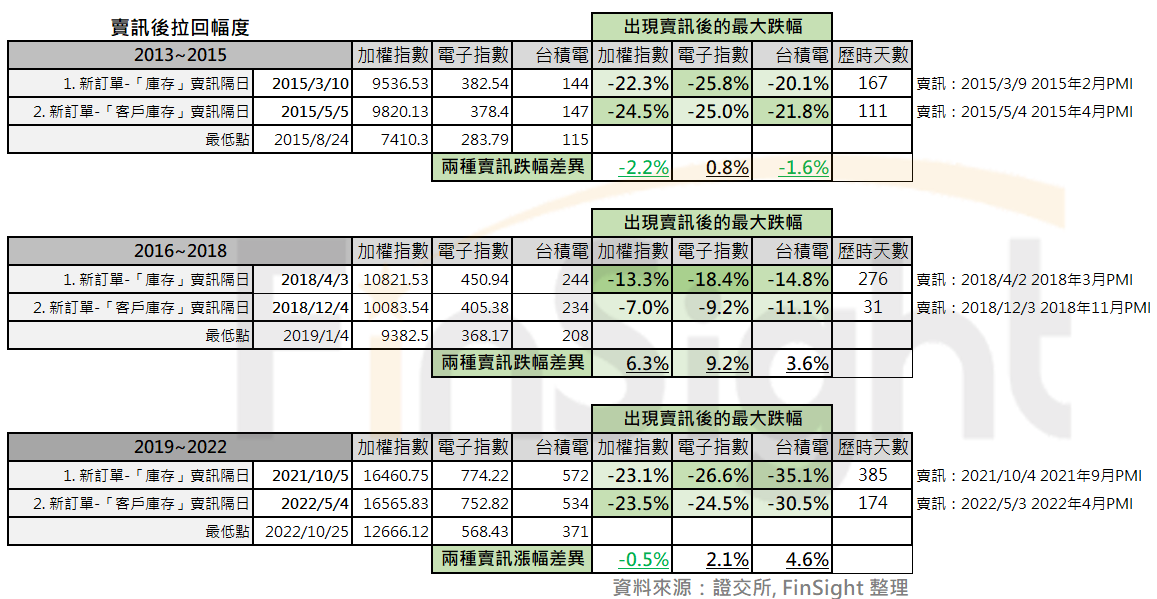
Splitting the two apart shows:
- The preliminary sell signal (new orders minus inventories) fires earlier. It takes 5 to 12 months from the signal to the low, but it avoids a larger drawdown: on the electronics index, 18% to 27%.
- The final sell signal (new orders minus customers' inventories) fires 2 to 8 months after the preliminary one. About half the time you sell at roughly the same level as the preliminary signal; the other half you sell lower. By the time it prints, the index has already started, or is about to start, falling fast, and the low comes 1 to 5 months later. It avoids 9% to 25% on the electronics index.
- Both still lead the low. If we have to define them: inventories is the left-side signal, meaning it fires before the turn is confirmed and lets you scale out gradually while you keep checking the industry; customers' inventories is the right-side signal, firing after the turn is confirmed. It is the final signal, and it says the index is entering its last leg down.
How to read the buy dates below: Taiwan-listed companies file quarterly reports by a fixed deadline (August 14 for the second quarter, November 14 for the third), so the inventory buy signal can only be confirmed once the filing window has closed. That is why every buy date is the trading day after a filing deadline.
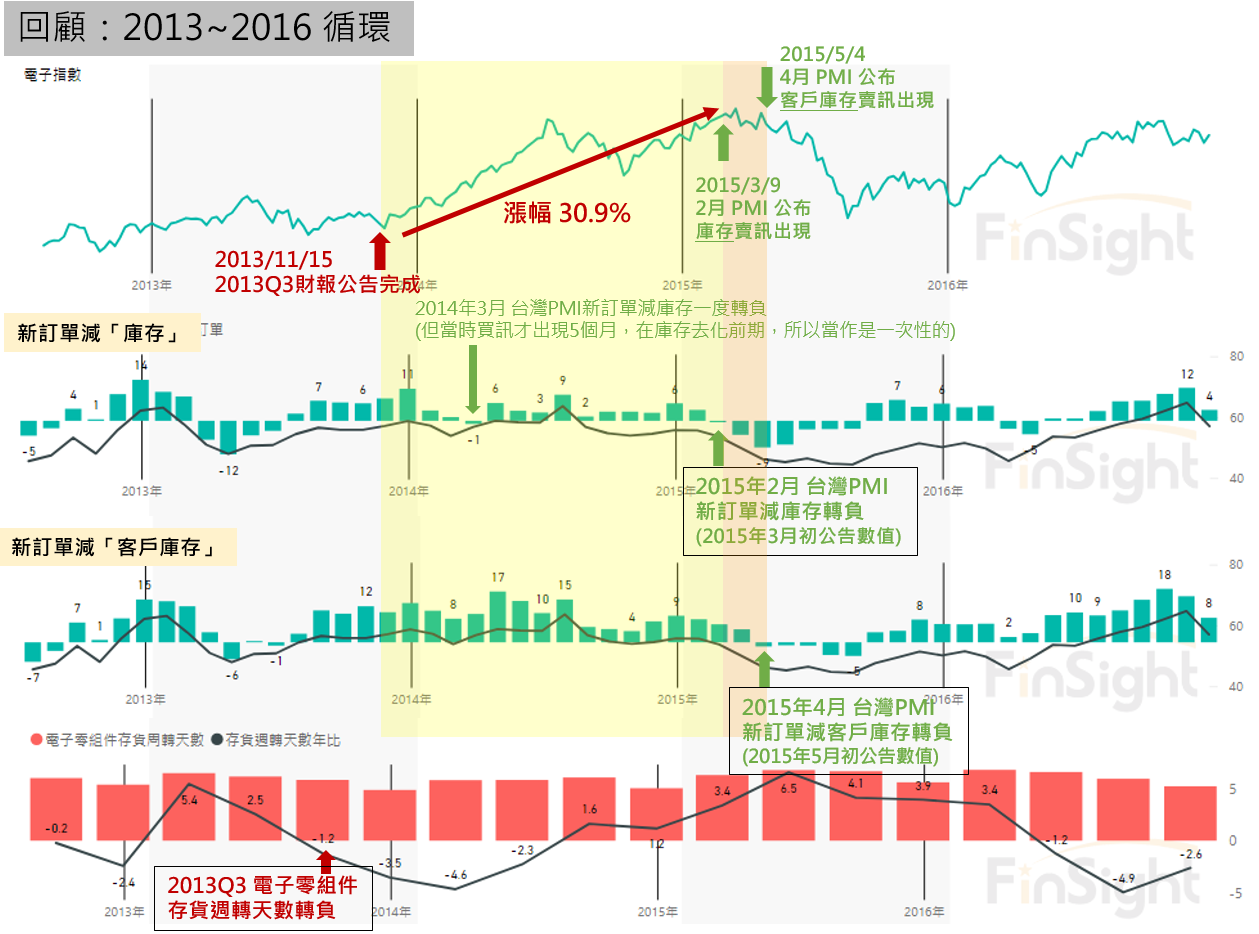
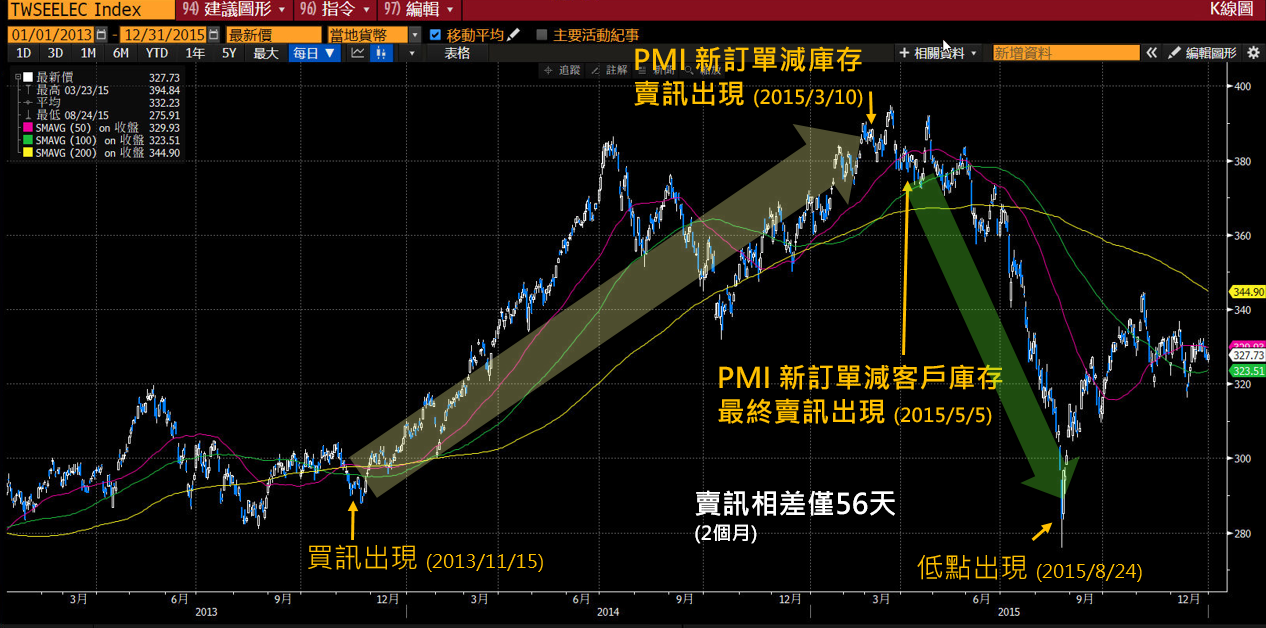
Cycle review: 2013 to 2015
- Buy signal: inventory days at electronic components companies fell below their year-earlier level in 3Q13. Filings were complete on November 14, 2013, so the entry is November 15, 2013.
- Preliminary (first) sell signal, new orders minus inventories: after the February 2015 PMI was published, the spread went negative. The sell is the trading day after the March 9, 2015 release, so March 10, 2015.
- Final sell signal, new orders minus customers' inventories: after the March 2015 PMI was published, the spread went negative. The sell is the trading day after the PMI release, May 5, 2015.
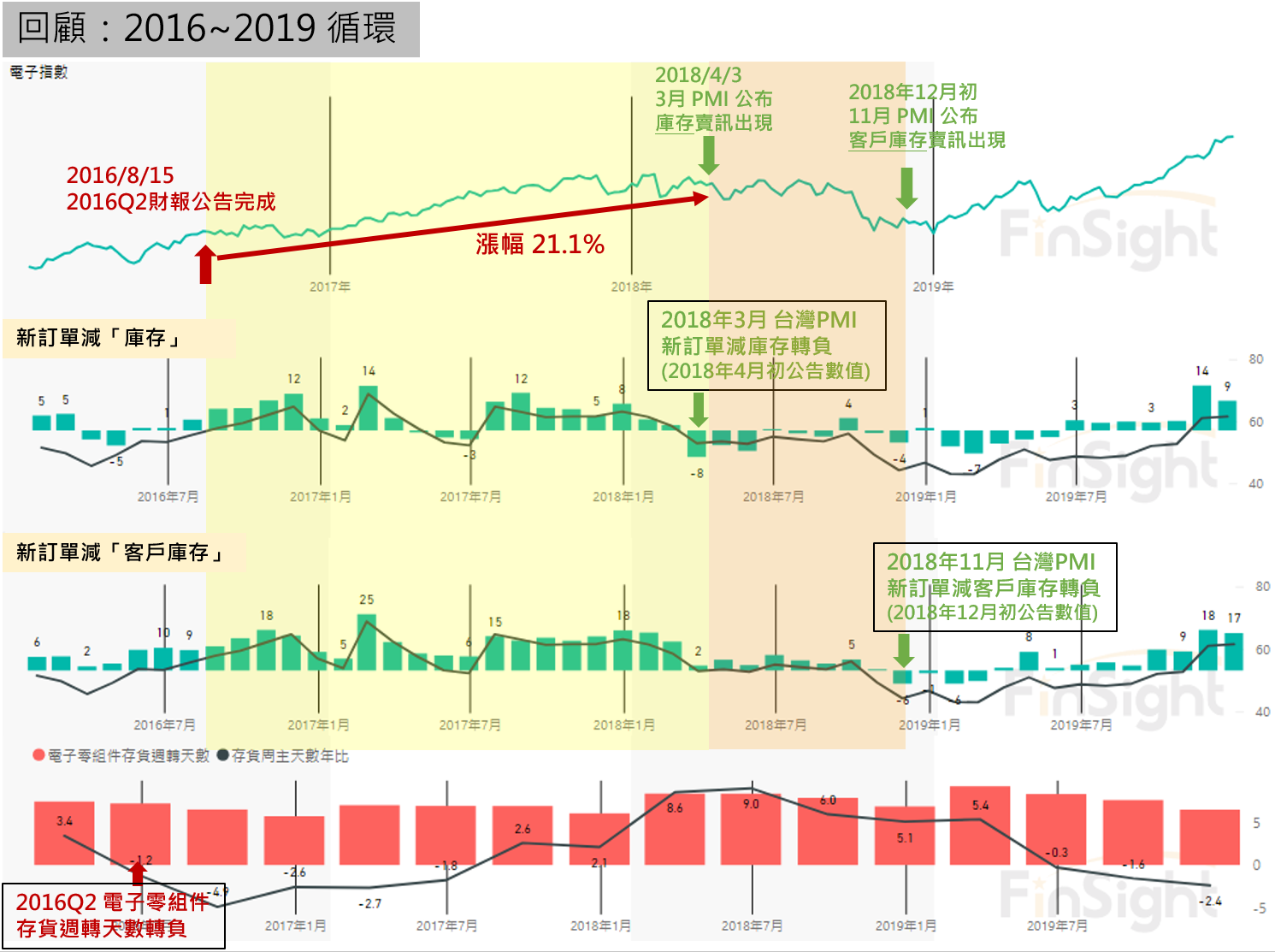
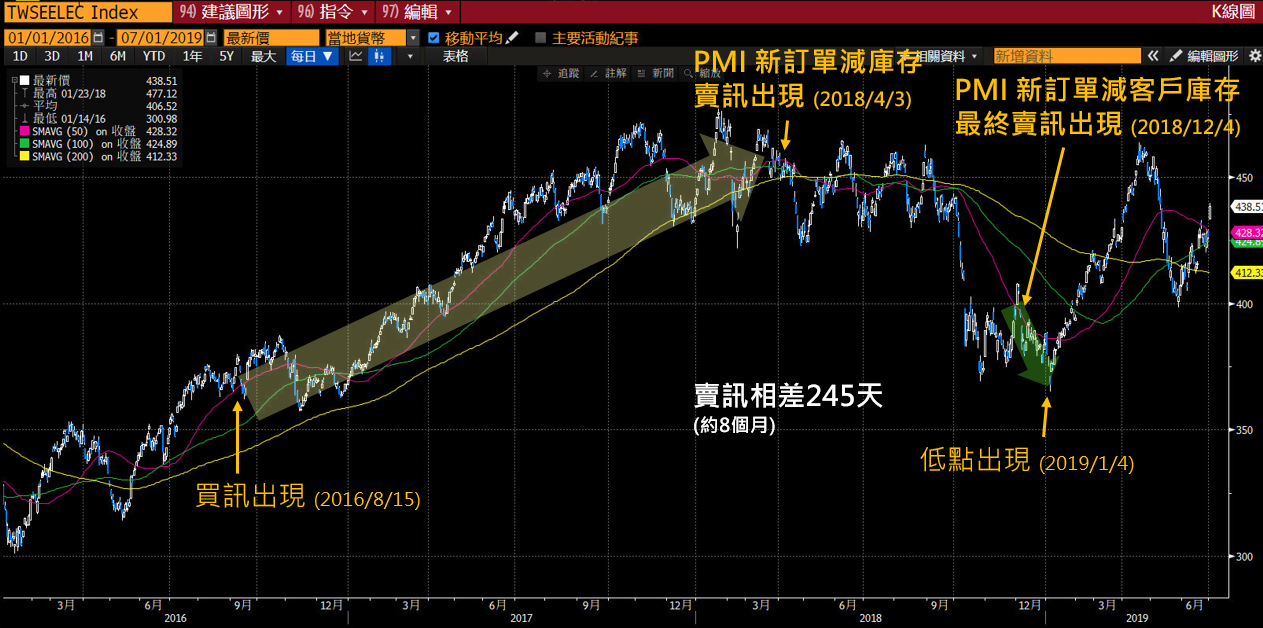
Cycle review: 2016 to 2018
- Buy signal: inventory days turned down year over year in 2Q16. Filings were complete on August 14, 2016, so the entry is August 15, 2016.
- Preliminary sell signal (new orders minus inventories): after the March 2018 PMI was published, the spread went negative. The sell is the trading day after the release, April 3, 2018.
- Final sell signal (new orders minus customers' inventories): after the November 2018 PMI was published, the spread went negative. The sell is the trading day after the release, December 4, 2018.
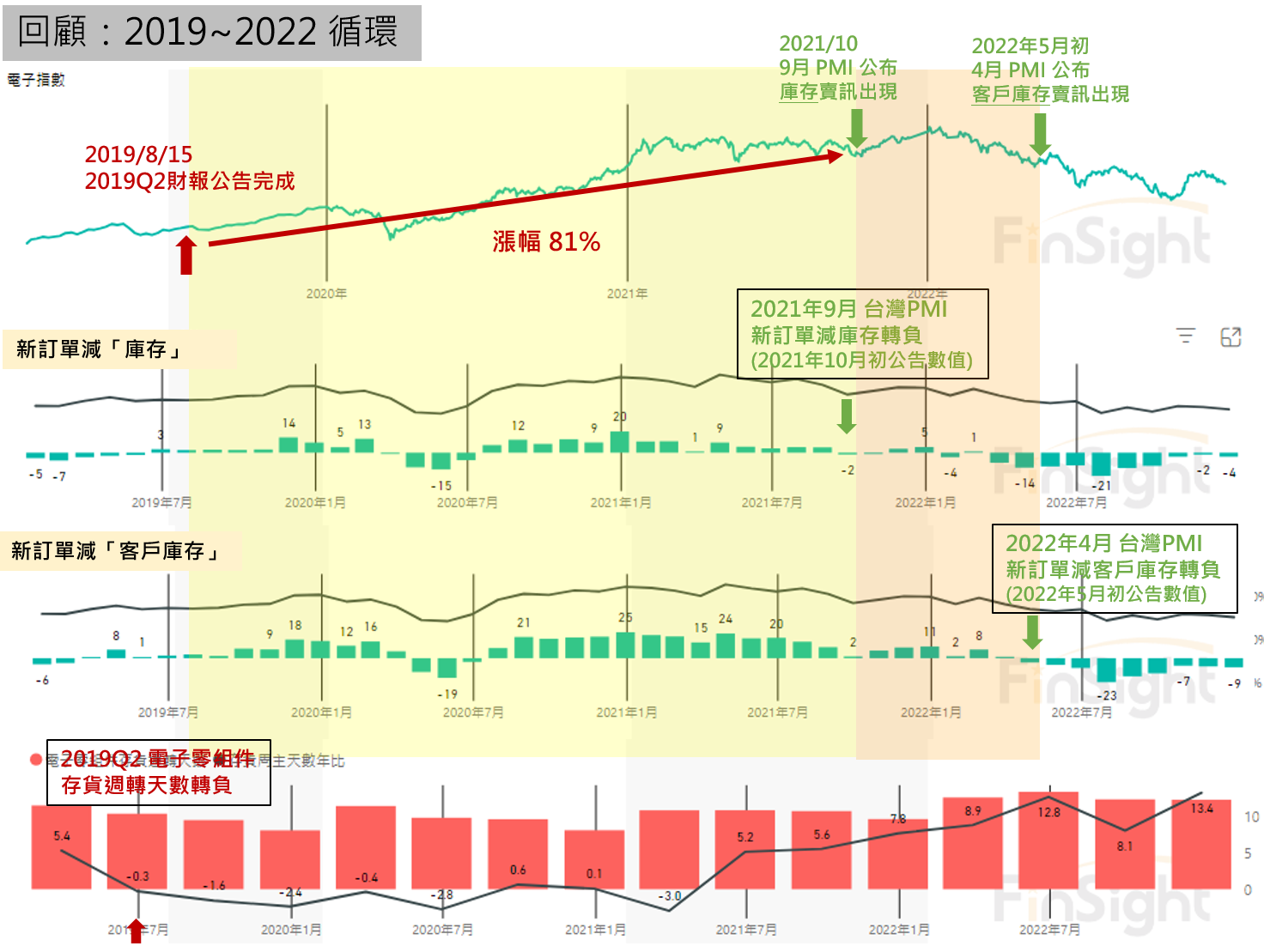
Cycle review: 2019 to 2022
- Buy signal: inventory days turned down year over year in 2Q19. Filings were complete on August 14, 2019, so the entry is August 15, 2019.
- Preliminary sell signal (new orders minus inventories): after the September 2021 PMI was published, the spread went negative. The sell is the trading day after the release, October 5, 2021.
- Final sell signal (new orders minus customers' inventories): after the April 2022 PMI was published, the spread went negative. The sell is the trading day after the release, May 4, 2022.
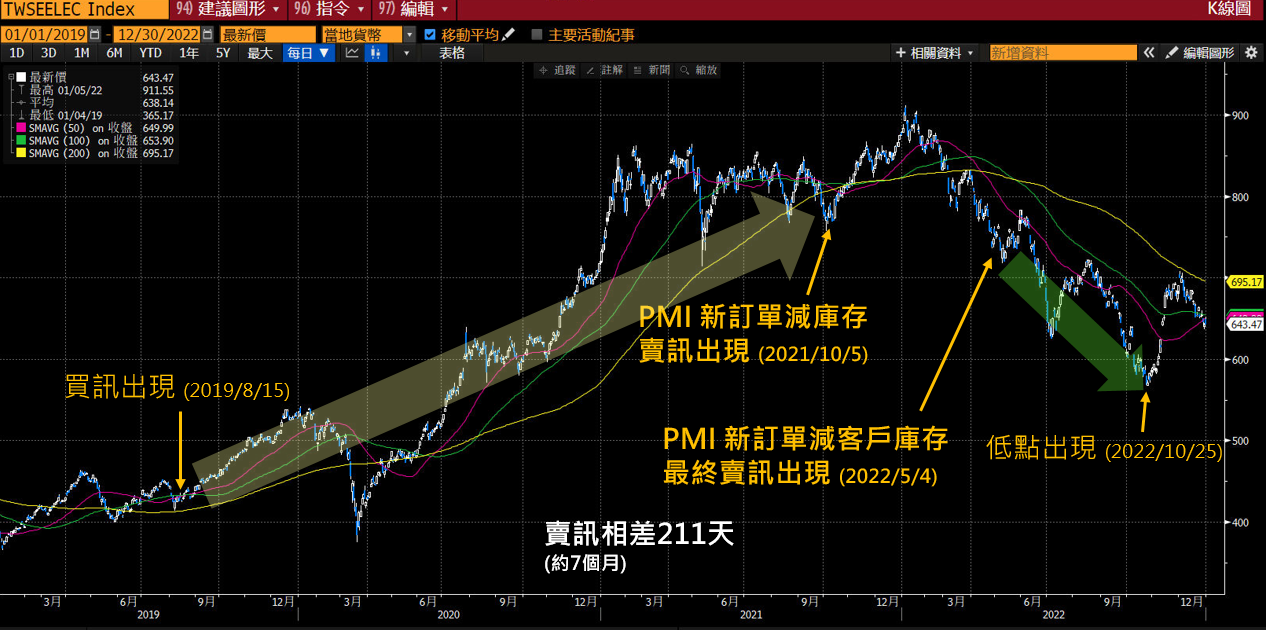
Cycle review: 2023 to today
- Buy signal: inventory days turned down year over year in 3Q23. Filings were complete on November 14, 2023, so the entry is November 15, 2023.
- Preliminary sell signal (new orders minus inventories): after the September 2024 PMI was published, the spread went negative. The sell is the trading day after the release, October 4, 2024, which was pushed back by a typhoon.
- Final sell signal (new orders minus customers' inventories): not yet.
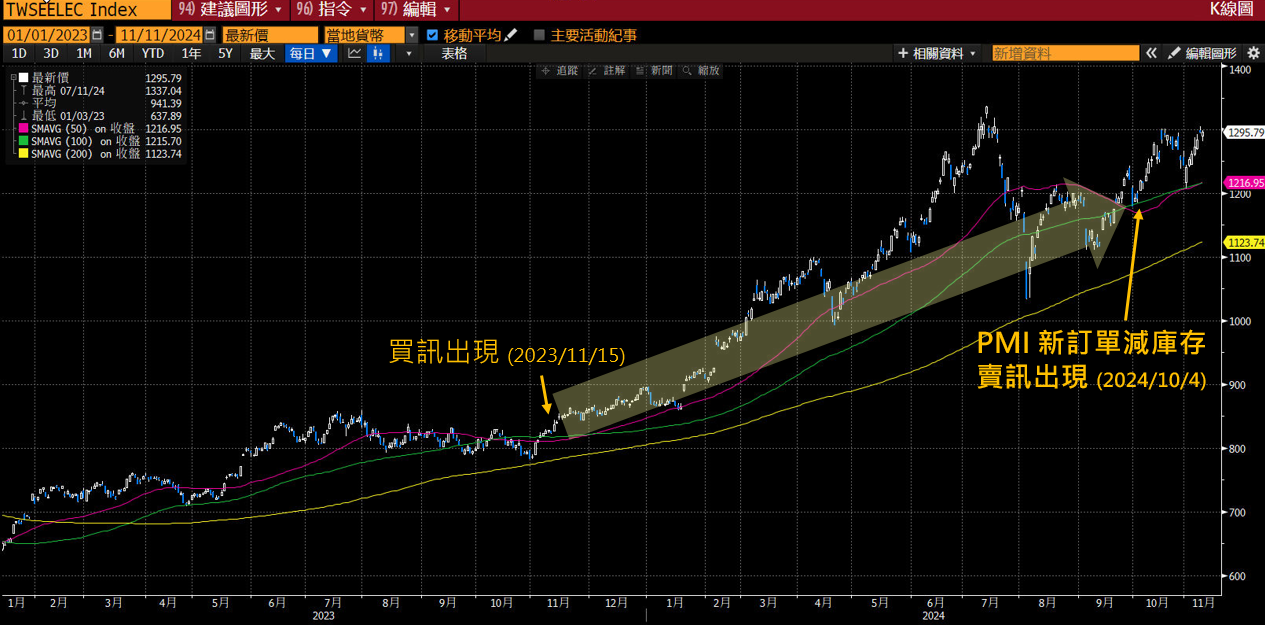
Conclusion: the preliminary electronics inventory sell signal is in, and history points to a 20% fall in the electronics index within six months
Splitting the sell rule into inventories and customers' inventories, and then reviewing the whole history, cleared up several things:
- The preliminary sell signal can whipsaw. Reading it alongside the actual inventory data raises the hit rate: if inventory days have stopped falling year over year, the final sell signal is more likely to follow. We will check that when Taiwan's quarterly reports are updated next week.
- It can take 2 to 8 months from the preliminary signal to the final one, which is what makes the preliminary signal a left-side signal. Historically, though, it gets you out at a better level than the final signal does.
- Customers' inventories is the final signal. Once it prints, the index is either already falling or about to, so if you plan to get out, take it seriously.
That said, this electronics bull is driven mainly by AI, and for now AI is the only thing working. How to think about inventory and the cycle from here is what we take up in the posts that follow. If you want the reasoning behind how we approach it, our December 2022 post on acting inside your circle of competence lays it out.