
Past electronics inventory corrections bottomed in about six months. Cloud and software net income estimates are down 7% to 10% in 60 days.
Reminiscences of a Stock Operator, Edwin Lefevre's book about Jesse Livermore, makes the point that nothing on Wall Street is ever new: what happens today happened yesterday and will happen again tomorrow, and successful speculation rests on people making the same mistakes they always have.
Key takeaways
- NVIDIA's second quarter of 2022, reported in August 2022, rhymes with its third quarter of 2018, reported in November 2018: gaming revenue fell 44% quarter over quarter and 33% year over year, while data center still grew 61% year over year. The consumer end is in the phase where consumer-facing results miss badly.
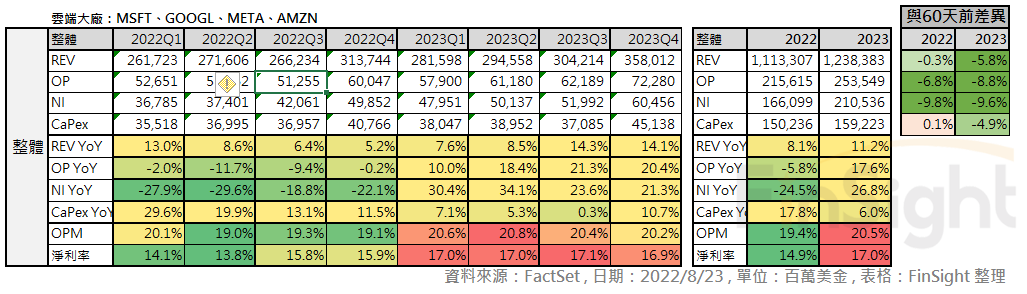
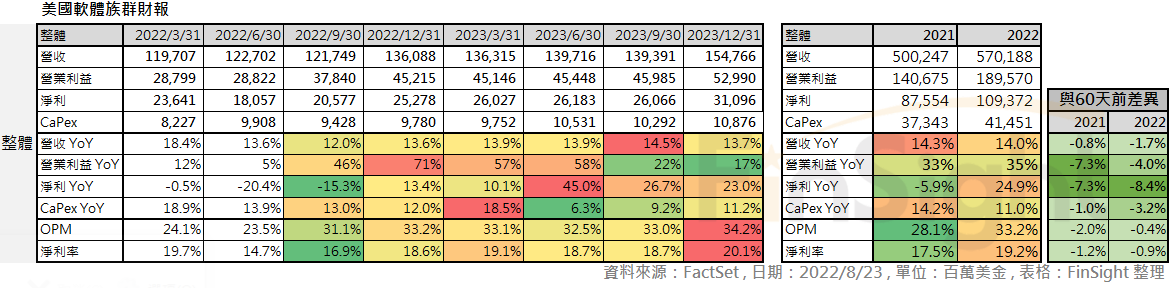
- Analyst net income estimates for the large US cloud companies (the hyperscalers) and for US software stocks are 7% to 10% lower than 60 days ago, and 2022 net income growth has turned negative for both. Capital spending (capex) has not been cut yet, but weaker profits usually slow the pace of investment.
- TSMC is not immune. It just gets hit last. In 2015 and 2018 it cut guidance, then missed its own guidance one or two quarters later, and by then the correction was near its end. Estimates for its largest customers are already down 7% to 9% including Intel, about 4% excluding Intel.
- A normal correction bottoms in roughly six months, which would put the buy signal for electronics destocking after the second quarter of 2023. The risk is the collapse in Taiwan's manufacturing PMI, which suggests this swing could overshoot.
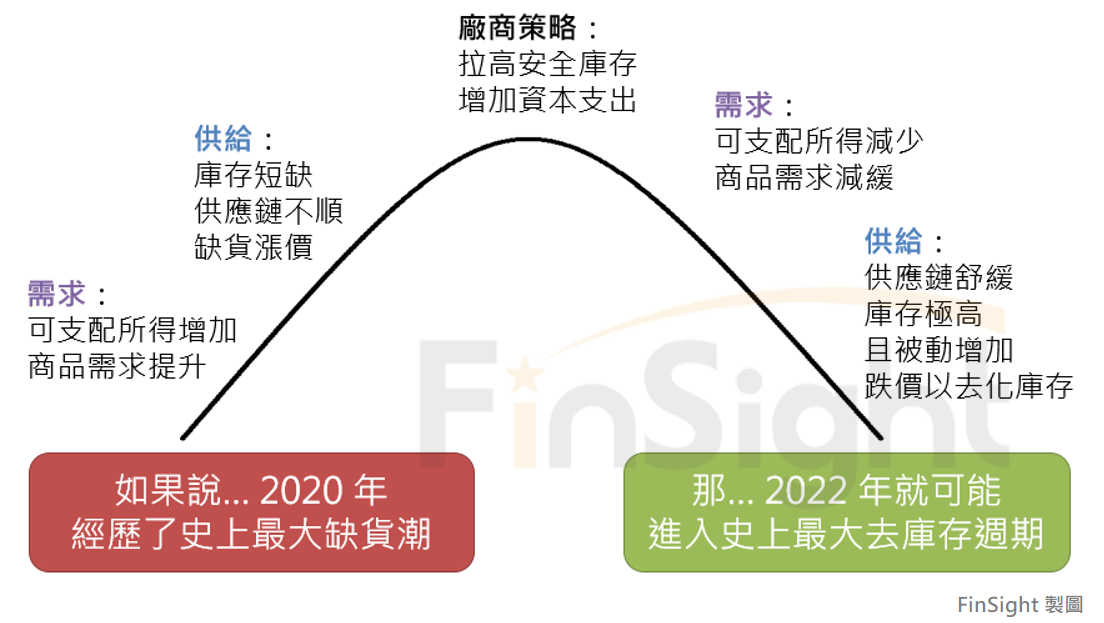
Our August 2022 post on Taiwan's second quarter filings found electronics inventory at historic extremes with heavy destocking pressure ahead. At the same time, industry profit is concentrated in foundry, which leaves the chain badly unbalanced, with the profit sitting in one link.
What is striking is how closely this earnings season repeats history. A quarter ago many companies said inventory was up but only back to a normal level. This quarter, the destocking those same companies are running is anything but small.
The market is still split on two questions: how wide the damage goes, and how long it lasts.
- Breadth: weak consumer demand is already a known fact. Does it reach the enterprise and commercial end, where demand has held up relatively well?
- Duration: is this the normal correction TSMC describes, like 2015 or 2018? Or is it what Intel described on its earnings call, consumer customers destocking on a scale not seen in the past ten years? A normal correction usually bottoms within about six months. Something not seen in ten years would take considerably longer.
This post works through both questions using what companies said in their second quarter 2022 results and where estimates stand now.
Does the consumer correction reach enterprise and commercial demand?
We covered this in our June 2022 post that used NVIDIA as the case study for how inventory corrections travel through the chain. Past cycles say the consumer correction very likely reaches the enterprise and commercial end later.
At the time we argued that NVIDIA's position in the first quarter of 2022, reported in May 2022, looked much like its position in the second quarter of 2018, reported in August 2018.
- After a long stretch of booming demand and repeated inventory adds, the company said for the first time that inventory was back to a normal level.
- No new gaming product launched that year, a sign that gaming demand was not urgent.
- Inventory days pushed above 12 weeks, and inventory grew faster than revenue (36% in 2018, 21% in 2022). Revenue growth estimates were being cut over the same stretch, and revenue fell from the prior quarter.
- For the first time in more than a dozen quarters, next-quarter guidance came in below consensus, and the company still sounded optimistic on demand.

Now we think NVIDIA's second quarter of 2022, reported in August 2022, looks like its third quarter of 2018, reported in November 2018. Both mark the same move, from inventory is back to normal to consumer destocking is under way.
- The first quarter of admitting that the consumer end has entered a correction, with results below consensus. In the third quarter of 2018, revenue missed consensus for the first time in 13 quarters, next-quarter guidance also came in below consensus, and the stock fell 18% after hours. In the second quarter of 2022, the company pre-announced, and revenue missed consensus by 17%, down 19% quarter over quarter and up 3% year over year.
- Gaming enters a violent correction and revenue misses badly. In the third quarter of 2018, gaming revenue dropped sharply and the company began holding back shipments to normalize channel inventory, expecting inventory to be back to normal the following quarter, then pushed that timing out another quarter when it next reported. In the second quarter of 2022, gaming revenue fell 44% quarter over quarter and 33% year over year. Management pointed to weaker demand, said the macro environment weighing on unit sales would persist, and said it was working with gaming partners on inventory and pricing.
- Data center keeps growing and holds up much better. In the third quarter of 2018 it grew 58% year over year, with very strong customer demand for its products. In the second quarter of 2022 it came in slightly below consensus on supply shortages but still grew 1% quarter over quarter and 61% year over year.
So we are clearly past the phase where guidance still sounds optimistic and into the stage where consumer-facing results miss badly. Companies with mostly consumer exposure came in well below consensus this quarter.
Whether it moves on to the stage where data center enters its own correction is the open question. Our June 2022 post on capex at the large US cloud companies suggested watching corporate profits: once profits are hit and cash on hand shrinks, one or two quarters of trimmed spending become possible.
Pulling together the latest analyst consensus, the picture is not encouraging. Compared with 60 days ago, before this quarter's results were published, 2022 and 2023 net income estimates for both the hyperscalers and US software stocks are down 7% to 10%. Net income growth for both groups has now formally turned negative for 2022. Capex has not been cut in any obvious way yet, but weaker profitability will eventually slow the pace of future investment.
Once the industry corrects, it takes time to find out whether any company stays untouched
That August 2022 post on Taiwan's electronics results made the point that the industry is extremely unbalanced right now, with supply chain profit tilted toward foundry and very wide differences in what companies guide to. TSMC's lead in advanced process and advanced packaging, plus strong demand for high performance computing (HPC), puts its growth beyond question, and it is one of the few semiconductor names whose earnings per share (EPS) estimates are still being revised higher. Across the Philadelphia Semiconductor Index (SOX), profits are clearly deteriorating, and TSMC is the only member whose operating income estimates are still going up. Analog and auto have held up relatively well.
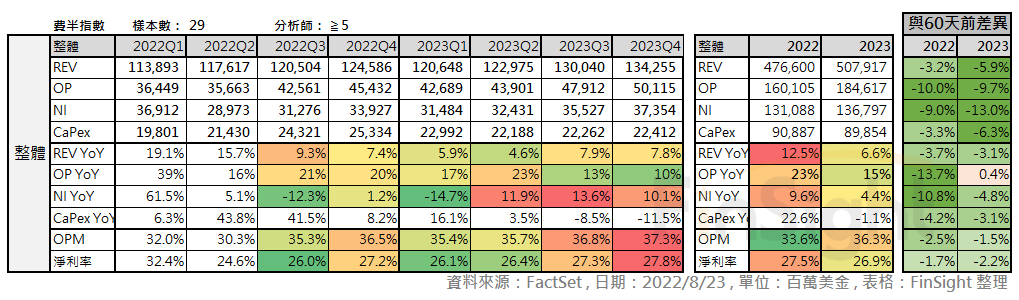
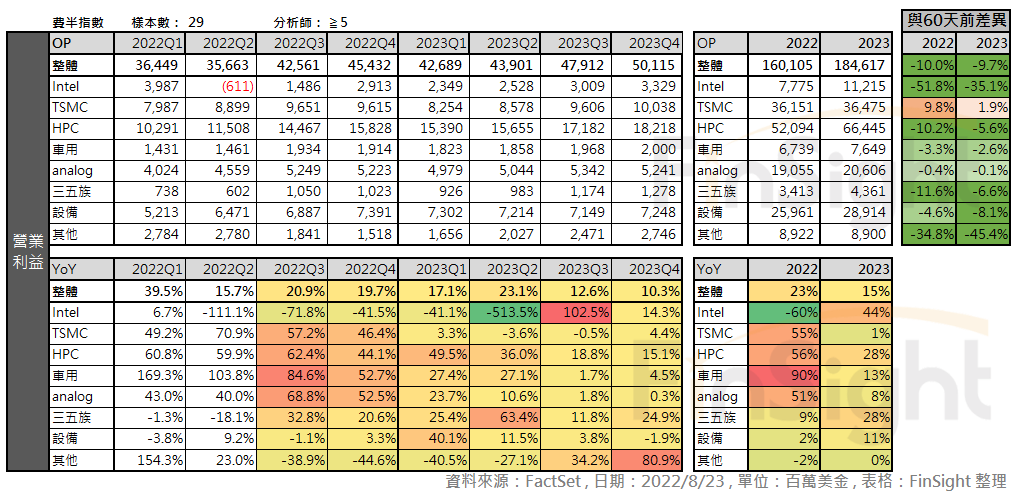
TSMC's better than expected growth comes back to that lead in advanced process and packaging and to strong HPC demand. In last quarter's results, its growth came almost entirely from HPC and advanced nodes, both running at about 50% year over year.
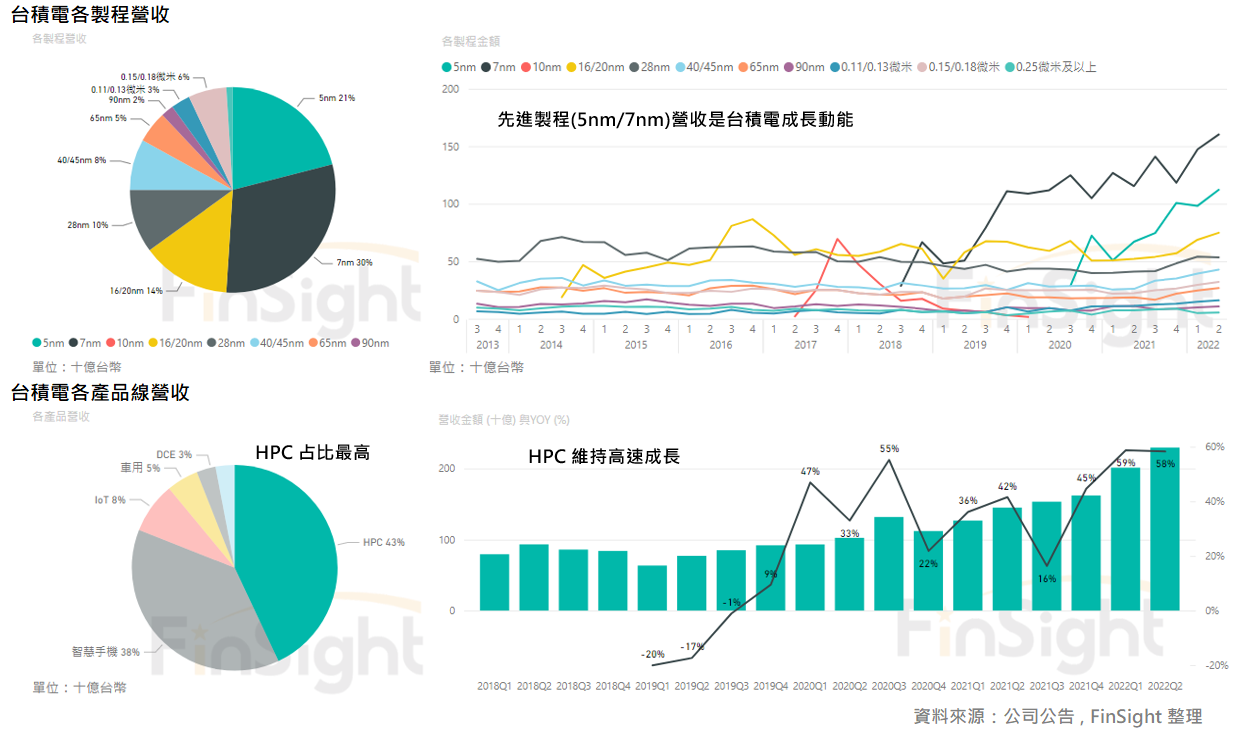
The most important thing on that earnings call, we think, is that TSMC confirmed the industry has entered an inventory correction, that it will run for several quarters into the first half of 2023, and that fabless inventory days should start to come down in the second half of 2022. TSMC's own view is that this correction looks like 2015 or 2018, and that its market leadership will keep it insulated.
Set aside for a moment whether this is a normal cyclical correction like 2015 and 2018 or something on a scale not seen in ten years. Going back through 2015 and 2018, we found that TSMC was not spared. It was hit last. In both episodes, once TSMC gets hit, the correction is in its final act.
- 2015: TSMC cut its fourth quarter 2015 guidance in the third quarter of 2015, then missed its own guidance in the first quarter of 2016 (gross margin of 43% against guidance of 47% to 49%, with operating margin also below guidance).
- 2018: TSMC cut its first quarter 2019 guidance in the fourth quarter of 2018, then missed its own guidance in the first quarter of 2019, on revenue, gross margin and operating margin.
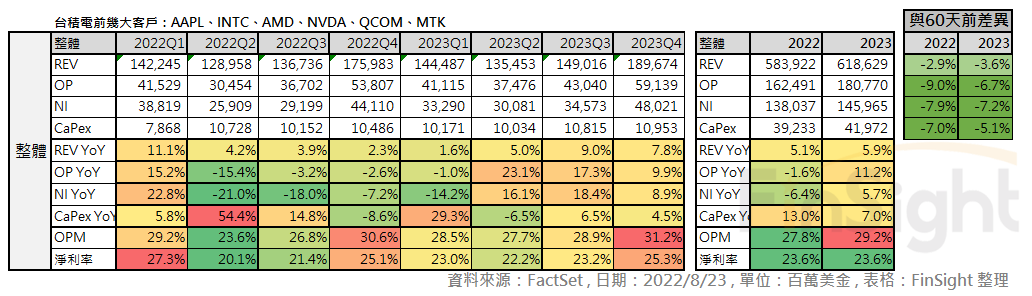
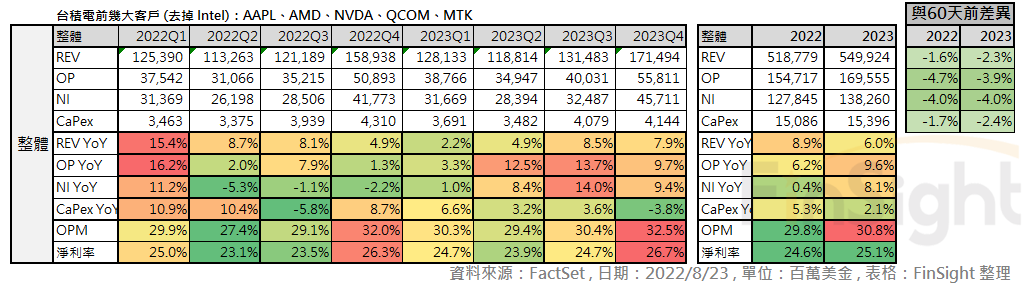
So can TSMC stay untouched this time? Look at its largest customers. Advanced nodes are more than half of its revenue, and the company's 2021 annual report put its top two customers at 26% and 10% of revenue. Add the next several large names, Apple, Intel, NVIDIA, AMD, Qualcomm and MediaTek among them, and that group may account for close to 50% of TSMC's revenue, our estimate.
The tables below therefore take TSMC's direct large customers as a sample and compare analyst earnings estimates with 60 days ago. Including Intel, estimates for the group are down 7% to 9%, and 2022 earnings are falling year over year. Excluding Intel, estimates are down about 4% and 2022 net income is close to flat.
The bullwhip effect, and Taiwan's PMI falling off a cliff
On the 2015 and 2018 template, weak consumer demand very likely reaches the enterprise and commercial end later. Even TSMC, which is holding up better than anyone, could guide below consensus or miss its own guidance in the first half of 2023.
In both 2015 and 2018, TSMC's stock broke to new lows after the guidance cut, then recovered before the quarter that missed guidance was actually reported. So a guidance cut at the best company in the group can work as a signal that a normal inventory correction is near its end. One caution: in both of those years the Fed softened its tightening stance once the economy slowed, and in 2018 there were Fed rate cuts helping as well. A guidance cut at the best company cannot carry that call on its own.
Line that up with the electronics inventory cycle, and the buy signal for electronics destocking, when inventory days fall below their year-earlier level, could show up after the second quarter of 2023. That said, Taiwan's manufacturing PMI has just fallen off a cliff. Our worry is that under the bullwhip effect this destocking cycle also overshoots what anyone expects. We will write that up separately.
Taiwan's manufacturing PMI is published monthly by CIER (the Chung-Hua Institution for Economic Research). Like ISM, its sub-indices are diffusion readings around 50, so a reading below 50 means more respondents reported contraction than expansion, not that activity has stopped.
In our own investing experience, the worst damage comes from believing in the trend and adding too much to good companies while the correction is still running. Early in a decline the good companies still sound strong, so positions tend to concentrate step by step into the names that are still performing. When those companies finally guide below expectations, the disappointment selling hits hard. If position sizing was careless, it is easy to get stopped out at the low.
For a long-term position, scaling in slowly with idle cash through an inventory correction can produce excellent returns. But many people, for one reason or another, cannot stick to the plan they started with. In an inventory correction, what really decides the outcome is position sizing and cash management.