Uber's AI usage is up ninefold since February with its bill flat, and four software vendors just laid out the AI governance layer, two already priced.
The AI market grows by splitting into layers. Models, pricing and customers each split along different lines, so we sort the layers before drawing conclusions. We laid that method out in our August 25, 2026 post, "Still Reading AI Model Pricing as a Price War? The Rules Changed in Mid-2025." This post applies the same method to the application layer: where does the AI dollar land as it flows downstream?
Key takeaways
- Uber's AI usage is up more than ninefold since February while total AI spending has stayed roughly flat, and the cost per thousand requests is 34% below its April peak. Starting to manage the bill is where real spending begins: companies only start managing a bill they intend to keep paying.
- The budget AI competes for is payroll, not the IT budget. US knowledge workers are paid more than $6 trillion a year (our rough estimate), against the roughly $150B of market-wide AI annualized revenue run rate (ARR) we expect at the end of 2026. AI ARR is less than 3% of that wage bill.
- What AI eats is the scaffolding, the layer of workarounds that covers for what models cannot do yet. The foundation model category gained 13.7 percentage points of adoption over the year while AI coding tools lost 4.2 points, and Databricks halved its cost per task just by simplifying the scaffolding.
- What AI does not eat is the governance layer: identity, permissions, logging and liability. Four software vendors laid out their governance products on August 26 and 27, 2026, two of them already priced and shipping, and the three that disclose an AI product line are still growing it by multiples, with Salesforce's Agentforce at $1.5B of ARR.
The market has two worries about the application layer this year, and they point in opposite directions.
- "Has AI spending topped out?" The first worry was that the companies using AI were spending without limit: in June, Uber burned its entire year's AI budget in one quarter, started restricting engineers' use of Claude Code, and could not explain the return. People gave that behavior a name, tokenmaxxing, meaning treating token usage as a performance metric and spending as much as possible. Two months later, companies are managing the bill and moving tasks onto cheaper models, and the worry has flipped to the opposite one: has AI spending topped out?
- "Is this the SaaS apocalypse?" The worry here is that AI eats software as a service, or SaaS. In February, Anthropic shipped a batch of plugins all at once, and the market read it as a sign that companies could build their own tools on top of the model and route around the software vendors. That is where the phrase SaaS apocalypse came from, and software stocks sold off hard on it.
August brought evidence on both. Uber's earnings call covered the bill, and Salesforce, Workday, Microsoft and ServiceNow all spoke about the software side.
The companies using AI: Uber went from burning its budget to a flat bill
In May, Uber's chief operating officer said the link between AI spending and the return on it "does not exist yet." In June came the news that it had burned through its full-year AI budget in one quarter. The August earnings call gave us the follow-up, and this is how the chief financial officer put it:
"We are optimizing token spend in several ways: setting better defaults for different use cases, moving certain tasks to low-cost or open-weight models, and giving employees clearer visibility into their own spending so they can manage it. The result is that our cost per token has come down over the past few months, and total AI spending has stayed roughly flat even as adoption keeps rising."
So Uber did three things: simple tasks moved to cheaper models, each use case got its own defaults, and employees can see what they are spending. Internal figures reported by the press in late August fill in the rest: weekly requests to AI agents are up more than ninefold since February, the cost per thousand requests is 34% below its April peak, and AI agents now account for more than 70% of submitted code changes.
The direction of those three numbers is clear. Usage went up ninefold, the AI bill did not go up with it, and it did not come down either. It is still running high. The savings came out of headcount.
This quarter Uber cut roughly 10% to 20% of headcount in several organizations, including 10% in customer support. The chief financial officer said that once engineers were using AI coding tools across the board, output per person doubled and the company could slow its hiring.
What Uber is saying is this: the AI money keeps going out, output doubled, and fewer people are needed. It has not disclosed a dollar figure for AI spending and has not set the bill against the salaries it saved, so nobody can claim the savings beat the spending. But the bottomless pit everyone worried about in June never showed up. AI spending has turned into a managed variable cost that earns its keep, which is why it keeps getting spent.
Managing the bill is not pulling back: SaaS also became long-term spending only after companies started counting
Back to the first worry from the introduction: companies have started managing the bill, so has AI spending topped out? Our view runs the other way, and the history of SaaS is the reason.
When cloud was new, through the 2000s and the 2010s, the market had plenty of doubts. Are you crazy to put your data in someone else's building? When does all of that capital spending at AWS ever pay back? Everyone is building data centers, so will there be too many of them?
Cloud went on to become the biggest long-term line item most companies carry. The turn did not come at peak excitement. It came when companies started doing the arithmetic seriously: total cost of ownership, service level requirements, compliance audits, the budget written into the annual plan. Going from "let's try it" to "budget for it every year" took exactly that set of management moves. The three things Uber is doing now are the AI version of them.
The AI bill stayed flat while headcount came down, which tells you the right comparison for AI spending is payroll. What Uber saved was customer support and slower hiring, and as we will see below, what the four software companies save from their own AI rollouts is also people.
The comparison, as a Workday finance executive described it, is not to software spending. It is to what the customer already spends on people in those roles, and how much of that task moves from people spending to AI agent spending.
If that comparison holds, the ceiling on AI spending is not the IT budget. It is payroll. US knowledge workers are paid more than $6 trillion a year and all employees more than $12 trillion (both our rough estimates), against the roughly $150B of market-wide AI ARR we expect at the end of 2026. Set against the knowledge-worker wage bill, that is less than 3%; against total payroll, less still.
Uber is pushing simple tasks down to cheaper models. Our August 31, 2026 post, "The Market Says AI Revenue Missed. So Why Is AI Compute Still Getting Tighter?" showed the side that moves up instead: the companies using AI most deeply raised their spending 45% in the single month of July, timed to the launch of Fable 5, a new model.
Simple tasks going to cheap models and hard tasks going to the strongest model are happening at the same time. So the answer to the first worry is that AI spending has not topped out. When companies start managing the bill, AI turns from an experiment into a line that gets written into the budget.
The companies selling software: the SaaS apocalypse? First split software into the scaffolding and the governance layer
Back to the second worry. The companies using AI are picking what to build themselves and what to keep buying, and the software companies show you what survives that decision.
Think of an enterprise AI rollout as putting up a building, with the model as the building itself. Where the building does not reach yet, you put up scaffolding against the outside wall. The model does not know anything about the company's internals, so retrieval feeds it knowledge. It cannot operate systems, so tool connectors give it hands. It cannot hold context, so memory management gives it recall. It is not smart enough, so you write very long prompts and break the workflow into small steps. We call that layer the scaffolding; the industry calls it the harness or the agent framework. The higher the building goes, the more of the scaffolding comes down.
The other layer is compliance: whose identity does this AI log in under, what data can it see, is every step logged, who approved the budget it is spending, and who is liable when it causes damage. We call that the governance layer; the industry also calls it the control layer. However high the building goes, the compliance requirement does not go away, because it comes from the organization and from the law, not from capability. However smart the model gets, no legal department is going to approve a system where the permissions and the audit trail get sorted out after the incident.
That was our view in July, when the market was still arguing about the SaaS apocalypse: the scaffolding, which sits close to the model, gets eaten by the model. The governance layer, which plugs into a company's internal data, permissions and liability, becomes the moat instead. Here is the evidence for each of the two layers.
The scaffolding: every new generation of models absorbs the previous generation's workarounds
Scaffolding gets eaten because it is technical debt from the day it is built. Scaffolding is what gets built to cover whatever the model could not do at the time, and every time the model gets stronger it pulls those functions into the body of the product.
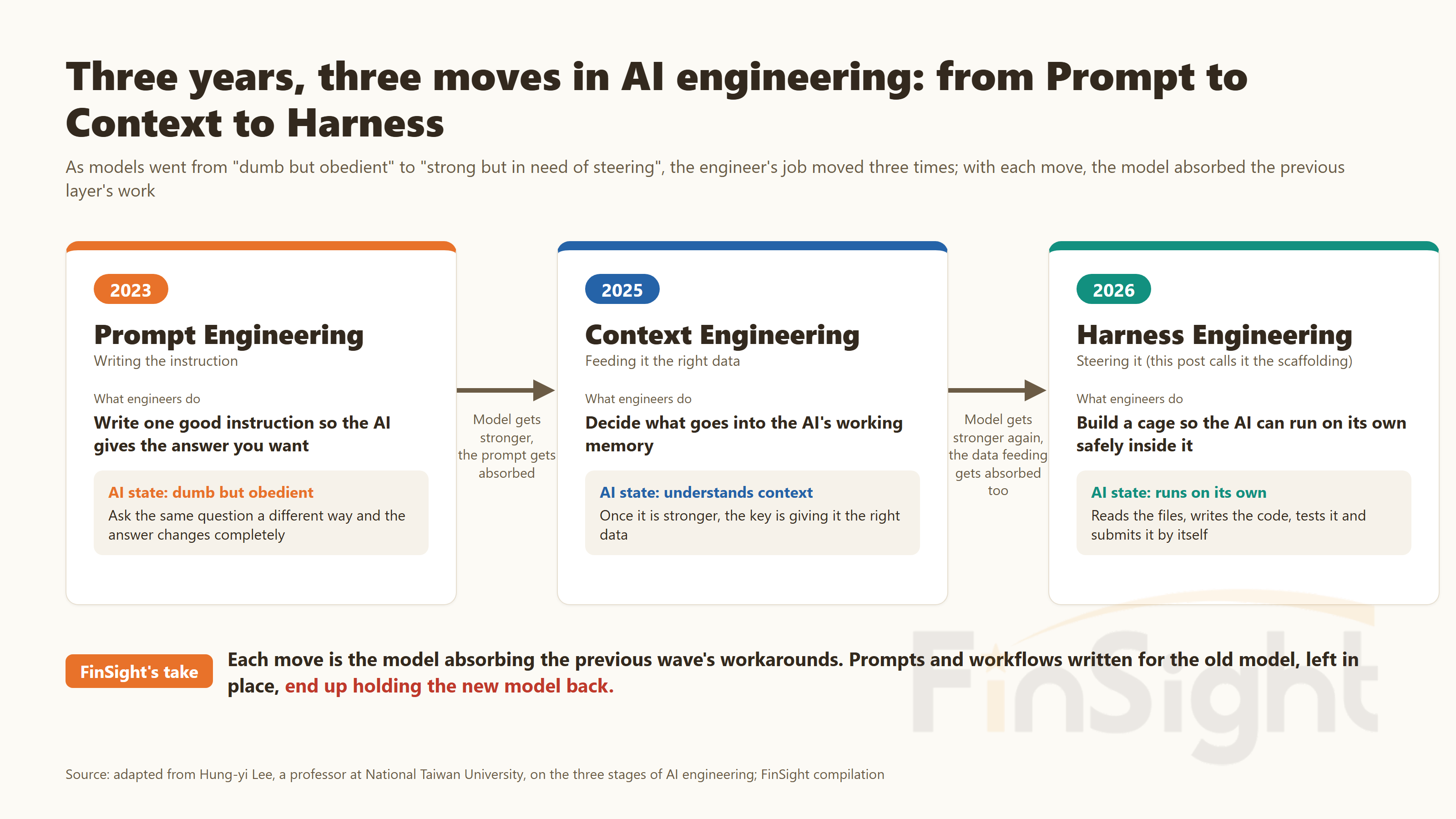
The three waves of AI engineering are like moving three times in three years: in 2023 people were writing prompts, in 2025 they were designing what data to hand the model, and in 2026 they are building the harness so the model can run on its own. Each new wave covers what the previous wave's model could not do, and the moment the model upgrades, the previous wave's method goes from an advantage to a burden.
And it is not only that the old work stops helping. It can hold you back. After a new model ships, the prompts, workflows and skill packs written for the old one often limit what the new one can do.
There are two sets of evidence. The first is a controlled test. In July, Databricks benchmarked real coding tasks from its own work, held the model constant, and swapped the existing scaffolding for a stripped-down version written by one person. Swapping the scaffolding cut cost per task in half, with no loss of quality. Swapping the model instead cut it by about a third. That says the scaffolding layer has more waste in it than the model layer, and the model companies would like that spending to come to them instead.
The second is payment data. The chart below takes the AI categories inside Ramp's corporate card data and asks, for each one, whether more or fewer companies are paying for it than a year ago.
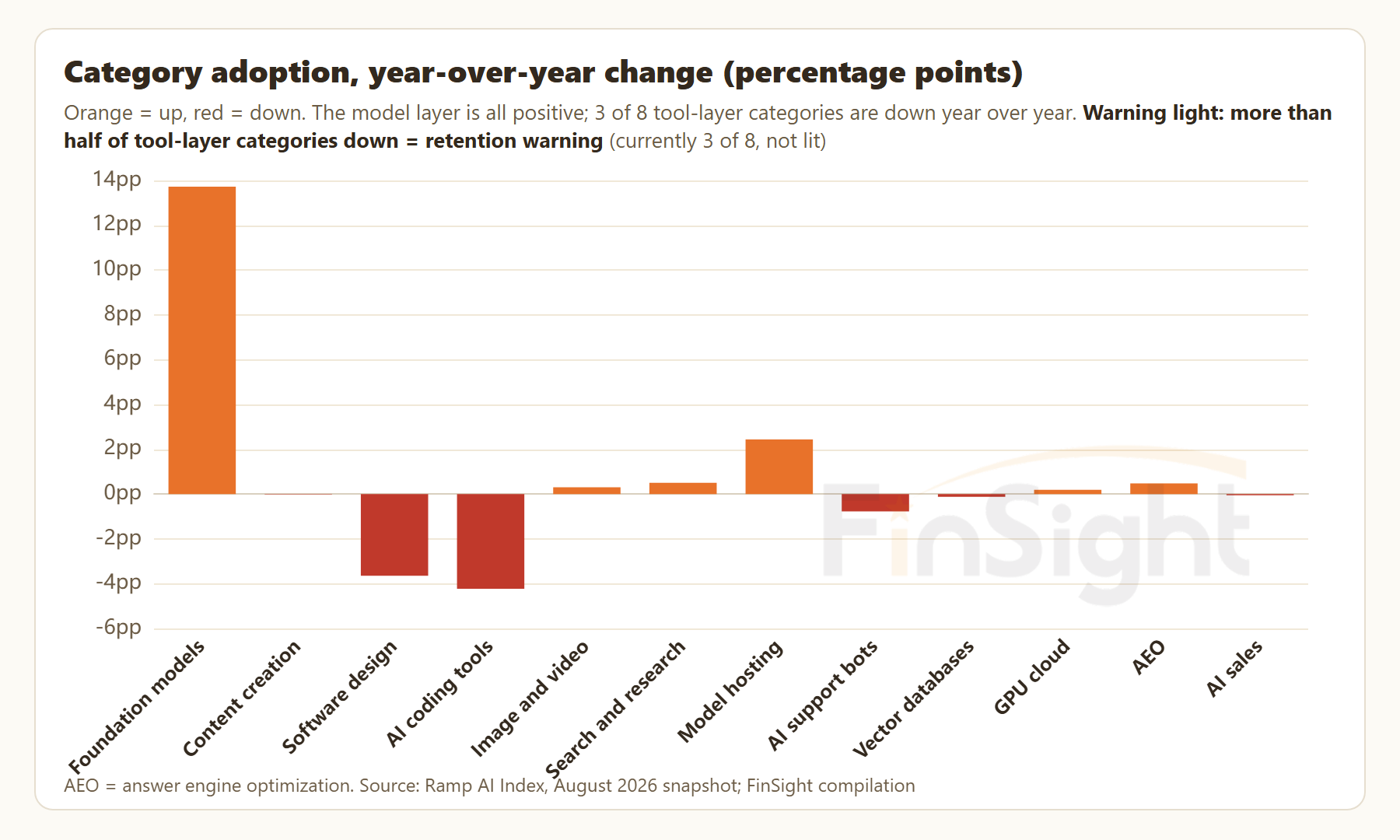
The foundation model category is up 13.7 percentage points over the year, so the model layer is still moving into the enterprise across the board. In the same sample, AI coding tools are down 4.2 percentage points, and software design, AI support bots and AI sales are all negative as well. Those are exactly the categories that exist to cover for what the model cannot do. Companies are still buying AI. What they have dropped is the middle layer of tooling, going straight to the model companies' own products instead. (Ramp's sample skews to US midsize companies, so read the direction rather than the level.)
Turn that around: the scaffolding getting eaten is itself evidence that models are still improving fast. The workarounds keep going obsolete because the thing they work around keeps getting better. The day scaffolding really does become a permanent moat is the day models have stalled, and then the question is the whole compute demand curve, which is much bigger than the tool stocks.
The governance layer: companies are managing the bill and still buying software
On August 26 and 27, 2026, Salesforce and Workday held earnings calls and Microsoft and ServiceNow spoke at the Deutsche Bank technology conference. We boil what the four of them said down to three points.
First, tokens are not eating the budget. The money is flowing to the companies that actually built something with it.
ServiceNow's chief financial officer said that the news stories are true: he talks to other CFOs every day and every one of them is talking about how to manage a token budget, and some customers really are spending less somewhere else because of token spending. But what ServiceNow sees, he said, is that even when customers are spending more in one place, as long as they see real value from the product, they still put more money into the software vendors that build AI into their products.
Microsoft said the same thing: IT budgets are being reordered toward AI, but where the return is clear, there is new budget on top.
The strongest piece of evidence is that the model companies are themselves big customers of these software companies. Nine of the ten largest AI companies in the world use Salesforce, and that group's spending is up 435% over the year. Anthropic's chief executive appeared on Salesforce's earnings call in person this quarter to announce Claudeforce, which plugs Anthropic's models into Salesforce's existing permission and security settings.
Second, last year was experiments. This year it is in production and billed.
Salesforce added 2,000 paying customers in production this quarter, 70% more than it added the quarter before. Workday has more than 5,500 customers running agents they built themselves. Microsoft Foundry has more than 100,000 customers and doubled its revenue over the year.
One of those customers is Uber for Business, which uses Agentforce to work its inbound lead lists: six weeks of work done in two, with 60% more deals closed. Uber is squeezing its own token bill and still buying software, which is as clean an example as you will get of what companies build for themselves and what they keep buying.
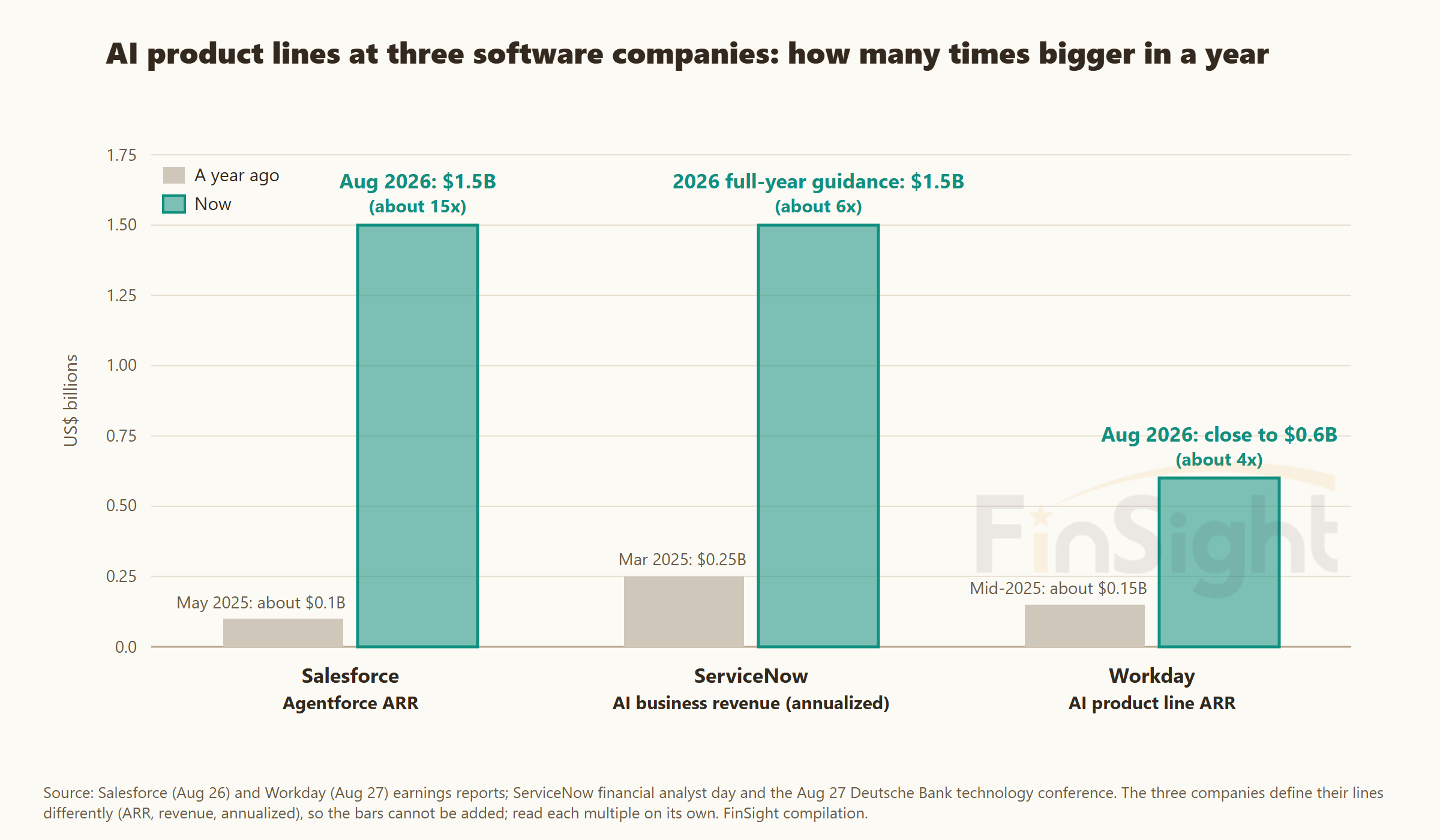
The three companies that disclose an AI product line are all still growing it by multiples. Salesforce's Agentforce is at $1.5B of ARR, and AI and data together are about to pass $4B. ServiceNow's AI business passed $1B in the second quarter, with full year guidance of $1.5B. Workday's AI product line is close to $600M of ARR, against a little over $150M a year ago.
Set against each company's total revenue, these are still small numbers, but the direction is clear: they keep growing by multiples.
More certain than the revenue is what they save internally. ServiceNow says internal AI efficiency alone saved $500M this year, about 3% of revenue, with headcount flat and revenue still growing 23%. The other three gave no dollar figure; all of them described flat headcount doing more work.
Third, the software companies have started selling new products that manage your AI for you. That is what the governance layer looks like once it is packaged and priced.
| Company | Product | What it sells |
|---|---|---|
| ServiceNow | AI Control Tower | Manage spending across every AI vendor, see the return, and hit an emergency stop when something goes wrong. The chief financial officer said this is exactly what customers are asking for when they talk about managing a token budget |
| Workday | Agent Passport | An auditable record for the security team, proving an agent passed risk testing before deployment and stays monitored after it. Cisco is the launch partner |
| Microsoft | ME7 and the Microsoft 365 admin center | Microsoft's AI usage console, shipping in the fourth quarter: who is using AI, on what, and for how much, with controls attached |
| Salesforce | Zero data retention and permission inheritance | Data never enters any model, and AI inherits the company's existing sharing and security model. Started in 2023, three years in the making |
Source: Salesforce and Workday earnings calls (August 26 and 27, 2026); Microsoft and ServiceNow at the Deutsche Bank technology conference (August 27, 2026); FinSight compilation
Uber squeezed its bill by letting employees see what they spend. The software companies are now selling that as a product.
A Microsoft finance executive said one of the most valuable things about Microsoft 365 is that it is predictable: a fixed amount per employee per month. Moving agents to usage-based pricing breaks that, and he called it "a big problem."
When the bill becomes unpredictable, somebody buys the tool that manages the bill. That looks like new budget rather than money moved off another line, and once a company's AI governance runs on one vendor's platform, it is very hard to switch.
Salesforce also brought David Friedberg, chief executive of the agriculture technology company Ohalo, onto this quarter's earnings call. He was one of the earliest proponents of the SaaS apocalypse argument. He said he built a CRM (customer relationship management system) with AI over a weekend and quickly found that the operations, account management and security work took far more effort than he had expected, so he decided not to build things like CRM or ERP systems and to build only a custom interface for his own industry. His revised position: the SaaS apocalypse is still coming, but the threat has been downgraded. What AI rebuilds is vertical software that ties a whole industry to one workflow, and horizontal platforms come out stronger.
In this post's terms, AI can build the scaffolding but not the governance layer, so people come back and buy the platform anyway.
The gap between individual names is widening, and this rally is mostly the multiple coming back
All four built AI into their products, and they are several quarters apart on getting paid for it.
ServiceNow is already raising prices, with packages up 20% to 30%. Salesforce's premium tier carries a 60% to 80% price premium, but only 5% of users have upgraded. Microsoft has just moved to usage-based pricing and has no numbers yet. Workday is still giving it away.
There is a list on the losing side too. Monday.com, which makes project management boards, has been marked down by the market. Airtable, which makes spreadsheet-style databases, was acquired for $2.25B against an $11.7B valuation in 2021. The one most worth looking at is Intuit, which makes tax filing software and is down 48% year to date. Tax filing is about as real-world as software gets, and the stock still fell.
So closeness to the real world is not the thing. Three things hold software up: data the model cannot reach (the customer relationships inside a CRM), the boundary of who is liable when something goes wrong (identity, security), and the operations staff a company does not want to employ itself, which is Friedberg's point. Software with clear rules, public data and a job that starts and ends on the screen gets eaten no matter how real-world it is. That is the same split as scaffolding versus governance layer.
As for the rally in software stocks, most of it is the multiple coming back. The market has stopped pricing in the end of software, and the discount is gone, but not one of the four guided to an acceleration. Salesforce grows about 6% once the contribution from acquisitions is stripped out, and while its bookings, measured as cRPO, accelerated to 14%, it takes a year or two for faster bookings to show up fully in revenue. "We are not going away" now has evidence behind it. "We are going to accelerate" is nowhere near as clear.
Back to the two worries from the top: the answer is the same thing
- Has AI spending topped out? No. Uber's usage went up ninefold, its bill stayed high, and what it saved was people. Companies are turning AI from an experiment into a line written into the budget, the same way SaaS did, and starting to count the cost is where real spending begins.
- Is the SaaS apocalypse here? No. What AI eats is the scaffolding, with every new generation of models absorbing the previous generation's workarounds. What it cannot eat is the governance layer, which four software companies laid out as products in the week of August 26 and 27, 2026, two of them already priced and shipping, with even the model companies at the top of the stack lining up to buy it.
We do not think it is a coincidence that both of these happened at once. Companies starting to manage the bill and software companies starting to sell bill-management tools are two sides of the same moment: when AI is genuinely in use and connected to the real world, this is what grows out of it.
The risks sit in three places.
- Models stall. The whole chain of reasoning assumes models keep getting stronger. If scaffolding ever does become a permanent moat, what has to change is not just this post but the entire compute demand curve.
- The model companies build the governance layer themselves. Claudeforce today is an alliance, with Anthropic plugging into settings Salesforce already owns. The day a model company builds identity, permissions and logging well enough that large enterprises will adopt the whole stack, the governance layer business gets eaten from above.
- Only the leaders collect the rent. All four want to own that layer, and they have started taking it from each other. The two things this post puts on the scorecard are right there: whether Workday's signed customer count picks up once the free period ends, and whether the second-tier software companies' numbers hold up next quarter.